Business Solutions
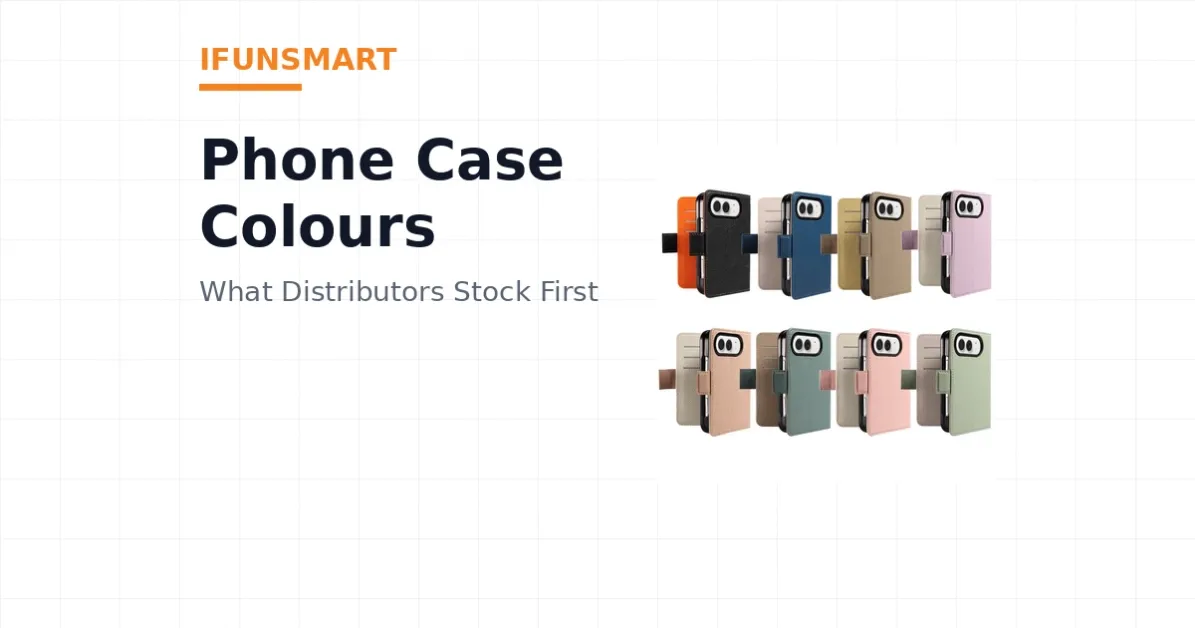
Phone Case Colours: What Distributors Stock First
Black and clear sell first, and colour is where a range earns or loses money. How distributors split depth and breadth across models, styles and the 50-pc colour MOQ.
BLUF
Colour is the cheapest decision in a phone case order and the one that most often strands stock. Stock black and clear deep, add the phone's own colours next, and treat every extra colour as a 50-pc commitment — because the MOQ applies per colour, not per style.
Short answer
A distributor does not stock colours. A distributor stocks a depth-and-breadth plan, and colour is how that plan is written on the order:
- Depth first: black and clear. Every model, every style that offers them. These are the colours a shop sells when a customer walks in without a colour in mind, and they are the colours a marketplace listing sells when the buyer sorts by best seller.
- Breadth second: the phone's own colours. iPhone 18 Pro Max ships in Black, Silver, Glacier and Burgundy; iPhone 17 Pro Max in Silver, Cosmic Orange and Deep Blue. A case in the phone's own colour is the case a buyer picks when they want the phone to look the way Apple or Samsung made it.
- Accent third: one or two colours per style that make the range visible — a pink or orange liquid silicone, a red ring-stand, a blue frosted back. Accents earn their place on the shelf; they do not earn it on the first order.
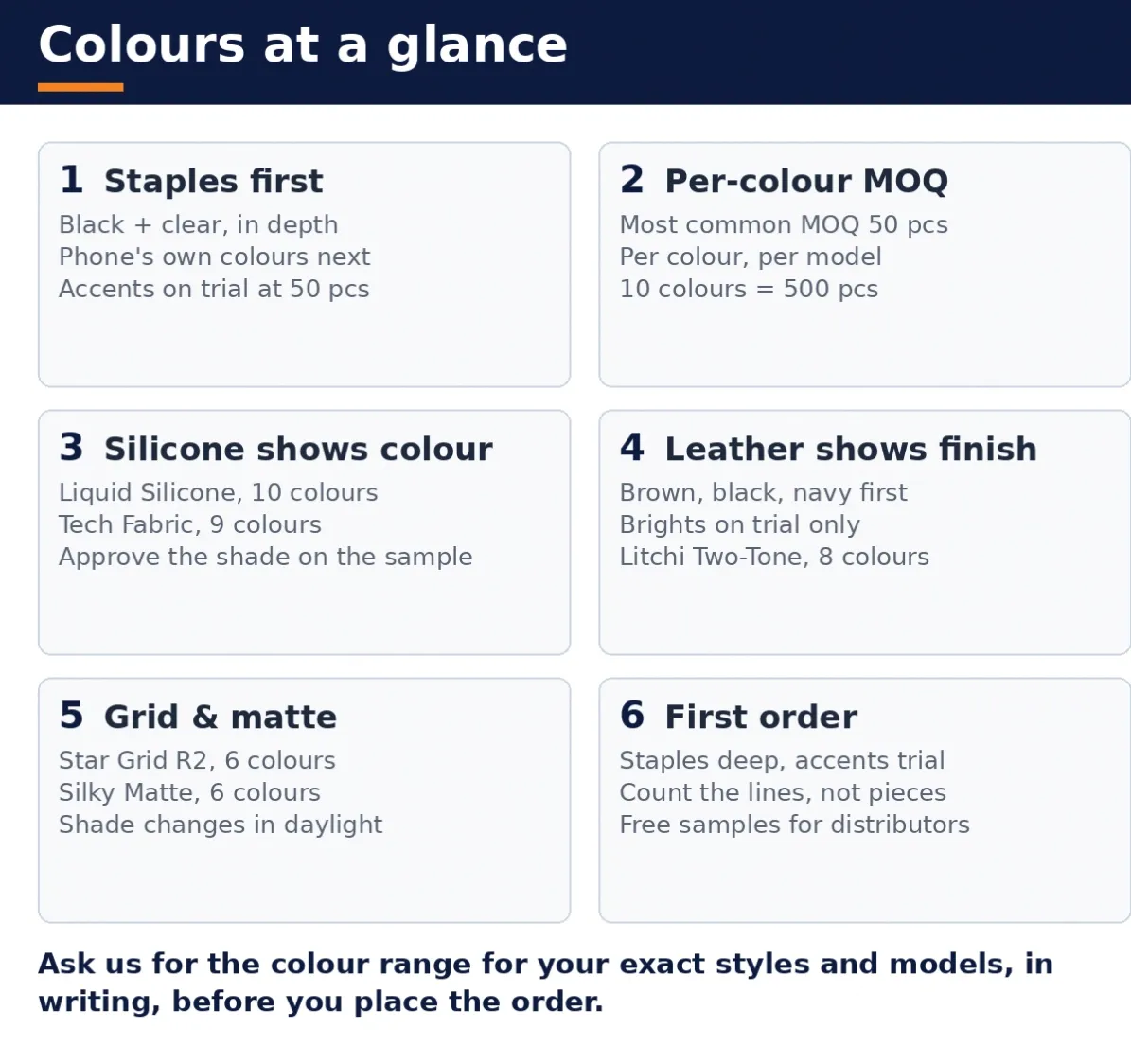
- The rule that decides everything: our most common MOQ is 50 pcs per colour per model, and it varies by product line. A style in ten colours is a 500-pc commitment before a single case is sold. A style in three colours is 150 pcs. Count colours the way the factory counts them — per colour, per model — and the range plans itself.
Colours at a glance
Style | Colours confirmed | What the range means for the order |
|---|---|---|
Liquid Silicone Magnetic Case, iPhone 18 Pro Max | 10 colours: Light blue, pink, purple, orange, black, cherry red, brown, navy, grey, white | Full range is 500 pcs at the most common MOQ — start with black, clear-adjacent neutrals and one accent |
Tech Fabric Magnetic Case | 9 colours (page names none) | 9-colour lineup suits a retail wall; order depth in black and the two neutrals first |
Matte MagSafe Case, Galaxy A57 | 8 colours listed: Matte Frosted Clear, Girly Pink, Hot Pink, Smoky Gray, Navy Blue, Purple, Blackish Green, Black | Wide range on a value model — depth in black and navy first, pinks as a trial |
2700GS Magnetic Case, iPhone 18 Pro Max | 8 colours | Wide range; pick the four that match the phone's own colours, then add accents |
Litchi Two-Tone Magnetic Wristlet Folio, iPhone Duo | 8 colours: Black, red, purple, navy, light blue, green, pink, orange | Two-tone leather folio — the colour is the product; brown, black and navy first, brights on trial |
iPhone Air 2 Triangle Textured | 7 colours — factory-confirmed pre-order, no live product page yet | Textured finish shows colour differently — approve the colour on the sample, not on a screen; confirm the range in writing |
Star Grid R2, iPhone 18 Pro Max | 6 colours: Orange, Dark Cherry, Blue, Light Blue, White, Black | Colour-block grid — the colour is the vented back; six colours is one 300-pc range at the most common MOQ |
Silky Matte MagSafe Case, iPhone & Samsung | 6 colours: Orange, Khaki, Grayish White, Green, Blue, Black | Matte frosted finish mutes bright colours — approve the shade on the sample, not on a screen |
P7 Replaceable Panel Case | 6 colours: Blue, Pink, Purple, Orange, Black, Cherry Red | Panels are the colour — the frame stays, the panel changes, so the colour range is the product |
iPhone Air 2 Kickstand Clear / Ring-Stand Clear | 6 colours each — factory-confirmed pre-order, no live product page yet | Clear body with a coloured ring or frame — the colour is the accent, the case stays transparent; confirm the range in writing |
Premium MagSafe Armor, iPhone 18 Pro Max | 5 colours | Five colours, one rugged build — depth over breadth suits field and outdoor buyers |
Clear Glitter MagSafe Case | Silver, Red, Blue, Gold, Pink | Glitter reads as a colour family — stock the glitter, not every shade, on the first order |
iPhone Air 2 Coloured Frame Clear | 6 frame colours — factory-confirmed pre-order, no live product page yet | Same clear body, six frame colours — the frame is the cheapest way to offer six colours; confirm the range in writing |
Our most common MOQ is 50 pcs per colour per model, bulk distributor orders start at 500 pcs per order in total, and samples are free for distributors. Payment terms are T/T and Western Union only — the full terms are in the checklist in section 7. The rest of this guide is the depth-and-breadth plan, the colours that always move, how colour behaves on each material, how the per-colour MOQ shapes the range, colour by model and channel, and the first-order colour plan — in that order, because a distributor who gets the colours right and the quantities wrong still ends the season with dead stock.
1. The colour question is really a depth-versus-breadth question
Every colour conversation with a distributor comes down to one trade-off: depth or breadth. Depth means many pieces of few colours — 200 black, 150 clear, 100 of the phone's own colour. Breadth means few pieces of many colours — 50 of each of ten colours. Depth sells through; breadth looks good on a wall and strands stock. The distributor who gets this backwards orders breadth, sells the black and the clear in the first month, and spends the next five months discounting the seventh colour.
The reason is simple and has nothing to do with taste. A phone case buyer who walks into a shop usually knows the model and often knows the style, but rarely arrives with a colour decided. They pick from what is in front of them, and what is in front of them is the colour the shop has in depth. A marketplace buyer is the same: they search the model, they sort by best seller, and the best seller is the colour with the most reviews — which is the colour that has been stocked deepest, longest. Colour popularity is not a fixed property of a colour. It is a property of how deep the colour was stocked.
That is why this guide never gives a ranked list of “the ten best-selling colours” with percentages. No such list can be verified for a distributor's own market, and a list that cannot be verified is a list that misleads. What can be verified is the structure: black and clear move first in every market we ship to, the phone's own colours move second, and accents move when they are visible — on a retail wall, in a listing's first image, in a corporate gift box. The rest of this guide works from that structure, and from the colour counts our own product pages confirm.
There is one more reason depth beats breadth on the first order: the reorder. A distributor who stocks deep in black and clear reorders black and clear, and the reorder is a single line, a single PI, a single freight booking. A distributor who stocks ten colours thin reorders ten lines, and every line is a new MOQ decision. The reorder guide in this series makes the same point from the other side: keep the best sellers in stock, and the best sellers are the colours you stocked deep. Colour strategy and reorder strategy are the same decision, made twice.
2. Start with the colours that always move: black, clear, and the phone's own colours
Black is the first colour on every order, for a reason that has nothing to do with fashion. Black hides wear, matches every phone colour, photographs the same in every listing, and is the colour a corporate buyer picks when the case carries a logo. A black case with a laser-engraved logo is the standard corporate gift in this trade, and it is the standard because it never looks wrong. Stock black in every style that offers it, in depth, before adding a second colour to any style.
Clear is the second colour, and it is a different product, not just a different colour. A clear case sells the phone, not the case: the buyer wants to see the phone's own colour and finish through the back. That is why clear cases live or die on anti-yellowing — a clear case that yellows in three months is a case that comes back as a complaint, and the anti-yellowing guide in this series explains what to check on a sample. Clear is also the colour where the magnet ring shows: a MagSafe clear case with a visible ring is a different listing from a clear case without one, and the buyer who wants the ring visible buys clear for exactly that reason. Stock clear in the styles where the phone's colour is the selling point — the current iPhone and Samsung flagships — and stock it deep.
The phone's own colours are the third layer, and they are the layer most distributors under-order. Apple ships the iPhone 18 Pro Max in Black, Silver, Glacier and Burgundy, and the iPhone 17 Pro Max in Silver, Cosmic Orange and Deep Blue. A buyer who owns a Burgundy iPhone 18 Pro Max and wants a case in Burgundy is not choosing a colour — they are choosing to keep the phone looking the way it arrived. A case in the phone's own colour is the easiest sale in the range, because the buyer has already decided. Match the case colour to the phone colour where the style offers it: a Glacier silicone for a Glacier phone, a Deep Blue leather wallet for a Deep Blue phone, a Cosmic Orange accent for a Cosmic Orange phone.
The mistake is to read “the phone’s own colours” as “every colour the phone ships in, in every style”. A phone colour that sells in one style does not sell in another. Cosmic Orange works as a liquid silicone accent; it does not work as a leather wallet colour, because leather buyers buy brown, black and navy. Glacier works as a clear case’s complement — the phone shows through — and as a frosted back; it does not work as a glitter case. Match the colour to the style as well as to the phone, and approve the match on the sample: a colour on a screen is not the colour on the case, and a colour on a silicone case is not the colour on a leather case.
3. Colour behaves differently on every material
A colour is not a colour. The same "blue" is four different products on four materials, and a distributor who orders by colour name alone will be surprised by what arrives. Approve the colour on the sample for each material, and write the colour decision per style, not per range.
- Clear and frosted PC show the phone. The case colour is the phone colour plus the case's own tint, and a smoke or frosted tint changes the phone's colour more than the product photo suggests. The Smoke Soft Slim case is the example in this range: a smoke tint over a Burgundy phone is a different colour from a smoke tint over a Silver phone, and the buyer sees the combination, not the case alone. Order clear and smoke in depth, and treat every tinted clear as a colour to approve on the sample, not a colour to approve from a swatch.
- Liquid silicone shows the colour. Silicone takes colour evenly and holds it, which is why the Liquid Silicone Magnetic Case carries ten colours on the iPhone 18 Pro Max page — the material is the colour range. Ten colours is the widest confirmed range in this guide, and it is also the range that most punishes a breadth-first order: ten colours at the most common MOQ is 500 pcs for one style on one model, which is the whole bulk threshold spent on a single style. Start a silicone range with black, one neutral and one accent, and add colours on the reorder, when the first three have shown which way the market leans. The sample check for silicone is the colour itself: hold the sample next to the phone, in daylight, and check the colour against the listing photo, because a silicone colour that looks right on a screen can look wrong next to the phone.
- Leather shows the finish. A leather colour is a dye and a grain, and the same brown is a different product on a smooth calfskin folio and on a pebbled wallet. The R20 leather wallet and the leather wallet for the Galaxy A27, A37 and A57 are the examples in this range: brown, black and navy are the colours that sell, and the bright colours that work in silicone do not work in leather, because a leather buyer is buying a wallet, not a fashion case. Order leather in brown, black and navy first, and treat any brighter leather colour as a test — 50 pcs, one model, and a reorder only if it sells through.
- Glitter, printed and textured finishes show the finish before the colour. A Clear Glitter case in Silver, Red, Blue, Gold or Pink reads first as glitter and second as a colour, which is why the glitter range works as a family: stock the glitter, and let the buyer pick the shade. A printed case is the same — the print is the product, the base colour is the background. A textured case, like the iPhone Air 2 Triangle Textured in seven colours, is the same again: the texture catches the light, and the colour reads differently at every angle. For all three, approve the colour on the sample in daylight, and do not approve a glitter, print or texture colour from a screen — the screen flattens exactly what the buyer is paying for.
- Metal and magnetic hardware add a second colour. A ring stand, a camera frame or a metal button is usually silver, black or gold, and it sits against the case colour. The Premium MagSafe Armor in five colours carries metal buttons; the 2700GS magnetic case in eight colours carries a metal camera frame; the P7 replaceable panel in six colours carries a coloured frame against a detachable panel. Check the hardware colour against the case colour on the sample: a gold ring on a pink case is a different product from a gold ring on a black case, and a silver frame on a Glacier case is a different product from a silver frame on a Burgundy case. The hardware is part of the colour decision, not an afterthought to it.
Colour-block and grid styles put the colour on the back panel, and the panel is the whole look. The Star Grid R2 comes in six colours — Orange, Dark Cherry, Blue, Light Blue, White and Black — and the vented grid is the colour: a Dark Cherry grid reads as a dark case, a White grid reads as a light one, and the mesh pattern makes the shade look deeper than a flat swatch. The Silky Matte MagSafe Case comes in six colours — Orange, Khaki, Grayish White, Green, Blue and Black — and the matte frosted finish mutes every one of them: the Orange is softer than the name suggests, the Grayish White is warmer than a screen shows. For both, the sample check is the shade itself, in daylight, against the phone — because a grid or a matte finish changes the colour more than the colour name does.
4. How many colours per style: the 50-pc rule decides
The most common MOQ is 50 pcs per colour per model, and it varies by product line. That single sentence is the whole colour strategy, because it turns every colour into a quantity. A style in three colours is a 150-pc commitment on one model. A style in six colours is 300 pcs. A style in ten colours is 500 pcs — the whole bulk threshold, spent on one style. No colour decision is free, and no colour decision should be made without the arithmetic beside it.
Work the arithmetic before the order, not after it. Take the styles on the first order and write the colours beside each one, with the quantity per colour. A first order that lists five styles in four colours each is twenty lines at 50 pcs — 1,000 pcs before a single case is sold, and twenty lines to manage on the reorder. A first order that lists five styles in two colours each is ten lines at 50 pcs — 500 pcs, the bulk threshold exactly, and ten lines to manage. The second order is the better first order, because the distributor who orders two colours deep learns which colours sell, and the distributor who orders four colours thin learns only that two of them did not.
The per-colour MOQ also decides which styles earn a wide range and which do not. A wide range earns its place when the style is the range: the P7 replaceable panel case, where the panel is the colour and the frame stays — six colours, Blue, Pink, Purple, Orange, Black and Cherry Red, and the buyer buys the panel, not the frame. A wide range earns its place when the material is the colour: the Liquid Silicone Magnetic Case in ten colours, where silicone takes colour evenly and the range is the product. A wide range does not earn its place when the style is the protection: the Premium MagSafe Armor in five colours, where the buyer buys the build and the colour is secondary — depth in black and one accent beats breadth in five.
There is a second arithmetic to run: the colour count across models. Fifty pieces per colour per model means the same colour on two models is two MOQs, not one. A black liquid silicone case for the iPhone 18 Pro Max and the same black case for the iPhone 17 Pro Max is 100 pcs, not 50. A distributor who stocks six colours across three models is stocking eighteen lines, and eighteen lines at 50 pcs is 900 pcs. This is why the model decision comes before the colour decision: pick the models first, from the installed base in the market — the model and mould guide in this series lists what we hold moulds for — and then pick the colours per model, with the arithmetic beside each one.
The formula to run before any order is: Total pieces = Styles x Colours x Models x MOQ (50 pcs, most common — varies by product line). Two worked examples: a lean line of 2 styles x 2 colours x 2 models x 50 pcs = 400 pcs, focused on the colours that sell; an over-extended line of 2 styles x 6 colours x 3 models x 50 pcs = 1,800 pcs, with the stock fragmented across thirty-six lines. Run the formula, count the lines, and cut colours before cutting depth.
Custom colours follow the same rule, with one addition: ask us first. A custom colour is a colour we match to a sample, a Pantone reference or a brand colour, and whether it is possible depends on the material and the style — silicone takes a custom colour more readily than leather, and a printed case takes a custom colour differently from a solid case. A custom colour is not a colour to promise a retail buyer until the factory has confirmed it in writing, on the sample, for the exact style and model. The logo rule is the same: a 100-pc trial order can carry a logo by laser engraving, and the per-piece charge is confirmed in writing for the exact order. Colour and logo are both decided on the sample, in writing, before the bulk order.
5. Colour by model and channel: the same colour sells differently in different places
An iPhone colour range is not a Samsung colour range, and a retail colour range is not an Amazon colour range. The same case in the same colour sells differently because the buyer in each place is buying a different thing.
On iPhone, the range follows the phone. The current flagships — iPhone 18 Pro Max and iPhone 17 Pro Max — carry the widest confirmed style and colour ranges in this series, because the installed base is the largest and the accessory trade follows it. Black and clear first, the phone's own colours second, one accent third. On the iPhone Air 2, the range is the series itself: five styles, each with its own colour logic — Kickstand Clear in six colours, Ring-Stand Clear in six ring colours, Space, Octagon and Pure in three finishes, Coloured Frame Clear in six frame colours, Triangle Textured in seven colours — and the distributor stocks the series by choosing which colour logic fits the buyer, not by stocking every colour of every style. These five styles are pre-order: the factory confirmed the colours on 2026-11-20, and there is no live product page for them yet, so confirm the colour range in writing before promising it to a buyer. On older iPhones, the range narrows: the buyer of a case for an older model is buying a replacement, and the replacement buyer buys black or clear.
On Samsung, the range follows the model tier. The Galaxy S26 Ultra carries the magnetic range — the Silky-Frosted, the Silky Matte ring-stand, the Bear Hug, the Clear Glitter, the Bling — and the colour logic is the same as iPhone: black and clear first, the phone's own colours second. The Galaxy A-series — A27, A37, A57 — carries the value range: the leather wallet, the RFID wallet, the Puffer, the Matte MagSafe, the ring-stand clear. The A-series buyer is price-aware, and the price-aware buyer buys black, brown and navy before they buy an accent. The foldables — Z Fold 8 and Z Flip 8 — carry the narrowest range, because the buyer of a foldable case is buying fit and hinge protection first, and colour second. Stock the foldable range in black and one accent, and let the fit sell the case.
By channel, the logic splits three ways. A retail shop buys breadth it can see: a wall of nine Tech Fabric colours sells the range, and the shop buyer wants the wall full, even if three colours sell slowly — because the wall is the advertisement. An Amazon or marketplace seller buys depth it can rank: one listing, one colour, deep stock, reviews accumulating on the colour that sells — because the listing is the advertisement, and a listing with ten colours and five reviews each ranks below a listing with two colours and fifty reviews each. A corporate gift buyer buys one colour: black, with a logo, in the quantity the event needs — because the gift is the brand, and the brand is one colour. The same distributor serves all three, and the colour plan is three plans: a wall plan, a listing plan and a gift plan, written on the same order.
6. When colour goes wrong: the four ways a range strands stock
Colour mistakes are cheap to make and expensive to hold, because a stranded colour is 50 pcs that cannot be re-coloured, re-printed or re-sold as another colour. Four mistakes cause most of it.
The first is ordering the accent before the staple. A distributor who orders pink, orange and purple before black and clear has a range that photographs beautifully and sells slowly, because the buyer who wants pink already owns a pink case, and the buyer who wants a case buys black. Order the staples first, in depth, and let the accents earn their place on the reorder.
The second is ordering a colour the style cannot carry. A bright colour on a leather wallet, a pale colour on a rugged Armor case, a glitter colour on a field-team build — each one is a colour that fights the style, and the buyer reads the fight as a product that does not know what it is. Match the colour to the style: brights on silicone and clear, neutrals on leather, accents on the ring and the frame rather than on the whole rugged build.
The third is approving a colour from a screen. A colour on a phone screen is backlit; a colour on a case is not. A glitter colour on a screen is flat; a glitter colour in daylight sparkles. A textured colour on a screen is even; a textured colour in daylight changes at every angle. The sample exists for this decision: hold it next to the phone, in daylight, and check it against the listing photo. A colour approved from a screen is a colour that arrives as a surprise, and a surprise colour is a colour that comes back.
The fourth is ordering colours across too many models. Six colours on one model is a range; six colours on three models is eighteen lines, and eighteen lines is a warehouse problem, not a range. Pick the models first, from the installed base, and then pick the colours per model — and when the range grows, grow it by adding a model to a colour that already sells, not by adding a colour to a model that has not sold yet.
None of these mistakes is a reason to avoid colour. Colour is where a range earns its margin: the accent that makes the listing stand out, the phone-matched colour that sells itself, the corporate black that carries the logo. The mistakes are reasons to order colour deliberately — staples first, style-matched, sample-approved, model by model — and to let the reorder, not the first order, decide which accents stay.
7. The first-order colour plan
Send this plan with the first enquiry, in the same message as the model list and the quantities. The answers belong in writing, before the deposit — not in a chat message, and not after the goods are on the water.
1. Models first, colours second. List the models in the order of the installed base in your market — the model and mould guide in this series lists what we hold moulds for. Confirm the exact model in writing on a sample before the bulk order. A case for the wrong model is a case that does not fit, and a case that does not fit is a case that comes back.
2. Staples in depth, accents on trial. Order black and clear in depth on every style that offers them, add the phone's own colours next, and order each accent at the most common MOQ of 50 pcs — one model, one style — as a trial. Reorder the accents that sell through; drop the accents that do not. A colour that sells through earns depth; a colour that does not earns no reorder.
3. Count the lines, not the pieces. Write the colours beside each style, with the quantity per colour, and count the lines: styles times colours times models. A first order of five styles in two colours on two models is twenty lines at 50 pcs — 1,000 pcs. If the line count is higher than the warehouse can hold, cut colours before cutting depth. Depth sells; breadth photographs.
4. Match the colour to the material and the style. Approve every colour on the sample, in daylight, next to the phone — clear and frosted against the phone's own colour, silicone for even colour, leather in brown, black and navy first, glitter and texture for the finish before the shade, metal hardware against the case colour. A colour approved from a screen is a colour that arrives as a surprise.
5. Write the colour plan by channel. One plan for the retail wall, one for the marketplace listing, one for the corporate gift — black with a logo for the gift, depth for the listing, breadth for the wall. The same order serves all three, but only if the colours are split by channel before the order is placed, not after it arrives.
6. Logo and custom colour, confirmed on the sample. Confirm the logo position and the logo method — laser engraving is permanent, silk-screen fades — on the sample order, in writing, before the bulk order. A 100-pc trial order can carry a logo by laser engraving, and the per-piece charge is confirmed in writing for the exact order. Ask us in writing whether a custom colour is possible for your exact style, material and model — and do not promise it to a retail buyer until the factory has confirmed it on the sample.
7. Reorder by colour, not by style. When the first order sells through, reorder the colours that sold — black and clear first, the phone's own colours second, the accents that moved third — and do not reorder the colours that did not. The reorder is where the colour plan is corrected, and a distributor who reorders by colour keeps the best sellers in stock and lets the dead colours go.
Seven items, one PI. A supplier who answers them in writing before the deposit is a supplier who can be ordered from again. A supplier who will not answer them is a supplier who has already told the distributor what the order is worth.
FAQs
What colour phone cases sell best wholesale?
Black and clear sell first in every market we ship to, because the buyer who walks in without a colour decided picks black, and the buyer who wants to see the phone picks clear. Next come the phone's own colours — iPhone 18 Pro Max in Black, Silver, Glacier and Burgundy; iPhone 17 Pro Max in Silver, Cosmic Orange and Deep Blue — because a case in the phone's own colour is the easiest sale in the range. Accents sell when they are visible: on a retail wall, in a listing's first image, in a corporate gift box. We do not publish a ranked list of best-selling colours with percentages, because no such list can be verified for your market — what we can tell you is the structure, and the structure is staples first, phone colours second, accents third. Ask us for a quote in writing for your exact order — we never state a price in an article.
Should I order black or clear phone cases first for a bulk order?
Order both, in depth, before any other colour. Black is the colour a shop sells when a customer walks in without a colour in mind, it hides wear, it matches every phone colour, and it is the colour a corporate buyer picks when the case carries a logo. Clear is a different product, not just a different colour: it sells the phone, not the case, and it is the colour where the magnet ring shows on a MagSafe case. The split between them depends on the style and the channel — a retail wall wants both visible, a marketplace listing wants depth in the colour that ranks, a corporate gift wants black with a logo. What does not change is the order: black and clear first, the phone's own colours second, accents on trial at the most common MOQ of 50 pcs per colour per model.
What is the MOQ per colour for phone cases?
Our most common MOQ is 50 pcs per colour per model, and it varies by product line — always confirm the MOQ for your exact style in writing before the order. The per-colour rule is what shapes the range: a style in three colours is a 150-pc commitment on one model, a style in six colours is 300 pcs, and a style in ten colours — like the Liquid Silicone Magnetic Case for iPhone 18 Pro Max — is 500 pcs, which is the whole bulk threshold for one style. Bulk distributor orders start at 500 pcs per order in total, and samples are free for distributors. Count colours the way the factory counts them — per colour, per model — and cut colours before cutting depth when the line count gets too high.
Can I order phone cases in a custom colour?
Ask us in writing for your exact style, material and model — whether a custom colour is possible depends on the material and the style, and we confirm it on the sample before the bulk order. Silicone takes a custom colour more readily than leather, and a printed case takes a custom colour differently from a solid case. Send the colour reference — a sample, a Pantone reference or a brand colour — with the first enquiry, and do not promise the colour to a retail buyer until the factory has confirmed it in writing, on the sample, for the exact style and model. The same rule covers the logo: a 100-pc trial order can carry a logo by laser engraving, and the per-piece charge is confirmed in writing for the exact order.
What colours should I stock for iPhone 18 Pro Max and Samsung Galaxy S26 Ultra?
For iPhone 18 Pro Max, stock black and clear in depth, then the phone's own colours — Black, Silver, Glacier and Burgundy — and one accent from the confirmed ranges: the Liquid Silicone Magnetic Case in ten colours, the Premium MagSafe Armor in five, the 2700GS magnetic case in eight, the Star Grid R2 in six colours, Orange, Dark Cherry, Blue, Light Blue, White and Black, and the P7 replaceable panel in six colours, Blue, Pink, Purple, Orange, Black and Cherry Red. For Galaxy S26 Ultra, the same structure: black and clear first, then the magnetic range — Silky-Frosted, Silky Matte ring-stand, Bear Hug, Clear Glitter in Silver, Red, Blue, Gold and Pink, and Bling — with the colour approved on the sample, because a magnetic ring and a metal frame change how a colour reads. For both models, order accents at the most common MOQ of 50 pcs as a trial, and reorder the colours that sell through. Ask us for a quote in writing for your exact order — we never state a price in an article.
About iFunSmart
iFunSmart — Ifun Electronics Technology Co., Ltd, Guangzhou, China — has made phone cases since 2010, with 1000+ designs, 500+ models and 500K+ pcs/month capacity, exported to 30+ countries. Our most common MOQ is 50 pcs per colour per model and it varies by product line; bulk distributor orders start at 500 pcs per order in total, and samples are free for distributors. Payment terms are T/T and Western Union only; new customers may pay a 30% deposit first, and after the goods are ready the factory sends photos, a video and a packing list — the customer pays the balance, then the goods ship. We reply within 24 hours. Ask us for a quote in writing for your exact order, including the colour range for your styles and models.
Contact us
WhatsApp us at +86 13632248734, or email contact@ifunsmart.com, with your model list, styles, colours and quantities — and the seven-item colour plan from section 7. We will confirm the fit, the colour range and the logo position for your exact order in writing before the deposit.
Read more