Business Solutions
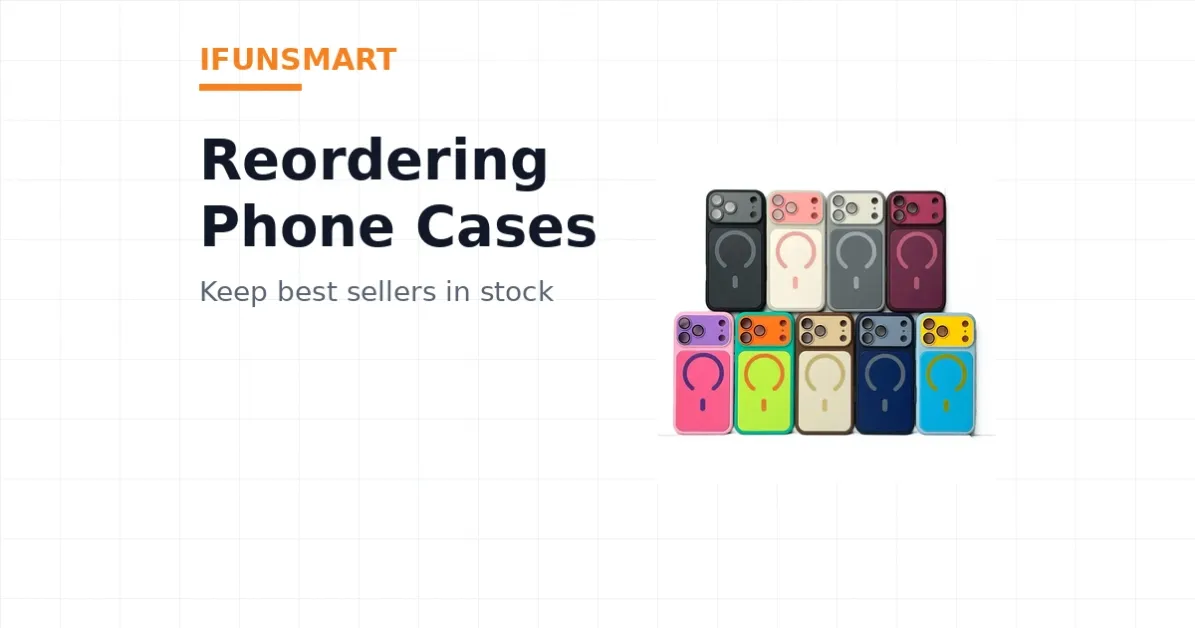
Reordering Phone Cases: Keep Best Sellers in Stock
A first order proves a case sells. A reorder keeps it selling. When to reorder, what to repeat exactly, what to change, and how to put mixed models and colours on one order.
BLUF A first order proves a case sells. A reorder keeps it selling. Reorder when a colour sells out twice, repeat the exact specification, keep the colours your customers ask for, and put mixed models on one order so the order total reaches bulk level.
Short answer
The first order is a test. The reorder is the business. A distributor who orders once and never reorders has a shelf of samples, not a range — and a distributor who reorders late has a shelf with a gap where the best seller used to be. The gap is what costs the money: the customer who came in for the case that sold out buys a competitor's case instead, and the next time they come in they ask for the competitor's case by name.
Reordering is not complicated, but it is exact. The case that sold was a specific model, a specific style, a specific colour and a specific magnet grade. Change any one of those and the reorder is a different product, and the customer who asked for the one that sold will notice. The discipline is to repeat the specification exactly, to reorder before the shelf is empty rather than after, and to use the reorder to widen the range only where the sell-through says to widen it — more of the colour that sold, the same case for the next model in the family, and nothing else until the numbers say so.
This guide covers the reorder trigger, the specification to repeat, colour continuity, mixed-model orders, model phase-out, and the reorder checklist to send the factory.
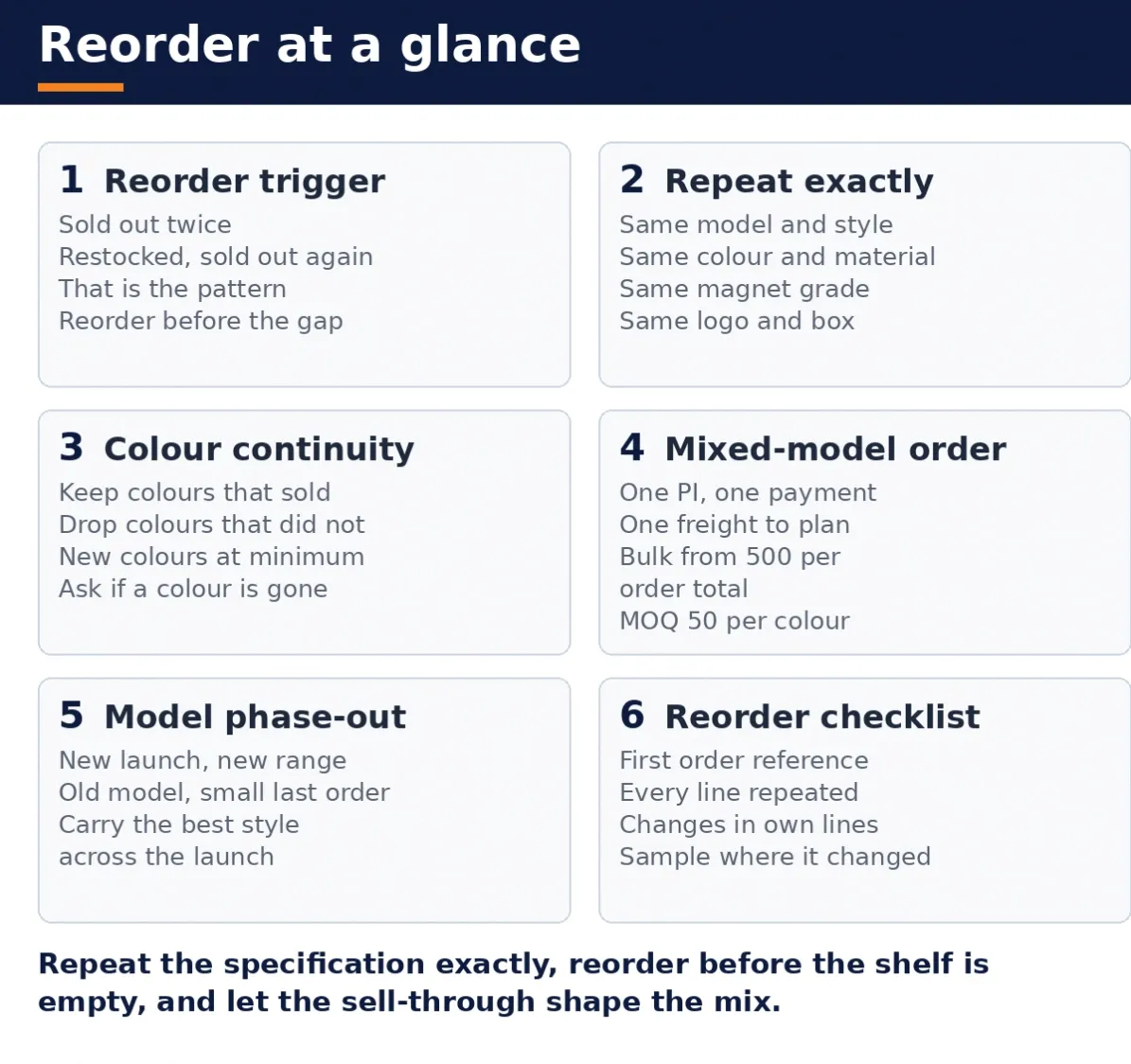
1 — The reorder trigger — before the shelf is empty, not after
The most common reorder mistake is waiting for the shelf to be empty. By the time a case is out of stock, the customer who wanted it has already gone elsewhere, and the factory still needs its production window before the replacement arrives. The reorder belongs before the gap, not after it.
Sell out twice, then reorder. The clearest signal a case has earned a reorder is that it sold out, was restocked, and sold out again. One sell-out can be a launch spike, a single bulk buyer, or a colour that happened to match one phone. Two sell-outs is a pattern: the same customers came back for the same case. That is the case to reorder first, in the largest quantity, and the case to protect when the next order is shaped.
Watch the colour, not just the model. A model can look healthy while one colour is gone. If the black case for the iPhone 18 Pro Max is sold out and the blue one is still on the shelf, the model is not selling — the black one is. Reorder the colour that sold, not the model in general. The colour that sold twice is the one to order deepest; the colour that never moved is the one to drop, not to reorder “to keep the range complete”. A complete range of slow colours is dead stock with a tidy label.
Reorder on the pattern, not on the calendar. Some distributors reorder on the first of the month. That works only if the selling pattern follows the month, and it usually does not — a launch month sells differently from a quiet month, and a holiday season sells differently from both. The trigger is the stock level of the best seller, not the date. Check the shelf for the cases that sold out twice, and reorder when the remaining stock of those cases is low enough that the next delivery will arrive before they run out. Ask us for the current production window in writing for each model on the reorder, and count backwards from the date you need the cases — not from the date you feel like ordering.
Keep one line of buffer for the best seller only. A buffer of the best-selling colour is cheap insurance; a buffer of everything is a warehouse. Hold a little extra of the one or two cases that sold out twice, and hold nothing extra of the cases that have not earned it. The buffer is for the case your customers ask for by name, not for the case you hope they will ask for.
2 — Repeat the specification exactly — the reorder is the same case, or it is a different case
A reorder that changes the specification is not a reorder. It is a new first order, with a new sample to approve and a new risk that the case the customer liked is not the case that arrives.
Send the first order back. The safest reorder message is the first order, repeated. Send the factory the model, the style, the colour, the material, the magnet grade and the logo and packaging requirements exactly as they were on the first order, and ask for confirmation that the reorder matches them line by line. Our RFQ guide covers what a first enquiry should contain; a reorder is the same list, with the words “same as order” in front of every line. If anything has changed since the first order — a new colour, a different logo position, a different box — say so in its own line, so the change is a decision, not an accident.
The magnet grade is part of the specification. A magnetic case that sold was a case with a specific magnet grade. Our magnetic lines use N52 magnets at 2700 Gauss, and the hold, the charger alignment and the wallet grip the customer liked all depend on that grade. A reorder with a weaker magnet is a case that holds less well, charges less reliably and earns a complaint from the customer who bought the first one. Ask for the magnet grade in writing on the reorder, the same as on the first order, and check it on the sample the way our MagSafe guide describes it.
Colour is a specification, not a preference. “Black” is not one colour. The black that sold may be a matte black, a glossy black or a black with a coloured ring, and the customer who asks for “the black one again” means the black that was on the shelf. Name the colour exactly as it appeared on the first order and on the product page, and ask for confirmation that the reorder colour matches. If the factory has renamed a colour or replaced it with a close one, that is a change to approve, not a detail to discover when the goods arrive.
Packaging and logo travel with the reorder. The box, the barcode, the logo position and the printing method are part of what the customer bought. A reorder in a different box, or with the logo printed a different way, is a different product on the shelf even if the case inside is identical. Repeat the packaging and logo specification from the first order, and confirm it in writing. Our packaging guide covers the box, the barcode and the dieline; our printable-area guide covers what artwork can go where. Both apply to the reorder exactly as they applied to the first order.
3 — Colour continuity — the colour your customers ask for must still exist
A distributor's range is a promise: the colour a customer bought last month will be there next month. Break that promise and the customer buys the colour somewhere else, and then buys the next case there too.
Keep the colours that sold, drop the colours that did not. The reorder is the moment to prune. The colour that sold out twice stays, and stays in depth. The colour that never moved goes — not “one more order to be fair to it”, but out, so its shelf space and its money go to the colour that sells. A range of six colours where two sell is a range of two colours carrying four passengers. Prune at the reorder and the range gets stronger every cycle.
Ask whether a colour is still available before you promise it. Colours are discontinued, materials change, and a colour that was available on the first order may not be available on the reorder. Ask us for the current colour list in writing for each model on the reorder, before you tell your customer the colour is coming. If a colour is gone, tell the customer before they order, and offer the closest colour as a choice — not as a surprise in the delivery.
New colours are a second order, not a reorder. A new colour is a test, like a first order. Put it on the reorder only in the minimum quantity — 50 pieces per colour per model — and watch whether it sells out twice before it earns depth. Do not let a new colour take the place of the colour that sold. The reorder's job is continuity; the new colour's job is to prove its
elf.
4 — One order, mixed models — how the 500-piece bulk level works
A distributor rarely reorders one model. The shelf holds several models, several styles and several colours, and the reorder that makes sense is one order covering all of them — one PI, one payment, one freight.
The bulk level is the order total, not the model. Distributor and bulk orders start from 500 pieces per order in total. That 500 is the whole order, not 500 of one model — so a mixed order across models, styles and colours reaches it without over-committing to any single line. A reorder of the best-selling colour for three models, plus the second colour for two of them, is one bulk order, not five small ones.
Shape the mix from the sell-through. The mix is not equal shares. The model and colour that sold out twice takes the largest share; the model that sells steadily takes a steady share; the new colour takes the minimum. The minimum order is 50 pieces per colour per model, so every line on the reorder is at least 50 — and the lines that earned depth take more. If the mix does not add up to a sensible order, the sell-through is telling you something: either a line does not belong on the reorder, or a line that belongs is missing.
One PI, one freight, one delivery to plan. A single order means a single proforma invoice, a single payment under the same terms — T/T or Western Union, with a 30% deposit first for new customers — and a single freight to plan. After the goods are ready we send photos, a video and the packing list before the balance is paid and the goods ship, the same as on the first order. Splitting the same reorder into five small orders means five invoices, five payments and five freights for the same shelf. Put it on one order.
Check the model list before you mix. Not every model you sold last season is still in production, and not every style you sold is still made for every model. Ask us for the current model and mould list in writing for the reorder — our mould-coverage guide lists the families we hold tooling for — and build the mix from the list that is current, not from the list that was current on the first order. A model that has been replaced belongs on the phase-out
plan in section 5, not on the reorder.
5 — Model phase-out — when the phone moves on, the case range must move with it
Phone models do not last forever. A new iPhone or Samsung launch moves buyers to the new model, and the case for the old model stops selling — not all at once, but steadily, and then suddenly. The reorder plan has to see that coming.
New launch, new range; old model, managed decline. The iPhone 18 Pro and Pro Max have been on sale since September 2026, the iPhone Duo since October 2026, and the Galaxy S26 line since March 2026. Those are the models whose cases sell now. The Galaxy S27 is expected early in 2027, though Samsung has not confirmed it, and each launch like it moves a share of buyers to the new phone. Our pre-launch ordering guide covers how to order before a launch; the reorder rule is the mirror of it — when a new model launches, start the range for the new model and wind down the range for the model it replaces, rather than reordering the old model in depth and discovering the buyers have moved.
Do not reorder the old model in depth. The last reorder for a model being replaced should be a small one — the minimum quantity, in the colours that still sell — because the stock that remains when the buyers move on is dead stock, and dead stock is money on a shelf that no one wants. The time to reorder an old model deeply has passed; the time to reorder it at all is only while its cases are still selling out twice.
Carry the best seller across the launch. The style that sold best for the old model is the style to order first for the new one — the same magnetic clear case, the same rugged case, the same wallet folio, cut for the new dimensions. The customer who bought the magnetic clear case for the S26 Ultra is the customer who will want the magnetic clear case for the S27, and the distributor who has it on the shelf on launch week is the distributor who keeps that customer. But a case is cut to one device's dimensions, button positions and camera layout, so the new model's case is a new case: confirm the fit on the real phone before the bulk order runs, the way our sampling guide describes it, and do not assume the old model's case fits the new phone.
Clear the old stock deliberately. When a model is phased out, the remaining stock needs a plan — a final promotion, a bundle with the new model's case, or a clearance to a channel that still sells the old phone. That plan belongs in the reorder conversation, not after the stock is already dead. Tell us which models you are winding down and we can confirm what is still available in writing, so the final order for the old model is the right size and the first order for the new model is ready when the buyers arrive.
6 — The reorder checklist — what to send the factory
A reorder fails when the message is vague. Send the factory one message, with every line filled in, and ask for written confirmation of every line before production runs.
- The order reference. The first order's reference, so the factory can pull the exact specification. If you do not have it, send the model, style, colour, material, magnet grade, logo and packaging as a fresh list — but the reference is faster and safer.
- Every line, repeated. One line per model, style and colour, with the quantity. The minimum order is 50 pieces per colour per model. The lines that sold out twice take the largest quantities; the new colour takes the minimum.
- What changed, in its own lines. Any change — a new colour, a different logo position, a different box — in its own line, so it is a decision, not an accident. If nothing changed, say so: “no changes from the first order”.
- The current lists, confirmed in writing. The current colour list, the current model and mould list, and the current production window for each model on the reorder. Ask for all three in writing, and build the final quantities from the answers.
- The sample, where it matters. A reorder of the exact specification does not need a new sample. A reorder with any change — a new colour, a new model, a different material — does, and distributors receive free samples from us. Approve the changed line on the sample before the bulk order runs, the way our sampling guide describes it: fit on the real phone, the magnetic hold on the real charger, the camera and the screen clear.
- Payment and delivery, stated in the order. Payment by T/T or Western Union; new customers may pay a 30% deposit first. After the goods are
ready we send photos, a video and the packing list before the balance is paid and the goods ship. Put the delivery address and the freight terms in the same message, so the order that comes back matches the shelf you are filling.
Send the checklist, get the written confirmation, and the reorder is a repeat of a proven seller — not a gamble on a new one. The shelf stays full of the cases your customers ask for by name, and the next reorder starts from a range that is stronger than the one before it.
FAQs
-
When should I reorder phone cases? Reorder before the shelf is empty, not after. The clearest trigger is a case that sold out, was restocked, and sold out again — two sell-outs is a pattern, not a spike. Reorder the colour that sold, not the model in general, and ask us for the current production window in writing for each model so the delivery arrives before the remaining stock runs out.
Do I have to order the same quantity as my first order? No. Repeat the specification exactly — the same model, style, colour, material, magnet grade, logo and packaging — but set the quantities from the sell-through. The lines that sold out twice take the largest quantities; a new colour takes the minimum, which is 50 pieces per colour per model. Distributor and bulk orders start from 500 pieces per order in total, and that 500 is the order total, so a mixed order across models and colours reaches it.
Can I mix models, styles and colours in one reorder? Yes — and you should. One order means one proforma invoice, one payment and one freight to plan. Build the mix from the sell-through: the best seller takes the largest share, steady sellers take a steady share, and new lines take the minimum. Ask us for the current model and colour lists in writing first, so the mix is built from what is available now, not from what was available on the first order.
What if a colour I sold is no longer available? Ask us for the current colour list in writing before you promise the colour to your customer. Colours are discontinued and materials change, and a colour from the first order may not be available on the reorder. If it is gone, tell the customer before they order and offer the closest colour as a choice — not as a surprise in the delivery.
Should I keep reordering cases for an older phone model? Only while they are still selling out, and only in small quantities. Each new phone launch moves buyers to the new model, so the last reorder for a model being replaced should be the minimum quantity in the colours that still sell. Carry the
best-selling style across to the new model — the same magnetic clear case, rugged case or wallet folio, cut for the new dimensions — and confirm the fit on the real phone before the bulk order runs.
About iFunSmart
iFunSmart has made phone cases in Guangzhou since 2010, with more than 1,000 designs, more than 500 models and a monthly capacity of more than 500,000 pieces, supplying buyers in more than 30 countries. Our magnetic lines use N52 magnets at 2700 Gauss. The minimum order is 50 pieces per colour per model, distributor and bulk orders start from 500 pieces per order in total, and distributors receive free samples. Payment is by T/T or Western Union; new customers may pay a 30% deposit first, and after the goods are ready we send photos, a video and the packing list before the balance is paid and the goods ship. Ask us for a written quote on your first order.
Contact us on WhatsApp at +86 13632248734, or click “Contact Us” now to get our full model range and latest price list!
Read more