Business Solutions
Phone Case Retail Display: Pegboards, Stands & Shelf Impact
A case that cannot hang, stand or face forward does not sell in a shop. Pegboard specs, counter and floor displays, shelf-ready packs — and what to ask before the order.
BLUF
A phone case sells in a shop only if it can hang, stand or face forward. Match the pack to the wall, the case to the counter, and the range to the shelf — and confirm every display detail in writing before the order.
Short answer
A distributor does not sell cases to a shop. A distributor sells a shop a display that happens to hold cases, and the display has four places to live:
- The wall: a pegboard or slatwall, where boxed cases hang on hooks. The pack needs a Euro slot, the hook needs to match the board's hole pattern, and the range needs to read as a wall, not a jumble.
- The counter: a counter display unit, or CDU, at the checkout — small footprint, pre-filled, header card on top. The case that stands on its own kickstand or ring stand is the case that works here.
- The floor: a free-standing display unit, or FSDU, for a launch or a season — the whole range in one unit, with a header the shopper reads from the aisle.
- The shelf: shelf-ready packaging, facings in a row, colour-blocked, with a shelf talker on the best seller. The case that faces forward sells; the case that faces sideways does not.
Our most common MOQ is 50 pcs per colour per model, bulk distributor orders start at 500 pcs per order in total, and samples are free for distributors. Payment terms are T/T and Western Union only — the full terms are in the checklist in section 7. The rest of this guide is the four placements, the pegboard specification, the counter and floor units, shelf impact, what the case itself must do on a display, and the first-order display plan — in that order, because a distributor who gets the display right and the quantities wrong still ends the season with dead stock.
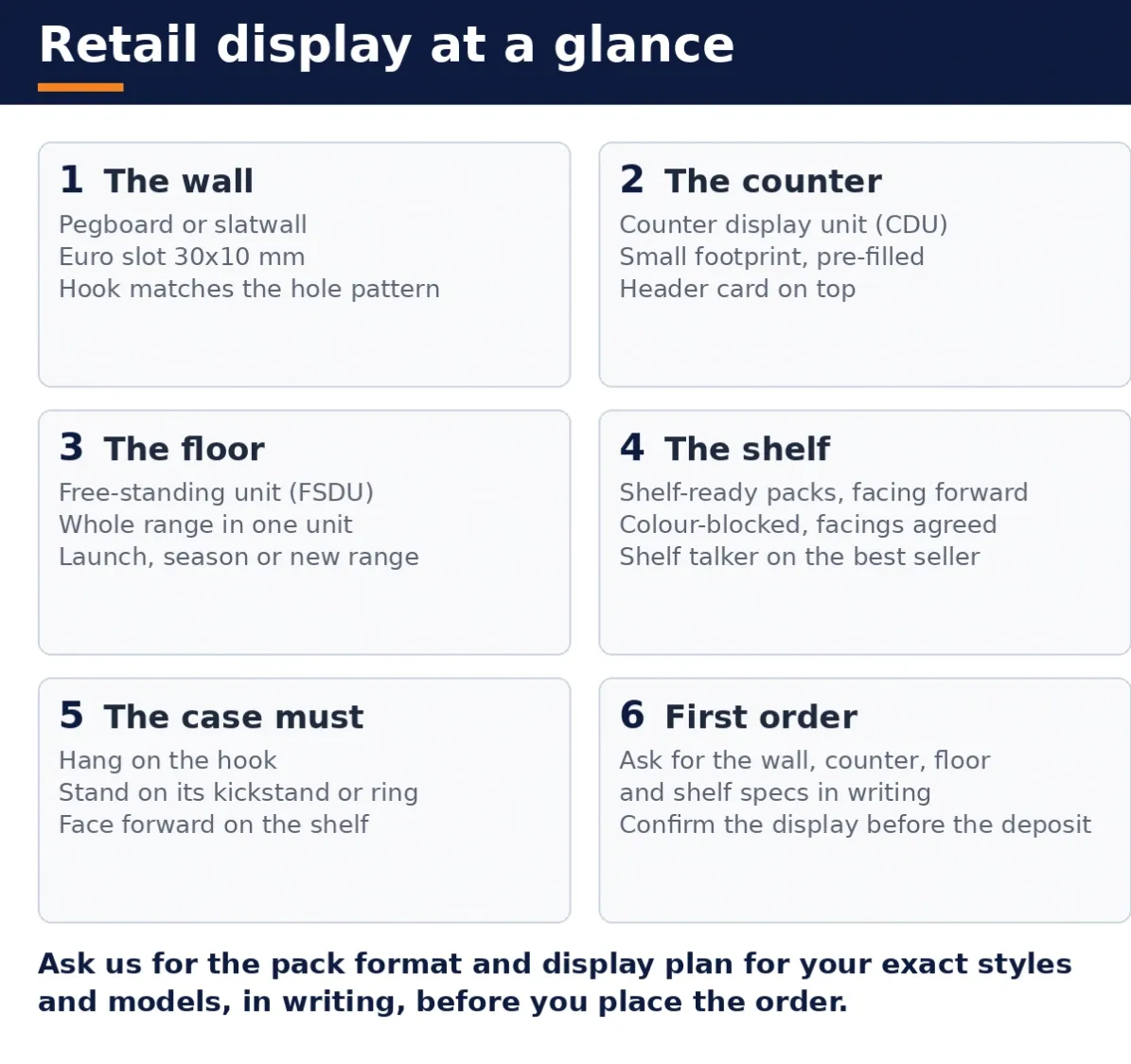
Retail display at a glance
Placement | What it is | What the case and pack must do | When a distributor uses it |
|---|---|---|---|
Pegboard wall | Perforated board, cases hang on hooks | Retail pack with a Euro slot, 30x10 mm; hook matches the board's hole pattern | The shop's permanent case wall, model by model |
Slatwall | Horizontal grooves, slide-in accessories | Pack hangs from a slatwall hook, not a pegboard hook — the two do not cross over | Shops fitted with slatwall instead of pegboard |
Counter display unit (CDU) | Compact point-of-sale unit on the counter or checkout | Small footprint, pre-filled, header card; case stands on its own kickstand or ring | Impulse buys at the till, accessories beside the case |
Free-standing display unit (FSDU) | Self-supporting unit on the shop floor | Whole range in one unit, header read from the aisle | A launch, a season, a new model range |
Shelf | Shelf-ready packs in a row, colour-blocked | Pack faces forward, colour reads at a glance, shelf talker on the best seller | Supermarket and large-format retail, model by model |
Endcap | Branded display at the end of an aisle | One promotion, one range, one message | A promotion, a bundle, a holiday push |
1. The display question is really a "where does the buyer stand" question
Every display conversation with a distributor comes down to one question: where does the buyer stand when they decide? A buyer standing at a wall decides by scanning a range. A buyer standing at a till decides by impulse, in seconds. A buyer walking an aisle decides by a header they can read from three metres away. A buyer standing at a shelf decides by the facing in front of them. Four places, four decisions, and a case that is displayed for the wrong place is a case that is not displayed at all.
That is why this guide never gives a single "best display" for phone cases. There is no single best display, because a distributor's shop buyers do not have a single shop. A mobile-accessories shop has a pegboard wall and a counter. A supermarket has shelves and an endcap. A department store has a floor unit for the launch and a shelf for the range. A kiosk has a counter and nothing else. The distributor's job is to know which of the four placements each shop buyer has, and to supply the pack and the case that fit that placement — not to supply one display and hope it fits everywhere.
The second reason is the pack. A phone case is small, light and flat, and it is sold in a box that is barely bigger than the case. That box is the display: it hangs on the hook, it stands on the counter, it faces forward on the shelf. A box without a Euro slot cannot hang on a pegboard. A box without a flat base cannot stand on a counter. A box without a clear front cannot face forward on a shelf. The display decision is made when the pack is specified, not when the goods arrive — and a distributor who orders the wrong pack orders a display problem, not a display.
The third reason is the range. A display holds a range, and a range is a colour and model plan — the colour guide in this series makes the same point from the other side: black and clear in depth, the phone's own colours next, accents on trial. A wall of nine Tech Fabric colours sells the range; a shelf of two colours in depth sells the best seller. The display and the colour plan are the same decision, made twice: once when the range is ordered, once when it is put on the wall.
2. The pegboard wall: three measurements decide whether the hook fits
The pegboard wall is where most phone cases are sold in a specialist shop, and it is also where most display problems start — because a pegboard is not one thing. It is a hole pattern, and the hook only fits when three measurements match: hole diameter, centre-to-centre spacing, and panel thickness. A hook that fits one board does not fit another, and a distributor who orders hooks without the three measurements orders hooks that fall out.
The hole pattern first. Three measurements decide whether a hook fits, and they are worth writing down as a specification, not a description:
- Hole spacing, centre to centre: the North American standard is 1 inch (25.4 mm); in Europe a metric 25 mm grid is common, and a 19 mm grid turns up on some boards. A hook cut for a 25.4 mm board does not seat properly on a 25 mm board.
- Hole diameter: the commercial standard is 1/4 inch (6.35 mm), the size most retail hardware is built around and the reference used in ANSI/BHMA A156.5-2022. Lighter boards use 1/8-inch (3.18 mm) or 3/16-inch (4.76 mm) holes, and a 1/4-inch hook does not seat in a 3/16-inch hole.
- Panel thickness: measured at a cut edge, it decides how far the hook's locking tab travels behind the board.
Measure the actual board: hole diameter with callipers, centre-to-centre spacing across three holes, and panel thickness at a cut edge. Write the three figures down, with a photo of the board, and send them with the display enquiry. A shop buyer who cannot give the three measurements has not measured the board — ask for the measurements, not for a description.
The standoff second. A pegboard needs a gap behind it, usually 10 to 25 mm, so the hook shank can drop in and lock. A board mounted flush to the wall takes no hooks at all, and a board with too little gap takes a hook that rocks and slips under load. This is the measurement most often skipped, and it is the one that decides whether a loaded hook stays up through a season of customers pulling cases off and putting them back. Ask the shop buyer for the standoff as well as the hole pattern — and if the shop is fitting a new board, the standoff belongs in the fitting brief, not in a complaint after the first hook falls.
The pack third. A boxed case hangs on a pegboard hook through a Euro slot — the punched slot at the top of the retail pack, 30 by 10 mm, verified for the packaging guide in this series. The slot must be punched cleanly, centred, and strong enough to carry the box through handling: a slot that tears is a case on the floor, and a case on the floor is a case that does not sell. The hook length matters as well: a short hook holds one or two boxes, a long hook holds a depth of boxes, and the depth is the stock the shop holds on the wall. Ask the shop buyer for the hook length they use, and pack the case so the box depth and the hook length agree — a deep box on a short hook overhangs, and an overhanging box is a box that falls.
One more check, before the order: the wall is not a pegboard everywhere. Slatwall — horizontal grooves with slide-in accessories — is common in the same shops, and pegboard hooks do not fit slatwall, and slatwall accessories do not fit pegboard. A distributor who supplies a pegboard hook to a slatwall shop supplies a hook that cannot be used. Ask which wall the shop has, and supply the hook that fits it. The question costs one line in the enquiry; the wrong hook costs a wall of cases that cannot be hung.
3. The counter: a small unit, a short decision, a case that stands on its own
The counter display unit — CDU, also called a counter top unit — is the smallest display in this guide and the one with the shortest decision. It sits on the counter or at the checkout, where the buyer is already paying, and it sells on impulse: the case the buyer sees while they wait, the accessory they add to the case they just bought. A CDU works when it is small, pre-filled and obvious — and it fails when any of the three is missing.
Small, to the millimetre. A counter has limited space, and the shop's till, card reader and bags already take most of it. A CDU that takes more counter than the shop will give is a CDU that goes under the counter. Ask the shop buyer for the footprint — width and depth in millimetres, on the actual counter — and design the unit to that footprint, not to a catalogue size. The footprint is the brief; everything else follows it.
Pre-filled, so it sells on arrival. A CDU that arrives empty is a CDU that stays empty, because the shop has no time to fill it. The standard format is the PDQ display — pre-packed, pre-filled, the shop opens the box and the display is the box. A distributor who supplies a pre-filled CDU supplies a display that is selling within minutes of delivery. A distributor who supplies an empty unit and a carton of cases supplies a job for the shop, and the shop has other jobs. Ask us in writing whether a pre-filled counter unit is available for your exact order — the unit, the fill, and the header card are decided together, before the order, not after the goods arrive.
Obvious, with a header card. A CDU needs a header card — the printed panel on top that says what the unit holds, for which models, and why the buyer should look. The header is the advertisement; the unit is the shelf. A unit without a header is a tray of cases, and a tray of cases does not stop a buyer at the till. The header carries the brand, the model range and one message — and it carries no price, because the price belongs in the distributor's own terms, in writing, to the shop.
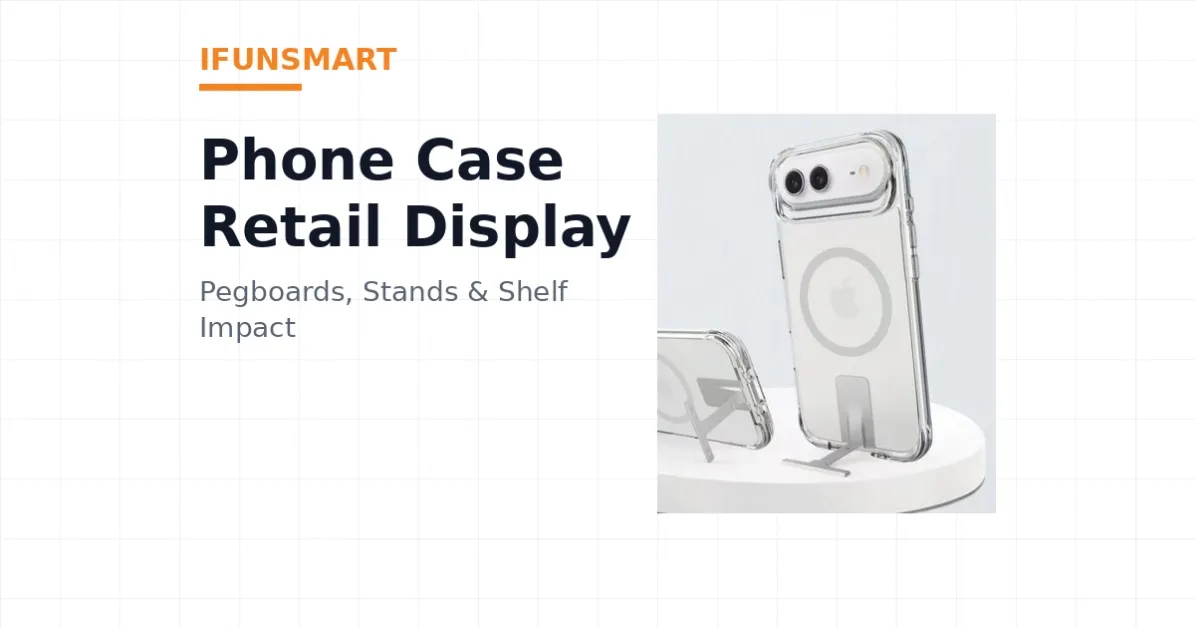
The case matters on the counter more than anywhere else, because the counter case is handled, not just seen. A case with a kickstand or a ring stand stands on its own on the counter — the iPhone Air 2 Kickstand Clear case, six colours, stands on its kickstand, and the Star Grid R2 stands on its 360-degree ring. A case that stands is a case the buyer picks up, opens the stand, and tries — and a case the buyer tries is a case the buyer buys. A flat case on a counter is a case the buyer has to pick up to see, and a case the buyer has to pick up to see is a case that stays in the tray. When the counter is the placement, order the styles that stand: kickstand, ring stand, pivot stand — and check the stand on the sample, on a bench, before the bulk order. The sample check is a factory check: cycle the stand, check it sits flush, check the hinge friction holds the case upright — never a consumer anecdote about using the phone.
4. The floor: a free-standing unit for a launch, a season, or a new range
The free-standing display unit — FSDU — is the largest display in this guide and the one a distributor earns, not buys. It stands on the shop floor, supports itself, and carries the whole range in one unit, with a header the shopper reads from the aisle. A shop gives floor space to a display that earns it, and floor space is the most expensive space in the shop — so the FSDU has to justify itself on the first day.
A launch justifies it. A new iPhone or Samsung range — the iPhone 18 Pro Max, the Galaxy S26 Ultra — is the moment a shop wants the whole range in one place, because the buyer who walks in for the new phone wants the new case in the same visit. The FSDU for a launch carries the new models, the styles that fit them, and the colours that match the phone — and it carries them on the day the phone is on sale, not a month later. The ordering guide in this series makes the same point: order before the launch, confirm the fit on a sample, and have the range ready when the phone lands. A launch FSDU that arrives late is a floor unit for last month's phone.
A season justifies it. The holiday season — Black Friday, Christmas — is the moment a shop wants depth in one place, because the buyer who comes in for a gift buys the case and the accessory together. The holiday stocking guide in this series is the range plan for that unit: black and clear in depth, the phone's own colours next, one accent per style, and the reorder ready when the first depth sells through. A seasonal FSDU that arrives with the wrong colours is a floor unit that holds dead stock in the shop's most expensive space.
A new range justifies it. A distributor who adds a new style — a replaceable-panel case, a rugged Armor build, a card-wallet range — needs one place where the shop buyer and the shopper can see the whole new range at once. The FSDU is that place: the frame and the panels together, the rugged builds side by side, the wallet styles in a row. A new range on a shelf, mixed with the old range, is a new range the shopper never notices.
What a distributor should not do is supply an FSDU as the default display. A floor unit for a range that is already on the wall is a floor unit that takes space from a range that needs it, and a shop that gives floor space once and regrets it does not give it twice. Ask the shop buyer what earns the floor — a launch, a season, a new range — and supply the unit for that reason, in writing, with the fill, the header and the date it goes on the floor. And ask us in writing whether a floor unit is available for your exact order: the unit, the fill and the header are decided together, before the order, never after the goods arrive.
5. The shelf: shelf-ready packs, facings, and the colour block
The shelf is where a distributor's range meets a supermarket or a large-format retailer, and the shelf has rules the wall and the counter do not. A shelf does not hang and does not stand — it faces. The pack faces forward, in a row, and the buyer reads the row the way they read a shelf of anything else: left to right, top to bottom, best seller at eye level. A case that faces sideways on a shelf is a case that is not on the shelf at all.
Shelf-ready packaging first. A shelf-ready pack — SRP — is a pack that goes from the shipping carton to the shelf without re-packing: the outer carton opens into a tray, the tray sits on the shelf, and the cases inside face forward. A distributor who supplies shelf-ready packs supplies a shelf that is stocked in minutes; a distributor who supplies loose boxes supplies a shelf that takes a member of staff half an hour to fill, and a shelf that takes half an hour to fill is a shelf that stays empty when the staff are busy. Ask the retail buyer whether the shelf takes shelf-ready packs, and in what tray size — the tray dimensions belong in the pack brief, with the model list and the quantities, before the order.
Facings second. A facing is one pack-width of shelf, and the number of facings is the number of packs the buyer sees. A range with one facing is a range the buyer has to look for; a range with three facings is a range the buyer cannot miss. The distributor's job is to agree the facings with the retail buyer — how many packs wide, how many rows high, which styles get the facings — and then to supply the depth to keep those facings full. A facing that is empty is worse than no facing: it tells the buyer the range is out of stock. The reorder guide in this series is the discipline for this: keep the best sellers in stock, and the best sellers are the facings that sell through first.
Colour blocking third. A shelf of cases in random colours is a shelf the buyer cannot read; a shelf blocked by colour — black together, clear together, the phone's own colours together — is a shelf the buyer reads at a glance. The colour guide in this series is the plan: black and clear in depth, the phone's own colours next, accents as a single block, not scattered through the range. A colour block also tells the shop when to reorder: when the black block is empty, the black is selling, and the reorder is black. When the accent block is full, the accent is not selling, and the reorder is not the accent.
The shelf edge fourth. A shelf talker — a card that sticks out from the shelf at eye level — calls out one feature for one style: the magnet, the ring stand, the anti-yellowing clear back. A shelf strip — a printed strip along the front edge of the shelf — blocks out the brand's space and carries the model range. A wobbler — a small card that moves slightly — pulls the eye to a new style or a new model. These are the shelf's own formats, and they are cheap, light and printed — but they only work when they name one thing. A shelf talker that lists five features lists none. Ask the retail buyer which shelf-edge format the shelf takes, and supply the artwork for one message per style — the model, the style, and the one reason to pick it up.
6. What the case itself must do on a display
A display is a pack and a unit, but the case inside has to do three things on it: hang, stand, or face — and a case that cannot do the one its placement needs is a case that does not sell there, whatever the display costs.
Hang: the pack hangs, so the pack must be built to hang. A Euro slot, punched cleanly and centred, on a box that is not too deep for the hook and not too heavy for the slot. A box that is deep and heavy on a short hook overhangs and falls; a box that is light and flat on a long hook wastes the depth. The pack specification — box size, slot position, board weight — belongs in the enquiry, with the hook length the shop uses. And the case inside must survive the hang: a case that is handled a dozen times a day by shoppers pulling it off the hook and putting it back needs a coating that does not mark and a frame that does not loosen. Check the coating adhesion and the frame fit on the sample, on a bench, before the bulk order — parting lines, coating adhesion, batch tolerance, magnet pull-force, hinge friction. These are factory checks, not consumer stories.
Stand: the case stands, so the stand must work. A kickstand case stands on its kickstand; a ring-stand case stands on its ring; a pivot-stand card wallet stands on its pivot. The stand must hold the case upright on a counter, in both portrait and landscape, and it must do it after the buyer has opened and closed it a dozen times in the shop. Check it on the sample: cycle the stand on the bench, check it sits flush when closed, check the hinge friction holds the case upright when open. A stand that flops is a case that lies flat on the counter, and a case that lies flat on the counter is a case the buyer does not see.
Face: the case faces, so the front must read. A clear case faces the phone — the buyer sees the phone's colour through the back, and the case sells the phone. A colour case faces the colour — the buyer sees the shade, and the shade must match the listing photo, in daylight, on the sample. A printed or glitter case faces the finish — the buyer sees the print or the glitter, and the finish must read the way it reads in the listing. A leather case faces the grain — the buyer sees the dye and the grain, and the grain must be even across the batch. Approve the facing on the sample, in daylight, next to the phone — because a case approved from a screen is a case that arrives as a surprise, and a surprise case is a case that comes back.
Stack: the case stacks, so the back must be flat enough to stack and the pack must be square enough to face. A case with a proud ring or a deep camera frame does not stack flat, and a pack that does not stack does not fill a shelf tray neatly. This is not a reason to avoid ring stands or camera frames — it is a reason to know which styles stack and which hang, and to put the stacking styles on the shelf and the hanging styles on the wall. The display plan and the style plan are the same decision, made twice.
7. The first-order display plan
Send this plan with the first enquiry, in the same message as the model list, the styles, the colours and the quantities. The answers belong in writing, before the deposit — not in a chat message, and not after the goods are on the water.
1. Ask the shop buyer for the wall. Pegboard or slatwall, hole diameter, centre-to-centre spacing, panel thickness, standoff behind the board, and the hook length they use. A display enquiry without these figures is an enquiry that cannot be answered. Send the three pegboard measurements with a photo of the board.
2. Ask the shop buyer for the counter. Footprint in millimetres on the actual counter, and whether the counter takes a pre-filled unit. A counter unit that does not fit the counter is a unit that goes under it.
3. Ask the shop buyer for the floor. What earns the floor — a launch, a season, a new range — and the date it goes on the floor. A floor unit without a reason and a date is a floor unit that takes space from a range that needs it.
4. Ask the retail buyer for the shelf. Shelf-ready packs or loose boxes, tray size, facings per style, and which shelf-edge format the shelf takes. A shelf plan without facings is a shelf plan that cannot be stocked.
5. Match the pack to the placement. Euro slot for the wall, flat base for the counter, forward-facing front for the shelf, header card for the counter and floor units. The pack is specified with the order, not after it.
6. Match the style to the placement. Kickstand, ring stand and pivot stand for the counter; clear and colour for the shelf; the full range for the wall; the launch range for the floor. A style that cannot hang, stand or face where it is placed is a style that does not sell there.
7. Confirm the display in writing. Ask us in writing whether a pre-filled counter unit, a floor unit, a header card or a shelf-ready tray is available for your exact order — and do not promise a display to a shop buyer until the factory has confirmed it in writing, for the exact styles, models and quantities. A display promised and not delivered is a shop buyer lost.
Seven items, one PI. A supplier who answers them in writing before the deposit is a supplier who can be ordered from again. A supplier who will not answer them is a supplier who has already told the distributor what the order is worth.
FAQs
How do I display phone cases in a retail shop?
Start with where the buyer stands. On the wall, hang boxed cases on a pegboard or slatwall — the pack needs a Euro slot, 30 by 10 mm, and the hook must match the board's hole pattern, so measure hole diameter, centre-to-centre spacing and panel thickness before ordering hooks. On the counter, use a small pre-filled counter display unit at the checkout, with a header card and styles that stand on their own kickstand or ring. On the floor, use a free-standing unit for a launch, a season or a new range. On the shelf, use shelf-ready packs in a row, colour-blocked, with a shelf talker on the best seller. Ask us for a quote in writing for your exact order.
What is a phone case pegboard display and what hook size do I need?
A pegboard display is a perforated board with cases hanging on hooks, and the hook only fits when three measurements match: hole diameter, centre-to-centre spacing, and panel thickness. The North American standard is 1-inch — 25.4 mm — hole spacing on centre, with 1/4-inch holes the commercial standard; in Europe a metric 25 mm grid is common, and a 19 mm grid turns up on some boards. A 1/4-inch hook does not seat in a 3/16-inch hole, and a hook cut for a 25.4 mm board does not seat properly on a 25 mm board — so measure the actual board with callipers and send the three figures with a photo. The board also needs a 10 to 25 mm gap behind it so the hook shank can seat. Ask us for a quote in writing for your exact order.
What is a counter display unit (CDU) for phone cases?
A counter display unit is a compact point-of-sale display that sits on a counter or at a checkout and sells on impulse — the case the buyer sees while they wait, the accessory they add to the case they just bought. It works when it is small enough for the counter footprint, pre-filled so the shop opens the box and it is selling within minutes, and headed by a printed header card that says what the unit holds and for which models. The best counter styles are the ones that stand on their own — a kickstand case, a ring-stand case, a pivot-stand card wallet — because a case that stands is a case the buyer picks up and tries. Ask us in writing whether a pre-filled counter unit is available for your exact order — the unit, the fill and the header card are decided together, before the order. Ask us for a quote in writing for your exact order.
Do phone case suppliers provide display stands?
Ask us in writing for your exact order. What we confirm is custom packaging — the retail box, the Euro slot, the logo and the pack format — and what we confirm in writing for a specific order is whether a display-ready pack, a header card, a pre-filled counter unit or a floor unit is available for your styles, models and quantities. Do not promise a display to a shop buyer until the factory has confirmed it in writing: a display promised and not delivered is a shop buyer lost. What a supplier should always answer in writing before the deposit is the pack specification — box size, slot position, tray size — because the pack is the display, and the pack is specified with the order, not after it.
How many phone cases fit on a retail display?
There is no single number, because the answer is the board, the hook and the pack — not the case. On a pegboard, count the facings across the board width and the depth down the hook, and multiply: the number of packs that fit across, times the number that fit down the hook, is the number the wall holds. On a counter unit, the footprint decides: the unit holds what fits inside its width and depth, and a pre-filled unit arrives with its fill counted. On a shelf, the facings decide: the number of packs wide times the rows high, and the depth to keep those facings full. Send us the board width, the hook length, the counter footprint or the shelf dimensions with the first enquiry, and we will work the count with you in writing — we never state a figure for a display we have not measured.
About iFunSmart
iFunSmart — Ifun Electronics Technology Co., Ltd, Guangzhou, China — has made phone cases since 2010, with 1000+ designs, 500+ models and 500K+ pcs/month capacity, exported to 30+ countries. Our most common MOQ is 50 pcs per colour per model and it varies by product line; bulk distributor orders start at 500 pcs per order in total, and samples are free for distributors. Payment terms are T/T and Western Union only; new customers may pay a 30% deposit first, and after the goods are ready the factory sends photos, a video and a packing list — the customer pays the balance, then the goods ship. We reply within 24 hours. Ask us for a quote in writing for your exact order, including the display plan for your shop buyers.
Contact us
WhatsApp us at +86 13632248734, or email contact@ifunsmart.com, with your model list, styles, colours, quantities — and the seven-item display plan from section 7. We will confirm the fit, the pack format and the display for your exact order in writing before the deposit.
Read more
- Phone Case Colours: What Distributors Stock First — https://www.ifunsmart.com/posts/phone-case-colours-what-distributors-stock-first
- Phone Case Packaging: Boxes, Barcodes and the Dieline — https://www.ifunsmart.com/posts/phone-case-packaging-boxes-barcodes-dieline
- Phone Cases as Corporate Gifts: Logo & First Order — https://www.ifunsmart.com/posts/phone-cases-as-corporate-gifts-logo-first-order
- Reordering Phone Cases: Keep Best Sellers in Stock — https://www.ifunsmart.com/posts/reordering-phone-cases-keep-best-sellers-in-stock
- Holiday Phone Case Stocking: Order Before Black Friday — https://www.ifunsmart.com/posts/holiday-phone-case-stocking-order-before-black-friday
- TPU vs PC vs Liquid Silicone vs Leather: What Each Material Means for a Bulk Order — https://www.ifunsmart.com/posts/phone-case-materials-tpu-pc-silicone-leather
- Phone Case Sampling: How to Evaluate a Sample Before a Bulk Order — https://www.ifunsmart.com/posts/phone-case-sampling-how-to-evaluate-a-sample-before-bulk
- Slim Phone Cases: Thin TPU vs Thin PC vs Aramid — https://www.ifunsmart.com/posts/slim-phone-cases-thin-tpu-vs-thin-pc-vs-aramid