Business Solutions
Slim Phone Cases: Thin TPU vs Thin PC vs Aramid
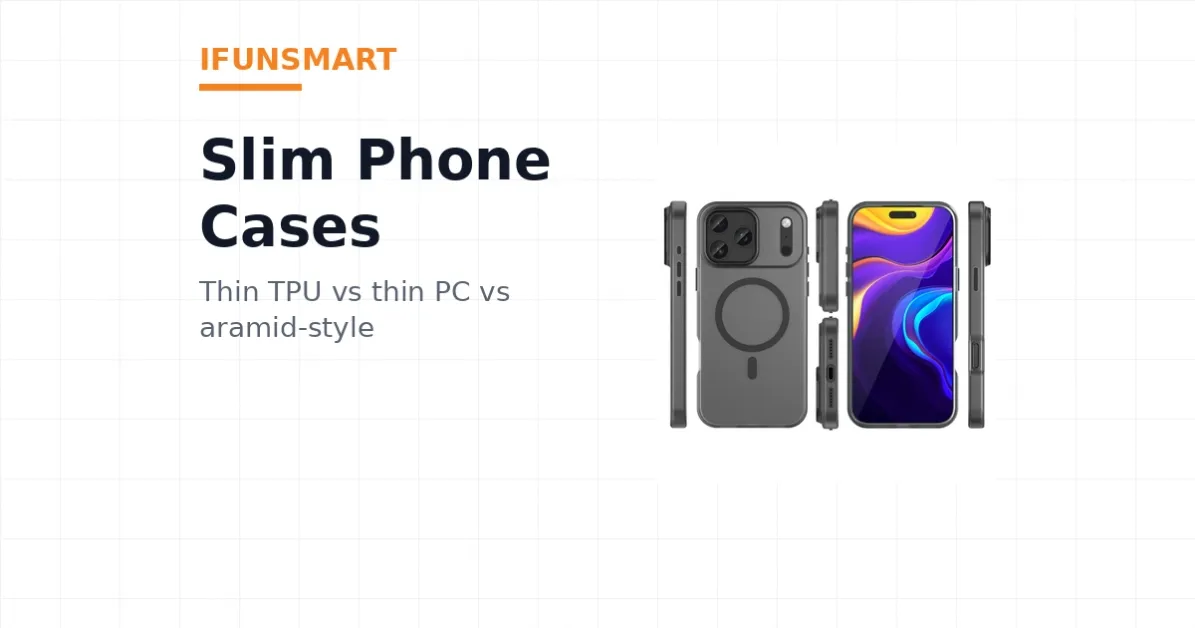
Slim phone cases for wholesale buyers: thin TPU vs thin PC vs aramid-style — what each build is, which models to stock slim first, six fit checks, and MOQ. Aramid: ask us.
BLUF
A slim case should keep the phone feeling like the phone. Order thin TPU for a clear flexible shell, thin PC for a hard slim back, and ask us about aramid-style — we do not stock an aramid case today. Check the fit on a sample before any bulk order.
Short answer
Slim means the case adds as little as possible to the phone — and the word itself is unregulated, so judge the case on a sample, not on the label. Our confirmed slim line is the Smoke Soft Slim MagSafe case for iPhone 17 Pro Max: a PC + TPU build with a slim-fit profile, MOQ 50 pcs per colour per model. For the iPhone Air — Apple's thinnest iPhone at 5.64 mm and 165 g — we carry two clear MagSafe cases built not to add bulk to a thin phone. Our Silky Touch matte MagSafe case also carries a slim profile across iPhone 17/16/15/14/13 and Samsung S26/S25/S24/S23. We do not stock an aramid case today: a site-wide search for aramid and kevlar returns nothing, so aramid-style is "ask us", and our carbon-fibre texture case is a texture, not aramid. Our most common MOQ is 50 pcs per colour per model, bulk distributor orders start at 500 pcs per order in total, and samples are free for distributors.
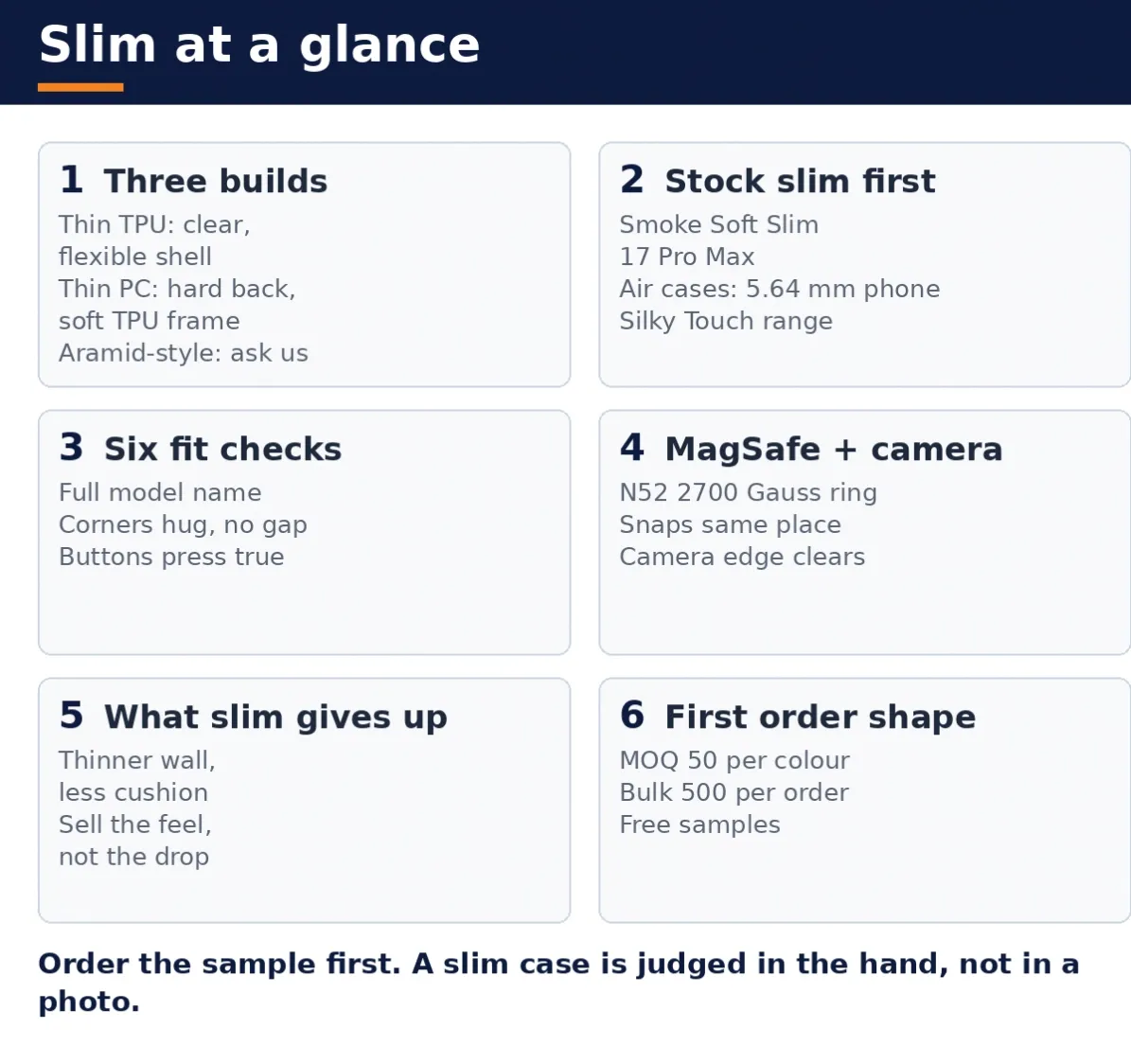
- What counts as a slim case? "Slim" is a feeling before it is a measurement, and no standard defines it. One factory's slim is another factory's standard shell, which is why a buyer should never order slim cases from a product name alone. Compare fitted samples and case-only measurements — not just the word "ultra-thin".
A slim case does three things. First, it keeps the phone's own shape: the back stays close to the phone, the sides do not bulge, and the phone still slides into a pocket or a car mount the way it did without a case. Second, it keeps the phone's own features working: buttons press the same, the camera sits clear, and a MagSafe ring lines up with chargers and wallets. Third, it protects the parts that hit first — the corners, the camera edge and the screen lip — without turning the phone into a brick.
That third point is the trade-off that defines the whole category. A slim case protects against scratches, scuffs and everyday knocks. It is not a rugged case, and a buyer who orders slim expecting rugged protection will be disappointed — and will hear about it from their own customers. Order slim for customers who want the phone to feel like the phone. Order armor for customers who drop phones for a living. The rest of this guide is about choosing between the slim builds, and about checking the one you choose on a sample before the bulk order.
Three builds cover almost every slim order: thin TPU, thin PC, and aramid-style. Thin TPU is a flexible clear or frosted shell. Thin PC is a hard, thin back, usually with a TPU frame. Aramid-style is a woven fibre-look shell — the premium end of the slim range. Only the first two are confirmed in our range today; the third is "ask us", and section 2 explains why that matters.
- Thin TPU vs thin PC vs aramid-style: the three builds Start with the build, not the brand. Each of the three builds behaves differently in the hand, in the pocket and on a shelf, and the build you choose decides what your customer notices first.
Thin TPU — the flexible clear shell. TPU is a soft, flexible plastic. A thin TPU case bends around the phone, grips the edges, and goes on and off easily. In clear form it shows the phone's own colour, which is why it is the default slim case for buyers who sell on the phone itself rather than on the case. Our confirmed example is the Smoke Soft Slim MagSafe case for iPhone 17 Pro Max: a PC + TPU build with a slim-fit profile and an anti-fingerprint finish, so the back does not show every touch. Check three things on the sample: the corners, which must hug the phone without gaping; the button covers, which must press like the phone's own buttons; and the surface, which must stay clear and not pick up marks after a week in a pocket. Thin TPU yellows over time on clear versions — ask us about the anti-yellowing treatment on the model you order, and check a sample that has been handled, not just a fresh one.
Thin PC — the hard slim back. PC is a hard plastic. A thin PC back stays flat, keeps its shape, and shows a colour or a finish cleanly — matte, frosted or clear. Because PC does not flex, a thin PC case almost always has a soft TPU frame around the edge: the hard back carries the look and the soft frame carries the fit. Our confirmed examples sit on the iPhone Air, the thinnest iPhone at 5.64 mm: a matte clear MagSafe case with a rotatable ring stand, built from a matte clear back with a soft TPU bumper, and a clear MagSafe case with an integrated stand, built from a composite plate with a TPU layer (listed on the product page as a 2.5 mm plate + 2.0 mm TPU). Both are built for a phone where every extra millimetre is visible, so the case is designed not to add bulk to a thin phone. Check two things on the sample: the seam where the hard back meets the soft frame, which must be tight all the way round, and the camera edge, which must stand above the lenses without making the phone rock on a table.
Aramid-style — ask us, do not assume. Aramid is a woven fibre material, and an aramid-style case is the slim case that looks and feels technical: a woven finish, a thin wall, a premium hand feel, usually with a magnetic ring. It is the build buyers ask for when they want the thinnest premium case on the shelf. Be direct about our position: we do not stock an aramid case today. A search of our full range for aramid and kevlar returns nothing, so do not order aramid from us on the strength of this guide. What we do carry is a carbon-fibre texture case — a magnetic case with a 360-degree rotating ring stand whose back carries a carbon-fibre texture. A texture is a look, not a material: it is not aramid, it does not behave like aramid, and it should never be sold as aramid. If your range needs a genuine aramid-style slim case, ask us in writing: tell us the model, the quantity and the finish you need, and we will confirm whether we can source or tool it before you promise it to your customers.
A practical way to compare the three: order one sample of each build you are considering, for the same phone model, and put them in three different pockets for a week. The one that still looks new, still fits tight and still charges on a MagSafe stand is the one to order in bulk. A catalogue photo cannot run that test.
- Which models should you stock slim first? Stock slim where the phone itself is slim, and where your customers already buy on feel. Two phones set the order.
Start with the iPhone 17 Pro Max. It is the largest phone in the iPhone 17 range — 163.4 x 78.0 x 8.75 mm, 233 g — and it is the phone where a slim case makes the biggest difference to the hand, because the phone is already big. Our Smoke Soft Slim MagSafe case is made for this model only, in PC + TPU, with a slim-fit profile and an anti-fingerprint finish. It is the only case in our range that carries "slim" in its name, which makes it the cleanest first slim SKU: one model, one build, one story to tell a customer. MOQ is 50 pcs per colour per model. If your customers buy the Pro Max, start here.
Then the iPhone Air. At 5.64 mm thick and 165 g, with a 6.5-inch display, the iPhone Air is Apple's thinnest iPhone to date — announced 9 September 2025 and on sale from 19 September 2025. A buyer who sells to Air owners is selling to people who chose thin on purpose, so the case must not undo the choice. We carry two clear MagSafe cases for the iPhone Air: a matte clear case with a rotatable ring stand, and a clear case with an integrated stand that also covers iPhone 16/15 series and Samsung Galaxy models. Both keep the phone visible and add a stand, which is the feature Air buyers ask for once the thinness is taken for granted. Note the difference between the two: the ring-stand version is built around the Air, while the integrated-stand version is a wider range that also fits older iPhones and Samsung models — check the model list on the product page before you order, because the same case name can cover different models.
Then the wide range: Silky Touch. Not every slim order is for one phone. Our Silky Touch matte MagSafe case carries a slim profile across iPhone 17/16/15/14/13 series and Samsung S26/S25/S24/S23 series, in PC + TPU. Its main selling point is the matte touch and the drop protection, with slim as a secondary quality — order it when you need one slim-feel SKU that covers the models your customers already own, rather than a dedicated slim case for one flagship. The same logic applies to the Racket ring stand case for the iPhone Duo, which is built to "stay slim" around a folding phone — a secondary slim quality on a rugged case, not a slim case in the first place. Do not list either of these as a dedicated slim case to your customers; list them as cases with a slim profile, and keep the Smoke Soft Slim as the dedicated slim line.
What not to stock slim yet. Do not stock an aramid-style slim case from our range until we confirm it in writing — there is none today. Do not stock a slim case for the iPhone Air 2 or the iPhone 18 yet either: our Air 2 series is open for pre-order in five styles, but those are pre-order styles, not slim stock, and the fit is confirmed on a sample before any bulk order ships. Ask us for the current slim list per model before you plan the quantities — the list changes as new moulds finish.
- Six fit checks before you approve a slim case A slim case fails in small ways, and small ways are what customers return. Run these six checks on the sample — the structure follows the checks any slim-case buyer should run, and every one of them is answerable in five minutes with the phone in your hand.
- Match the full phone name. Keep iPhone 17, 17 Pro and 17 Pro Max on separate order lines, and keep the iPhone Air on its own line too. The camera openings and body dimensions differ between models, and a case that fits the Pro will not fit the Pro Max. Check the model on the sample against the model on the order, not against the model on the box.
- Corner fit. Press each corner. A slim case must hug the phone with no gap and no lift. A corner that lifts is a corner that will peel in a pocket, and a corner that gapes lets grit in, which scratches the phone the case is meant to protect. Check all four corners, not just the two you can see.
- Button feel. Press every button through the case — volume, power and Camera Control where the phone has one. The press should feel like the phone's own button, not mushy and not stiff. A slim case has less material over the buttons, so this is where a bad mould shows first. If a button needs two presses, reject the sample.
- MagSafe alignment. Put the phone, in the case, on a MagSafe charger and on a magnetic wallet or car mount. It should snap to the same place every time and stay there when you lift the phone. A thin case can still weaken the hold if the magnet ring sits even slightly off-centre — and a slim case that slides off a car mount is a returned case. Our magnetic cases use N52 magnets rated at 2700 Gauss; the rating is the magnet, not the hold, so test the hold on the sample with the accessories your customers actually use.
- Camera clearance. Lay the phone face-down on a table. The camera edge must hold the lenses off the surface, and the phone must not rock. On the iPhone Air this matters twice over, because the camera sits on a raised plateau — the case must clear the plateau, not just the lenses. Check it with the phone in the case, not with the case empty.
- Pocket and hand feel. Put the cased phone in the pocket you actually use — jeans, jacket, bag — and take it out ten times. A slim case should slide in and out without catching, and it should not pick up lint or show marks after a day. This is the check a photo cannot run: a case that looks slim in a listing and feels sticky in a pocket will come back.
If the sample fails any one of these six, say so before the bulk run. A failed sample costs a sample. A failed bulk order costs a container.
- What a slim case gives up — and how to sell that honestly Every slim case is a trade, and the honest way to sell it is to name the trade before the customer finds it. A thinner wall means less material between the phone and the ground. A thinner frame means less cushion at the corners. A case that keeps the phone feeling like the phone cannot also protect like a case built for drops — and a buyer who promises both will lose the customer either way.
So do not sell a slim case on protection. Sell it on what it does: it keeps the phone's shape, it keeps the phone's colour visible, it keeps the phone sliding into a pocket, and it keeps MagSafe accessories working. Protection is the secondary promise: scratch and scuff protection, everyday knocks, and a raised edge around the camera and the screen. If your customer needs drop protection as the first requirement, point them at an armor case instead — we carry rugged lines for exactly that buyer, and a customer who buys the right case is a customer who comes back.
Two more honest points. First, a slim clear case will show marks over time, and a clear TPU case can yellow — ask us about the anti-yellowing treatment on the model you order, and tell your customers to expect normal wear, not a permanent showroom finish. Second, a slim case is not a one-size-fits-all product: the same build fits differently on a 233 g Pro Max and a 165 g Air, which is why the sample must be for the exact model you will order in bulk. A sample for the wrong model proves nothing.
- How to order slim cases first Order slim the same way as any first order, with the sample first and the bulk order after it.
First, enquire. Send us a message on WhatsApp with the build (thin TPU, thin PC, or aramid-style if you need it), the model, the colours and the quantity. A complete enquiry gets a faster answer than a one-line message: build, model, colours, quantity, logo or no logo, and packaging.
Second, take a sample. Samples are free for distributors. Run the six fit checks in section 4 on the sample, for the exact model you will order. If the sample passes, confirm the bulk order. If it does not, tell us what failed and we fix it before the bulk run.
Third, plan the quantities. Our most common MOQ is 50 pcs per colour per model, and MOQ varies by product, so ask us per style before you plan the quantities. Bulk distributor orders start at 500 pcs per order in total, not per model, with free samples for distributors — so a first slim order can mix the Smoke Soft Slim for the Pro Max with an Air case and a Silky Touch range and still count as one bulk order. A practical first order is 500 pcs across two builds: the dedicated slim case for your best-selling model, and a wide-range slim-profile case for the models your customers already own.
Fourth, logo and packaging. Your logo can go on the case — a 100-pc trial order can already carry a logo by laser engraving, which is permanent, unlike silk-screen printing, which fades and needs a higher MOQ. Neutral packaging is usually in stock and a logo sticker can be added to it. If you want custom packaging, ask us before the bulk order, not after.
Fifth, payment. Payment is T/T or Western Union. New customers may pay a 30% deposit first. When the goods are ready, we send photos and video and the packing list, you pay the balance, and then the goods ship. That order — deposit, proof, balance, ship — is the same for a slim order as for any first order, and it is what protects both sides.
There is no fixed slim-case price list to quote here, because the price depends on the build, the model, the colour and the quantity — and because a price quoted without those four is a guess, not a quote. Send us the four and we quote in writing. What a quote should show, and what a quote that hides those four should warn you about, is covered in our quotation guide — linked below.
FAQs
What is the MOQ for slim phone cases?
Our most common MOQ is 50 pcs per colour per model, and MOQ varies by product, so ask us per style. That is the MOQ on every confirmed slim case in this guide — the Smoke Soft Slim for iPhone 17 Pro Max, the two iPhone Air cases and the Silky Touch range. Bulk distributor orders start at 500 pcs per order in total, not per model, with free samples for distributors.
Which slim iPhone 17 Pro Max case should I order first?
Order the Smoke Soft Slim MagSafe case. It is the only case in our range that carries "slim" in its name, it is made for the iPhone 17 Pro Max only, and it is a PC + TPU build with a slim-fit profile and an anti-fingerprint finish. It is the cleanest first slim SKU: one model, one build, one story. Take a sample first and run the six fit checks in section 4 before the bulk order.
Do you have an aramid slim case?
Not today. A search of our full range for aramid and kevlar returns nothing, so we do not stock an aramid case. Our carbon-fibre texture case is a texture, not aramid — it looks woven, but it is not an aramid material and should never be sold as one. If your range needs a genuine aramid-style slim case, ask us in writing with the model, the quantity and the finish, and we will confirm whether we can source or tool it before you promise it to your customers.
Will a slim case still work with MagSafe?
Yes, if the magnet ring is placed right — and that is a sample check, not a catalogue claim. Our magnetic cases use N52 magnets rated at 2700 Gauss, but the rating is the magnet, not the hold: put the cased phone on your MagSafe charger, wallet and car mount and check it snaps to the same place every time. A thin case can still weaken the hold if the ring sits off-centre, so test it with the accessories your customers actually use.
Thin TPU or thin PC — which should I stock for resellers?
Stock thin TPU if your customers buy on the phone itself: a clear flexible shell shows the phone's colour and goes on and off easily. Stock thin PC if your customers buy on finish: a hard slim back with a soft TPU frame shows a matte or frosted colour cleanly and keeps its shape. If you can only stock one, stock thin TPU for the clear look — and take a sample of the other build to show. The choice is about what your customer notices first: the phone, or the case.
About iFunSmart
iFunSmart has made phone cases in Guangzhou since 2010, with 1,000+ designs, 500+ models and 500K+ pcs a month, shipped to 30+ countries. We hold moulds for iPhone, Samsung, Xiaomi, Google and more, and we cut new tooling to order for distributors and brands. Our most common MOQ is 50 pcs per colour per model; bulk distributor orders start at 500 pcs per order in total, with free samples for distributors. Payment is T/T or Western Union; new customers may pay a 30% deposit first, and we send photos, video and a packing list before the balance is due. Ask us for the current slim list per model in writing — if a style is in stock, we will tell you, and if it is not, we will tell you that too.
WhatsApp us: +86 13632248734 — we reply within 24 hours.
Contact us: https://www.ifunsmart.com/contact
Read more
iPhone 17 Pro Max Cases: What Buyers Order First — https://www.ifunsmart.com/posts/iphone-17-pro-max-cases-what-buyers-order-first
TPU vs PC vs Liquid Silicone vs Leather: Which Phone Case Material Should You Order? — https://www.ifunsmart.com/posts/phone-case-materials-tpu-pc-silicone-leather
Which Phone Models Do We Hold Moulds For? — https://www.ifunsmart.com/posts/phone-case-model-mould-coverage
Phone Case Sampling: How to Evaluate a Sample Before a Bulk Order — https://www.ifunsmart.com/posts/phone-case-sampling-how-to-evaluate-a-sample-before-bulk
iPhone Air 2 Cases: 5 Styles to Pre-Order — https://www.ifunsmart.com/posts/iphone-air-2-cases-5-styles-pre-order
Phone Case RFQ: What to Send a Factory in Your First Enquiry — https://www.ifunsmart.com/posts/phone-case-rfq-what-to-send-a-factory-in-your-first-enquiry
When a Phone Case Quote Looks Too Cheap: Red Flags Before You Pay — https://www.ifunsmart.com/posts/when-a-phone-case-quote-looks-too-cheap
MagSafe Cases 2026: N52 2700 Gauss Test & Magnet Guide — https://www.ifunsmart.com/posts/magsafe-cases-2026-n52-2700-gauss-test-magnet