Business Solutions
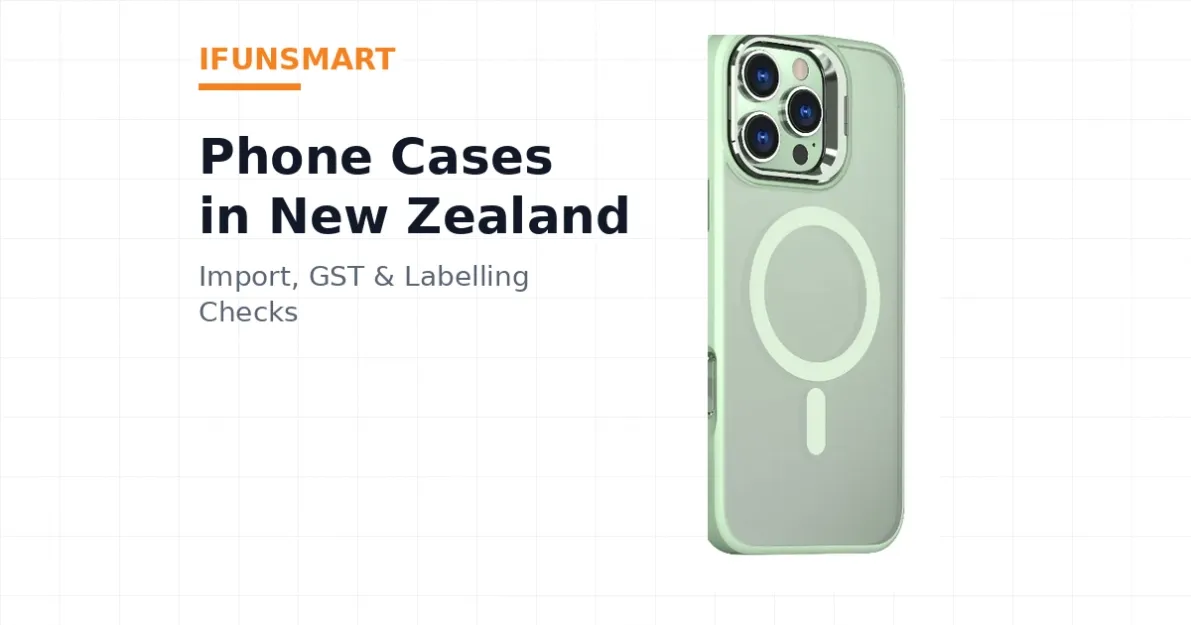
Phone Cases in New Zealand: Import, GST & Labelling Checks
New Zealand charges 15% GST and, for Chinese-origin cases, 0% duty under the NZ–China FTA. The NZD 1,000 border line, the goods levy, labelling rules and what to stock first.
BLUF
New Zealand charges 15% GST on phone-case imports and, for Chinese-origin cases, 0% duty under the NZ–China FTA. The line that matters is NZD 1,000: below it no border tax, above it Customs collects GST plus a goods levy — and needs a Customs Number and an import entry.
Short answer
New Zealand is the smallest market in this series — about 5.34 million people — and the simplest to import into. There is one tax that matters, one duty rate that matters, one border line, and one labelling rule. The tax is GST at 15%. The duty is 0% for Chinese-origin goods under the NZ–China Free Trade Agreement, in force since 1 October 2008. The border line is NZD 1,000: a consignment at or below it pays no duty or GST at the border, and a consignment above it is charged GST at the border plus a goods levy, and needs a Customs Number and an import entry lodged within 20 days. The labelling rule is that no New Zealand law requires a country-of-origin label on a phone case — but any origin claim on the box must be truthful, and a kiwi, a flag or New Zealand-sounding branding on a Chinese-made case is treated as an origin claim.
That simplicity is the point of this guide. A New Zealand distributor does not need a new import playbook — the same first-order discipline as every other market in this series applies, with three New Zealand specifics added: the NZD 1,000 line and the goods levy that replaced the old entry fees on 1 April 2026, the wood-packaging rule that can hold a shipment at the border, and the packaging stewardship scheme that is declared but not yet mandatory. The rest of this guide works through each of those in order, then what to stock first in a market where Apple and Samsung together hold most of the phones, then what to ask in writing and what the first order looks like. The most common MOQ is 50 pcs per colour per model, and it varies by product line. Bulk and distributor orders start at 500 pcs per order in total. Samples carry a fee, refundable on orders of 500+ pcs — ask us to confirm the amount per style in writing. A 100-pc trial order can carry a logo by laser engraving. Payment is T/T and Western Union only, with a 30% deposit for new customers, photos and video and the packing list after the goods are ready, then the balance, then the goods ship.
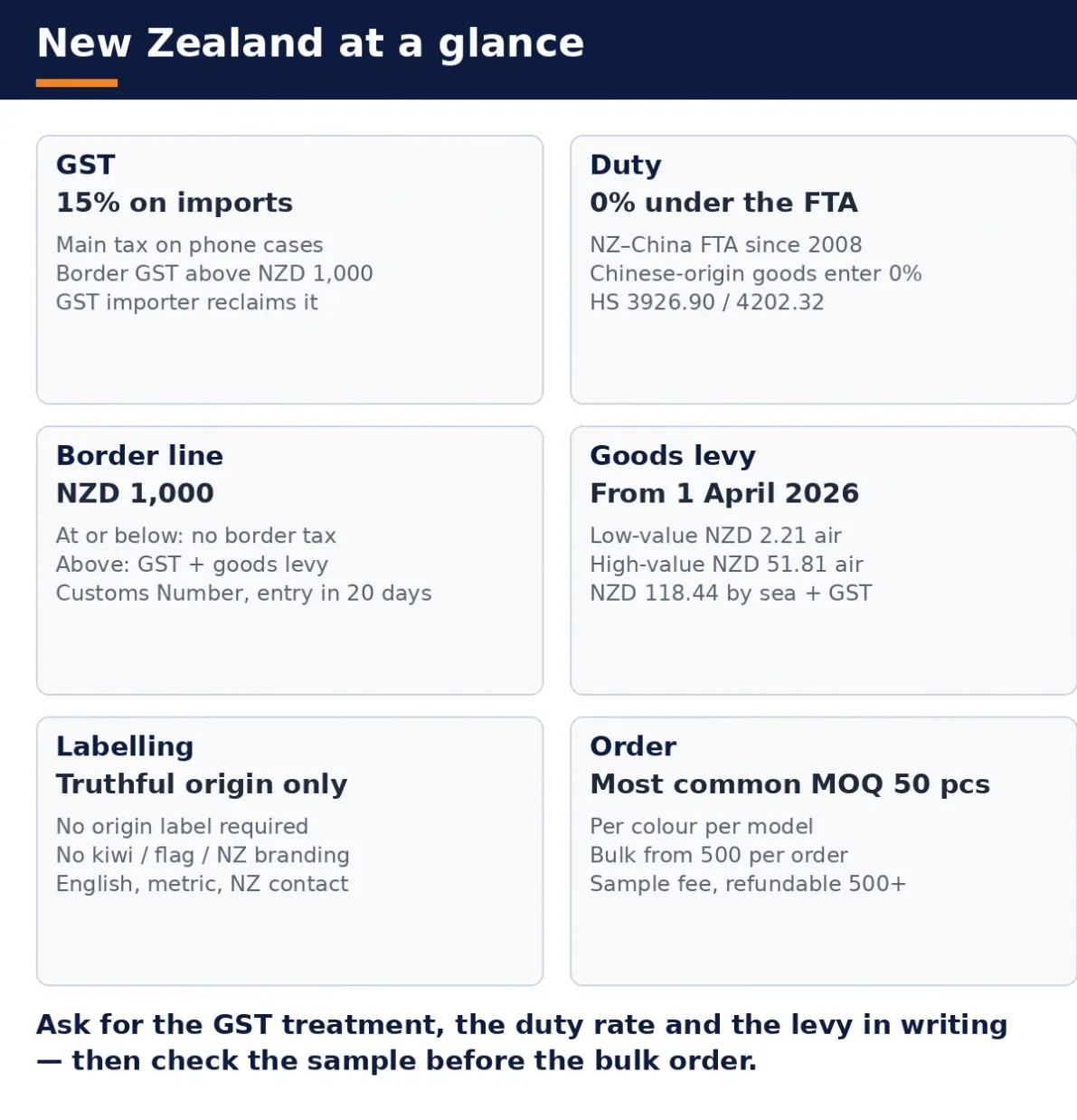
New Zealand at a glance
Check | What applies in New Zealand |
|---|---|
GST | 15% — the main tax on phone-case imports |
Duty | 0% for Chinese-origin goods under the NZ–China FTA (in force 1 Oct 2008) |
Border line | NZD 1,000 — at or below it, no duty or GST at the border; above it, GST + goods levy + import entry |
Import entry | Customs Number required at NZD 1,000 or more; entry lodged within 20 days of arrival |
Goods levy | From 1 Apr 2026: low-value NZD 2.21 air / NZD 2.09 sea + GST; high-value NZD 51.81 air / NZD 118.44 sea + GST |
Labelling | No origin label required on a phone case — but any origin claim must be truthful; no kiwi/flag/NZ branding on Chinese-made cases |
Packaging stewardship | Plastic packaging is a declared priority product, but no mandatory scheme is in force yet |
Market | About 5.34 million people; Apple and Samsung lead the phone market |
MOQ | Most common 50 pcs per colour per model, varies by product line |
Sample | Fee charged, refundable on orders of 500+ pcs — ask us to confirm the amount per style in writing |
1. What GST does a New Zealand buyer pay on phone cases?
GST is 15%, and it is the main tax on a phone-case import. Everything else in this guide is detail around that one number — the border line that decides whether GST is charged at the border or at the sale, who collects it, and what a GST-registered importer can claim back.
The NZD 1,000 line. A consignment valued at NZD 1,000 or less pays no duty and no GST at the border. A consignment valued above NZD 1,000 is charged GST at the border, at 15%, on the value of the goods plus any duty plus the freight, postal or courier charge plus insurance. The value test excludes transport and insurance from the NZD 1,000 figure itself — the line is drawn on the goods value — but the GST, once it applies, is charged on the goods value plus freight and insurance. That distinction matters for landed-cost maths: the freight is not part of the threshold test, but it is part of the GST base.
The offshore-seller rule — and why it usually does not apply to a distributor order. Since 1 December 2019, an overseas business selling low-value goods to New Zealand consumers must register for NZ GST, collect 15% at the sale and return it, once its supplies to New Zealand consumers exceed NZD 60,000 in a 12-month period. The rule covers merchants selling directly to consumers online, online marketplaces and redeliverers, and only one entity collects GST per sale — the marketplace first, then the merchant, then the redeliverer. Two limits matter for a wholesale buyer. First, the threshold counts supplies to consumers only — supplies to a GST-registered New Zealand business are excluded. Second, goods sold to a GST-registered New Zealand business for business use are generally excluded from the offshore-seller rules altogether. A factory selling business-to-business to a GST-registered New Zealand distributor is therefore normally outside the offshore-seller regime, and GST is handled at the border by the importer instead. The offshore-seller rule becomes relevant only if the same factory also sells direct to New Zealand consumers — through its own site or a marketplace — and passes NZD 60,000 a year of consumer sales, in which case it must register and charge 15% at the sale. An offshore supplier below the threshold may also choose to register voluntarily.
What a GST-registered importer can claim back. A GST-registered New Zealand business that imports goods pays GST at the border and can claim it back as an input tax deduction, provided the goods are used solely to make taxable supplies. The Customs import entry — or the deferred payment statement or cash statement — serves as the supporting invoice for the claim. In practice this means the border GST on a distributor order is a cash-flow item, not a cost: it is paid at the border and recovered through the importer's own GST return. The importer's GST number should be on file with the broker before the goods ship, because the entry is the document the claim rests on.
The aggregation warning. The NZD 1,000 value is assessed on all items imported by one person or company at one time, not per transaction. Splitting one order into sub-NZD 1,000 parcels that arrive together does not avoid GST or duty — Customs aggregates them. A distributor who wants a shipment to stay under the line must actually ship it as a separate consignment at a separate time, and even then the saving is the border GST on a small order, not a strategy for a bulk run. Bulk and distributor orders start at 500 pcs per order in total, so a real distributor order is above the line by design — the question is not whether GST applies, but whether the paperwork is ready when it does.
2. What duty applies — and what does the NZ–China FTA change?
For a Chinese exporter, the duty answer is 0%. The reason is the New Zealand–China Free Trade Agreement, signed on 7 April 2008 and in force since 1 October 2008, under which all tariffs on Chinese exports to New Zealand were eliminated by 2016. An upgrade protocol to the agreement came into effect on 7 April 2022. A phone case made in China and shipped to New Zealand therefore enters at 0% duty, provided the origin is Chinese and the preference is claimed correctly.
The HS code. Plastic, TPU and silicone phone cases are normally classified under HS heading 3926.90, "other articles of plastics". Leather wallet and folio cases fall under 4202.32. Cases with an electronic function — a battery case, a case with wireless charging built in, an LED case — fall under 8517.79. Those headings come from trade guides, not from a New Zealand Customs ruling, and the final classification is the importer's or broker's responsibility. The heading matters because it is the line the broker puts on the import entry, and it is the line the duty rate attaches to. Ask the broker to confirm the heading for each style before the first order, and keep the confirmed heading on file — a leather folio and a plastic clear case do not share a heading, and a mixed order is entered line by line.
The MFN rate — stated as a check, not a figure. New Zealand's normal tariff — the rate that applies without a trade agreement — is not stated in this guide, because it was not confirmed for phone cases specifically. The Ministry of Business, Innovation and Employment states that most goods imported into New Zealand have no import tariffs, and that tariffs of 5% or 10% apply to some imported goods including some textiles, footwear, processed foods, machinery, steel and plastic products. Whether a phone case under HS 3926.90 attracts a normal-tariff rate at all is a question for the Working Tariff Document of New Zealand, the authoritative source, or the FTA Tariff Finder. For a Chinese exporter the question is academic — the FTA rate is 0% — but a distributor who also sources from a country without an FTA with New Zealand should check the normal rate for that origin before ordering. This guide states no MFN figure for phone cases, and a quote that states one should be checked against the Working Tariff Document.
The origin evidence. The FTA preference is a claim, and a claim needs evidence. This guide does not state which origin document New Zealand Customs requires for the FTA preference — whether a certificate of origin, a declaration, or another form — because that was not verified in this research. Ask the broker what origin evidence New Zealand Customs needs for the preference before the first order, and make sure the factory's export documents carry it. The commercial invoice, the packing list and the certificate of origin travel with the goods, and the packing list should match the invoice line by line — model, style, colour, quantity — because a mismatch between the packing list and the declaration is the most common reason a shipment is held for inspection. A document that is missing at the port is a shipment that waits at the port.
3. What happens at the border?
New Zealand Customs Service collects duty, GST and levies at the border, and the Ministry for Primary Industries (MPI) is the biosecurity agency. The process has four steps, and the only one that surprises first-time importers is the levy — a per-consignment charge that applies to every import, including low-value ones, since 1 April 2026.
Step one: the Customs Number. A Customs Number is required for shipments valued at NZD 1,000 or more. It is the importer's identifier with Customs, and the broker needs it before lodging the entry. A distributor ordering for the first time should apply for it before the goods ship, not after they arrive.
Step two: the import entry. An import entry must be completed within 20 days of the goods arriving in New Zealand. For commercial imports — goods brought in to sell — New Zealand Customs advises the importer to use a customs broker, who liaises with Customs on their behalf. For consignments under NZD 1,000, a simplified entry or electronic cargo information is used, usually lodged by the freight forwarder or carrier. For a bulk distributor order the entry is a standard import declaration, lodged electronically by the broker, with the tariff classification, the value, the origin and the GST treatment stated on it. Customs sets exchange rates fortnightly in advance, and the rate on the day the goods arrive applies — so the NZD value on the entry is the value at arrival, not the value on the day the order was placed.
Step three: the goods levy. From 1 April 2026, a Customs and MPI goods levy is charged on all imports, unless exempt, to recover border management and biosecurity costs. It replaced the old Import Entry Transaction Fee and Biosecurity System Entry Levy. The levy is charged per consignment, separately from duty and GST, and GST is added to it. The amounts, from 1 April 2026, are: for a low-value consignment of NZD 1,000 or less, NZD 2.21 by air or NZD 2.09 by sea, plus GST — usually paid by the freight forwarder, who may pass it on; for a consignment over NZD 1,000, NZD 51.81 by air or mail, or NZD 118.44 by sea, plus GST, paid by the importer. The high-value air levy is made up of NZD 7.24 for Customs and NZD 44.57 for MPI; the sea levy is NZD 73.87 for Customs and the same NZD 44.57 for MPI. These figures are the current rates published in the New Zealand Customs goods levies table — confirm them on customs.govt.nz before the first order, because the MPI share is re-verified each 1 July when the levy period turns over. The levy is small next to the GST on a bulk order, but it is a real line on the landed cost, and a quote that ignores it is a quote that understates the border cost.
Step four: biosecurity — the packaging, not the cases. The cases themselves — plastic, TPU, silicone, leather — are not a biosecurity risk good. The risk is the packaging. Any solid-wood pallets, crates or dunnage must meet MPI's Import Health Standard for wood packaging material from all countries, in force since 19 January 2020: the wood must be debarked and ISPM 15 treated and marked — heat treatment to 56 °C at the core for 30 minutes, or an approved fumigation — or covered by an accepted treatment or phytosanitary certificate. Packaging made wholly of manufactured wood — plywood, particle board, oriented strand board, fibreboard, veneer — and wood 6 mm thick or less is exempt. In practice: standard cardboard cartons need no biosecurity treatment at all, and only solid-wood pallets or crates trigger the rule. A distributor ordering by sea should ask the factory to ship on ISPM 15-marked pallets, or to switch to cardboard or plywood packaging, to avoid an MPI hold and treatment fees at the border. Phone cases are not on New Zealand's prohibited or restricted import lists, and no product-specific import licence applies to them — confirm that with the broker, because the lists change and the broker is the one who signs the entry.
4. What must the label and the box say?
New Zealand has no single product-labelling law and no labelling standard written for phone accessories. The obligations come from a mix of the Fair Trading Act 1986, the Consumer Guarantees Act 1993, product-safety rules and category standards — and for a phone case, the practical rules are four.
First, no origin label is required — but any origin claim must be true. The Fair Trading Act does not require all products to be labelled with a place of origin. Mandatory country-of-origin labelling in New Zealand applies only to certain foods and to clothing and footwear. But section 13(j) of the Fair Trading Act prohibits false or misleading representations about place of origin, and the Commerce Commission treats symbols as origin claims too — a kiwi, a flag, or New Zealand-sounding branding on a Chinese-made case is an origin claim, and a false one is a breach. The rule for the box is simple: if it says where the case was made, it must say "Made in China", accurately. If it says nothing about origin, nothing is required. Never print "Made in New Zealand", a kiwi, a flag, or any New Zealand-sounding branding on packaging for Chinese-made cases.
Second, the case must be of acceptable quality and fit for purpose. The Consumer Guarantees Act 1993 guarantees that goods are of acceptable quality, fit for purpose and match their description, and it applies after purchase. An importer must ensure the goods sold in New Zealand meet those standards — which is why the sample check in section 7 matters: a case that does not fit the model it is sold for, or whose magnet does not hold the charger it is sold with, is not merely a returns problem, it is a Consumer Guarantees Act problem. The Act is enforced after the sale, so the protection is built before the sale, on the sample.
Third, the label should be in English, in metric, with a New Zealand contact. Practical labelling guidance from New Zealand legal guides — not statute — is that labels should be in English, use metric units, state origin where claimed, give material and usage information, and carry New Zealand supplier contact details. Imported artwork should be checked for risky claims: overseas certification logos, and claims such as "compostable" or "BPA free", need evidence behind them. A claim on the box that cannot be evidenced is a Fair Trading Act risk, and the importer — not the factory — is the one the Commerce Commission comes to. The Commerce Commission enforces the Fair Trading Act.
Fourth, no certification claims. Do not claim iFunSmart holds GPSR, REACH or RoHS certifications — it does not, and this guide states no such claim anywhere. European content in this series is educational only, and New Zealand has no equivalent certification requirement for phone cases. A box that carries a certification mark the factory does not hold is a false representation, and it is the importer's problem at the border and after the sale.