Business Solutions
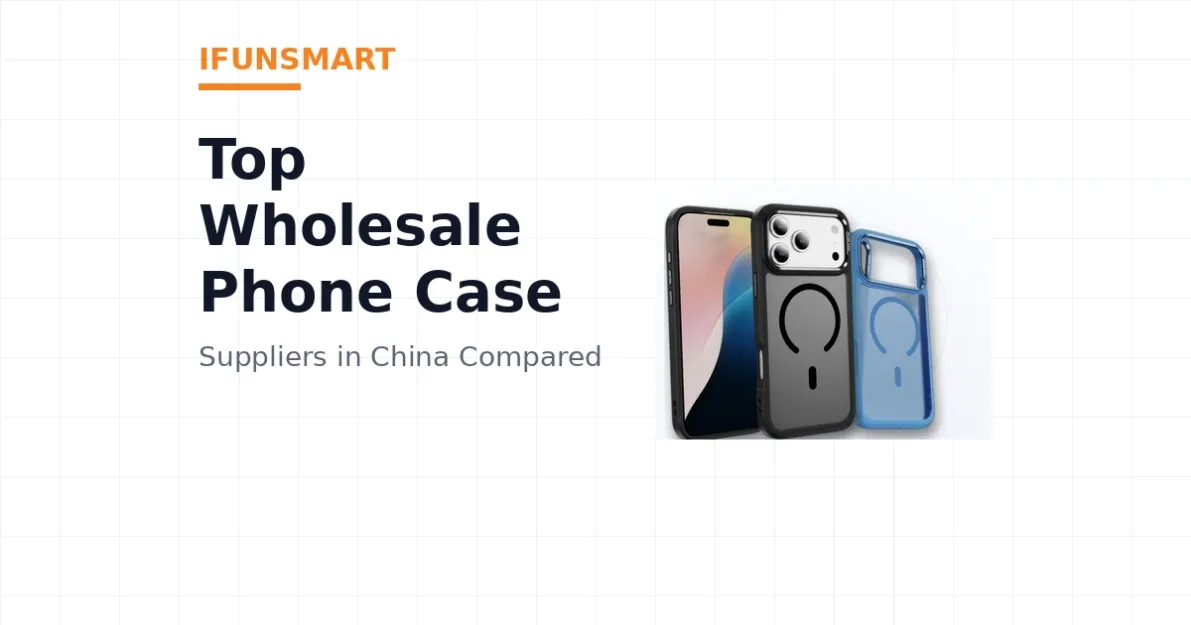
Top Wholesale Phone Case Suppliers in China Compared
How distributors compare wholesale phone case suppliers in China: supplier types, MOQ by product line, mould cover for iPhone 18, custom logo, and the 8 checks before the deposit.
BLUF
There is no official ranking of wholesale phone case suppliers in China, and any "top 10" list is that author's own pick. Compare suppliers on six checks — type, mould cover, MOQ per line, sample, quote lines and payment — and the best one for your order picks itself.
Short answer
A distributor searching "wholesale phone case supplier China" does not need another list of names. A list cannot tell you whether the supplier holds the mould for the model you sell, whether its MOQ fits a 500-piece first order, or whether its quote covers the same spec as the next supplier's. Those three questions decide the order, and they are answered by documents — a mould list, a per-line MOQ and a line-by-line quote — not by a ranking.
This guide gives you the comparison itself. Section 1 explains what "top" and "best" mean when there is no official ranking. Section 2 sorts suppliers into three types — factory, trading company and platform seller — and says which order each type fits. Section 3 gives the MOQ question a real answer, per product line, with a worked example from our own range. Section 4 covers moulds and new models, including iPhone 18. Section 5 covers custom work — logo, colours and packaging. Section 6 turns it into an 8-check comparison you can run on any shortlist before the deposit.
One worked example runs through the whole guide: our own factory, iFunSmart in Guangzhou. It is the only supplier this article describes in detail, because it is the only one whose facts we can prove — in business since 2010, 1000+ designs, 500+ models, 500K+ pieces a month, exported to 30+ countries. Every number attached to it is a number we can show you in writing. Use the same standard on every other supplier you compare: if a claim cannot be shown in writing, it does not count in the comparison.
Our most common MOQ is 50 pcs per colour per model, bulk distributor orders start at 500 pcs per order in total, and samples carry a fee that is refundable on orders of 500+ pcs — ask us to confirm the amount per style in writing. Payment terms are T/T and Western Union only — the full terms are in section 6.
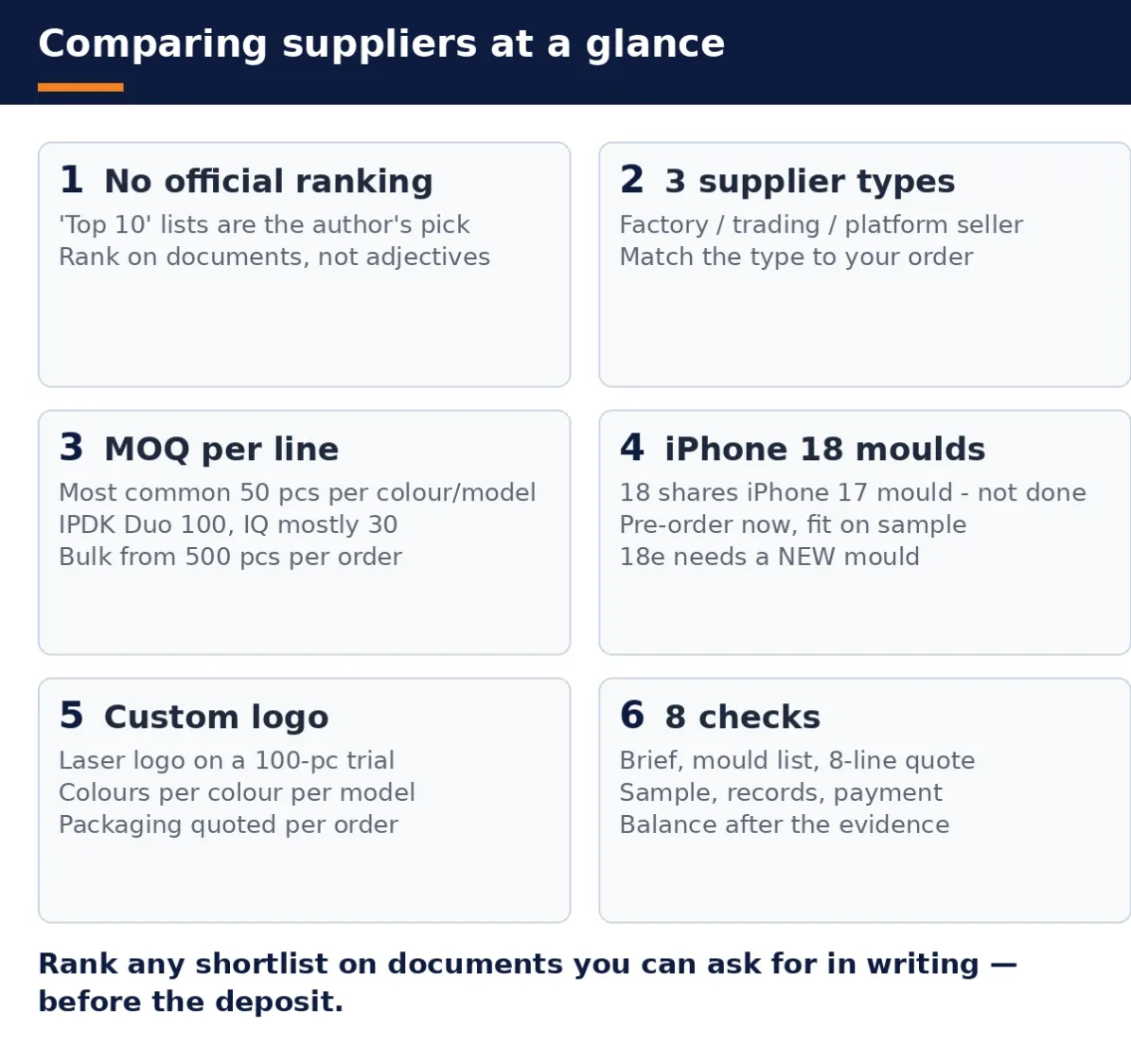
Comparing suppliers at a glance
Check | What to ask for | A pass looks like |
|---|---|---|
Supplier type | Factory, trading company or platform seller — in writing | The type matches your order size and your need for mould control |
Mould cover | Mould list for the models in your brief | Every model in the brief is on the list, gaps named honestly |
MOQ | MOQ per colour per model, per product line | Per-line figures in writing — most common 50, never a single flat number |
New models | iPhone 18 / Air 2 mould and pre-order status | Fit confirmed on a sample before the bulk run |
Custom work | Logo method, colours, packaging — per style | Laser logo on a 100-pc trial; custom packaging quoted per order |
Quote + payment | 8-line quote, T/T and Western Union, 30% deposit | Same spec, same trade term — or no comparison |
1. What does "top phone case suppliers China" actually mean?
"Top phone case suppliers China" is the most searched phrase in this market, and it has no official answer. There is no government ranking, no industry register and no audited league table of phone-case suppliers. Every "top 10" or "top 12" list a buyer finds is one author's own selection — usually a supplier ranking itself first, or a sourcing agent ranking its own partners first. That does not make the lists useless, but it changes how to read them: a list is a starting point for a shortlist, never a verdict.
Read a list the way you would read a catalogue. Ask three questions about it before you trust any name on it. First, who wrote it — a factory, a trading company, a marketplace or an agent — and what does the author gain if you pick the supplier at the top? Second, what was the ranking based on — mould count, export volume, years in business, or nothing stated at all? A list that states no criteria has ranked on nothing. Third, does the list give you anything you can verify — a mould list, a per-line MOQ, a sample policy, a payment sequence — or only adjectives? "Best quality" and "most reliable" are adjectives. A mould list is evidence.
The honest version of "top" is narrower than the search phrase suggests. A supplier is top for your order when it holds the moulds for the models you sell, when its MOQ fits the size of your first order, when its sample proves the spec you quoted, and when its payment sequence puts the balance after the evidence — photos, video and packing list — rather than before it. A supplier that is top for a 50,000-piece Amazon seller may be wrong for a 500-piece distributor trial, and a supplier that is top for clear TPU cases may hold no mould at all for the leather folio your channel sells. "Top" without "for what order" is an empty word.
That is why this guide does not publish a ranking. Ranking other companies would mean stating their MOQs, prices, certifications or volumes — figures we have not verified and have no right to publish. What it does instead is give you the six checks in the table above, so you can rank any shortlist yourself, on documents you can ask for in writing. A supplier that answers all six in writing is a supplier you can compare. A supplier that answers with a catalogue link and a single price has not answered the comparison at all.
The same warning applies to "best wholesale phone case manufacturer China". "Best" is a claim about fit, not a title. The best manufacturer for a distributor is the one whose factory controls the mould, the material and the re-order — because the re-order is where a distributor's margin is made, and only a factory that holds the mould can re-run a style without starting over. Sections 2 and 4 say how to check that, and section 6 turns it into a checklist. If a supplier cannot show you its mould list, its "best" is a slogan, and slogans do not survive the first bulk run.
2. Factory, trading company or platform seller — which type fits your order?
Every wholesale phone case supplier in China is one of three types, and the type decides what it can and cannot do for you. A factory owns its moulds and runs its own production. A trading company buys from factories and adds a margin. A platform seller — a shop on a marketplace — is usually one of the first two, selling through a storefront instead of direct. The type is not a quality grade: a good trading company can be the right choice for a small mixed order, and a bad factory can be the wrong choice for any order. The China phone case factory vs trading company choice is a choice about control — who holds the mould, who sets the material, and who answers when the bulk run differs from the sample.
Supplier type | What it controls | Fits best when | Watch out for |
|---|---|---|---|
Factory (OEM/ODM) | Moulds, materials, printing, assembly, QC | You re-order the same styles; you need a fit confirmed in writing; you want a custom logo or packaging | A factory that claims every model for every style, with no gaps — it has not checked its own moulds |
Trading company | Sourcing across factories; mixed orders | Your first order mixes many styles in small quantities; you need one invoice for several factories' goods | It cannot answer a mould question from its own floor; the margin sits between you and the factory |
Platform seller (marketplace shop) | A storefront; sometimes its own factory behind it | You want a small test buy with platform payment protection; you already know the exact style | The shop name is not the factory name; MOQ and custom work are often limited to listed stock |
A phone case wholesale distributor China buyers find in search results is usually the second type under a different name: a local wholesaler or distributor that buys from factories and sells on, often with stock on hand. That can be useful — stock on hand means a fast first delivery — but it changes the comparison. A distributor sells you its stock; a factory sells you its production. If you need a custom logo, a custom colour or a model the distributor does not stock, the distributor has to go back to a factory anyway, and you are paying for two margins and waiting for two answers. If you need 500 pieces of a listed style tomorrow, the distributor may be the faster route. Ask which one you are dealing with before you compare prices, because a stock price and a production price are prices for two different things.
The three checks that prove which type a supplier is are the same three checks in our factory guide, and they take one email. First, the mould list: ask for the moulds held for the models in your brief, in writing. A factory answers with a list — models, and which styles each model is available in. A trading company answers with a catalogue. Second, the production floor: ask which steps are done in-house — moulding, printing, magnet fitting, assembly, packing — and who runs quality control, at which stages, and what record they keep. Third, the range as evidence: a factory with 1000+ designs and 500+ models, running 500K+ pieces a month since 2010, has a range because it has the moulds. But the range is also where to be careful — a wide catalogue does not prove that the style in your brief is in stock, or that its mould is current. The mould list for the models in your brief is the check; the catalogue is the menu.
One more distinction matters for a distributor, and it is the one buyers forget to ask: who holds the mould when you come back? A factory that holds the mould will still hold it for the second order. A trading company that sourced your first order from a factory it no longer uses may not be able to re-run the same style at all — and the second order is where the margin is made, because the brief is already written and the sample is already approved. Ask, in writing, whether the mould is held for the models in your order, before the deposit. It is a one-line question, and the answer decides whether you have a supplier or a one-off buy.
3. What MOQ will a phone case supplier in China actually ask for?
"Phone case supplier China MOQ" is the second question every buyer asks, and the honest answer is that there is no single MOQ. The MOQ is set per product line, per colour and per model — because a colour change means a machine wash, a colour mix and a re-pack, and a different product line means a different mould, material and process. Any supplier that quotes one flat MOQ for its whole range has not looked at its own lines. Ask for the MOQ per line, per colour, per model, in writing, and read the quote line by line.
The figures below are our own range, stated as fact:
Product line | MOQ per colour per model |
|---|---|
IPDK Duo | 100 pcs |
ISF Samsung | 50 pcs |
IP leather IP001–007 | 50 pcs |
IP leather IP008–018 | 30 pcs |
IQ (mostly) | 30 pcs |
IQ-001 / IQ-002 | 50 pcs |
IPD | 20, 30 or 50 pcs by line |
Our most common MOQ is 50 pcs per colour per model — that is the majority figure, not a universal one. A buyer who reads "most common 50" as "MOQ 50 for everything" will misquote a customer on an IPDK Duo style (100) or over-order an IQ style (30). The per-line table is the quote; the "most common" figure is only a starting point for a budget.
Two consequences follow that buyers often miss. First, colours multiply the order: a brief that lists twelve colours for one model at 50 pcs per colour is already a 600-piece order on that model alone. Decide the colour split before the quote — depth in fewer colours, or breadth across styles — because the MOQ is charged per colour, not per model. Second, the bulk threshold is separate from the MOQ: bulk distributor orders start at 500 pcs per order in total, not per model. A single style in its full colour range can already be a bulk order, and a mixed order across styles reaches 500 pcs the same way. The MOQ says how few you can order of one style in one colour; the 500-piece threshold says where distributor ordering starts. Do not confuse the two, and do not let a supplier confuse them for you.
What a MOQ cannot tell you is the price, and this guide states no price for that reason. A quote shows its price only against a spec — model, material, magnet figure, colours, logo, packaging, trade term — and a price without a spec sheet is a headline, not a quote. If a supplier's MOQ looks low, check the spec behind it: a lower MOQ on a thinner material, a weaker magnet or a polybag instead of a retail box is not a cheaper order. Section 6 gives the eight lines a quote must show before two quotes can be compared at all.
One more MOQ question is worth asking in writing, because it decides the trial: can a small trial order carry your logo? On our range, a 100-piece trial order can already carry a logo by laser engraving — laser is permanent, where silk-screen fades and needs a higher MOQ. Confirm the method for the material in your order, in writing, before the trial. Section 5 covers custom work in full.
4. Can the supplier cover the models you sell — including iPhone 18?
A supplier's mould list is the most honest document it owns. It says which models it can actually make, in which styles, and it says it by omission: the models that are not on the list are the models it cannot make yet. A distributor's first question should therefore not be "what do you have?" but "do you hold the mould for the models in my brief?" — and the answer should come back as a list, in writing, before any price is discussed.
Our mould cover: 500+ models across 1000+ designs, checked per model, not assumed from a series name: a case that fits the iPhone 18 Pro does not fit the iPhone 18 Pro Max, and a brief that names a series instead of a model is a return waiting to happen. Ask for the mould list for the exact models in your brief, and treat a supplier who claims every model for every style as a supplier who has not checked.
New models are where the mould list matters most, and iPhone 18 is the current test. The iPhone 18 Pro Max was announced on 9 September 2026 and went on sale on 18 September 2026, so the demand is real and the mould question is live. Here is our own position, stated plainly because a distributor needs it before quoting a customer:
- iPhone 18: the re-tool shares the iPhone 17 mould. It is NOT done yet. Pre-orders can be placed now, and allocation is held while the fit is confirmed on a sample — the sample confirms the fit before the bulk run.
- iPhone Air 2: the re-tool shares the iPhone Air mould. It is NOT done yet. Pre-orders are open across 5 styles, all MagSafe compatible, with raised camera protection and a shockproof frame.
- iPhone 18e: this model needs a NEW mould, and the factory is still deciding whether to open it. Do not quote a customer a delivery date for iPhone 18e cases until the mould decision is made in writing.
That is the standard to apply to any iPhone 18 case wholesale supplier: does it say, in writing, whether the mould is done, shared with an earlier model, or still to be opened — and does it confirm the fit on a sample before the bulk run? A supplier that promises iPhone 18 delivery without answering the mould question is promising a fit it has not verified. For a distributor, the cost of that promise is a bulk run that does not fit, and a bulk run that does not fit is the most expensive order in the year.
The same check applies to Samsung and the Android breadth. Cover iPhone and Samsung first — they are the two ranges every channel sells — then the Android breadth in the models your channels actually sell, confirmed against the mould list in writing, not assumed from a series name. A distributor who stocks only iPhone is stocking part of the market, and a supplier who can only cover iPhone is a partial supplier for a distributor who sells Android too. Ask for the full list, and keep it with the brief: it is the document the second order is checked against as well.
A buyer searching for a phone case supplier Guangzhou has one practical advantage to weigh, and it is worth stating plainly: Guangzhou is where the moulds, the printing, the magnet fitting and the assembly sit in one supply chain, so a Guangzhou factory can confirm a fit, run a sample and re-run a style without shipping tooling between cities. That is our base — Ifun Electronics Technology Co., Ltd, Guangzhou, making phone cases since 2010 — and it is why the mould list, the sample and the re-order all run through one factory rather than through a chain of intermediaries. It is an advantage of place, not a guarantee: a Guangzhou address does not prove a mould list, and the list is still the check. Ask for it wherever the supplier sits.
5. What can a custom phone case supplier in China actually customise?
"Custom phone case supplier China" covers four different jobs, and a supplier that does one of them well may not do the others at all. The four are: a logo on a stock style, a colour of your choice, your own packaging, and a fully custom design. Ask which of the four you are buying, because the MOQ, the artwork and the sample are different for each.
A logo on a stock style is the smallest custom job, and the one most distributors actually need. The method matters more than the logo itself. Laser engraving is permanent — it marks the material itself — and on our range a 100-piece trial order can already carry a logo by laser engraving. Silk-screen print fades with wear and needs a higher MOQ, so it is the wrong method for a small trial even when it looks cheaper on the quote. Debossing and embossing sit between the two: a pressed mark that survives handling, quoted per style. Confirm the method for the material in your order, in writing, before the trial — a method that works on a matte TPU case may not work the same way on a leather folio, and the sample is where that shows up. Send the artwork as a file, not as a screenshot: the factory needs the artwork to set the position, the size and the method, and a screenshot cannot be engraved.
A colour of your choice is the second job, and it is governed by the MOQ table in section 3. Custom colours are charged per colour per model, because each colour is its own run — so a brief that asks for twelve custom colours is twelve runs, not one. Decide the colour split before the quote, and approve the colour against a physical swatch, not a screen thumbnail: screens lie about colour, swatches do not.
Your own packaging is the third job, and it is the one buyers most often leave until after the deposit. A case in a plain polybag is a different product in the shop from the same case in a printed retail box, with a barcode and a dieline the buyer's channel accepts. Custom packaging is quoted per order — ask for it with the quote, not after it — and agree the box text before the packaging is printed, including any language the buyer's market requires. The packaging guide in this series covers boxes, barcodes and the dieline; the point here is that packaging is part of the custom order, not an afterthought, and a supplier that cannot quote it cannot deliver it.
A fully custom design — your own shape, your own mould — is the fourth job, and it is a different conversation from the first three. It needs a mould decision, a sample cycle and a volume that justifies the tooling, and no figure in this guide states what that volume is, because it depends on the design. If a supplier quotes a custom mould without asking for your drawings, your quantities and your target models, it has not quoted a mould — it has quoted a guess. Ask for the mould question in writing first, and treat the answer as the start of the custom project, not the end of it.
One thing custom work does not change is the sample rule. Order the sample in the exact model, colour and logo method of the planned bulk order: a sample in a different colour proves the fit and the construction, it does not prove the colour; a sample without the logo proves the case, it does not prove the logo method on that material. The approved sample is the production standard, confirmed in writing — and the bulk run is checked against it, not against a photo.
6. How to choose a phone case supplier — the 8 checks before the deposit?
Choosing a supplier is a comparison, and a comparison needs the same evidence from every supplier on the shortlist. The eight checks below are the ones to clear before the deposit is paid, and each one names the document or the written confirmation to ask for. Run them on every supplier you compare — including us — and the best supplier for your order is the one that passes the most checks in writing, not the one with the lowest headline price.
- Write the brief. Model, material, magnet figure, colours, logo method, packaging, quantity — one document, sent identically to every supplier compared. A supplier who answers it line by line is a supplier who can be compared; a supplier who answers with a catalogue link and a single price has not answered the brief.
- Check the supplier type. Factory, trading company or platform seller — and a phone case wholesale distributor in China, where that is what you are dealing with. Match the type to your order: a factory for re-orders and custom work, a trading company or distributor for a small mixed first buy.
- Check the mould list. Moulds held for the exact models in the brief, gaps named honestly — including the iPhone 18, iPhone Air 2 and iPhone 18e positions in section 4. A model with no mould is a model to ask about in writing before quoting a customer.
- Compare quotes on identical specs. Eight lines — model and fit, material and construction, magnet grade and pull figure per style, colours and quantities with the MOQ per colour per model, logo method and position, packaging and whether it is included, trade term, payment terms — or no comparison. A price without a spec sheet is a headline, not a quote.
- Approve a physical sample. Ordered in the exact model, colour and logo method of the bulk order; bench-checked against the brief — fit, parting lines, coating adhesion, magnet pull, hinge friction, carton integrity; confirmed in writing as the production standard. A sample approved by photo is not approved at all. Samples carry a fee that is refundable on orders of 500+ pcs — ask us to confirm the amount per style in writing.
- Ask for the inspection records. Incoming, in-process, final and outgoing — and at minimum the final inspection report with defect grading per SKU and the pre-shipment record with carton photos. A factory that sends a final inspection report is a factory that inspected; a factory that sends a single photo of a case on a table has not sent an inspection record.
- Confirm the payment sequence and the landed cost in writing. Our terms are T/T and Western Union only. New customers may pay a 30% deposit first; after the goods are ready the factory sends photos, a video and the packing list; the customer pays the balance, then the goods ship. Confirm the trade term and the documents with the shipment — packing list, commercial invoice, certificate of origin where the buyer's import needs one — and confirm the duty treatment for your country with your broker.
- Confirm the re-order. The mould is held for the models in the order, the approved sample stays the production standard, and the brief, the quote and the inspection records carry over to the second order. A supplier that holds the mould and keeps the records is a supplier you can re-order from without repeating the whole workflow — and the second order is where the margin is made.
Two honest notes close the comparison. First, the compliance duties sit with the importer, not the factory: phone cases sold in the EU must meet the GPSR traceability and labelling duties, and REACH chemical restrictions apply to the materials — both are restriction and traceability regimes, not certificates, and there is no such thing as "GPSR certification". This article does not claim iFunSmart holds GPSR, REACH or RoHS certifications — we do not. What to ask any factory for is practical: the model and batch marking, the manufacturer details, the safety information for the packaging, and the packaging material data — in writing, with the quote. Second, no comparison in this guide names or ranks another company, because a ranking would need figures we have not verified. The comparison is yours to run, on the eight checks above, and the supplier that passes them in writing is the supplier to order from.
FAQs
Q1: Who are the top phone case suppliers in China?
There is no official government or industry ranking of phone case suppliers in China. Published "top 10" lists are their authors' own selections, so read them as a starting point, not a verdict: check who wrote the list, what criteria it states, and whether it gives you anything verifiable, such as a mould list or a per-line MOQ. Judge a supplier on four verifiable facts instead: mould ownership for the models you sell, a per-line MOQ that fits your first order, a physical sample approved before the bulk run, and transparent payment terms — T/T and Western Union, 30% deposit, balance after the photos, video and packing list. This guide does not rank other companies, because ranking them would mean publishing figures we have not verified.
Q2: What is the MOQ from a phone case supplier in China?
There is no single MOQ — it is set per product line, per colour and per model. On our range the most common MOQ is 50 pcs per colour per model, and it varies by line: IPDK Duo styles are 100, ISF Samsung styles are 50, IP leather IP001–007 are 50 and IP008–018 are 30, IQ styles are mostly 30 (IQ-001/002 are 50), and IPD styles are 20, 30 or 50 by line. Bulk distributor orders start at 500 pcs per order in total. Colours multiply the order — twelve colours at 50 pcs per colour is already a 600-piece order on that model — so decide the colour split before the quote, and confirm the MOQ for the exact style and model in writing.
Q3: Factory or trading company — which should a distributor choose?
A factory, when you re-order the same styles, need a fit confirmed in writing, or want a custom logo or packaging — because the factory holds the mould and controls the re-order. A trading company or a wholesale distributor in China, when your first order mixes many styles in small quantities and you need one invoice — but it cannot answer a mould question from its own floor, and the margin sits between you and the factory. Prove the type with three checks: the mould list for your models, which production steps are done in-house and who runs quality control, and whether the mould is held for your re-order.
Q4: Can I order custom phone cases from China with my logo on a small trial?
Yes — a 100-piece trial order can already carry a logo by laser engraving, which is permanent, where silk-screen fades and needs a higher MOQ. Confirm the method for the material in your order, in writing, before the trial, and send the artwork as a file, not a screenshot. Order the sample in the exact model, colour and logo method of the bulk order, and get written confirmation that the approved sample is the production standard. Samples carry a fee that is refundable on orders of 500+ pcs — ask us to confirm the amount per style in writing. Custom colours are charged per colour per model, and custom packaging is quoted per order — ask for both with the quote.
Q5: Where do I find an iPhone 18 case wholesale supplier in Guangzhou?
Look for a Guangzhou factory that answers the mould question in writing: whether the iPhone 18 re-tool is done, shared with the iPhone 17 mould, or still to be opened — and whether the fit is confirmed on a sample before the bulk run. Our own position: the iPhone 18 re-tool shares the iPhone 17 mould and is NOT done yet — pre-orders can be placed now, with allocation held while the fit is confirmed on a sample; the iPhone Air 2 re-tool shares the iPhone Air mould and is NOT done yet, with pre-orders open across 5 styles; the iPhone 18e needs a NEW mould and the factory is still deciding whether to open it. A supplier that promises iPhone 18 delivery without answering the mould question is promising a fit it has not verified. Guangzhou matters because the moulds, printing, magnet fitting and assembly sit in one supply chain — but a Guangzhou address does not prove a mould list, and the list is still the check.
About iFunSmart
iFunSmart — Ifun Electronics Technology Co., Ltd, Guangzhou, China — has made phone cases since 2010: 1000+ designs, 500+ models, 500K+ pieces a month, exported to 30+ countries. We reply within 24 hours. Send your brief — model, material, colours, logo and quantity — and we will quote it line by line, send a sample (fee refundable on orders of 500+ pcs), and confirm the fit, the MOQ and the inspection records in writing before your deposit.
WhatsApp: +86 13632248734 — https://wa.me/8613632248734 — or email contact@ifunsmart.com — or visit www.ifunsmart.com.
Read more
- Factory or Trading Company? How to Tell Before You Order Phone Cases — https://www.ifunsmart.com/posts/phone-case-factory-vs-trading-company
- What Distributors Look for in a Phone Case Supplier — https://www.ifunsmart.com/posts/phone-case-supplier-for-distributors
- How to Source Phone Cases from China: First-Order Checks — https://www.ifunsmart.com/posts/how-to-source-phone-cases-from-china-first-order-checks
- Bulk Phone Case Orders: How Volume Changes the Order — https://www.ifunsmart.com/posts/bulk-phone-case-orders-volume-guide
- How to Read a Phone Case Quotation — https://www.ifunsmart.com/posts/phone-case-quotation-guide
- Phone Case Sampling: How to Evaluate a Sample Before a Bulk Order — https://www.ifunsmart.com/posts/phone-case-sampling-how-to-evaluate-a-sample-before-bulk
- Phone Case Payment Terms: What a First Order Looks Like — https://www.ifunsmart.com/posts/phone-case-payment-terms-first-order
- Importing Phone Cases: Documents & Checks First — https://www.ifunsmart.com/posts/importing-phone-cases-documents-checklist