Business Solutions
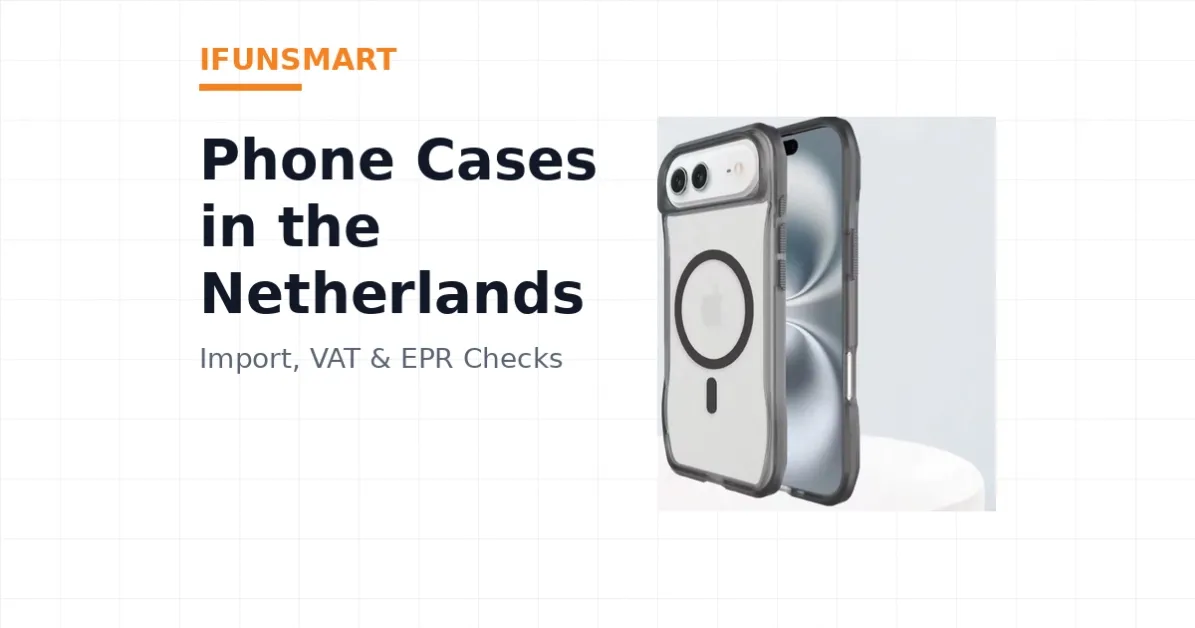
Phone Cases in the Netherlands: Import, VAT & EPR Checks
Netherlands import guide for phone-case distributors: 21% BTW, around 6.5% duty, the €150 exemption gone, Verpact packaging EPR and the Article 23 VAT deferral — confirm each figure with your broker.
BLUF
A phone case shipment into the Netherlands pays 21% BTW and around 6.5% duty on the CIF value, plus Verpact packaging EPR if you place more than 50,000 kg of packaging a year. Plain cases are generally outside WEEE; battery cases are inside. The €150 exemption ended 1 July 2026.
Short answer
The Netherlands is the distribution hub of the European Union — Rotterdam is Europe's largest port, and a bulk shipment landed there can reach the whole EU market by barge, rail and road. It is the fifth country guide in this series after Germany, France, Italy and Spain — because the EU rules are the same in all 27 Member States, and the Netherlands-specific rules are the ones that catch a first order out. The duty is the common EU tariff, the GPSR applies directly, and the €150 exemption ended on the same day in Rotterdam as in Berlin. What is the Netherlands' own is the 21% BTW rate, the Article 23 VAT deferral that removes the cash outlay at the border, the Verpact packaging EPR with its 50,000 kg threshold, and the fact that there is no Dutch-only labelling law for phone cases — Dutch on the pack is the safe choice, not a statutory one.
A distributor importing phone cases into the Netherlands for the first time needs four things settled before the goods ship:
- Landed cost — duty plus BTW on the CIF value, with the duty confirmed by a broker, and the Article 23 deferral applied for if the business imports regularly.
- Packaging — Verpact registration and declaration if the threshold is crossed, plus the PPWR Declaration of Conformity the importer must hold.
- Product rules — plain cases are generally outside WEEE and need no CE mark; battery and electronic cases are inside both.
- Labelling — manufacturer and importer details, the EU responsible person named, and safety information in a language Dutch consumers understand.
None of those four is a reason not to order. Each of them is a reason to agree who does what, in writing, before the deposit — because the cost of fixing a registration after the goods have landed is always higher than the cost of registering before they ship.
Our most common MOQ is 50 pcs per colour per model, bulk distributor orders start at 500 pcs per order in total, and samples carry a fee that is refundable on orders of 500+ pcs — ask us to confirm the amount per style in writing. Payment terms are T/T and Western Union only — the full terms are in section 6.
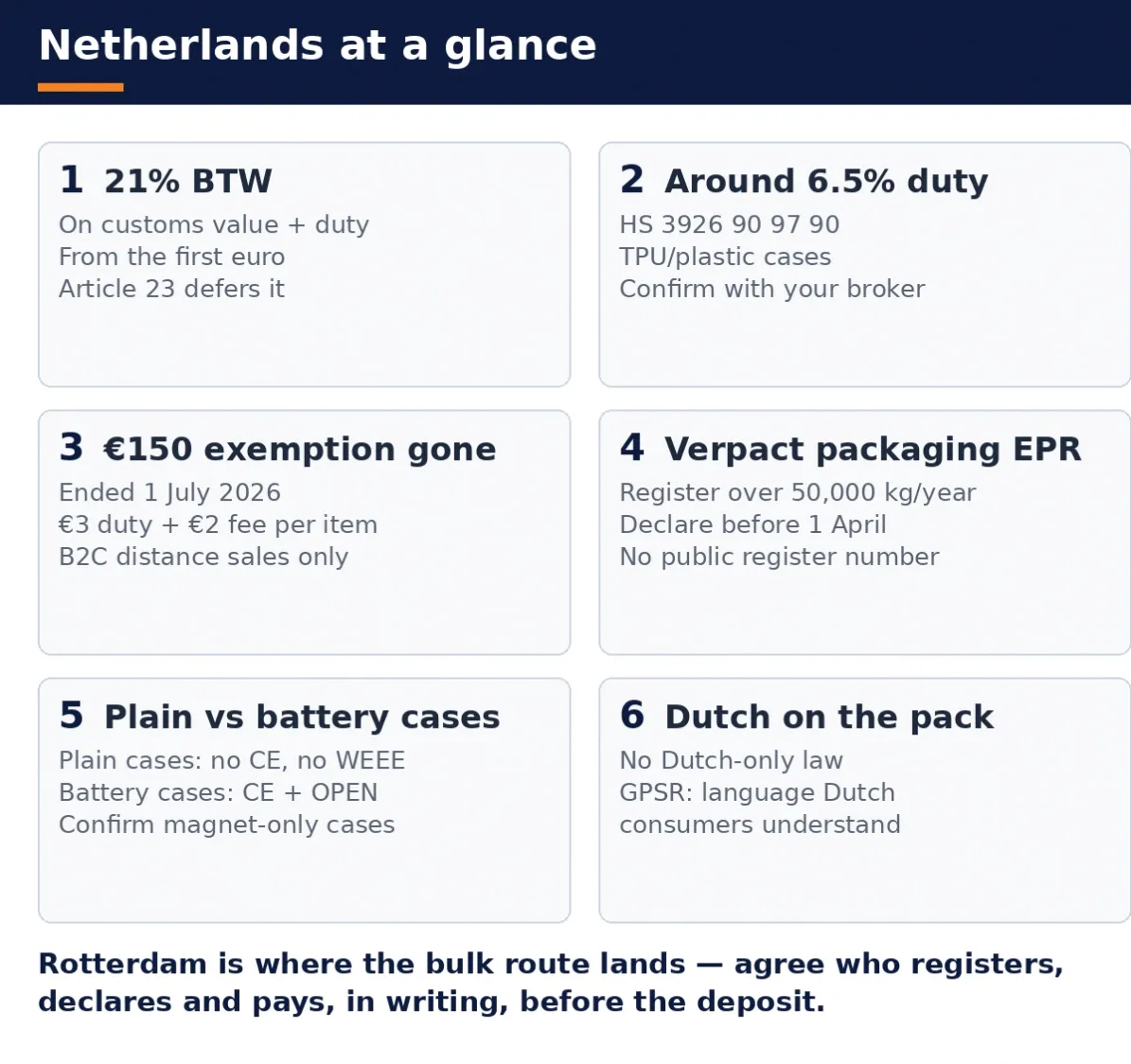
Netherlands at a glance
Item | What applies in the Netherlands | What to do |
|---|---|---|
Import BTW | 21% on customs value + duty + costs to destination, from the first euro | Apply for an Article 23 licence if you import regularly — it defers the BTW to your VAT return |
Duty | Around 6.5% on HS 3926 90 97 90 (TPU/plastic cases) | Confirm with your broker — the figure is from a TARIC mirror, not the official TARIC database |
€150 exemption | Abolished 1 July 2026; €3 flat duty per item to 1 July 2028; €2 handling fee per item from 1 November 2026 — B2C distance sales only | Bulk B2B was never covered — import in bulk to a Dutch warehouse, not in sub-€150 parcels |
Packaging EPR | Besluit beheer verpakkingen 2014 — Verpact; register + declare if over 50,000 kg/year | Agree in writing who registers and who pays; hold the PPWR Declaration of Conformity |
WEEE | Plain cases generally out of scope; battery/electronic cases in scope via Stichting OPEN | Confirm borderline products with your scheme |
Labelling | No Dutch-only law for phone cases; GPSR safety information in a language Dutch consumers understand | Put Dutch on the pack, with the importer details and the EU responsible person |
EORI | Free; Dutch companies compose "NL + RSIN" (9 digits); declarations in DMS | Have the EORI ready before the goods arrive |
1. What does a Dutch importer actually pay on a phone case shipment?
The landed cost of a phone case shipment into the Netherlands has three layers, and only one of them is the price on the quote. The first layer is the customs duty. The second is the import BTW. The third is the packaging cost — the Verpact contribution, which is not on the customs declaration in the same way, but is still a cost of putting the product on the Dutch market. A buyer who compares two suppliers on the unit price alone is comparing the smallest layer and ignoring the other two.
The duty comes first, because the BTW is charged on the value including the duty:
- Plain TPU or plastic cases (HS 3926 90 97 90) — "other articles of plastics, other", a classification confirmed by a UK advance tariff ruling for a clear TPU smartphone case. The most-favoured-nation duty rate for that code is around 6.5% on the customs (CIF) value, and no anti-dumping duty is shown for China on this code. The word "around" matters: the 6.5% figure comes from a TARIC mirror, not from the official TARIC database itself, so confirm it with your customs broker rather than treating it as a broker-confirmed rate.
- Leather and battery or electronic cases — leather cases classify differently, under Chapter 42, and battery or electronic cases may classify under Chapter 85. Their duty rates are not researched here, so ask the broker for those too, per model, before quoting a customer.
- No preferential rate — there is no EU–China free-trade agreement, so no preferential rate applies to goods of Chinese origin on this code.
The BTW comes second. The Netherlands' standard BTW rate is 21%, and phone cases fall under it — the reduced 9% rate (food, books, medicines) does not apply to them. Import BTW is charged on the customs value plus the duty plus other import taxes plus the incidental costs up to the place of destination, and it applies from the first euro — the €22 VAT exemption on low-value imports was abolished EU-wide on 1 July 2021, so there is no low-value BTW relief left to claim. An example, using the verified rates only: a shipment with a CIF value of €10,000 pays duty of around €650 at 6.5%, giving a VAT base of €10,650, and import BTW of €2,236.50 at 21%. The €10,000 is an example, not a real shipment — the arithmetic is the point: the BTW is charged on the value including the duty, so the duty and the BTW are not two separate costs on the same base, they stack. For a fully deductible business, import BTW paid at the border is a cash-flow question, not a cost — it can be deducted as input tax, provided the goods are imported under the importer's own name.
The third question is when the BTW is paid — and here the Netherlands has a genuine advantage over most EU states. Normally it is paid in cash to customs at clearance, together with the duty. A business established in the Netherlands that imports regularly may instead hold a "Vergunning artikel 23" — an Article 23 licence — under which the import BTW is not paid at customs at all: it is declared in the importer's periodic Dutch VAT return and deducted as input tax in the same return, netting to zero for a fully deductible business, so no cash leaves the account at the border. The conditions are that the business is established in the Netherlands, imports regularly from outside the EU, and keeps a separate administration clearly showing the import BTW owed per import. The Belastingdienst decides on the application within eight weeks, so apply well before the goods arrive. Two limits matter: the licence covers BTW only — customs duty is still payable at import — and a business in the small-entrepreneurs scheme (KOR) cannot hold one. A non-EU business cannot apply itself; it must engage a Dutch fiscal representative, who applies for the permit on its behalf and declares and deducts the VAT on its own return. Without a representative, import BTW must be paid at customs on the import declaration.
Two more facts belong in this section because they are the ones a first-time importer gets wrong. First, the paperwork: any company carrying out customs activities in the EU needs an EORI number. It is free. A company established in the Netherlands that files its own declarations can compose its own EORI number — "NL" plus its RSIN padded with zeros to nine digits — and use it immediately; customs checks and registers it automatically on first use. Companies using an agent, filing abroad, or sole proprietorships must apply via the Dutch Customs National Helpdesk, and companies headquartered outside the EU apply on the form for non-EU companies. Dutch Customs decides on an application within five working days, though non-EU applications can take longer. Declarations are filed electronically in DMS, the Declaration Management System, which replaced AGS in 2024 — a business can declare itself with DMS-compatible software or use a customs agent. Second, the distance-selling rule: the EU-wide €10,000 per year distance-selling threshold applies, and stock held in a Dutch warehouse makes the sale a domestic Dutch sale — the One-Stop Shop does not cover it, and a Dutch VAT number is needed. A distributor who holds stock in Rotterdam should ask its tax adviser about Dutch VAT registration before the first domestic sale.
2. The €150 exemption is gone — what changed on 1 July 2026?
Until 30 June 2026, a low-value consignment — intrinsic value of €150 or less — sent directly from a third country to an EU consignee entered duty-free. From 1 July 2026 it does not. Council Regulation (EU) 2026/382, adopted on 11 February 2026, deleted the exemption from Regulation (EC) No 1186/2009. Because it is a Council Regulation, it applies directly in every Member State, including the Netherlands — no Dutch transposition law was needed, and no Netherlands-specific extra rule was found. The change is an EU change that happens to apply in Rotterdam as in Berlin, not a Dutch change.
Two charges replaced the exemption. From 1 July 2026 to 1 July 2028, goods sold at a distance to EU customers pay a flat €3 customs duty per item — per declaration line, under the Commission's guidance. This is a customs duty in its own right under the Union Customs Code, not a fee. From 1 November 2026, a permanent, non-refundable €2 Union handling fee per item applies to every distance sale imported into the EU, whatever its value — including parcels over €150 — and it is not refunded if the goods are returned. The €45 relief for private-to-private consignments survives, and the IOSS VAT scheme cap stays at €150 — IOSS still only covers goods of €150 or less, so the duty threshold and the VAT threshold no longer coincide.
For a wholesale buyer, the practical effect is narrower than the headlines suggest — and that is the point worth stating plainly. The €3 duty and the €2 fee apply to distance sales of imported goods — B2C sales to an end consumer. They do not apply to B2B imports to VAT-registered recipients, which pay the standard TARIC duty rate instead. A B2B commercial shipment, such as a distributor importing 500 or more cases from China, was never covered by the €150 relief in the first place: it always paid the normal TARIC duty on the full customs value. The abolition changes three things for a distributor, and none of them is the duty on the bulk shipment itself. First, a bulk order can no longer be split into sub-€150 direct-to-consumer parcels to avoid duty. Second, any direct-to-consumer dropshipping from China now carries €3 duty plus €2 fee per item. Third, bulk import into an EU warehouse and onward domestic fulfilment is now relatively more attractive — low-value parcel volumes fell by more than 60% against the pre-duty trend in the third quarter of 2026 as sellers switched to bulk EU warehousing. For context, 4.6 billion low-value e-commerce consignments entered the EU in 2024, 91% of them from China, and 5.9 billion low-value items in 2025, more than 90% from China. The lesson for a distributor is structural: the cheap route was the parcel route, and the parcel route is closed. The bulk route — one shipment, one declaration, one warehouse — is now the route the rules favour, and it is the route a distributor already uses. Rotterdam, Europe's largest port at 428.4 million tonnes and 14.2 million TEU in 2025, is where that bulk route lands.
3. Packaging: Verpact EPR and the PPWR Declaration of Conformity
The Netherlands has one packaging EPR system and one new EU packaging regulation, and they are constantly confused because they share a subject and a date. The first is the extended producer responsibility (EPR) scheme under the Besluit beheer verpakkingen 2014 (Packaging Management Decree 2014). The second is the EU Packaging and Packaging Waste Regulation (EU) 2025/40 (PPWR), which generally applies from 12 August 2026. One is a registration, declaration and contribution duty; the other is a conformity duty on the packaging itself. A distributor needs both settled, and needs to know which one it owes, because the party who owes each one can be different.
The EPR duty falls on the "producer" — the business that first places packaged goods on the Dutch market: manufacturer or brand owner, importer, or first distributor. Since 1 January 2023 the obligation sits with the brand owner (the private-label holder), not the contract manufacturer; if the brand owner is not established in the Netherlands, the obligation falls on the importer established in the Netherlands. A Chinese factory shipping directly to Dutch consumers is itself the producer. The single producer responsibility organisation is Verpact — named Afvalfonds Verpakkingen until 2024 — which collects the packaging waste-management contribution under the Afvalbeheerbijdrageovereenkomst Verpakkingen 2023–2027.
The threshold is what most first-time importers get wrong. A producer or importer placing more than 50,000 kg of packaging on the Dutch market in a calendar year must register with Verpact, keep a packaging administration, submit a contribution declaration by material and weight before 1 April of the following year, and pay the contribution. Below 50,000 kg no declaration or contribution is due — but the business must be able to show its calculation that it stays under the threshold. Two categories have no threshold at all: single-use plastic packaging and deposit packaging (beverage cans and bottles) must be declared and registered from the first item, regardless of weight. Producers above the threshold must also file a separate statutory annual report under Article 8 of the Decree before 1 August, on prevention and recycling measures. Unlike Germany's LUCID, Verpact keeps no public producer register — marketplaces verify packaging compliance from a confirmation, certificate or invoice, not a public number. The per-kilogram contribution tariffs were not verified for this article, so no rate is stated here — ask Verpact or your adviser for the current tariff by material.
The PPWR layer sits on top of that. Because it is a Regulation, it applies directly in the Netherlands with no transposition needed. From 12 August 2026, manufacturers of packaging (and of packaged products) must assess their packaging against the Regulation's phased requirements, keep a Technical File, and draw up a Declaration of Conformity. EU importers must obtain and hold a copy of the manufacturer's Declaration of Conformity and make the technical documentation available to market-surveillance authorities on request. Anyone who has packaging made under their own name or trademark counts as the manufacturer, even if a third party physically makes it. Substances of concern must be minimised, with a combined heavy-metals limit of 100 mg/kg (lead, cadmium, mercury and hexavalent chromium), and identification information — manufacturer or importer name, trademark and contact details, plus a type, batch or serial number or similar identifier — must be marked on, or accompany, the packaging. Non-compliant packaging cannot legally be placed on the EU market after 12 August 2026. Later requirements are phased in from 2028 to 2030 — recyclability, minimum recycled content in plastic packaging, packaging minimisation, harmonised sorting labels — and are not presented here as already in force. The Dutch PPWR producer register is not yet open; it is to be run by Rijkswaterstaat, with registration expected from 2028.
The practical question for a distributor is who the producer is on its order. If the Dutch importer or distributor is the one first placing the packaged cases on the Dutch market, the EPR duty normally sits with them — or with the factory's Dutch authorised representative if the factory sells direct. A company without a Dutch establishment selling online directly to Dutch consumers is also caught by the Dutch rules, and under PPWR must appoint an authorised representative in the Netherlands. The article does not promise the factory handles it. Agree in writing who registers, who declares, who pays the contribution, and who holds the PPWR Declaration of Conformity — and ask the factory for the Declaration of Conformity and the packaging material data with the quote, because the importer is the party that must hold them.
- WEEE and GPSR: what a plain case is, and what a battery case is
A plain phone case and a battery case are different products under Dutch and EU law, and the difference decides two whole sets of duties. A plain case — TPU, PC, liquid silicone or leather, with no electronics — is a general consumer product. A case with a built-in battery, LEDs, charging, NFC or a speaker is electrical and electronic equipment. The article keeps the two apart, because a distributor who treats them as one product will either over-register or under-register, and both mistakes cost money.
WEEE is governed in the Netherlands by the Regeling AEEA, which transposes the WEEE Directive 2012/19/EU. It sets producer registration, collection and treatment duties for electrical and electronic equipment. A plain phone case is generally not in scope: WEEE covers equipment dependent on electric currents or electromagnetic fields, and a passive plastic or leather case is not that. Since 15 August 2018 the Dutch scope is "open" — any product with an electrical function, unless excepted — but a passive case has no electrical function. So no WEEE producer registration and no WEEE take-back duty arises for the case itself. The word "generally" is deliberate — it is the consistent position of the compliance guides checked, and it follows from the WEEE definition of EEE, but it was not verified against a Dutch court or authority ruling, so a buyer with a borderline product should confirm with its scheme. The borderline product to watch is a case with a passive MagSafe magnet ring only: a magnet is not electronics, but confirm it rather than assuming it.
A battery or electronic case is in scope. Once a case contains a battery or electronic components it counts as EEE, and the producer or importer duties apply: registration, WEEE take-back financing, the crossed-out wheeled-bin marking, and the EU Batteries Regulation (EU) 2023/1542 for the battery itself, with CE marking, the bin symbol and labelling. In the Netherlands any business that is the first to place EEE on the Dutch market must join Stichting OPEN, the collective producer responsibility organisation for e-waste; affiliation with Stichting OPEN automatically registers the producer in the Nationaal (W)EEE Register. Batteries are registered through the same organisation — the former Stibat battery scheme merged into Stichting OPEN on 1 January 2024. A Dutch reseller buying stock from a Dutch supplier that already fulfilled the duties does not carry the primary registration for those units. Sellers of EEE in the Netherlands must also offer free take-back of a similar old device when a new one is sold — the 1:1 take-back rule. A distributor ordering battery cases should ask, in writing, who holds the Stichting OPEN registration and who finances the take-back, before the first order — the same written-agreement rule as the packaging EPR in section 3.
The GPSR — the General Product Safety Regulation, Regulation (EU) 2023/988 — is the other framework, and it applies to both kinds of case. It has been fully applicable since 13 December 2024, replacing the General Product Safety Directive, and because it is a Regulation it applies directly in the Netherlands with no transposition needed. It covers all non-food consumer products sold to EU consumers, including online and marketplace sales. Its duties are traceability and labelling, not certification: the product must carry a type, batch or serial number or other identifier, easily visible and legible; the manufacturer's name, trade name or trademark, postal address and electronic address must appear on the product, packaging or an accompanying document; the importer must add its own name and contact details on the product or packaging; and there must be an economic operator established in the EU responsible for the product — the manufacturer in the EU, the importer, an authorised representative or a fulfilment service provider — whose name and address must appear on the product, packaging, parcel or accompanying document and in the online listing. Safety information and warnings must be in a language the member state of sale determines. Technical documentation and risk assessment are kept for 10 years. Enforcement in the Netherlands sits with the NVWA, the Netherlands Food and Consumer Product Safety Authority, under the Commodities Act (Warenwet).
The GPSR point that matters most for a distributor is the one the article states plainly: the GPSR is a safety and traceability framework, not a certification. There is no such thing as "GPSR certification", and this article does not claim iFunSmart holds one — we do not. The correct phrasing is that phone cases sold in the Netherlands must meet the GPSR traceability and labelling duties, and the importer is the responsible operator. What to ask the factory for is practical: the model and batch marking, the manufacturer details and the safety information to put on the packaging, in Dutch. Ask for those in writing with the quote, and the labelling is settled before the goods ship instead of after they arrive.
5. Labelling: Dutch is the safe choice, and no CE mark on a plain case
Dutch labelling rules have one feature that surprises first-time importers: there is no Netherlands-specific law requiring Dutch on a plain phone case's packaging. The strict Dutch-language labelling rule that is often quoted applies to food — Regulation (EU) No 1169/2011 and the Dutch Food Information Commodities Decree require food information in Dutch. That rule does not extend to phone cases. What the GPSR does require for non-food products is instructions and safety information in a language the member state of sale determines — in practice, in a language Dutch consumers understand. The NVWA's guidance asks for clear instructions and safety information in a language Dutch consumers understand; it does not name Dutch as the only possible language, but Dutch is the safe choice for warnings and instructions. Recall notices must state in Dutch where consumers can get more details. The safe wording for a distributor is therefore simple: put Dutch on the pack or in the leaflet, and keep English as well. The manufacturer and importer name and address and the responsible person's details must be on the product, packaging or an accompanying document.
The CE mark is where a first-time importer most often over-labels. A plain TPU, PC, silicone or leather phone case needs no CE mark: no EU directive covers it, because the Machinery, EMC, LVD and RoHS directives all require drive, electronics or voltage that a passive case does not have. Putting a CE mark on a plain case is a wrong mark, not extra safety — the Commission states CE marking is forbidden on products where no EU requirement exists, and it tells a buyer the product was assessed against directives that do not apply to it. A case with a battery, LEDs, charging, NFC or a speaker is different: it is EEE or radio equipment, CE marking is required, with an EU Declaration of Conformity covering the applicable directives (RoHS, EMC, RED where radio is involved, LVD where voltage thresholds are met) and, for the battery, the Batteries Regulation (EU) 2023/1542 with CE marking, the crossed-out bin symbol and label information. One edge case to watch: a phone case marketed as a toy for children falls under the Toy Safety Directive and needs CE marking.
REACH applies to all cases, plain and electronic, but it is a restriction regime, not a mark: chemical restrictions under REACH Annex XVII and SVHC duties apply to the materials — watch PAHs in soft plastics and rubber, and phthalates in soft PVC and TPU. Do not present "REACH compliant" as a certificate, and do not claim iFunSmart holds a REACH certification — we do not.
The trade advice on Dutch labelling is blunt and worth repeating: ask the Dutch importer what the label must say, in writing, before the packaging is printed, not after it is packed. The importer is the party the NVWA will look to, and the importer is the party who knows what its own channels require — bol.com, Amazon.nl and Coolblue each check the listing information before the product goes live.
6. What to stock for the Netherlands — and the first-order checklist
The Netherlands' phone market is an Android-majority market, and that decides the first order. StatCounter's January to September 2026 figures for the Netherlands — mobile web-traffic shares, not unit sales — put iOS at 35.9% and Android at 63.9%. No Netherlands-specific Apple versus Samsung brand split was retrievable, so none is stated here; the closest verified figures are Europe-wide shipments in the third quarter of 2026, with Samsung at 35% and Apple at 31% of European smartphone shipments — labelled as Europe, not the Netherlands. The stocking conclusion is simple: cover iPhone and Samsung first, then the Android breadth — Xiaomi, Oppo and the rest — in the models your channels actually sell, confirmed against the mould list in writing, not assumed from a series name. A distributor who stocks only iPhone in the Netherlands is stocking about a third of the in-use base.
The channels follow the same pattern. Bol.com is by far the largest online store in the Netherlands — €5.81 billion GMV in 2025, ahead of Amazon.nl at €3.31 billion, AliExpress at €1.81 billion and Coolblue at €1.74 billion. Amazon.nl has operated as a full Dutch marketplace since March 2020, with about 6.4 million monthly users in the Netherlands in the second half of 2025 — roughly half the Dutch population. Total Dutch online spending was €35.7 billion in 2025, and China's share of Dutch cross-border online purchases rose from 28% to 31% in 2025. No Netherlands-specific phone-case sell-through figures were found, so none are stated here — the channel list is the verified fact, and the sell-through is the buyer's own data to gather. Rotterdam is the other half of the channel story: at 428.4 million tonnes and 14.2 million TEU in 2025 it is Europe's largest port, the main deep-sea gateway for Asia–Europe container traffic, with onward Rhine barge, Betuwe rail and road links — which is why a distributor can hold stock in the Netherlands and serve the whole EU market from one warehouse.
The first order for the Netherlands, then, is a normal distributor order with four Netherlands-specific checks added to it. The checklist below is the one to clear before the deposit is paid, and each item names the document or the written confirmation to ask for.
- Confirm the landed cost with your broker. Duty at around 6.5% on HS 3926 90 97 90 for TPU and plastic cases (confirm the figure and the classification per model — leather and battery cases classify differently), plus 21% BTW on the customs value including the duty. Ask whether an Article 23 licence is worth applying for, and confirm the EORI and the DMS declaration are ready.
- Agree the packaging obligations in writing. Who registers with Verpact, who files the annual packaging declaration, who pays the contribution — and who holds the PPWR Declaration of Conformity, and what the packaging weighs per piece so the declaration can be made.
- Sort the product rules by case type. Plain cases are generally outside WEEE and need no CE mark; battery and electronic cases are inside Stichting OPEN, need CE marking and a Declaration of Conformity, and fall under the Batteries Regulation. Confirm a magnet-only case with your scheme.
- Settle the labelling before the packaging is printed. Dutch on every pack, the manufacturer's details and the product identifier, the importer's own details, and the EU responsible person named — all in the online listing before purchase.
- Stock the Android majority. iPhone and Samsung first, then the Android breadth — in the models your channels actually sell, confirmed against the mould list in writing, not assumed from a series name.
- Run the normal first-order checks. A written brief, a factory check against the mould list, a like-for-like quote comparison, a physical sample approved in writing as the production standard, and the pre-shipment checks — the workflow in our sourcing guide. The Netherlands checks above sit on top of that workflow; they do not replace it.
- Confirm the payment sequence in writing. T/T and Western Union only; 30% deposit for new customers; photos, video and packing list after the goods are ready; balance, then ship.
- Confirm the re-order. The mould is held for the models in the order, the approved sample stays the production standard, and the brief, the quote and the inspection records carry over to the second order.
FAQs
Q1: What is the import duty on phone cases in the Netherlands?
Around 6.5% on the CIF value for a plain TPU or plastic case under HS 3926 90 97 90, with no anti-dumping duty shown for China on that code — but confirm the figure and the classification with your customs broker before quoting a customer, because the 6.5% comes from a TARIC mirror, not the official TARIC database. Leather cases classify under Chapter 42 and battery or electronic cases may classify under Chapter 85, with different rates. Import BTW of 21% is then charged on the customs value including the duty, from the first euro.
Q2: What is the Article 23 licence, and should I apply for one?
The Article 23 licence (Vergunning artikel 23) lets a business established in the Netherlands that imports regularly defer import BTW to its periodic VAT return, where it is declared and deducted in the same return — netting to zero for a fully deductible business, so no cash leaves the account at the border. The Belastingdienst decides within eight weeks, so apply well before the goods arrive. It covers BTW only — customs duty is still payable at import. A non-EU business cannot apply itself; it needs a Dutch fiscal representative. A business in the small-entrepreneurs scheme (KOR) cannot hold one.
Q3: Do I need to register for packaging EPR to sell phone cases in the Netherlands?
If you are the company first placing the packaged cases on the Dutch market, and you place more than 50,000 kg of packaging a year, yes — register with Verpact, keep a packaging administration, and submit the contribution declaration by material and weight before 1 April of the following year, plus the statutory annual report before 1 August. Below 50,000 kg no declaration or contribution is due, but you must be able to show your calculation. Single-use plastic packaging and deposit packaging must be declared from the first item. Since 1 January 2023 the obligation sits with the brand owner, or with the importer if the brand owner is not established in the Netherlands. Agree in writing who registers and who pays — do not assume the factory has handled it. Verpact keeps no public producer register, unlike Germany's LUCID.
Q4: Do phone cases need a CE mark or WEEE registration in the Netherlands?
A plain TPU, PC, silicone or leather case needs no CE mark and is generally outside WEEE — no CE directive covers a passive case, and putting a CE mark on one is a wrong mark, not extra safety. A case with a battery, LEDs, charging, NFC or a speaker is electrical equipment: it needs CE marking with a Declaration of Conformity, registration via Stichting OPEN (which auto-registers the producer in the Nationaal (W)EEE Register), and the battery falls under the Batteries Regulation (EU) 2023/1542. A case with only a passive MagSafe magnet ring is a borderline product — confirm it with your scheme. All cases fall under the GPSR traceability and labelling duties and under REACH chemical restrictions, which are restriction regimes, not certificates.
Q5: What phone cases should I stock first for the Dutch market?
Cover iPhone and Samsung first, then the Android breadth — StatCounter's January to September 2026 figures for the Netherlands put iOS at 35.9% and Android at 63.9% of mobile web traffic, measured as page views, not sales. Sell through bol.com, the largest Dutch online store, plus Amazon.nl and Coolblue. Order in bulk to a Dutch warehouse: the €150 duty exemption ended on 1 July 2026, so sub-€150 direct-to-consumer parcels from China now carry €3 duty plus a €2 handling fee per item, while a bulk B2B shipment pays the normal duty on the full customs value — and Rotterdam, Europe's largest port, is where that bulk route lands. Our most common MOQ is 50 pcs per colour per model and bulk distributor orders start at 500 pcs per order in total — ask us for a quote on your brief.
About iFunSmart
iFunSmart — Ifun Electronics Technology Co., Ltd, Guangzhou, China — has made phone cases since 2010: 1000+ designs, 500+ models, 500K+ pieces a month, exported to 30+ countries. We reply within 24 hours. Send your brief — model, material, colours, logo and quantity — and we will quote it line by line, send a sample (fee refundable on orders of 500+ pcs), and confirm the fit, the MOQ and the inspection records in writing before your deposit.
Read more
- Selling Phone Cases in the EU: GPSR, REACH & RoHS Documents — https://www.ifunsmart.com/posts/selling-phone-cases-eu-2026-gpsr-reach-rohs-documents
- Phone Cases in Germany: VerpackDG, WEEE & Import Checks — https://www.ifunsmart.com/posts/phone-cases-in-germany-verpackdg-weee-import-checks
- Phone Cases in France: Import, VAT & EPR Checks — https://www.ifunsmart.com/posts/phone-cases-in-france-import-vat-epr-checks
- Phone Cases in Italy: Import, VAT & EPR Checks — https://www.ifunsmart.com/posts/phone-cases-in-italy-import-vat-epr-checks
- Phone Cases in Spain: Import, VAT & EPR Checks — https://www.ifunsmart.com/posts/phone-cases-in-spain-import-vat-epr-checks
- Selling Phone Cases in the UK: UKCA, VAT & Import Checks — https://www.ifunsmart.com/posts/phone-cases-uk-ukca-vat-import-guide
- Importing Phone Cases: Documents & Checks First — https://www.ifunsmart.com/posts/importing-phone-cases-documents-checklist
- Freight and DDP Explained: Air vs Sea for Phone Case Orders — https://www.ifunsmart.com/posts/phone-case-freight-ddp-air-vs-sea
- Phone Case Payment Terms: What a First Order Looks Like — https://www.ifunsmart.com/posts/phone-case-payment-terms-first-order