Business Solutions
Custom iPhone 18 Pro Cases: Same Shell as the 17 Pro?
The iPhone 18 Pro shares the 17 Pro's footprint — 150.0 x 71.9 x 8.75 mm — but the same shell is not the same case. What to check, what to order first, and how the pre-order works.
BLUF
The iPhone 18 Pro shares the 17 Pro's footprint — 150.0 x 71.9 x 8.75 mm — but the same shell is not the same case. Our re-tool shares the 17 Pro mould and is not finished yet: pre-order now to hold allocation, and confirm the fit on a sample.
Short answer
Apple published the same three dimensions for the iPhone 18 Pro as for the iPhone 17 Pro: 150.0 mm tall, 71.9 mm wide, 8.75 mm deep. The Pro Max matches the same way, at 163.4 x 78.0 x 8.75 mm. That is the whole of what "same shell" means on paper — and it is also where the easy answer ends.
The weight moved: the 18 Pro is 211 g against the 17 Pro's 206 g, and the Pro Max is 249 g against 233 g. Apple publishes no camera-plateau dimension, no button-position drawing and no explanation for the extra grams. A case mould is cut to the phone's full shape — the plateau, the button positions, the curve of the frame — not to three numbers on a spec sheet. So a supplier that tells you "same dimensions, so your 17 Pro case fits the 18 Pro" is selling you a shortcut, and a supplier that tells you the re-tool is finished when it is not is selling you a date it cannot keep.
Our position is the one in this guide. The iPhone 18 re-tool shares the iPhone 17 mould, and it is not finished yet. Pre-orders are open now — a pre-order holds your allocation while the fit is confirmed on a sample — and the fit is confirmed on that sample before anything ships. The iPhone 18e is a different story: it needs a new mould, and the factory is still deciding whether to open it, so no date is promised for it at all. Section 7 lists the five questions to ask any supplier in writing before the deposit.
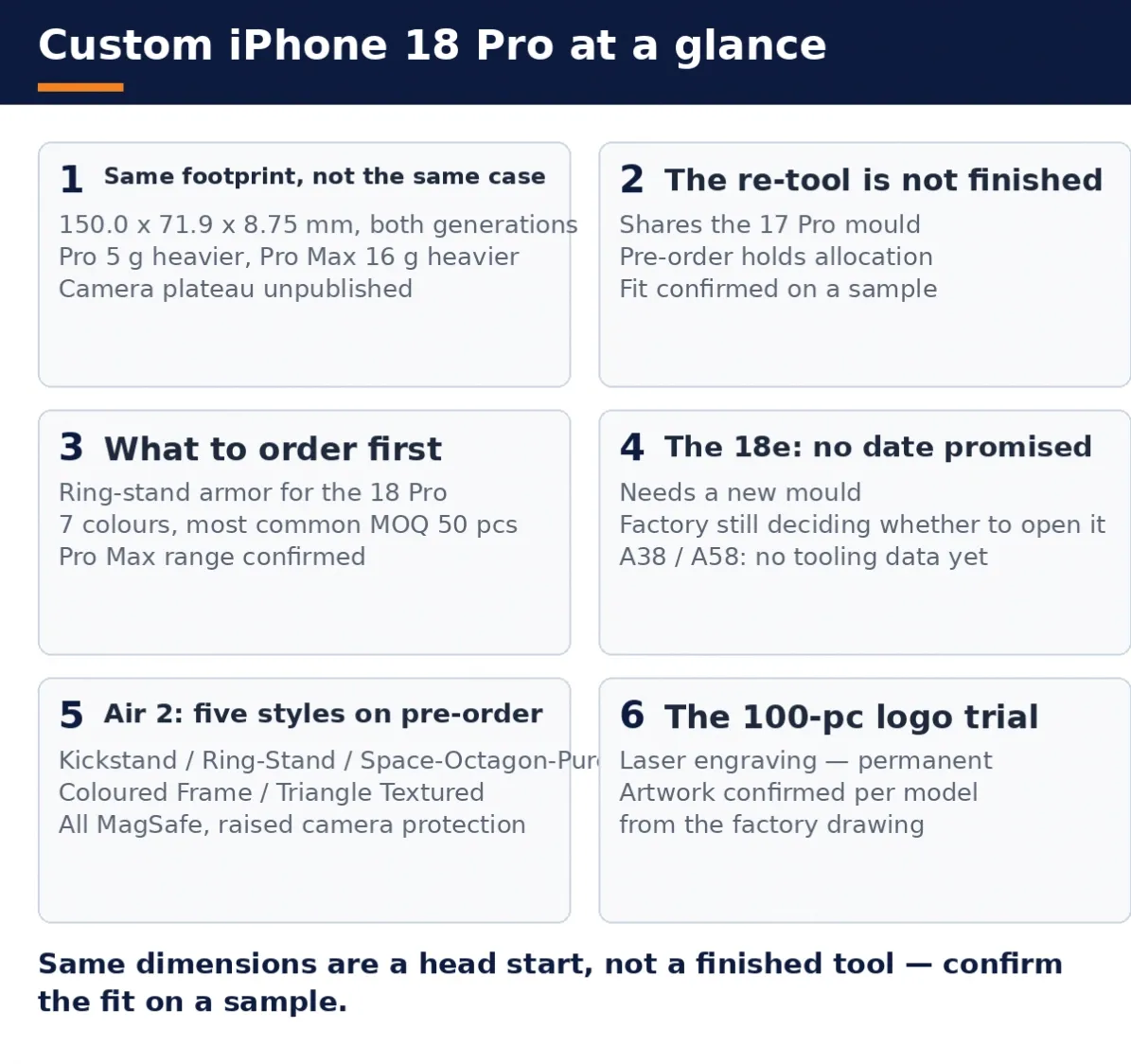
Custom iPhone 18 Pro at a glance
Question | The short answer |
|---|---|
Is the 18 Pro the same shell as the 17 Pro? | Same published footprint — 150.0 x 71.9 x 8.75 mm — but 5 g heavier, and Apple publishes no plateau dimension |
Is the mould ready? | The re-tool shares the 17 Pro mould and is not finished yet — ask us for the current status in writing |
Can I order now? | Yes — pre-order holds your allocation while fit is confirmed on a sample |
What styles exist for the 18 Pro? | Ring-stand armor confirmed on a live page; the Pro Max range is confirmed — other Pro styles, ask us in writing |
What about the 18e and Air 2? | 18e needs a new mould, factory still deciding — no date promised; Air 2 re-tool shares the Air mould, 5 styles on pre-order |
What is the trial order? | 100 pcs can carry a logo by laser engraving |
What does a custom order cost? | Ask us — a quote shows the style, model, colours, logo method and quantity in writing; no price is stated in this guide |
1. Same shell? What "same" means, and what it does not
"Same shell" is a claim about three numbers. Apple publishes the iPhone 18 Pro at 150.0 mm tall, 71.9 mm wide and 8.75 mm deep, and the iPhone 17 Pro at exactly the same three numbers. The Pro Max pair matches the same way: 163.4 x 78.0 x 8.75 mm for both generations. If a case were a box, that would settle the question — a box of the same size fits the same box. A phone case is not a box.
A case mould is cut to the phone's full shape. The camera plateau — the raised platform that carries the three lenses — has a height, a width, a corner radius and a position on the back, and Apple publishes none of those dimensions. The buttons have positions along the frame: the volume buttons, the Action button, the Camera Control button, the power button. The frame has a curve, and the glass has an edge. A case that is right on the three published numbers and wrong on the plateau will not sit flush; a case that is right on the plateau and wrong on a button will press that button permanently. The three numbers are the starting point for a mould, not the mould itself.
The weight is the tell that something inside changed. The 18 Pro is 211 g against the 17 Pro's 206 g — 5 g heavier in a body of exactly the same published size — and the Pro Max is 249 g against 233 g, 16 g heavier. Apple has not explained where the extra grams went, and the extra weight does not by itself change the shell. But it is a reminder that the phone inside the shell is not the same phone, and that the shell's published dimensions are not the whole of the phone. A factory that cuts a mould from the three numbers alone is guessing at the rest — and the rest is where a case fails.
There is one more thing the three numbers do not cover: the finish. The 18 Pro ships in Black, Silver, Glacier and Burgundy, in an aluminium unibody with a Ceramic Shield 2 front and a Ceramic Shield back. The 17 Pro's colours and materials were different, and a clear case shows the phone's own finish through it — so the colour story of the two generations is not the same even where the footprint is. A distributor ordering clear cases for the 18 Pro is ordering for four new finishes, not for last year's four.
The honest reading is therefore narrow: the footprint is unchanged, the weight is not, the plateau is unpublished, and the finish is new. "Same shell" is true for the three numbers and unproven for everything else — which is why the fit has to be confirmed on a sample, in writing, before the deposit. Any supplier that skips that step is asking you to trust the three numbers. We do not ask that of our buyers, and you should not accept it from anyone else.
2. The re-tool: what our factory is doing, in plain words
A re-tool is a mould cut from an existing tool. The iPhone 18 re-tool shares the iPhone 17 mould, which means the factory starts from a tool it already runs rather than from a blank block of steel. That is genuinely faster and cheaper than a new mould — and it is also the reason some suppliers announce the 18 Pro as "ready" the day the phone is announced. Sharing a mould is not the same as finishing the re-tool. The shared tool still has to be re-cut for the new phone's plateau, button positions and frame curve, and that work is not finished yet.
Here is where our factory stands, as Kelly confirmed on 20 November: the iPhone 18 re-tool shares the iPhone 17 mould and is not done yet. Pre-orders can be placed now. A pre-order holds your allocation — your place in the production queue, in the model and style you chose — while the fit is confirmed on a sample. The fit is confirmed on that sample before anything ships. That is the whole of the promise, and it is deliberately narrow: we do not promise a date for a tool that is still being cut, and we do not promise a fit that has not been checked on a sample.
The same position holds for the iPhone Air 2. Its re-tool shares the iPhone Air mould, and it is not done yet either. The five Air 2 styles are on pre-order on the same terms: Kickstand Clear in six colours, Ring-Stand Clear in six ring colours, Space, Octagon and Pure in three finishes, Coloured Frame Clear in six frame colours, and Triangle Textured in seven colours. All five are MagSafe compatible, with raised camera protection and a shockproof frame. A pre-order holds the allocation while the fit is confirmed on a sample — the same as the 18 Pro.
The iPhone 18e is different again, and the difference matters. The 18e needs a new mould — a tool cut from scratch, not a re-tool of an existing one — and the factory is still deciding whether to open it. No date is promised for the 18e, and no pre-order is taken for a tool that may not be cut. A supplier that quotes you an 18e delivery date today is quoting a date for a mould that does not exist yet. Ask them to put the tooling status in writing, and watch the date disappear.
The Samsung A38 and A58 sit in the same place as the 18e: no tooling data yet. They are not promised, not quoted and not pre-ordered until the factory confirms the tooling. If a buyer asks about them, the honest answer is the same as for the 18e — the tooling is unconfirmed, and the order waits for the tool.
Three things to take from this section. First, "shares the mould" is a head start, not a finished tool. Second, a pre-order is a held allocation, not a shipped case — and the fit check on the sample is the step that turns one into the other. Third, a supplier that will not state its tooling status in writing is a supplier whose tooling status you cannot rely on. Ask for it in writing, on the quote, before the deposit.
3. What to order first for the 18 Pro
Order the styles that exist, in the models they exist for, and confirm the rest in writing. That is the whole of the ordering rule for a new generation, and the 18 Pro is no exception.
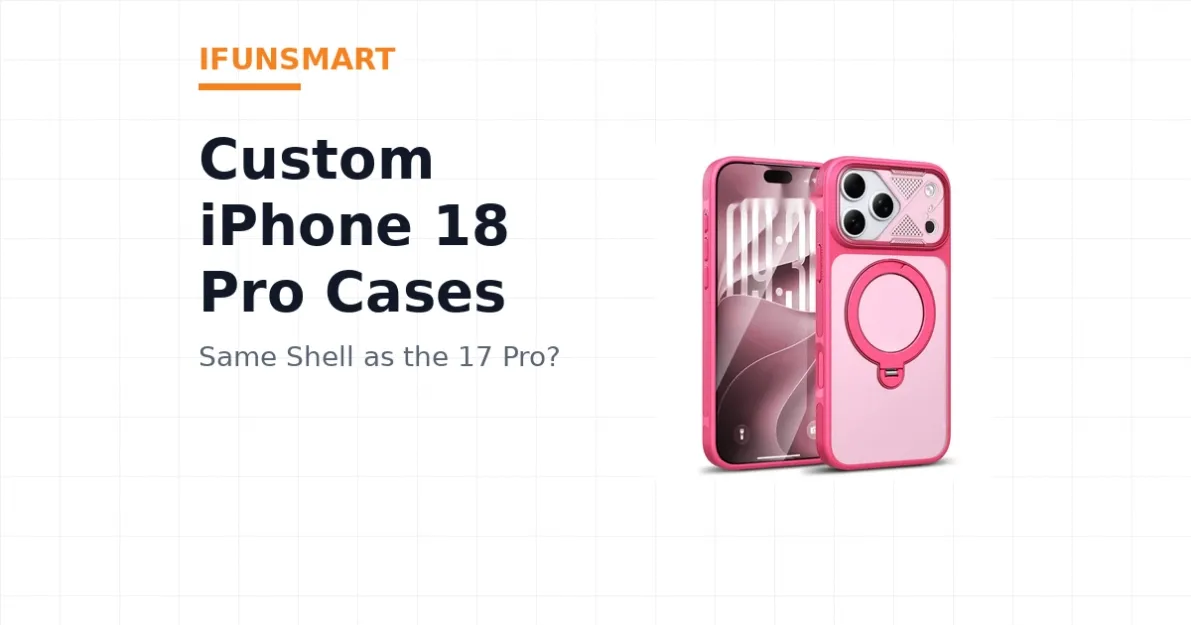
One style is confirmed for the iPhone 18 Pro by name on a live product page: the Magnetic Ring Stand Armor Case, with a sliding camera cover. It is a hard back panel with a sliding lens cover, a metal magnetic ring and a soft TPU frame; the ring rotates through a full turn and doubles as a stand and a grip; the front lip and the camera bezel stand above the glass. It comes in seven colours — cherry red, orange, light grey, light blue, deep blue, green and black — at the most common MOQ of 50 pcs per colour per model, with logo customisation and custom packaging. It is the style to lead with for the Pro: it is confirmed, it is armoured, and it carries the two features Pro buyers ask for first — a stand and a lens cover.
The Pro Max range is wider, and it is confirmed on live product pages too: the Clear MagSafe N52H; the Premium Armor with metal buttons in five colours; the Star Grid R2 with its hollow-mesh vent, 360-degree ring stand and detachable lens cover; the Star Origin R2 with its 360-degree magnetic ring stand, in seven colours; the Airbag Ring Stand; the Liquid Silicone in ten colours; the R20 leather wallet; the Luxury Leather Wallet; the Slide-Window; the Starry; the P7 replaceable panel with five stand options; and the 2700GS magnetic case with a metal camera frame in eight colours. A distributor ordering for the Pro Max has a full range to build from today. A distributor ordering for the Pro should not assume the same range transfers across — the Pro and the Pro Max take different moulds, and a case for one will not fit the other. Mixed orders are fine, and they are quoted and counted separately, because each model has its own tooling and its own minimum.
What is not confirmed for the 18 Pro by name on a live product page: a leather wallet, a liquid silicone case, a slide cover, and any aramid style. A site-wide search for aramid returns no products at all, so no aramid case is offered for any model — not the 18 Pro, not the Pro Max, not any other. For each unconfirmed style, the answer is "ask us": send the model and the style, and we will confirm in writing whether the mould exists for it. Do not order an unconfirmed style on the strength of the Pro Max list. The Pro Max list proves the range exists for the Pro Max. It proves nothing about the Pro.
Two more ordering rules from the earlier guides in this series. First, the magnet figures differ by style and are stated per style where the product page states them — the 2700GS case is 2700 Gauss, other styles state their own figures or none at all — so never quote a single Gauss figure for the whole 18 Pro range. Second, no drop-test height, drop count or military standard is claimed for any iFunSmart case in this guide. The product pages carry their own drop wording; the guide tells buyers to ask for the test report in writing instead of repeating any figure. The drop-protection guide in this series explains how to read those numbers.
Order the confirmed style first, in the colours the page lists, at the most common MOQ of 50 pcs per colour per model. Add the Pro Max range where the buyer also carries the Pro Max. Confirm every other Pro style in writing before it goes on the order. That is the first order for the 18 Pro: small, confirmed, and built on styles that exist.
4. The 18e and the Air 2: two different answers
Buyers ask about the 18e and the Air 2 in the same breath as the 18 Pro, and the two answers are different — which is exactly why they need separate sections.
The iPhone 18e needs a new mould. A new mould is a tool cut from scratch: new steel, new cavity, new fit checks, and a tooling decision that has to be made before any of that starts. The factory is still deciding whether to open it. That decision turns on the same things every tooling decision turns on — how many buyers want the model, how many styles the tool would serve, and whether the volume justifies the steel. Until the decision is made, there is no tool, no sample and no date. The honest answer for the 18e is therefore a short one: ask us, and we will tell you when the factory has decided. Any supplier that gives you an 18e delivery date today is giving you a date for a tool that has not been approved, let alone cut.
The Air 2 is the opposite case. Its re-tool shares the iPhone Air mould, so the tool exists in outline and needs re-cutting rather than starting from scratch — the same position as the 18 Pro. It is not done yet, and the same pre-order terms apply: a pre-order holds the allocation while the fit is confirmed on a sample. The five styles are all on pre-order now, and they are the whole of the Air 2 range as the factory confirmed it: Kickstand Clear in six colours; Ring-Stand Clear in six ring colours; Space, Octagon and Pure in three finishes; Coloured Frame Clear in six frame colours; Triangle Textured in seven colours. All five are MagSafe compatible, with raised camera protection and a shockproof frame.
The Air 2 styles are worth ordering as a set, because they are built to be ordered as a set. The Kickstand Clear and the Ring-Stand Clear are the two stand styles — one with a kickstand, one with a ring — and a buyer that stocks both covers the two ways a customer props a phone up. The Space, Octagon and Pure are the three finishes of the same clean shell — a buyer that stocks all three covers the finish question without adding a new mould. The Coloured Frame Clear is the colour story: six frame colours on a clear back, so the frame does the colour work and the back stays clear. The Triangle Textured is the grip story: seven colours of a textured back for buyers that sell on feel. A first Air 2 order that takes two stand styles, the three finishes and the coloured frame covers the range in five lines — and every line is a pre-order on the same terms.
One caution applies to both the 18e and the Air 2, and to the A38 and A58 as well: never let a supplier fold an unconfirmed model into a confirmed order. A mixed order that includes a model whose tooling is unconfirmed is an order with a hole in it — the confirmed lines ship, the unconfirmed line waits, and the buyer discovers the gap after the deposit. Keep the unconfirmed models on a separate line, in writing, with their own tooling status. If the tool is not confirmed, the line is not on the order.
5. Custom logo and the 100-pc trial order
A custom iPhone 18 Pro case is a standard shell with your design on it, and the design is where the order starts. The shell is the starting point, not the product: the same 18 Pro shell can carry a printed graphic, a laser-engraved logo, a moulded-in design or a plain finish, and the method you choose decides the minimum, the look and the durability.
The four print methods this series has confirmed are UV printing, IMD, silk screening and heat transfer — and sublimation, which needs a compatible coated blank. UV printing cures the graphic with UV light and carries full colour and photographic detail; it is the way to test a design on a short run. IMD seals the graphic inside the moulded wall, so it cannot peel or scratch off; it is the default for high-volume branded work. Silk screening lays the graphic through a mesh stencil in spot colours — no gradients — and suits a small logo in one or two colours. Heat transfer moves a graphic layer onto the case with heat and pressure. Each method has its own limits, and the right method is the one that fits the design: a photographic design goes to UV, a logo that must survive daily handling goes to IMD or laser, a gradient goes anywhere except silk screen.
The logo trial is the smallest custom order that makes sense, and it is confirmed: a 100-pc trial order can carry a logo by laser engraving. Laser engraving is permanent — the logo is cut into the surface, not printed onto it — which is why it suits a trial: the buyer gets a branded case that will not fade, on an order small enough to test the design. The per-piece charge for the engraving is confirmed in writing per order; no figure is stated in this guide, because a figure stated here would go stale. A trial order is also the cheapest way to check the artwork: the printable area is confirmed per model from the factory drawing, never guessed, and the trial shows whether the logo sits where the buyer intended it to — on the lower back, clear of the camera plateau and the magnetic ring.
Artwork is the part of the order buyers most often get wrong, and it is the part the factory cannot fix after the deposit. Send the artwork as a print-ready file, at the resolution the factory asks for, in the format it asks for — and ask for the format in writing if it is not on the quote. A low-resolution file prints soft; a file with the wrong colour profile prints the wrong colour; a file that has not been checked against the printable area prints across the camera cutout. The factory will check the file before production, but the check is only as good as the file. Send the final artwork, not a draft, and get the factory's confirmation that the file is print-ready before the deposit.
Custom packaging follows the same rule as the case: it is confirmed per order, in writing. The case can ship in a plain polybag, a printed retail box with a barcode, or a custom box the buyer designed — and the packaging is part of the product on a retail shelf, not an afterthought. Ask for the packaging options on the quote, with the barcode and labelling requirements for the market the cases will sell in. The packaging guide in this series covers the box, the barcode and the dieline in full.
One last point on the trial order: it is a trial of the design and the fit, not a trial of the price. A 100-pc trial tells you whether the logo looks right, whether the case fits the phone, and whether the colour reads the way the buyer expected. It does not tell you the unit price of a 5,000-pc order, because the unit price moves with the quantity. Use the trial for what it is for — design, fit and colour — and negotiate the bulk price on the bulk order.
6. How a custom order works, step by step
A custom order has five steps, in this order: the brief, the sample, the approval, the deposit, and the shipment. Each step has one document, and the document is what the next step runs on. Skip a step, and the step after it has nothing to run on.
The brief. Send the model, the style, the colours, the logo method and the quantity — in writing, on the RFQ. The model is the exact model: iPhone 18 Pro, not "iPhone 18" and not "the new Pro". The style is the style by name: ring-stand armor, clear magnetic, liquid silicone. The colours are the colours by name, from the product page's list. The logo method is the method: laser engraving, UV printing, IMD, silk screening. The quantity is the quantity per colour per model, because the most common MOQ is 50 pcs per colour per model and it varies by product line — so the quantity is stated per line, not per order. A brief that says "500 cases" has not said how many of which model, in which colours, and the factory cannot quote it. The RFQ guide in this series lists everything the brief should carry.
The sample. Samples carry a fee that is refundable on orders of 500+ pcs — ask us to confirm the amount per style in writing. The sample is where the fit is confirmed: the case seats fully on the phone, the corners wrap with no gap, the buttons click cleanly, the camera cutout does not intrude into the lens field, and the magnetic ring holds a charger firmly. Check the sample the way a factory QC bench checks it — fit, construction, lips, corners, and the documents that came with it — not by dropping it on the floor. The sampling guide in this series covers the bench checks in full. For a pre-order model like the 18 Pro, the sample is also where the fit is confirmed before the order ships: the pre-order holds the allocation, and the sample turns the allocation into a confirmed order.
The approval. Approve the sample in writing — the style, the colour, the logo position, the packaging — before the deposit. An approval in a chat message is not an approval: it cannot be found later, it cannot be attached to the order, and it cannot be shown to the factory. Approve by email, with the sample reference, the model, the style, the colours and the logo method stated. If the sample is wrong, say so in the same email, with the correction stated — a new colour, a moved logo, a different style — and wait for the corrected sample. A correction after the deposit is a rework, and a rework is charged.
The deposit. Payment is T/T and Western Union only. New customers may pay 30% deposit first. The deposit is paid after the approval, not before it — the approval is what the deposit is paying for. No other payment methods are offered. Get the deposit terms on the quote, in writing, with the balance terms beside them, before the deposit is sent.
The shipment. After the goods are ready, the factory sends photos and video and the packing list. The customer pays the balance, then the goods ship. Check the photos and the video against the approved sample — the style, the colour, the logo, the packaging — and check the packing list against the order: the model, the style, the colours and the quantities, line by line. If something does not match, say so before the balance is paid, because the balance is the last point at which a correction is cheap. After the balance, the goods ship, and the shipment is the order as it was made.
Bulk orders start from 500 pcs per order in total — the threshold at which the sample fee is refundable and the order counts as a bulk order. A bulk order is not five lines of 100 pcs; it is a total of 500 pcs across the order, counted per line for the MOQ. A distributor that orders 50 pcs of ten colours of one style has ordered 500 pcs and met the threshold; a distributor that orders 50 pcs of one colour of one style has ordered 50 pcs and has not. Count the total, and count it per line.
7. Five questions to ask any supplier in writing
A custom 18 Pro order is only as strong as the answers behind it. Ask these five questions in writing — on the RFQ, not in a chat message — and keep the answers with the order. A supplier that has the tooling will answer all five without difficulty. A supplier that cannot answer them has told you what its "same shell" claim is worth.
- What is the tooling status for the iPhone 18 Pro — and for the Pro Max separately? The two models take different moulds. Ask whether the tool is a re-tool or a new mould, whether it is finished, and when the fit was last confirmed on a sample. "Shares the 17 Pro mould" is a head start, not a finished tool — ask for the status in writing.
- How was the fit confirmed, and on what? Ask whether the fit was confirmed on a retail phone, on a sample, or on the published dimensions alone. A fit confirmed on a sample is evidence; a fit confirmed on three numbers is a guess. Ask for the sample, and check it on the bench.
- Which styles exist for the 18 Pro by name — and which do not? Ask for the style list with the model beside each style. A style that exists for the Pro Max does not exist for the Pro until the factory says so. If a style is not on the list, it is not on the order.
- What is the MOQ per line, and what counts toward the bulk threshold? The most common MOQ is 50 pcs per colour per model, and it varies by product line — so ask per line. Ask what counts toward the 500-pc bulk threshold, and get the answer on the quote.
- What does the quote show — and what does the sample cost? A quote should show the style, the model, the colours, the logo method, the quantity per line, the deposit terms and the sample terms. Ask for the sample fee per style in writing, and whether it is refundable on orders of 500+ pcs. A quote that does not show the sample terms is a quote that has not been finished.
One honest note closes the guide. The iPhone 18 Pro is the easiest new model to order badly, because the three numbers make it look finished and the tooling is not. A distributor that asks the five questions, checks the bench sample and keeps the tooling status in writing has bought a case that fits the phone it was made for. A distributor that buys the three numbers has bought a shortcut — and a shortcut is the most expensive thing in a bulk order, because it is paid for twice: once in the deposit, and once in the dead stock.
FAQs
Q1: Is the iPhone 18 Pro case the same as the iPhone 17 Pro case?
The two phones share the same published footprint — 150.0 x 71.9 x 8.75 mm — but the 18 Pro is 5 g heavier, Apple publishes no camera-plateau dimension, and the finishes are new. A case mould is cut to the phone's full shape, not to three numbers, so a 17 Pro case is not automatically an 18 Pro case. Our iPhone 18 re-tool shares the iPhone 17 mould and is not finished yet; pre-orders are open, and the fit is confirmed on a sample before anything ships. Ask any supplier for the tooling status in writing, and check the fit on a bench sample before the deposit.
Q2: Can I pre-order custom iPhone 18 Pro cases wholesale now?
Yes. A pre-order holds your allocation — your place in the production queue, in the model and style you chose — while the fit is confirmed on a sample. The confirmed style for the 18 Pro is the Magnetic Ring Stand Armor Case with a sliding camera cover, in seven colours, at the most common MOQ of 50 pcs per colour per model, with logo customisation and custom packaging. The Pro Max range is wider and confirmed on live product pages. Send the model, style, colours, logo method and quantity in writing, and we will confirm the tooling status, the MOQ per line and the sample terms on the quote.
Q3: What is the MOQ for custom iPhone 18 Pro cases?
The most common MOQ is 50 pcs per colour per model, and it varies by product line — so the MOQ is confirmed per line on the quote, never assumed. Bulk orders start from 500 pcs per order in total, counted across the order's lines. A 100-pc trial order can carry a logo by laser engraving, which is permanent and suits a design test on a small quantity. The per-piece charge for the engraving is confirmed in writing per order. No price is stated in this guide; ask us for a quote with the style, model, colours, logo method and quantity stated.
Q4: What about the iPhone 18e — can I order cases for it?
Not yet, and no date is promised. The iPhone 18e needs a new mould — a tool cut from scratch, not a re-tool of an existing one — and the factory is still deciding whether to open it. Until that decision is made there is no tool, no sample and no date. The Samsung A38 and A58 are in the same position: no tooling data yet. If a supplier quotes you an 18e delivery date today, ask them to put the tooling status in writing. For the iPhone Air 2, the position is different: its re-tool shares the iPhone Air mould, and five styles are on pre-order now — Kickstand Clear, Ring-Stand Clear, Space/Octagon/Pure, Coloured Frame Clear and Triangle Textured — all MagSafe compatible, with raised camera protection and a shockproof frame.
Q5: How do I order custom iPhone 18 Pro cases from a factory in Guangzhou?
Send a written brief — model, style, colours, logo method and quantity per line — and ask for the tooling status, the MOQ per line and the sample terms on the quote. Check the sample on the bench: fit at every corner, buttons that click cleanly, a camera cutout that does not intrude into the lens field, and a magnetic ring that holds a charger firmly. Approve the sample in writing before the deposit. Payment is T/T and Western Union only; new customers may pay 30% deposit first; after the goods are ready the factory sends photos and video and the packing list, the customer pays the balance, and then the goods ship. Samples carry a fee that is refundable on orders of 500+ pcs — ask us to confirm the amount per style in writing. We reply within 24 hours.
About iFunSmart
iFunSmart — Ifun Electronics Technology Co., Ltd, Guangzhou, China — has made phone cases since 2010: 1000+ designs, 500+ models, 500K+ pieces a month, exported to 30+ countries. We reply within 24 hours. Send your brief — model, material, colours, logo and quantity — and we will quote it line by line, send a sample (fee refundable on orders of 500+ pcs), and confirm the fit, the MOQ and the inspection records in writing before your deposit.
WhatsApp: +86 13632248734 — https://wa.me/8613632248734 — or email contact@ifunsmart.com — or visit www.ifunsmart.com.
Read more
- iPhone 18, 18e, Air 2, Galaxy A38 & A58: Mould Update — https://www.ifunsmart.com/posts/iphone-18-18e-air-2-galaxy-a38-a58-mould-update
- iPhone Air 2 Cases: 5 Styles to Pre-Order — https://www.ifunsmart.com/posts/iphone-air-2-cases-5-styles-pre-order
- iPhone 18 Pro Max Cases: What Buyers Should Order First — https://www.ifunsmart.com/posts/iphone-18-pro-max-cases-what-buyers-should-order-first
- iPhone 17 Pro Cases: What Buyers Order First — https://www.ifunsmart.com/posts/iphone-17-pro-cases-what-buyers-order-first
- Phone Case RFQ: What to Send a Factory in Your First Enquiry — https://www.ifunsmart.com/posts/phone-case-rfq-what-to-send-a-factory-in-your-first-enquiry
- Phone Case Sampling: How to Evaluate a Sample Before a Bulk Order — https://www.ifunsmart.com/posts/phone-case-sampling-how-to-evaluate-a-sample-before-bulk
- Mixed-Model Phone Case Orders: How to Combine Models — https://www.ifunsmart.com/posts/mixed-model-phone-case-orders-how-to-combine-models
- How to Source Phone Cases from China: First-Order Checks — https://www.ifunsmart.com/posts/how-to-source-phone-cases-from-china-first-order-checks