Business Solutions
iPhone 18, 18e, Air 2, Galaxy A38 & A58: Mould Update
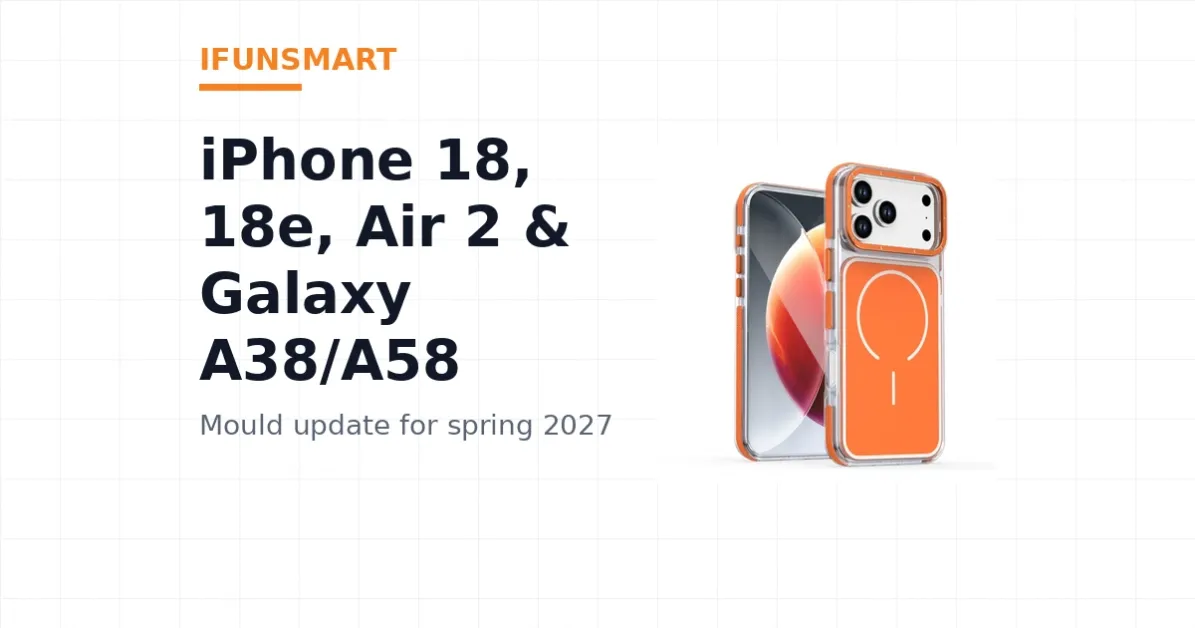
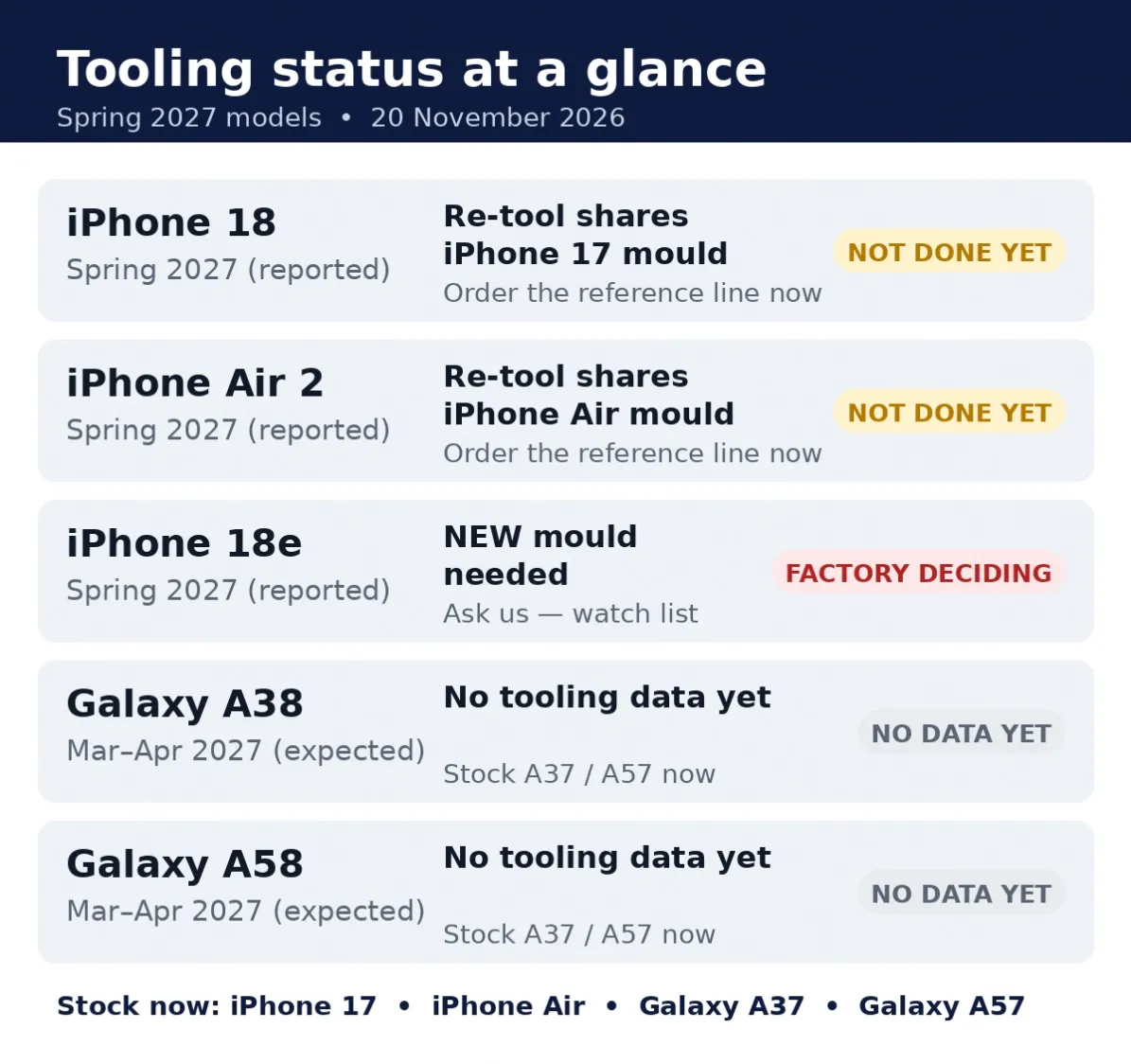
Five new models are coming in spring 2027. Our factory's tooling plan: iPhone 18 and Air 2 share re-tooled moulds, the 18e needs a new mould, and the Galaxy A38/A58 have no tooling data yet.
BLUF
Five phones your customers will ask about are coming in spring 2027 — iPhone 18, iPhone 18e, iPhone Air 2, Galaxy A38 and Galaxy A58. iPhone 18 and Air 2 cases are open for pre-order; the 18e needs a new mould, and the A38/A58 have no tooling data yet.
Short answer
Here is the tooling picture as it stands today, 20 November 2026. The iPhone 18 Pro, iPhone 18 Pro Max and the foldable iPhone Duo already launched on 9 September 2026 and are on sale, so their cases are in production now. The other five models are all reported for spring 2027. Our factory's current plan: the iPhone 18 case comes from a re-tooled iPhone 17 mould, and the iPhone Air 2 case comes from a re-tooled iPhone Air mould — but neither re-tool is finished yet, as of 20 November 2026. The iPhone 18e needs a brand-new mould, and the factory is still deciding whether to open it. The Galaxy A38 and A58 have no tooling data yet. If you sell iPhone 17, iPhone Air, Galaxy A37 or Galaxy A57 cases today, those are the lines that carry over — stock them first, and confirm every new-model mould in writing before you place a first order.
Update 20 November 2026: the iPhone 18 / Air 2 case series is now open for enquiry and pre-order in five styles — kickstand, ring stand, Space/Octagon/Pure, coloured frame and Triangle textured. The moulds are not finished yet, but pre-orders are open — the pre-order holds your allocation while the fit is confirmed on a sample.
- Why are the iPhone 18, 18e and Air 2 coming in spring 2027, not fall 2026? Because Apple split the launch. On 9 September 2026 Apple unveiled the iPhone 18 Pro, iPhone 18 Pro Max and its first foldable iPhone, the iPhone Duo, and put them on sale on 18 September 2026. The standard iPhone 18, the iPhone 18e and the iPhone Air 2 were not at that event. Bloomberg's Mark Gurman has reported since then that all three will arrive in spring 2027, and MacRumors repeated the same window on 13 November 2026. Apple has not confirmed any of the three phones or a date, so treat spring 2027 as the current best consensus across the reporting, not a locked date.
The split is a first for Apple. For years every new iPhone arrived in one September event. Under the new pattern the premium models keep September and the lower-priced models get their own spring window, roughly six months later. For a case buyer that gap matters more than it looks: it means the spring models get their own ordering cycle, their own first-order window, and their own mould decisions — they do not ride on the September tooling.
Samsung is on a similar spring rhythm for its mid-range line. The Galaxy A37 and A57 were unveiled on 25 March 2026 and went on sale in April 2026. Dutch site GalaxyClub, which has a solid record on Samsung leaks, expects the Galaxy A38 and A58 to follow in March or April 2027. Samsung has confirmed nothing about either phone. The working assumption in the trade press is a March announcement and April availability, the same shape as the last two years.
What does that mean in practice? Five models, one season, and no finished moulds. The buyers who do well in spring 2027 will be the ones who asked about tooling in November and December, not the ones who waited for the launch event. A mould decision made in December is a sample in January; a mould decision made in March is a missed launch.
- Will an iPhone 18 case fit an iPhone 17? Yes — after the re-tool, and the re-tool is not finished yet. That is the short version of our factory's answer, and it is the most useful fact in this article, so here it is in full.
The standard iPhone 18 is reported to keep the same 6.3-inch display size as the iPhone 17, with no design change expected. Because the body is the same size class, our factory's plan is to modify the existing iPhone 17 mould rather than cut a new one: re-tool the iPhone 17 mould, and the resulting case fits the iPhone 18. The same logic applies to the internals buyers care about — the reported upgrades are a new A20 chip and more memory, neither of which changes the outside of the phone, so the case fit carries over.
But read the second half of that sentence carefully: the re-tool is not finished yet, as of 20 November 2026. When we asked the factory whether the two re-tools were done, the answer was a plain no — not yet. So today there is no finished iPhone 18 mould to sample from. There is a plan, a donor mould, and work in progress. The iPhone 18 case series has since opened for pre-order in five styles; the pre-order holds your allocation while the fit is confirmed on a sample.
What should a wholesale buyer do with that? Three things. First, if you already sell iPhone 17 cases, keep selling them — the iPhone 17 is the reference model for the iPhone 18, and its case range is the range that will carry over. Second, do not list an "iPhone 18 case" as in stock until the re-tool is finished and a sample has been checked against the real phone; until then it is a pre-order line, and your customers should know that. Third, ask your supplier for the tooling status in writing — "re-tool finished, sample available" is a fact you can plan on, and "re-tool in progress" is a date you should keep checking. We will update this article when our factory confirms the re-tool is done.
One more thing to watch: the iPhone 18 is also reported to move to a 120Hz display and a smaller Dynamic Island, and production is reported to begin in late November 2026. None of that changes the case fit, but it does mean demand for the standard model could be strong when it lands — Apple is reportedly planning a large production run. A shared mould is good news here: it means the case supply can scale on existing tooling instead of waiting for a new mould to be cut.
- Will an iPhone Air 2 case fit the first iPhone Air? Yes — after the re-tool, and again, the re-tool is not finished yet, as of 20 November 2026. The Air 2 series has since opened for pre-order in five styles; the pre-order holds your allocation while the fit is confirmed on a sample.
The iPhone Air 2 is reported for spring 2027, alongside the iPhone 18 and 18e, under the internal codename V62. The reported changes are aimed at the two things buyers complained about most on the first Air: a second rear camera — a 48MP ultra-wide joining the current wide camera, the Air's first dual-camera system — and a bigger battery. The chip is reported to move to the A20 Pro, and the display is reported to stay the same as the first Air, which lets Apple use its existing panel inventory. Apple has confirmed none of this.
For a case, the thin phone is the hard one. The first iPhone Air is a sub-6mm phone, and a case for it has to protect without erasing the reason anyone buys the phone — the thinness. A re-tooled mould is actually the safer route here: the factory already knows where the first Air's buttons, camera plateau and charging coil sit, and the re-tool keeps that knowledge. A brand-new mould would mean re-learning the fit from scratch.
The buyer guidance is the same as for the iPhone 18. If you sell iPhone Air cases now, that range is your Air 2 range in waiting — keep it stocked, and keep the colours and styles that sell, because they are the ones you will want on day one of the Air 2. Do not promise Air 2 fit until the re-tool is finished and sampled. And remember the Air 2 is the thinnest phone in this group, so ask for a sample before you commit volume: thin-phone cases fail on button feel and camera clearance more often than on anything else, and those are exactly the things a sample catches.
- Why does the iPhone 18e need a new mould? Because there is no donor mould to re-tool. The iPhone 18e is the odd one out in this group, and it is the one buyers should watch most closely.
The iPhone 18e is reported for spring 2027 as Apple's lower-cost model, the successor to the iPhone 16e. The reports describe a 6.1-inch LTPS OLED display at 60Hz — keeping the refresh rate of its predecessor — with the Dynamic Island replacing the notch, an A20 chip, a single 48MP rear camera, and more memory than the 16e. Apple has confirmed none of this, and the reports disagree on details: some say a 6.12-inch panel, some say 6.3-inch, and the front camera is reported anywhere from 12MP to 24MP. The shape that matters for a case — the body size, the camera position, the button layout — is not settled in the public reporting.
That uncertainty is why the factory's answer is different for the 18e. A re-tool only works when the new phone matches an old phone's body. The 18e does not match any current mould closely enough, so it needs a brand-new mould — and the factory is still deciding whether to open one. Opening a new mould is a real investment: steel, machining, test shots, and a bet that the model will sell in enough volume to pay it back. A factory does not make that bet lightly for a budget model, and it does not make it on rumours.
For a wholesale buyer, the 18e is therefore a "wait for the tooling decision" model, not a "pre-order now" model. If the 18e matters to your assortment — and for price-led markets it usually does, because the "e" phone is the volume iPhone — tell your supplier now that you want it, and ask to be told the day the mould decision is made. Volume commitments talk: a distributor who can say "I will take the first run" is the reason a factory says yes to a new mould. But do not pay a deposit on an 18e case, and do not promise your customers a date, until the mould exists and a sample has been fitted. The honest status today is: new mould required, decision pending.
- When will Galaxy A38 and A58 cases be ready? There is no tooling data yet, so there is no date to give — and any supplier who gives you one today is guessing.
The Galaxy A38 and A58 are expected in March or April 2027, succeeding the Galaxy A37 and A57 that launched on 25 March 2026. The early reporting, led by GalaxyClub, says the A38 will carry a much bigger battery — a rated 5,882mAh cell, marketed as 6,000mAh typical — while keeping the A37's cameras, and the A58 will keep the A57's cameras with 45W charging confirmed by a certification listing for model SM-A5860. Samsung has confirmed nothing about either phone, and no launch date has been announced.
Our factory's answer this week was direct: no data yet. That is normal for Samsung's A-series at this stage. The A phones are announced in March, and the tooling data — the drawings and dimensions a mould is cut from — arrives close to the announcement, not months ahead. Apple leaks its dimensions early through the case industry; Samsung's mid-range line does not leak the same way, so the factory waits for real data.
What can you do now? Stock the A37 and A57. They are the reference models: the A38 succeeds the A37 and the A58 succeeds the A57, so your A37/A57 range is the closest thing to an A38/A58 range that exists today, and those two phones are on sale now with real demand. When the A38/A58 dimensions arrive, the first question will be the same as for the iPhones — does the new phone share the old body, or does it need a new mould? The reported battery jump on the A38 is a warning sign here: a bigger battery usually means a thicker body or a rearranged interior, and either can break case fit. Do not assume the A38 case will be the A37 case with a new name. Wait for the data, then check the fit, then order.
One more note for buyers who sell into Europe: the A-series is a volume line in European retail and operator channels, and the A38/A58 launch window — March/April 2027 — lands right after the spring iPhone launch. Plan the two together. The same first-order discipline applies: sample first, confirm fit in writing, then commit volume.