Business Solutions
Phone Case Packaging: Boxes, Barcodes and the Dieline
Packaging decides whether your cases clear Amazon FBA and retail shelves — or get held, relabelled or re-packed. This guide covers the four channels, the FBA checklist, pegboard packs and the dieline.
BLUF
Packaging is not the box the case arrives in. It is the label Amazon scans, the tab a retail peg holds, and the barcode a cashier reads. Get any of those wrong and a good case is held, relabelled or re-packed. Settle the pack before production.
Short answer
A phone case needs a different pack for each place it will sell. Amazon FBA wants a scannable barcode on every unit and a polybag that meets its rules. A retail shelf wants a hang tab and a barcode a cashier can reach. A distributor wants a plain, strong, neutral carton. Your own web shop wants a pack that photographs well and survives the post. One pack cannot do all four jobs. The buyers who lose money on packaging are not the ones who chose the cheapest box. They are the ones who chose the pack last, after the cases were already made — and then discovered the barcode would not scan, the bag had no warning, or the box had no hang hole. This guide walks through the four channels, the FBA checklist, the retail pegboard rules, and the one document that prevents most of the damage: the dieline, approved before the production sample.
1. The pack is decided by the channel, not by the case
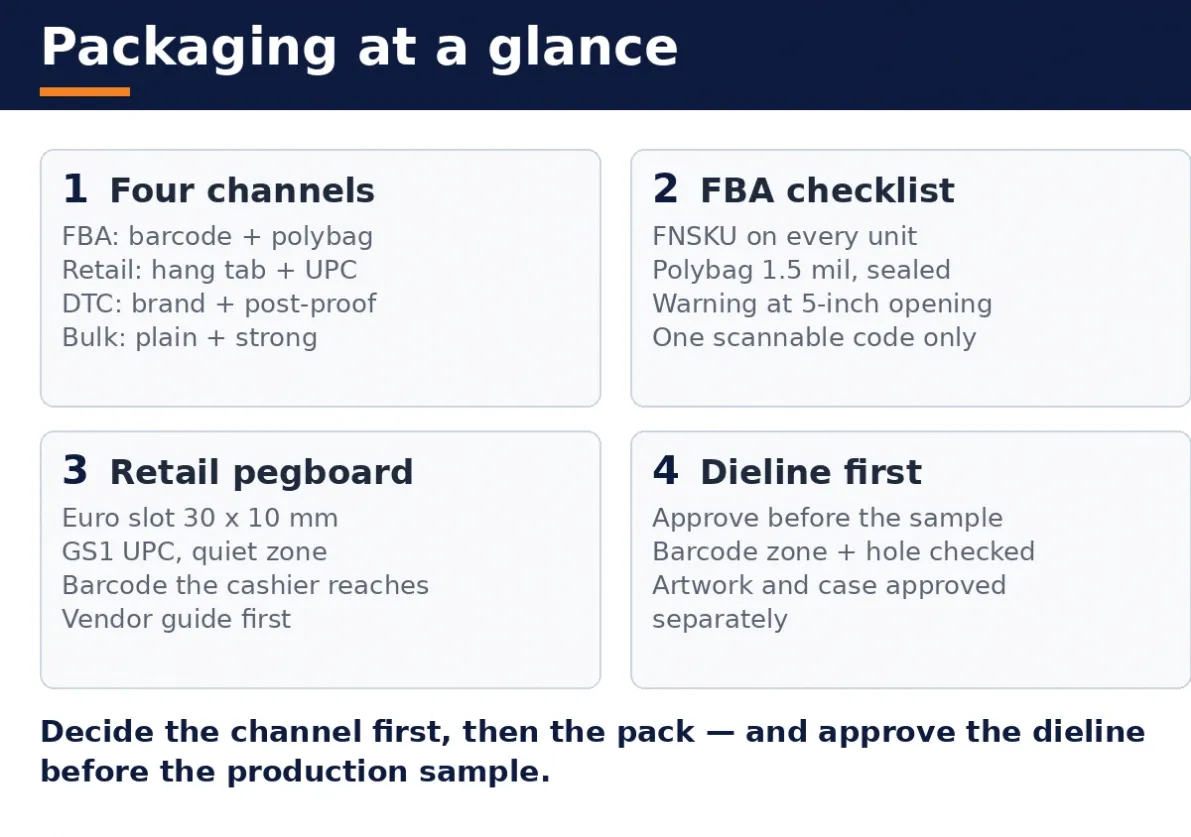
Start from where the case will sell, not from what the box looks like. The same case, in the same colour, needs a different pack in each channel — because a different person handles it, a different machine scans it, and a different rule applies to it.
Amazon FBA. The unit must carry one scannable barcode, sit in a polybag that meets Amazon's rules, and arrive in a box Amazon's warehouse can receive without opening every unit. The pack's job is to pass a scanner and survive a conveyor. Nothing on it needs to sell the product — the listing does that.
Retail pegboard. The pack must hang from a peg hook, stay straight while shoppers pull at it, show the product and the price, and carry a barcode the cashier can scan without unfolding a flap. The pack's job is to sell from a wall, in a few seconds, at arm's length.
Your own web shop (DTC). The pack is the first thing your customer touches. It should photograph well, open cleanly, protect the case in the post, and carry your brand. The pack's job is to make the buyer feel the order was worth it — and to survive a courier without a second box.
Distributor or wholesale bulk. The pack should be plain, strong and neutral: no retail branding the distributor has to cover, no hang tab nobody will use, no insert that adds cost to a pallet. The pack's job is to protect the goods and identify them — model, colour, quantity — so a warehouse can pick them fast.
Decide the channel first, then the pack. If you sell in two channels, you need two packs. A printed retail box sent into FBA still needs an FNSKU label on the outside and a polybag if Amazon's rules call for one — and a plain polybag that clears FBA will not hang on a retail peg. One pack forced into both jobs usually does neither well, and costs more to fix than two packs would have cost to make.
2. Amazon FBA: the checklist that decides whether your stock is received
Amazon's packaging rules are published in Seller Central, and they are enforced at the fulfilment centre — not negotiated there. Two changes in 2026 made them stricter, and both catch first-time sellers. Amazon ended its own prep and labelling service on 1 January 2026: the warehouse no longer polybags, labels or bubble-wraps non-compliant inventory for a fee. And commingling ended on 31 March 2026, which closed the manufacturer-barcode path for resellers. The checklist below is what to confirm with your factory before the cases ship.
One scannable barcode on every unit. Every FBA unit needs a scannable barcode. Brand owners enrolled in Brand Registry can still use the manufacturer barcode. Resellers must apply Amazon's FNSKU barcode to every unit, even when the product already carries a manufacturer barcode. Print the FNSKU in black ink on white, non-reflective label stock, at 300 dpi or better, at least 1 inch by 2 inches, with a clear quiet zone around the code. Place it on a flat surface on the outside of the pack — never over a seam, never wrapped around a curve, never on a surface that flexes. If the unit already shows a manufacturer barcode, cover it completely so only one scannable code remains. A label that will not scan is functionally absent, and a unit that cannot be scanned is not added to your inventory.
Polybag rules. A polybag must be at least 1.5 mil thick, completely transparent, and fully sealed. The barcode goes on the bag, not on the product inside it — the scanner reads the bag. Any polybag with an opening of 5 inches or larger must carry the suffocation warning, printed on the bag or permanently affixed near the opening, in the exact wording Amazon requires: “WARNING: To avoid danger of suffocation, keep this plastic bag away from babies and children. Do not use this bag in cribs, beds, carriages or playpens. This bag is not a toy.” A missing warning is one of the most common reasons a shipment is rejected, and it applies because of the size of the bag's opening — a small case in a large bag still needs it.
Multi-packs and sets. A set sold as one unit must be labelled “Sold as set, do not separate” on the outer packaging, so the warehouse does not split it. Each unit inside the set still needs its own identification if it can be sold separately — confirm with your factory which label goes where before the pack is printed.
The outer box. Amazon caps a standard box at 50 lb, and boxes over that weight need a heavy-package label. Keep the FNSKU visible on the outside of the unit pack, not hidden under tape or shipping materials. And put the country-of-origin label on the retail pack and on the master carton — “Made in China” must appear on both, and it must match your customs declaration.
Ask your factory three questions before you approve the pack: who applies the FNSKU labels, who supplies the polybags, and who checks that every label scans before the cartons are sealed. If the answer to any of the three is “you do it later”, budget the time and the labels — or ask the factory to do it. iFunSmart supports logo customisation and custom packaging; ask us which parts of the FBA prep we can handle for your order, and which parts you should arrange with your prep centre.
3. Retail shelves: hang tabs, Euro slots and the barcode the cashier can scan
A retail pack has a different customer: the shopper standing in front of a peg wall, and the cashier at the till. Both of them judge the pack in seconds, and neither of them will forgive a pack that tears, tilts or will not scan.
The hang tab. Phone cases are the classic peg product: small, light, and sold from a wall where floor space is expensive. The pack hangs from a peg hook through a hole in the top of the box or card. The three hole styles you will meet are the Euro slot (also called a sombrero slot, about 30 by 10 mm), the round hole (about 6 to 8 mm) and the delta or triangle hole. The fixture decides, not the brand: a Euro slot fits twin-hook Euro rails and most European grocery fixtures, a round hole fits single pegs. The Euro slot is the safest default for an export programme because it spreads the load over 30 mm instead of a single point — but always confirm the hole your retailer uses, because some chains specify one style and reject the other. Leave solid material between the top of the hole and the top edge of the pack, so the tab does not tear when a shopper pulls the pack off the peg.
The barcode. Most US retailers require a UPC barcode issued through GS1, printed at a scannable size with a clear quiet zone around it. The prefix belongs to whoever owns the brand — normally you, not the factory. The retail unit carries a GTIN-12 in UPC-A form under your GS1 company prefix; the shipping case carries an ITF-14 built from the same GTIN, and chains increasingly require the case mark to be scannable without opening the carton. Place the barcode where a cashier can scan it without unfolding a flap, and keep it out of the quiet zone of any hole or hook. A barcode that cannot be stickered over on a printed carton without a reprint is a mistake you pay for twice — once for the print run, once for the fix. Send the prefix, the allocation and the retailer's label specification with the artwork, not after the proof.
The retailer's vendor guide. Big-box retailers publish vendor packaging guides, and the requirements differ by retailer and by category. Common items are the barcode, the hole type and position, the maximum hanging weight, and a reinforced tab above a certain weight. Get the guide from your buyer and check it against the dieline before you approve a proof. If your buyer has no written guide, ask for the three facts in writing: the hole style, the barcode placement, and the maximum hanging weight. A verbal “standard retail pack” is not a specification — it is a guess, and it is usually wrong in exactly the detail that matters.
4. The dieline: approve it before the production sample
The dieline is the flat drawing of your pack: every cut line, fold line, glue flap, hang hole, barcode zone and print area, drawn to scale. It is the single most useful document in packaging, and the most commonly skipped. The rule is simple: approve the dieline before the production sample, not after. Once the sample is made, changing the pack means changing the tooling or the print plates — and the delay lands on your launch date.
What to check on the dieline. First, the size: does the case actually fit, with room for the insert, the leaflet and the finger notch that lets a shopper pull the case out? Second, the barcode zone: is there a clean white rectangle, with a quiet zone around it, away from folds, flaps and the hang hole? Third, the hole: is it the style your retailer uses, in the right position, with solid material above it? Fourth, the print: does the artwork sit inside the safe zone, clear of every cut and fold, with the standard bleed past the trim line? Standard prepress practice is 3 mm of bleed — background colours and images extend 3 mm past every outer die-cut line, and critical text stays at least 3 mm inside the trim. Fifth, the text: is the model name, the colour, the quantity and the origin label all on the pack, and spelled the way your listing spells them?
Artwork approval and case approval are separate milestones. The artwork — the printed design — and the case itself are approved separately, because they fail separately. A beautiful box that does not fit the case is useless, and a perfect case in a box with the wrong barcode is unsellable. Ask the factory for the dieline as a file you can open, check it against your retailer's guide, and approve it in writing. Then ask for the production sample in the approved pack — not in a plain bag with a promise that the box will follow. The sample in the real pack is the only sample that tells you whether the pack works: whether the case slides in, whether the flap closes, whether the barcode scans through the polybag, and whether the hang tab holds the weight.
5. What to send the factory in your packaging brief
A packaging brief is short. Send it with your first enquiry, not after the quotation — because the pack changes the price, the tooling and the timeline, and a quotation written without it is a quotation for the wrong product. The brief has eight items.
1. The channel. Amazon FBA, retail pegboard, your own web shop, or distributor bulk — and the country the pack will sell in. The country decides the origin label, the warning wording and the barcode standard.
2. The SKU list. Every model, every colour, every branding version — with the quantity for each. A buyer who orders 500 pieces across 20 variants needs 20 barcodes, not one. A total quantity can hide a small per-variant order, and the pack is priced per variant, not per order.
3. The pack type. Printed box with hang tab, plain box, polybag, blister, or neutral bulk carton. Say which one, and what goes inside it: case only, case plus screen protector, case plus strap, case plus leaflet.
4. The artwork files. Logo as a vector file, artwork at print size, and the exact text for the pack — model name, colour, quantity, origin, and any claim you want printed. If the artwork is not ready, say so, and ask the factory what it needs and when.
5. The barcode files. Your GS1 prefix and the allocated numbers, or the FNSKU labels Amazon generated for your listing. Say who prints and applies them — the factory, your prep centre, or you.
6. The inserts. Leaflet, warranty card, thank-you card, or nothing. An insert changes the size of the box and the weight of the carton, so it belongs in the brief, not in a later email.
7. The carton marking. Model, colour, quantity per carton, and the ITF-14 case mark built from the same GTIN as the retail unit. Ask for the case mark to be scannable without opening the carton.
8. The sample rule. One production sample, in the approved pack, with the approved barcode, before the bulk run. The sample is where the pack is tested — not the warehouse, not the shop, not your customer.
Send the eight items, attach the files, and ask for three things back: the dieline, the packaging options with their minimum quantities, and the written quotation for the case and the pack together. Packaging minimums vary by pack type — a printed box, a printed polybag and a zip-lock bag do not share one minimum — so ask for the figure for your pack, not a general number. iFunSmart supports logo customisation and custom packaging; send us your brief and we will confirm what we can make, what the minimum is for your pack, and what we need from you to start the dieline.
6. Five mistakes that hold a shipment
1. The barcode sits on a seam or a curve. The label looked fine on the artwork and will not scan on the pack. Check the label position on the physical sample, with a real scanner, before the bulk run.
2. Two scannable codes on one unit. The manufacturer barcode and the FNSKU are both visible, and the warehouse scans the wrong one. Cover the old code completely, so only one scannable code remains.
3. The polybag has no suffocation warning. The bag's opening is 5 inches or larger, and the warning was never printed. The shipment is rejected at the fulfilment centre, and the fix is a relabelling job on every unit.
4. The dieline is approved after the sample. The pack does not fit, the hole is the wrong style, or the barcode sits on a fold. The sample has to be remade, and the launch moves.
5. Packaging is decided after production. The cases are made, the cartons are sealed, and then someone asks what box they go in. The answer is a rush job, a second freight bill, or a plain bag that no retailer will hang. Decide the pack with the first enquiry, and the rest of the order runs on rails.
FAQs
Q1. Can the factory print my box and apply the barcodes for me?
Yes — ask for it in your first enquiry, not after the quotation. iFunSmart supports logo customisation and custom packaging. Tell us the channel, the pack type and the barcode files, and we will confirm what we can print and apply, and what the minimum quantity is for your pack. What we cannot do is guess your GS1 prefix or your FNSKU — those come from you.
Q2. Does every unit need an FNSKU label for Amazon FBA?
If you are a reseller, yes — since commingling ended on 31 March 2026, resellers must apply an FNSKU barcode to every unit, even when the product already carries a manufacturer barcode. Brand owners enrolled in Brand Registry can still use the manufacturer barcode. Either way, the code must be scannable: black on white, printed at 300 dpi or better, at least 1 inch by 2 inches, on a flat surface, with a clear quiet zone.
Q3. What is a dieline, and when should I approve it?
A dieline is the flat, to-scale drawing of your pack — cut lines, fold lines, glue flaps, hang hole, barcode zone and print area. Approve it before the production sample, in writing, against your retailer's vendor guide. Approving it after the sample means changing the tooling or the print plates, and the delay lands on your launch date.
Q4. Can one pack serve both Amazon and a retail shelf?
Usually not well. FBA wants a scannable barcode and a compliant polybag; retail wants a hang tab, a scannable UPC and a pack that sells from a peg. A printed retail box can go into FBA if it also carries the FNSKU on the outside and the polybag Amazon's rules call for — but a plain polybag that clears FBA will not hang on a peg. Price two packs before you try to force one pack into both jobs.
Q5. What should be printed on the master carton?
Model, colour and quantity per carton, the country of origin, and the ITF-14 case mark built from the same GTIN as the retail unit — scannable without opening the carton. The origin label must match your customs declaration. Ask the factory to confirm the carton marking with the artwork, not after the cartons are sealed.
About iFunSmart
iFunSmart has made phone cases in Guangzhou since 2010, with 1000+ designs, 500+ models and capacity of 500K+ pieces a month, shipped to buyers in 30+ countries. Our standard order is 50 pieces per colour per model, and distributor and bulk orders start at 500 pieces per order in total, with free samples for distributors. Logo customisation and custom packaging are available — send us your packaging brief and we will confirm the options and the minimum quantity for your pack. We reply within 24 hours.
Click “Contact Us” now to get our full model range & latest price list!
Read more
Selling iPhone 18 Cases on Amazon in 2026: Landed Cost & FBA
Phone Case RFQ: What to Send a Factory in Your First Enquiry
How to Read a Phone Case Quotation
Phone Case Payment Terms for Your First Order
Freight and DDP Explained: Air vs Sea for Phone Case Orders
Phone Cases for Private-Label & E-Commerce Brands
Phone Cases + Accessories That Sell With Them
Phone Case MOQ: 50 Pieces per Colour for Your First Order
Chat with Kelly on WhatsApp: https://wa.me/8613632248734