Business Solutions
Phone Cases for Online Marketplaces: Amazon, eBay & Etsy
One range across Amazon, eBay and Etsy: FBA prep and FNSKU rules, eBay returns, Etsy's production-partner rule, fit per handset, and which styles to stock first.
BLUF
One range can sell on Amazon, eBay and Etsy, but each has its own barcode, listing and returns rules. Amazon needs FBA prep and an FNSKU per reseller unit; eBay lets sellers set change-of-mind returns; Etsy allows only your own design or buyer personalisation, made by a disclosed production partner.
Short answer
A phone case wholesaler that sells to online sellers is really selling to three different buyers at once: an Amazon seller, an eBay seller and an Etsy seller — and the same physical case has to survive three different rulebooks. Amazon is the warehouse marketplace: the case goes into Amazon's fulfilment network, so the packaging, the barcode and the label are checked by a scanner before the case ever reaches a buyer. eBay is the listing marketplace: the seller writes the listing, sets the returns policy and ships the order, so the accuracy of the listing is the whole quality control. Etsy is the design marketplace: the case only qualifies if the seller designed it or the buyer personalised it, and the factory that made it must be disclosed as a production partner — a plain wholesale case resold unchanged does not qualify at all.
The range itself does not change between marketplaces. What changes is the listing, the barcode and the returns rule. One stock pool, three listings, one set of fit checks. A seller that lists the same case three ways without changing the listing text will earn "not as described" returns on at least one of them — and "not as described" is the return reason that costs the most, because on eBay the seller pays the return postage, on Amazon the return goes through Amazon's process, and on Etsy a personalised case cannot be resold at all. This guide works through the three rulebooks in order — Amazon first, because its prep rules are the strictest — then the fit, photo and packaging work that is the same on all three, and what to stock first.
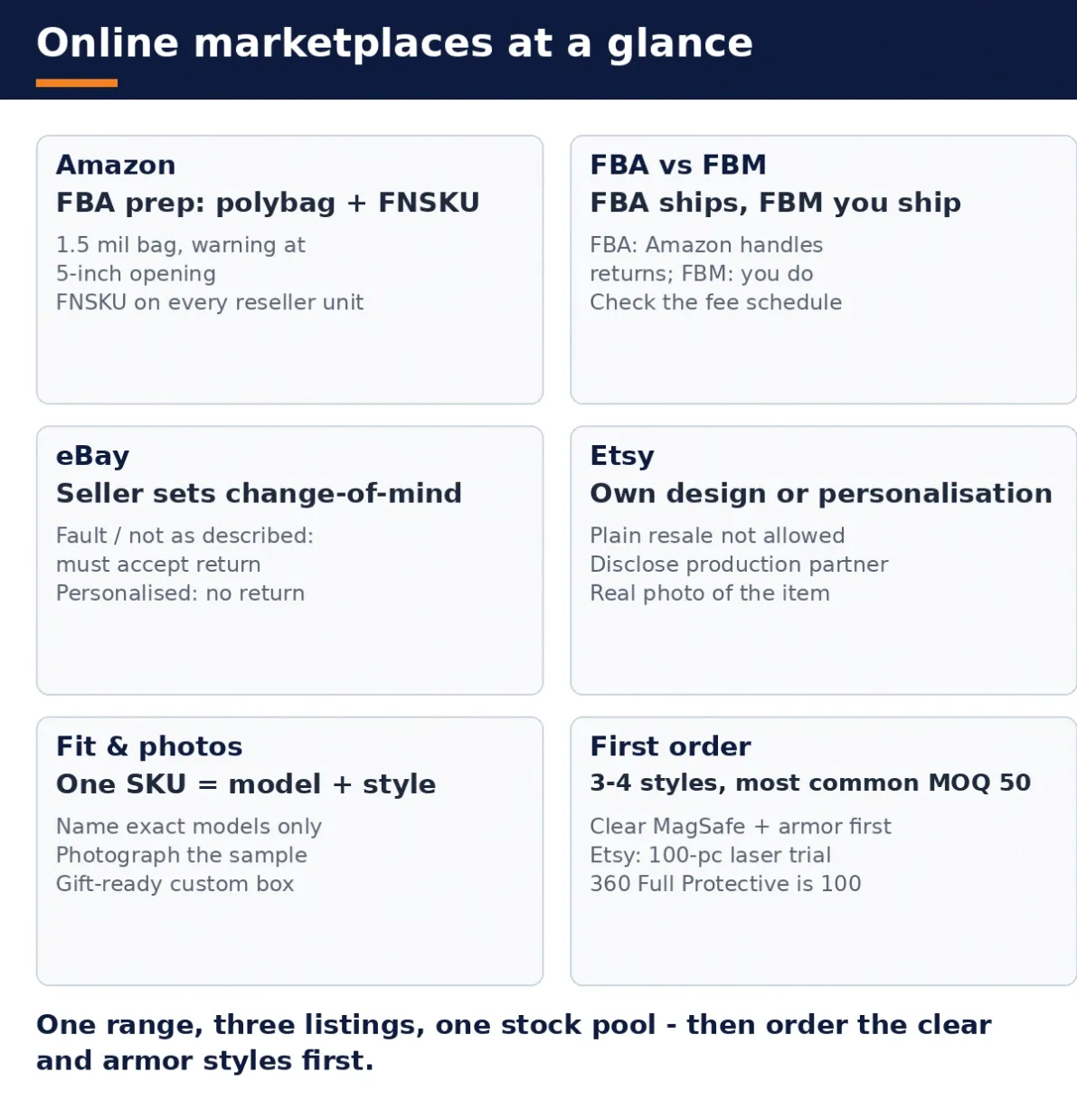
Online marketplaces at a glance
Check | Amazon | eBay | Etsy |
|---|---|---|---|
Who ships | FBA (Amazon ships) or FBM (seller ships) | Seller ships (fixed-price listings) | Seller or disclosed production partner ships |
Barcode | FNSKU on every reseller unit since 31 Mar 2026; GTIN (UPC/EAN) to list | GTIN to list; no FNSKU | No FNSKU; listing shows who made it |
Prep | Polybag 1.5 mil + suffocation warning at 5-inch opening; sealed, scannable | Seller's own packing; listing accuracy is the control | Own photo of the actual item required |
Returns | Through Amazon's process (FBA) | Change-of-mind: seller's choice; fault / not as described: must accept | Personalised items made to order; state the rules in the listing |
What qualifies | Any genuine case with a valid GTIN | Any genuine case, accurately listed | Only the seller's own design or buyer personalisation, production partner disclosed |
Brand | Brand Registry (trademark) lets a brand owner use the manufacturer barcode in FBA | Brand stated in the listing | Seller's own brand/design |
MOQ | Most common 50 pcs per colour per model; 360° Full Protective is 100 | Same range, same MOQ | Same range, same MOQ — custom logo via 100-pc laser trial |
Sample | Fee charged, refundable on orders of 500+ pcs — ask us to confirm the amount per style in writing | Same | Same |
Payment | T/T and Western Union only; 30% deposit for new customers; photos + video + packing list, then balance, then ship | Same | Same |
1. How does one range sell on three marketplaces at once?
It sells as one stock pool with three listings — not as three separate ranges. The mistake a first-time marketplace buyer makes is to buy three different assortments, one per marketplace, and then discover that the same iPhone 18 Pro Max clear MagSafe case is sitting in three warehouses under three different names. The range is the same. The listing is what changes.
One SKU is one model, one style and one colour — on every marketplace. A phone case is model-specific, and a marketplace listing is SKU-specific. "Clear MagSafe case for iPhone 18 Pro Max, orange" is one SKU; the same style in black is another SKU; the same style for iPhone 17 is another SKU again. Amazon needs a product identifier (usually a UPC or other GTIN) for most new listings, and every unique SKU needs its own GTIN. eBay needs the same discipline in the listing variations. Etsy needs it in the listing options. A buyer that orders "clear cases" without breaking the order into model, style and colour lines has not ordered anything a marketplace can list — and a supplier that quotes "clear cases" as one line has not quoted anything a marketplace seller can check. Ask for the quote line by line, with the model, the style, the colour, the quantity and the MOQ per line, and check it against the live product pages before the order ships. A phone case bulk order for online sellers is built the same way as any other bulk order: three or four styles in two or three colours each at the most common MOQ of 50 pcs per colour per model for the first order, then bulk and distributor terms from 500 pcs per order in total when the first order has sold and the colours are proven.
The stock pool is shared; the listing is not. The same physical case can be listed on Amazon, on eBay and on Etsy — but only if the listing on each marketplace follows that marketplace's rules. On Amazon the listing needs the GTIN and, for FBA, the FNSKU label on the unit. On eBay the listing needs the exact compatible models and the seller's returns policy. On Etsy the listing needs the seller's own design or the buyer's personalisation, and the production partner disclosed. A case that is listed on Etsy as a plain wholesale case with no design input from the seller does not qualify — Etsy prohibits reselling mass-produced items, and a shop that lists them risks suspension. The factory is not a secret to hide on Etsy; it is a production partner to disclose, in the shop settings and on each relevant listing, with the shipping origin stated accurately.
The returns risk is the same case, three different ways. Fit is the returns risk on all three marketplaces. A case that fits iPhone 18 Pro does not fit iPhone 18 Pro Max — iPhone 18 Pro Max is 163.4 x 78.0 x 8.75 mm and 249 g, a different body from the Pro — and a listing that says "iPhone 18 series" as one line will earn "not as described" returns. On eBay, "not as described" means the seller must accept the return and pays the return postage. On Amazon FBA, the return goes through Amazon's process and the unit comes back to the seller's stock or is disposed of under the seller's settings. On Etsy, a personalised case that comes back cannot be resold to another buyer, because it carries the first buyer's name or artwork. The fit check is therefore the same check on all three: name the exact models on the listing, check the case on the actual phone before the bulk run, and never promise a model the factory has not confirmed in writing. The universal folio in §6 is the honest answer for Xiaomi and Google — it is a folio that fits those phones, not a fitted case — and a seller that promises a fitted Xiaomi case on an assumed mould will be paying for the returns.
One range, three speeds. Amazon moves the most units the fastest, and punishes slow stock the hardest — FBA storage and returns handling make a slow style expensive to hold. eBay moves at the seller's own pace and rewards an accurate listing and a clear returns policy. Etsy moves slowly and rewards a design that no one else has. A marketplace phone case supplier in China that understands this will not push the same depth on all three: depth on Amazon's volume styles, breadth on eBay's long tail, and a small, designed range on Etsy. That is the shape of the first order in §6.
2. What does Amazon actually require before a case ships to FBA?
Amazon's rules are the strictest of the three, and they are the ones that stop a shipment at the warehouse door. They are also the most mechanical: a polybag, a warning, a barcode and a label. Get those four right and the case goes in; get one wrong and the shipment is rejected, relabelled at the seller's expense, or sidelined while the seller fixes it. These rules were verified for Article 30 and re-confirmed in this run from seven independent 2026 guides — and two of them changed in 2026, which is why older tutorials are now wrong.
The polybag — 1.5 mil, transparent, sealed, with the warning. Every unit that goes into FBA in a polybag must be in a bag at least 1.5 mil thick, transparent enough for the barcode to scan through the bag, and sealed — an open bag is not packaging, it is a wrapper. Any polybag with an opening of 5 inches (127 mm) or larger must carry the suffocation warning, printed on the bag or applied as a label, in English, in the exact wording Amazon requires: "WARNING: To avoid danger of suffocation, keep this plastic bag away from babies and children. Do not use this bag in cribs, beds, carriages or playpens. This bag is not a toy." The warning applies based on the bag's opening size, not the product inside — a small case in a large bag still needs it. Sources differ on the minimum font size for the warning, so this guide states the requirement and the exact wording and tells the buyer to confirm the font size against Seller Central for the bag size used. A phone case wholesale order for Amazon sellers should specify the polybag in the purchase order — thickness, transparency, seal and warning — because a supplier that interprets "polybag" loosely will ship a bag that Amazon rejects.
The FNSKU — on every reseller unit since 31 March 2026. This is the 2026 change that catches sellers who learned the old rules. Amazon ended commingling — "stickerless" inventory — for stock shipped on or after 31 March 2026. Since then, resellers, wholesalers and any seller not enrolled in Brand Registry as a Brand Representative must apply an FNSKU label to every unit, even when the product already has a UPC or EAN. The FNSKU is Amazon's own code for the seller's units: a Code 128B barcode, printed in black ink on a white, non-reflective label with removable adhesive, at least 1 x 2 inches, at 300 dpi or better from a thermal or laser printer — not inkjet — with a clear quiet zone around the barcode and the FNSKU code, product title and condition printed below it. Placement matters: not over a seam, not wrapped around a curve, not on a surface that flexes. The FNSKU sticker must completely cover any pre-existing manufacturer UPC, EAN or ISBN barcode on the retail packaging, and there must be only one scannable barcode per unit — a label that will not scan is functionally absent. A multi-pack sold as one unit must be labelled "Sold as set, do not separate" and carries a single FNSKU on the outer packaging, not one per component.
The one exception — brand owners in Brand Registry. A brand owner enrolled in Amazon Brand Registry with the Brand Representative selling role may use the manufacturer barcode instead of an FNSKU sticker on eligible products. Brand Registry is free, but it needs a pending or registered trademark for the brand name or logo, and a logo permanently affixed to the product or packaging. It does not waive the GTIN requirement — a listing still needs a valid product identifier — and a resold GS1-format UPC does not qualify for Brand Registry, because the GS1 company prefix must match the trademark owner. For a marketplace phone case supplier, the practical point is this: a buyer that owns its brand and holds the trademark can ship without FNSKU stickers; a buyer that resells or is still building its brand cannot, and must budget the labelling into the order. Ask the factory whether the FNSKU labels are applied before the goods ship, and in writing — Amazon's own FBA prep and labelling service ended on 1 January 2026, so labelling is now on the seller, and a shipment that arrives without labels is a shipment that does not go in.
The GTIN — one per SKU, verified against GS1. A new Amazon listing usually needs a product ID — a UPC or other GTIN, issued through GS1. Amazon verifies product IDs against the GS1 database, and a code that does not match is treated as invalid and the listing can be suppressed. A UPC has 12 digits and is used mainly in North America; an EAN has 13 digits and is the standard in Europe. Both are GTINs. Every unique SKU — each model, style and colour — needs its own GTIN. GTIN exemptions exist for certain categories, including handmade, custom, private-label and unbranded products in some cases, but an exemption is applied for in Seller Central and must not be assumed. A buyer that plans to sell under its own brand should get its GTINs directly from GS1 under its own company prefix, because that is also what Brand Registry needs. A buyer that resells uses the manufacturer's existing GTIN — and still needs the FNSKU on every unit for FBA.
FBA vs FBM — who ships, who handles the return. With Fulfilment by Amazon, Amazon stores the stock, picks, packs and ships each order, and handles customer service and returns. With Fulfilment by Merchant, the seller stores and ships the orders itself, or through a third party. FBA has its own fees — fulfilment, storage and returns processing — and this guide states no fee figure, because no fee was verified from an official source in this run; check Amazon's current fee schedule before quoting a landed cost. The choice is per SKU, not per seller: fast-moving volume styles go FBA, because Amazon's speed sells them; slow, oversized or custom-personalised styles often stay FBM, because FBA storage and returns handling punish slow stock. A phone case wholesale order for Amazon sellers should be split the same way — the clear MagSafe and the armor go FBA first, the personalised and slow styles stay FBM until they prove themselves. Article 2 of this series covers the US Amazon landed-cost calculation in detail; this article covers the prep and listing rules that come before the cost.
The carton — the last check before the truck leaves. Master cartons have their own rules: a weight cap and a longest-side cap, with FBA Box ID labels on the carton away from the seams. This guide states the published caps as planning figures with a "confirm in Seller Central" caveat, because the carton rule is the one sellers most often learn from a rejection notice. Boxes over the weight cap need a "Heavy Package" label. The carton labels, like the unit labels, must scan — a carton that cannot be scanned is a carton that does not go in.
3. How do eBay listings and returns work for phone cases?
Fixed price is the norm for a wholesale-sourced range. eBay started as an auction site, but fixed-price listings are the standard for new stock bought wholesale. Each model, style and colour is its own listing or variation, and the listing must state the exact compatible models. The listing photo should be the seller's own photo of the actual case — a supplier's catalogue render that shows a different colourway or a different model is a "not as described" return waiting to happen. The listing should also state what is in the box: the case, and nothing else, unless the listing says otherwise. A buyer that expects a screen protector because the photo showed one will open a return case for it.
Returns — the seller chooses for change-of-mind, and must accept for fault. This is the rule that matters most to a phone-case seller, and it is the opposite of what many first-time sellers assume. A seller may choose whether to accept returns when a buyer simply changes their mind. But if an item arrives damaged, does not match the listing description, or is the wrong item, the seller generally must accept the return. The listing's returns policy is set by the seller in advance, and eBay's own guidance is to review the return preferences regularly, offer a generous policy to attract buyers, and issue prompt refunds — preferably within two business days. A phone-case seller that offers a generous change-of-mind policy will sell more and eat a few returns; a seller that offers no returns will sell less and still have to accept every fault and not-as-described return. The policy is a commercial choice, not a legal shield — and the choice should be made in writing before the first listing, not after the first return.
Personalised cases are generally non-returnable — unless the seller got it wrong. A case with a custom logo, a name or a photo printed on it is a personalised item, and seller policies consistently state that personalised, bespoke or engraved items cannot be returned unless there has been an error on the seller's part or the item is defective or damaged. Under UK consumer law, the 14-day cooling-off period does not apply to items made to order or personalised for the buyer. The listing must say this plainly, and must tell the buyer to check the spelling, the dates and the artwork before ordering — because the seller will not be checking them, and a misspelled name on a case that cannot be returned is a dispute, not a sale. That is why the custom-logo trial in §6 starts at 100 pieces by laser engraving: laser is permanent, and a permanent logo on a case that cannot be returned is a logo that must be checked before the run, not after it.
The Money Back Guarantee sits underneath the seller's policy. eBay's Money Back Guarantee covers items that do not arrive, arrive faulty or damaged, or do not match the listing — whatever the seller's own returns policy says. A buyer reports within 30 days: from the estimated delivery date if the item has not arrived, or from delivery if it is not right. If an item is not as described, the seller pays the return postage. A seller that lists accurately rarely meets the guarantee; a seller that lists loosely meets it every week. The guarantee is also the reason to keep the proof: the tracking number, the listing text as it stood when the buyer ordered, and the photo of the case that shipped. A dispute without proof is a dispute the seller loses.
An eBay phone case bulk order is a depth order, not a breadth order. eBay rewards a listing that has been live for years with reviews behind it, so the winning shape is depth on a few proven styles rather than one unit of everything. The clear MagSafe, the armor and the card holder in §6 are the eBay depth styles: they are the styles a buyer searches for by name, they photograph well, and they fit the models buyers actually hold. The slow styles — the velvet, the leather wallet in an unusual colour — are the ones to list in breadth, one or two units each, until they prove themselves.
4. What can — and cannot — be sold on Etsy?
Etsy is the marketplace where most wholesale phone-case sellers make their most expensive mistake, because Etsy's rule is the opposite of Amazon's and eBay's. Amazon and eBay will list any genuine case. Etsy will not list a case at all unless the seller designed it or the buyer personalised it. A seller that buys 500 plain clear cases and lists them on Etsy as its own has not found a channel — it has found a suspension.
Reselling mass-produced items is not allowed. Etsy's rule, from its own help pages, is that everything listed must be made, designed, handpicked or sourced by the seller — and reselling mass-produced items is not allowed, with only limited exceptions for creative items that are handpicked or sourced by sellers. A ready-made wholesale case, bought unchanged and listed as the seller's own, does not qualify. Repackaging or rebranding a commercial item does not make it qualify. Offering personalisation as an option without altering the commercial item itself does not make it qualify. The test Etsy applies is the seller's creative role: did the seller design this, or did the buyer personalise this, or neither? If neither, the listing does not belong on Etsy.
What does qualify — the seller's own design, or the buyer's personalisation. Two routes qualify for phone cases. The first is "designed by a seller": the seller's original design, produced or printed onto a physical item by a third party — a production partner. The seller must disclose the production partner in the relevant listings, and give accurate information about where the item ships from. The second is "sourced by a seller": items that enable buyer creativity, including items personalised with a buyer's unique text or image, produced by a production partner. A case with the seller's own artwork printed on it qualifies under the first route. A case with the buyer's name, photo or artwork printed on it qualifies under the second. A plain case with no design input from anyone does not qualify under either. That is why the Etsy section of the first order in §6 leads with the custom-logo styles and the 100-pc laser-engraving trial, not with plain stock: the logo is not decoration on Etsy, it is the qualification.
The production partner must be disclosed — twice. If a seller works with a production partner, Etsy requires the partner to be listed in Shop Manager under Settings, in the production-partners section, and disclosed on each relevant listing as well. The listing must also state who made the item and where it ships from. A Chinese factory that makes the seller's original design is a production partner, not a secret supplier — hiding it risks the shop, and disclosing it is the compliant route. A buyer that orders from a factory should ask the factory, in writing, for the production-partner details the Etsy listing needs: the factory name as it should appear, the ship-from location, and the design files as they were produced. A factory that will not be named on a listing is a factory the seller cannot use for Etsy.
The listing photo must be the actual item. Etsy announced new listing-image and AI rules on 22 October 2026, clarified on 6 November 2026, with proactive enforcement planned from early 2027: most listings now need at least one real, unedited photo of the actual item against a real background. AI-generated content is allowed only with the seller's own creative input, and the use of AI must be disclosed in the listing description. A seller must not list with a supplier's catalogue render or an AI mockup as the only image — the finished case must be photographed. That is also why the sample matters more on Etsy than on either of the other two marketplaces: the sample is the case that gets photographed, and the listing photo is the product. A seller that has never held the case cannot photograph it, and a listing without a real photo of the actual item is a listing Etsy is moving to remove.
An Etsy phone case distributor is a design distributor, not a stock distributor. The buyer that does well on Etsy is the one that treats the factory as its production partner and the case as its canvas: its own artwork, its own brand, its own photography, its own personalisation flow with proofing before production. The buyer that does badly on Etsy is the one that treats it as a third Amazon — same plain stock, same listing text, same photos. Etsy is the smallest of the three marketplaces for phone cases by volume, and the most demanding by rule. A seller should open an Etsy shop only when it has a design to put on the case and a production partner to disclose — otherwise the shop is a liability, not a channel.
5. How do you keep fit, photos and packaging consistent across all three?
The three rulebooks differ, but the product work is the same on all three — and it is the work that decides whether a case sells twice. Fit, photography and packaging are the three things a buyer sees, and they are the three things a factory either gets right or gets wrong before the goods ship.
Fit — check the case on the actual phone, on the bench, before the bulk run. A sample is the cheapest insurance on a bulk order, and the sample check for a marketplace range is a bench check, not a consumer anecdote. Check the parting lines where the mould halves meet, the coating adhesion on the back plate, the batch tolerance between the first and the last case in the sample run, and the magnet pull-force on a magnetic case — the magnet must hold a charger and a mount, and the page figure is stated per style, never as a blanket figure for the range. Check the fit on the actual phone: the buttons must click, the camera cut-out must clear the lens module, and the case must sit flush with no rocking on a flat surface. Cycle a ring stand or a slide cover on the bench sample and check it sits flush after the cycles — do not describe the check as a consumer using the phone. A sample fee is charged, refundable on orders of 500+ pcs — ask us to confirm the amount per style in writing. The sample is also the case that gets photographed for the Etsy listing, so the sample check and the listing photo are the same job.
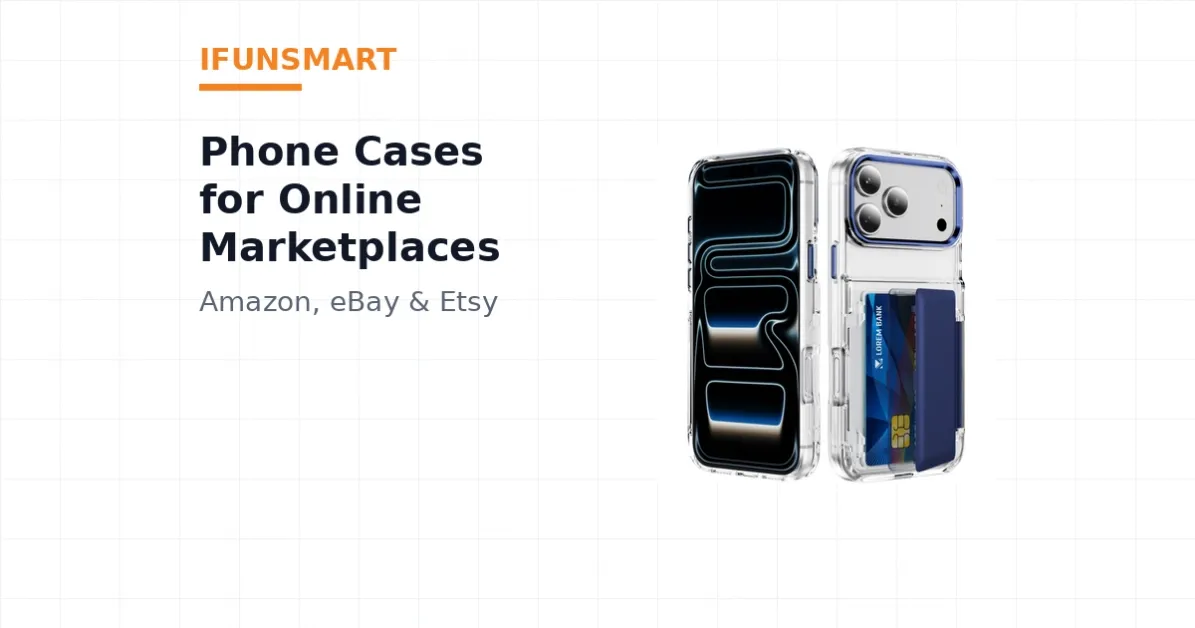
Photos — one real photo set, used three ways. The listing photo is the product on a marketplace. Amazon wants a clean, white-background main image with the case filling the frame. eBay wants the actual case, accurately coloured, with the model named. Etsy wants a real, unedited photo of the actual item against a real background. One photo set can serve all three if it is shot from the finished sample: front, back, side, the card slot or ring stand in use, and the case on the phone it fits. A supplier's catalogue render is not a substitute — it shows a different colourway, a different model, or a render that no physical case matches, and the buyer that lists with it will earn "not as described" returns. The cover photo of this article is the RFID Blocking Clear Card Holder Case exactly as it ships: the card in the slot is a generic placeholder, part of the product render, and the case is shown front and back with no hands and no marketing text. That is the standard a listing photo should meet.
Packaging — gift-ready is the differentiator, and the box is where the rules meet. A custom box with the buyer's brand, the manufacturer and importer details, and the language the destination market needs is what turns a case into a gift listing on eBay and Etsy, and what clears FBA without a relabel on Amazon. Custom packaging is a confirmed iFunSmart offer — every product page in §6 states "Support Logo Customization & Custom Packaging" — and the packaging MOQ is confirmed per style in writing, not stated here. The box also carries the barcode: the GTIN for the listing, the FNSKU for FBA, and the "Sold as set, do not separate" label for a multi-pack. The polybag inside the box carries the suffocation warning where the opening is 5 inches or larger. A buyer that orders custom packaging should send the artwork at the start — the logo file, the brand colours, the logo size and position — and should ask for the packaging options and the packaging MOQ per style in writing before the run is printed. Four print methods are confirmed for phone cases in this series: UV printing, IMD, silk screening and heat transfer — which method suits which style is confirmed per style in writing.
The logo trial — 100 pieces by laser engraving. A 100-pc trial order can carry a logo by laser engraving — laser is permanent, silk-screen fades and needs a higher MOQ — and the per-piece charge is confirmed in writing per order; this guide states no figure, because the figure is confirmed per order. The trial is the smallest order that proves the logo, the colour and the fit before the bulk run, and it is the order that proves the Etsy qualification: the seller's own logo on the case is the seller's own design, made by a disclosed production partner. A custom logo phone case for a marketplace is therefore not a separate product — it is the same case, with the seller's mark on it, ordered at the trial quantity first and at bulk quantity when the trial has sold.
6. What to stock first for online marketplaces
The range follows the marketplaces, and the marketplaces follow the phones buyers hold: iPhone first, Samsung second, and a universal folio for the rest. Every style below is on a live ifunsmart.com product page, fetched and checked on 28 November 2026 — 12 pages, all HTTP 200, no errors, no missing pages. Every page states "Support Logo Customization & Custom Packaging" and "Custom logo, colour and packaging available (OEM/ODM)". Eleven of the twelve are at the most common MOQ of 50 pcs per colour per model; the 360° Full Protective is 100. One leather wallet line is deliberately left out of the list below: its catalogue MOQ and its page MOQ disagree, and the factory has not confirmed which is correct — ask us, and do not order it on a guessed MOQ.
The first-order list — twelve styles, all live pages.
- Clear MagSafe, iPhone 17 and Samsung — 12FT Drop Clear MagSafe Case. 2.5 mm composite plate plus 2.5 mm TPU bumper, metal buttons, lens guard. The clear case is the first style for marketplaces because it shows the phone in the listing photo — and the listing photo is the product.
- Armor, iPhone 18 Pro Max — Premium MagSafe Armor Case. Thickened anti-scratch PC backplane plus thickened TPU bumper, metal buttons, heavy-duty protection. The rugged end of the range, for the buyer that wants one tough case in the line.
- Leather wallet, iPhone 18 Pro — Microfiber Leather Wallet Case. PU leather with a soft TPU inner shell and microfiber lining, magnetic flip cover, two card slots plus one cash slot with an RFID-blocking layer, adjustable stand. Six colours. The wallet style for the iPhone buyer that wants card storage with the case.
- Silky Touch MagSafe, iPhone 17 and Samsung — hybrid PC plus TPU, with the page itself stating a flexible 50-pc MOQ. The soft-touch style for the buyer that wants a skin-feel case across both brands.
- 360° Full Protective MagSafe with built-in screen protector, iPhone 17, Translucent Matte — PC plus TPU plus PET screen protector. MOQ 100 pcs per colour per model — the only style in this list above 50, stated here so no one orders it at 50.
- Ring stand, iPhone 18 Pro Max — Airbag Ring Stand MagSafe Case. Airbag frame, 360-degree rotating ring stand, built-in magnet ring. The stand style for the buyer that wants hands-free viewing in the line.
- Card holder, iPhone 17 and Samsung — RFID Blocking Clear Card Holder Case. Crystal-clear hard PC plus soft TPU bumper plus metal shaft, with a metal stand. The card-carrying clear case, for the buyer that wants storage without a wallet cover — and the cover product of this article.
- Velvet MagSafe with metal camera frame — textured PC plus velvet interior, raised metal camera frame, five textures and six colours per texture. The premium-feel style for the buyer that wants a texture story on the shelf.
- 2700GS Magnetic Case, iPhone 18 Pro and Pro Max — frosted PC back, flexible TPU bumper, raised metal camera frame, 2700 Gauss N52 magnet — the confirmed factory figure, stated per style and never as a blanket figure for the range.
- Leather wallet, Samsung Galaxy A27 / A37 / A57 — textured PU leather cover with a flexible TPU inner shell. The Samsung wallet, for the buyer that wants the second brand covered in the same style family.
- Star Grid R2 Heat-Dissipating Case, iPhone 18 Pro Max — magnetic 360-degree ring stand, detachable camera lens cover. The heat-dissipating style, for the buyer that wants a technical story in the range.
- Magnetic Closure Folio, iPhone / Samsung / Xiaomi / Google — universal folio, NOT a fitted case. The Xiaomi and Google answer for a buyer that needs something on the shelf now — a folio that fits those phones, not a fitted case. A marketplace seller that wants fitted Xiaomi cases should ask us which Xiaomi models are covered and which are not, before promising a customer a model.
The first order — how it is built. A buyer that wants to buy phone cases in bulk for online sellers starts with a trial-sized first order: three or four styles in two or three colours each, at the most common MOQ of 50 pcs per colour per model — not a bulk order. An order is built line by line: one line is one model, one style and one colour. Bulk and distributor terms start at 500 pcs per order in total, and that is the second order, not the first: it is the order a buyer places when the first order has sold, the colours are proven, and the next styles have been confirmed. An Amazon phone case supplier order should lead with the clear MagSafe and the armor, because those are the two styles that sell to the most buyers and survive FBA prep without a relabel. An eBay phone case bulk order should lead with the same two, in depth, because eBay rewards a listing that has been live for years with reviews behind it. An Etsy phone case distributor order should lead with the custom-logo styles — the clear MagSafe and the card holder with the seller's own design on them, ordered at the 100-pc laser trial first — because the logo is what qualifies the listing. A custom logo phone case marketplace order starts with the logo trial, and the buyer sends the logo artwork at the start — an AI or PDF file, or a high-resolution image — plus the brand colours, the logo size and the logo position. A sample fee is charged, refundable on orders of 500+ pcs — ask us to confirm the amount per style in writing. Payment is T/T and Western Union only, with a 30% deposit for new customers, photos and video and the packing list after the goods are ready, then the balance, then the goods ship. Ask for the current production window in writing on the quote — no day figure in this guide, because no day figure was verified.
Frequently asked questions
Who supplies phone cases wholesale for Amazon sellers?
A marketplace phone case supplier in China is a factory that makes cases at volume, lists the models on live product pages, takes a buyer's logo on the case, and ships a bulk order against a written specification — including the FBA prep the Amazon seller needs: polybag, suffocation warning and FNSKU labelling agreed in writing before the goods ship. iFunSmart is a phone-case OEM and ODM manufacturer in Guangzhou since 2010, with 1000+ designs, 500+ models and 500K+ pcs a month capacity, exported to 30+ countries. A buyer looking for phone case wholesale for Amazon sellers should ask for the same things this guide asks for: which styles are listed for the models its customers hold, what the MOQ is per line, what the sample costs, what the logo trial is, whether the factory applies FNSKU labels before shipping, and what the payment terms are — and should check the answers against live product pages, not against a sales message. No supplier publishes a dedicated Amazon + eBay + Etsy phone-case guide today, so a buyer should judge a supplier by its live product pages and its written answers, not by its search ranking.
What does Amazon FBA require for phone cases?
Amazon FBA requires a scannable barcode on every unit, a polybag at least 1.5 mil thick where a polybag is used, and a suffocation warning on any polybag with an opening of 5 inches or larger, in the exact wording Amazon requires. Since 31 March 2026, resellers and wholesalers must apply an FNSKU label to every unit, even when the product already has a UPC or EAN — only a brand owner enrolled in Brand Registry with the Brand Representative role may use the manufacturer barcode instead. The FNSKU is a Code 128B barcode, black ink on a white non-reflective label, at least 1 x 2 inches, printed at 300 dpi or better, placed where it scans and covering any pre-existing barcode. Amazon's own FBA prep and labelling service ended on 1 January 2026, so labelling is on the seller. A multi-pack sold as one unit must be labelled "Sold as set, do not separate" with a single FNSKU on the outer packaging. Check the current fee schedule on Amazon before quoting a landed cost — this guide states no fee figure.
Can I sell wholesale phone cases on eBay in bulk?
Yes — eBay is a fixed-price marketplace for new stock bought wholesale, and a bulk order is listed in depth on a few proven styles rather than one unit of everything. Each model, style and colour is its own listing or variation, and the listing must state the exact compatible models — a case that fits iPhone 18 Pro does not fit iPhone 18 Pro Max. The seller sets the returns policy: change-of-mind returns are the seller's choice, but a damaged item, a wrong item or an item that does not match the listing must be accepted, and eBay's Money Back Guarantee covers items that do not arrive, arrive faulty or damaged, or do not match the listing, reported within 30 days. Personalised cases are generally non-returnable unless the seller got the order wrong or the item is defective — so the listing must tell the buyer to check the spelling and the artwork before ordering. The most common MOQ is 50 pcs per colour per model, and bulk terms start at 500 pcs per order in total.
Can I sell wholesale phone cases on Etsy?
Only if the seller designed the case or the buyer personalised it — a plain wholesale case resold unchanged does not qualify on Etsy, because reselling mass-produced items is not allowed. The qualifying routes are the seller's own design, produced by a disclosed production partner, or a buyer's personalisation — a name, photo or artwork — produced by a disclosed production partner. The production partner must be disclosed in the shop settings and on each relevant listing, with the shipping origin stated accurately. Most listings now need at least one real, unedited photo of the actual item, under Etsy's listing-image rules announced in October 2026, and any use of AI must be disclosed in the listing description. A custom logo phone case for Etsy therefore starts with the seller's own artwork and the 100-pc laser-engraving trial — the logo is what qualifies the listing, not decoration on it.
What is the minimum order for phone cases to sell on online marketplaces?
The most common MOQ is 50 pcs per colour per model, and it varies by product line — it is not uniform. Eleven of the twelve styles in §6 are at 50 pcs per colour per model; the 360° Full Protective is 100. The catalogue lines behind the range show the variation: the IPDK Duo line is MOQ 100, the ISF Samsung line is MOQ 50, the IP leather line is MOQ 30 to 50, the IQ line is mostly MOQ 30, and the IPD line is MOQ 20, 30 or 50 by line. Bulk and distributor terms start at 500 pcs per order in total — not per model, not per colour, per order. A 100-pc trial order can carry a logo by laser engraving, which is the smallest order that proves the logo, the colour and the fit before the bulk run — and on Etsy, the logo is what qualifies the listing. No custom-logo MOQ is stated in this guide, because no page states one — ask us. A sample fee is charged, refundable on orders of 500+ pcs — ask us to confirm the amount per style in writing.
About iFunSmart
iFunSmart — Ifun Electronics Technology Co., Ltd, Guangzhou, China — has made phone cases as an OEM and ODM manufacturer since 2010, with 1000+ designs, 500+ models and 500K+ pcs a month capacity, exported to 30+ countries. The factory is at Yongning Street, Zengcheng District, Guangzhou, Guangdong 511340. The most common MOQ is 50 pcs per colour per model and it varies by product line. Bulk and distributor orders start at 500 pcs per order in total. Samples carry a fee, refundable on orders of 500+ pcs — ask us to confirm the amount per style in writing. A 100-pc trial order can carry a logo by laser engraving. Payment is T/T and Western Union only, with a 30% deposit for new customers, photos and video and the packing list after the goods are ready, then the balance, then the goods ship. We reply within 24 hours.
To start a phone case order for online marketplaces, send the model, the style, the colours and the quantities, and the destination: contact@ifunsmart.com or WhatsApp +86 13632248734.
Read more
- Selling iPhone 18 Cases on Amazon in 2026: Landed Cost, FBA Labels, and the First 500 Units — https://www.ifunsmart.com/posts/selling-iphone-18-cases-amazon-2026-landed-cost-fba
- Phone Cases for Private-Label & E-Commerce Brands — https://www.ifunsmart.com/posts/phone-cases-for-private-label-e-commerce-brands
- Phone Case Packaging: Boxes, Barcodes and the Dieline — https://www.ifunsmart.com/posts/phone-case-packaging-boxes-barcodes-dieline
- Phone Case Sampling: How to Evaluate a Sample Before a Bulk Order — https://www.ifunsmart.com/posts/phone-case-sampling-how-to-evaluate-a-sample-before-bulk
- Phone Case MOQ Explained: What 50 Pcs per Colour Really Means for Your First Order — https://www.ifunsmart.com/posts/phone-case-moq-50-per-colour-first-order
- Bulk Phone Case Orders: How Volume Changes the Order — https://www.ifunsmart.com/posts/bulk-phone-case-orders-volume-guide
- Payment Terms for Your First Order: T/T, Deposits, and What Actually Protects You — https://www.ifunsmart.com/posts/phone-case-payment-terms-first-order
- Phone Case Quality Check Before Shipment: A Wholesale Buyer's Checklist — https://www.ifunsmart.com/posts/phone-case-quality-check-before-shipment-checklist