Business Solutions
Phone Cases for Private-Label & E-Commerce Brands
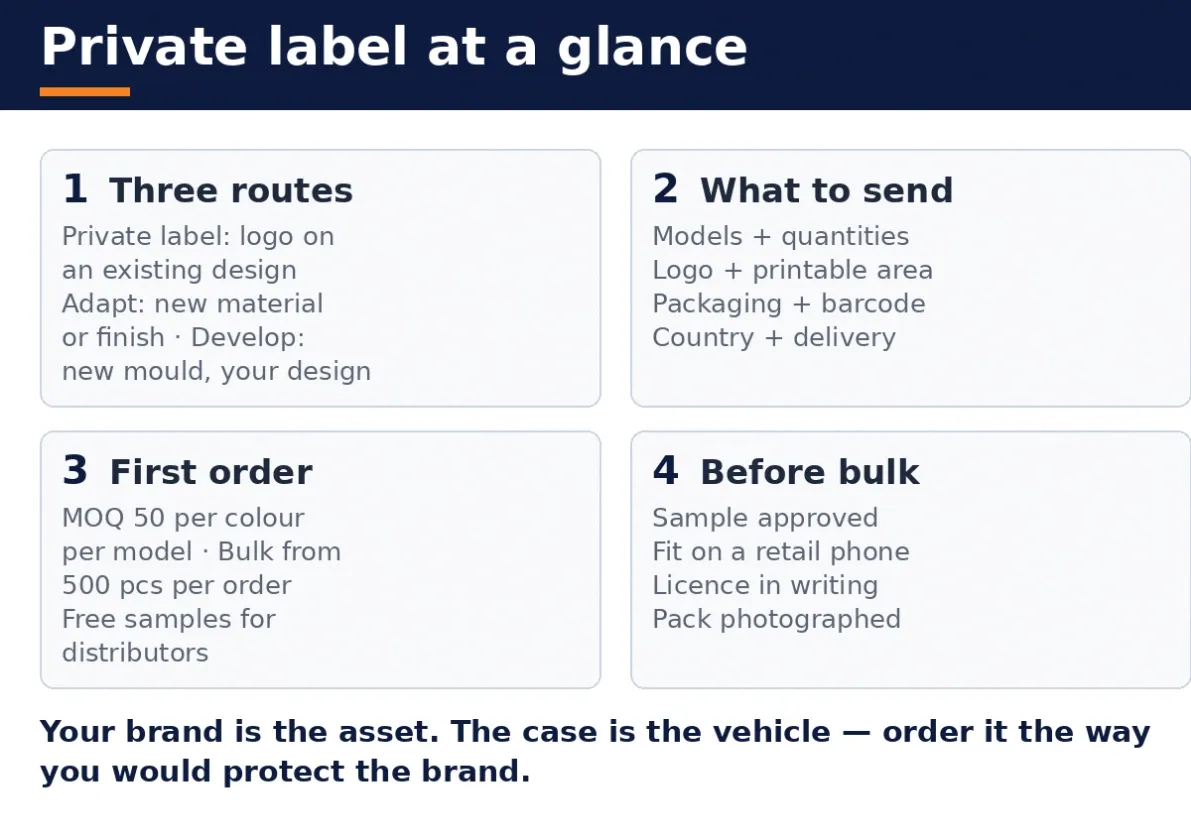
Your logo on a case is three decisions: which route, what artwork and packaging you send, and how the first order is shaped. How brands order from a factory.
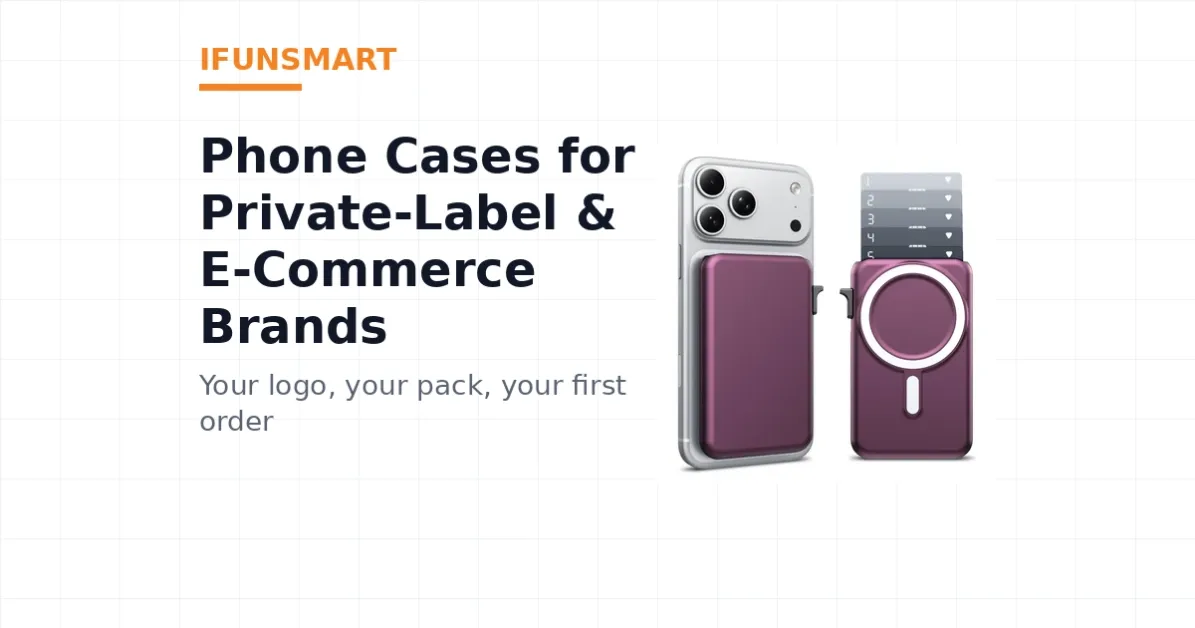
The short answer: A private-label case order is three decisions: which route (your logo on an existing design, an adapted platform, or a new mould), what artwork and packaging you send, and how the first order is shaped. Get those right and the order tests your brand without betting the business on it.
Send model, style, quantity and country on WhatsApp https://wa.me/8613632248734 — we reply within 24 hours with MOQ, sample cost and lead time for that model.
1. The question a Seoul brand actually asked
In October 2026, a brand in Seoul wrote to us with the most complete first enquiry we had seen that year. They wanted cases for their own brand — not a distributor range, not a white-label resale, but their own label on the product. Their list was long, and it is the best checklist a private-label buyer can start from: review our original designs and OEM capability for iPhone and Samsung Galaxy, a catalogue including MagSafe options, supported models, MOQ per design and per model, sample costs, production lead times, custom printing, branding and packaging — and two questions most first-time buyers forget to ask. First, are you a factory or a trading company? Second, are your original designs available for licensed use under our brand?
That enquiry is worth reading carefully, because it shows what a serious brand buyer actually needs to know before the first order — and it is also what most private-label guides on the internet skip. The guides written for Amazon, Shopify and TikTok Shop sellers are usually listicles: ten factories, a paragraph each, a MOQ that changes from one page to the next. They do not tell you how to choose between the three routes to your own brand, what to send the factory so the quotation comes back usable, or what to check before the bulk order is approved. This article does, in the order a buyer actually works through them. Read more: https://www.ifunsmart.com/posts/phone-case-factory-vs-trading-company
2. The three routes to your own brand
Every private-label case order follows one of three routes. They differ in cost, time and control — and the wrong route is the most common reason a first brand order disappoints.
Route one is private label on an existing design. You pick a case the factory already makes, and the factory puts your logo, your artwork and your packaging on it. This is the fastest route and the lowest risk: the mould exists, the fit is proven, the material is known. It suits a brand that wants its name on the shelf quickly — a first Amazon listing, a first Shopify drop, a first TikTok Shop test. The trade-off is that the same design may carry other brands' logos too, so your differentiation comes from the artwork, the colours and the packaging, not from the shape. Ask the factory which of its original designs are available for licensed use under your brand, and get that licence in writing — a design that is "available" in a chat message is not the same as a design you are licensed to sell.
Route two is adapting an ODM platform. You start from an existing case and change it: a different material, a different finish, a new colour, a magnetic ring added, a stand changed, a camera ring re-shaped. The mould is adapted rather than cut from scratch, so the order is slower than route one but faster than a new design — and the result is a case your competitors cannot buy off the same shelf. This is the route for a brand that has sold its first run and knows what its customers ask for: a stronger magnet, a softer touch, a colour its audience recognises. The factory should tell you, in writing, which parts of the platform can change and which cannot — a magnetic ring can usually be added, a hinge cannot be invented.
Route three is developing a new OEM structure. You bring a design — or a detailed brief — and the factory cuts a new mould for it. This is the only route that gives you a case nobody else has, and it is the slowest and most expensive of the three, because a new mould is a new tool and a new fit test. It suits a brand with a proven seller behind it: you already know the design sells, and you want it made to your specification at volume. Do not start here. Start with route one, prove the market, and move to route three when the sales justify the mould. Read more: https://www.ifunsmart.com/posts/custom-phone-case-oem-odm-logo-colour-packaging and https://www.ifunsmart.com/posts/phone-case-materials-tpu-pc-silicone-leather
Whichever route you choose, the factory question from the Seoul enquiry still applies: confirm, before you order, whether you are dealing with the factory or a trading company. A factory can change a mould, re-cut a fit and answer a quality question from its own production line. A trading company relays the question. For a brand order — where the product carries your name — that difference is the difference between a fix and an apology. Read more: https://www.ifunsmart.com/posts/phone-case-factory-vs-trading-company
3. What the factory needs from you — the six items that get a usable quote back
A factory cannot quote a brand order from "I want custom cases". The quotations that come back fast and usable all contain the same six items, and the buyers who send them get a written quote instead of a round of questions.
First, device and volume: which phone models, which designs, and how many pieces per model and per colour. A model list that says "iPhone and Samsung" is not a list — the factory needs the exact models, because every model is a different mould. Second, product reference: the design you want, by name or by photo, and whether it is an existing design, an adapted platform or a new structure. Third, branding: your logo file, where it goes on the case, how big it is, and whether the artwork is printed, debossed or applied another way — and the printable area you need, especially around a magnetic ring or a stand, where artwork can interfere with charging or with the mechanism. Fourth, packaging: the box or bag, the insert card, the barcode, the language on the pack. Fifth, sample and quality: whether you want a sample first, what you will check on it, and what the acceptance standard is. Sixth, commercial terms and continuity: your country, your delivery address, who owns the artwork and the mould if a new one is cut, and whether the design will be re-ordered — because a factory that knows a second order is coming treats the first order differently.
Send those six items in your first message and the factory can answer with a written quotation — MOQ, sample cost and lead time for that model — instead of asking you the same six questions back. That is the difference between a supplier who wants your order and a supplier who wants your email address. Read more: https://www.ifunsmart.com/posts/phone-case-quotation-guide and https://www.ifunsmart.com/posts/phone-case-model-mould-coverage
One warning from real enquiries: ask about the printable area before you approve the artwork. A buyer who wanted full custom artwork printed around a magnetic ring learned — before ordering — that the artwork had to leave the ring area clear so charging and the stand still worked. The artwork that looks best on screen is not always the artwork that works on the case. Send the factory your artwork file early, ask for the printable-area drawing for that design, and approve the sample before the bulk order — never the other way round.
4. Packaging: the part your customer sees first
For a distributor, packaging is protection. For a brand, packaging is the product — it is the first thing your customer touches, the first thing in the unboxing video, and the first thing that tells them whether your brand is a real brand or a reseller's sticker.
Specify the packaging as carefully as the case. The box or the bag, the insert card, the material and the finish, the barcode and the language on the pack, and whether the pack is retail-ready for your channel — a shelf box for a shop is not the same as a mailer for an online order. Ask the factory what packaging options exist for your design and your quantity, and ask for a photo of the packed sample before you approve the bulk order, not after it ships. A brand that sells on Amazon, Shopify or TikTok Shop lives or dies on the unboxing: the case is the same case your competitor sells, but the pack is yours.
Two practical points. First, packaging is part of the quotation — ask for it in the same written quote as the case, not as an afterthought, because a pack added late costs more than a pack planned from the start. Second, keep the pack consistent across your range: the same box, the same insert, the same barcode format, for every model and every colour. Your customer should recognise the pack before they read the name on it. And the accessories that sell alongside the case — screen protectors, chargers, cables, power banks, stands — can ship in the same order, in the same pack style, so the brand feels like a range rather than a single listing. Read more: https://www.ifunsmart.com/posts/phone-case-accessories-bundles
5. How to shape the first order
The first order for a brand should be narrow, magnetic-first and sample-tested — the same discipline as a pre-launch order, for the same reason: the first order tests the brand, it does not bet the business on it.
Keep the range narrow. One or two designs per model, in the colours that always sell — every colour is a separate production run, and ten designs spread thin teach you nothing. For a new iPhone, start with the Pro and Pro Max; for a new Galaxy S, the base and Ultra; for a foldable, the magnetic clear and rugged styles first, because launch-week buyers want protection and a magnetic ring before they want a fashion range. If your brand sells on a marketplace, start with the models your listing data already shows demand for — the models your customers already search for — not the models you hope they will want. Read more: https://www.ifunsmart.com/posts/ordering-before-a-new-iphone-or-samsung-launch
The numbers work in your favour if you keep the order small at first. MOQ is 50 pcs per colour per model, so a first order can test a model and a colour without committing to a container. Our catalogue lines vary by product — the iPhone 18 line is mostly 30 pcs, the Samsung foldable line 50, the iPhone Duo line 100 — so ask for the per-line MOQ in writing for the models you are ordering, and do not assume one number covers everything. For distributors, bulk orders start at 500 pcs per order in total, and samples are free — so order the sample, check the print, the fit and the pack on the real thing, and only then place the bulk order. Read more: https://www.ifunsmart.com/posts/phone-case-moq-50-per-colour-first-order and https://www.ifunsmart.com/posts/bulk-phone-case-orders-volume-guide
New customers pay 30% deposit by T/T or Western Union; after the goods are ready we send photos, a video and the packing list, and you pay the balance before the goods ship. Send us your model list and your artwork — we confirm what is covered, within 24 hours. Read more: https://www.ifunsmart.com/posts/phone-case-payment-terms-first-order
And plan the second order before the first one ships. The first order tells you which model sold through, which colour ran out and which design came back — a fit complaint in week one is a mould problem, and it should stop the second order for that design until the factory answers it in writing. The brands that win are not the ones that ordered the most first. They are the ones that ordered narrow, tested the sample, and re-ordered the winners. Read more: https://www.ifunsmart.com/posts/phone-case-supplier-for-distributors
6. Six checks before the bulk order
Before the bulk order is approved, run six checks — the same discipline as a pre-shipment check, applied one step earlier, when it can still change the order.
First, the sample: is it made from the same mould as the bulk order, and have you approved it — the print, the fit, the magnet, the pack — before production starts? Second, the fit: does the sample fit a retail phone, not a dummy unit, and does the magnetic ring still charge through the case with your artwork in place? Third, the licence: if the design is one of the factory's originals, is your licensed use under your brand confirmed in writing, and for which models and which markets? Fourth, the artwork: is the logo size, position and print method confirmed on the sample, and is the printable area respected around the ring and the stand? Fifth, the pack: have you seen a photo of the packed sample, with the barcode and the language as they will ship? Sixth, the continuity: who owns the artwork and the mould, what happens if the design needs a re-cut, and will the factory hold the mould for your re-order?
If any check fails, stop the bulk order and fix it — a week spent fixing a sample costs less than a container of cases carrying your brand name that you cannot sell. A factory that welcomes these checks is a factory that wants a second order. A factory that rushes past them wants a first order only. Read more: https://www.ifunsmart.com/posts/phone-case-quality-check-before-shipment-checklist
Your brand is the asset. The case is the vehicle. Order the case the way you would protect the brand: narrow first, sample first, licensed in writing, and checked before the bulk order ships. The factory that helps you do that is the factory to build with.
FAQ
What is the difference between private label and OEM/ODM phone cases? Private label means your logo, artwork and packaging on a case the factory already makes — the fastest route, with the mould and fit already proven. ODM means adapting an existing factory platform (different material, finish, colour or magnetic ring). OEM means developing a new structure to your design, with a new mould. Start with private label, prove the market, and move to ODM or OEM when sales justify it.
Can I use the factory's original designs under my own brand? Yes — if the factory confirms it in writing. Ask which original designs are available for licensed use under your brand, and for which models and markets. A design that is "available" in a chat message is not a licence; get the licensed use confirmed on the quotation before you order, and keep it with the order record.
What should I send the factory in my first enquiry? Six items: device and volume (exact models, designs, pieces per model and colour), product reference (existing design, adapted platform or new structure), branding (logo file, position, size, print method and printable area), packaging (box or bag, insert, barcode, language), sample and quality (what you will check and the acceptance standard), and commercial terms and continuity (country, delivery, who owns the artwork and any new mould, and whether you will re-order).
How many cases should my first private-label order be? Narrow. One or two designs per model, in the colours that always sell — every colour is a separate production run. MOQ is 50 pcs per colour per model, and our catalogue lines vary (the iPhone 18 line is mostly 30 pcs, the Samsung foldable line 50, the iPhone Duo line 100), so confirm the per-line MOQ in writing. For distributors, bulk orders start at 500 pcs per order in total and samples are free — order the sample, check the print, fit and pack, then place the bulk order.
What should I check before approving the bulk order? Six checks: the sample is from the same mould as the bulk order and you approved it; the sample fits a retail phone and the magnetic ring still charges with your artwork in place; your licensed use of the design is confirmed in writing; the logo size, position and print method are confirmed on the sample; you have seen a photo of the packed sample with the barcode and language as they will ship; and ownership of the artwork and the mould — and re-order continuity — is agreed.
About iFunSmart
Ifun Electronics Technology Co., Ltd, Guangzhou, since 2010. A phone case factory — 1,000+ designs, 500+ models, 500K+ pcs/month, exported to 30+ countries — supplying wholesalers, importers and distributors worldwide. Our 2700GS Magnetic Case for iPhone 18 Pro Max uses N52 magnets at up to 2700 Gauss. MOQ is 50 pcs per colour per model; bulk orders from 500 pcs per order in total; free samples for distributors. Ask us for a live video call from our production line, our mould and model list, or a sample — we reply within 24 hours. WhatsApp https://wa.me/8613632248734 — Email contact@ifunsmart.com