Business Solutions
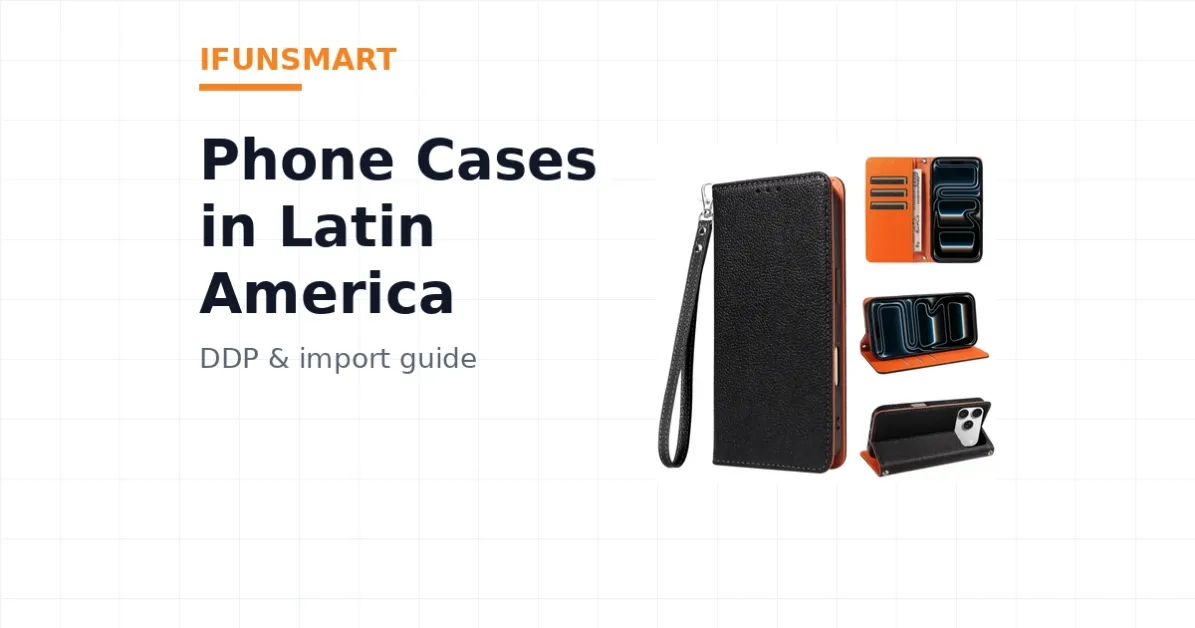
Phone Cases in Latin America: DDP & Import Guide
Latin America is six import regimes, not one market. DDP quotes one landed price — but Mexico, Brazil and Argentina tax very differently, and only Chile and Peru have China deals that cut duty to 0%.
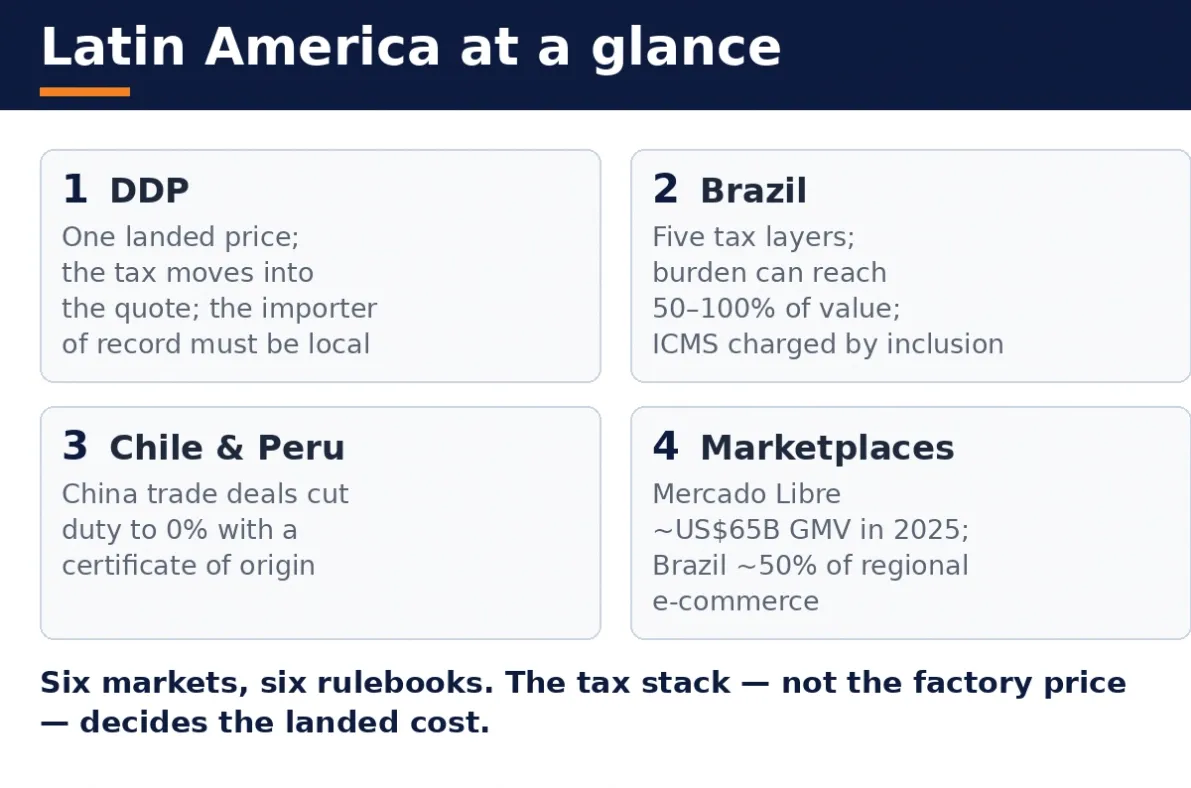
The short answer: Latin America is not one market — it is six different import regimes. DDP sounds like the easy answer: the seller delivers duty paid and you pay one landed price. But DDP does not remove the tax — it moves it into the quote, and in every Latin American market the importer of record must be local, so a DDP price is only as good as the forwarder behind it. Mexico and Brazil tax Chinese goods hard and have no trade deal with China; Chile and Peru do, and a valid certificate of origin can cut their duty to 0%. Brazil can take half a shipment's value at the border; Chile takes about a quarter. Before you compare DDP quotes, compare the tax stack underneath them. Confirm the rate and the documents for your country and your HS code with your broker before the goods ship, not after they arrive.
Send model, style, quantity and country on WhatsApp https://wa.me/8613632248734 — we reply within 24 hours with MOQ, sample cost and lead time for that model.
1. What DDP really means — and what it does not
DDP, Delivered Duty Paid, means the seller delivers the goods to your door with all duties and taxes paid. You pay one landed price and you do not clear customs yourself. That is the whole appeal — and the whole risk.
First, DDP does not make the tax disappear. Mexico's 16% VAT, Brazil's five-layer tax stack, Argentina's VAT plus three advance payments — all of it is still charged, only now it sits inside the seller's quote. If the quote does not break the tax out line by line, you cannot check the rate — or tell whether two quotes differ on freight or on tax.
Second, in every Latin American market the importer of record must be local. A factory in Guangzhou cannot be the importer of record in São Paulo or Mexico City on its own. A real DDP offer works because the seller or its forwarder has a local entity or partner who clears the goods in their name. Ask who that is, in writing, before you pay — if the seller cannot name them, the "DDP" price is a promise without a mechanism, and if the goods are stopped at the border, you are the one who has already paid. Read more: https://www.ifunsmart.com/posts/phone-case-freight-ddp-air-vs-sea
Third, DDP is worth most where the tax stack is simple and small — Chile and Peru — and worth least where it is large and layered — Brazil and Argentina, where the DDP price swings wildly between forwarders.
2. Mexico — no trade deal, and the 2026 tariff rise
Mexico has no free trade agreement with China, so Chinese goods pay the full general import tax, the IGI, at the rate of their eight-digit tariff line. There is no single rate — each line has to be checked with a customs broker or in the SIAVI system before ordering. Mexico's trade-weighted average tariff was 5.24% in the World Bank's 2023 data — but that blends zero-rated lines with much higher ones.
The change that matters came on 1 January 2026, when a decree raised the general tariff on 1,463 tariff lines for countries without a trade agreement — China first among them — into a 5% to 50% range. Cars and parts went to 25–50%, footwear, textiles and toys to 25–35%, steel up to 35%. A line that cost 10% duty in 2025 can cost 30% in 2026, so a DDP quote built on last year's rates is already wrong.
On top of duty, Mexico charges 16% VAT (IVA) on the customs value plus duty plus the processing fee — 8% only in the northern border strip — and a customs processing fee, the DTA, of 0.8% of the customs value. The IVA base includes the duty. Small parcels are no escape: since 15 August 2025, express shipments from countries with no agreement pay a flat 33.5% from the first dollar; the US$50 duty-free threshold applies only to USMCA origin. Since 1 January 2025 every import declaration must carry the importer's tax ID, the RFC, and the electronic customs value declaration, the Manifestación de Valor, is mandatory through VUCEM. Read more: https://www.ifunsmart.com/posts/importing-phone-cases-documents-checklist
3. Brazil — the heaviest tax stack in the region
Brazil is the largest market in Latin America and the most expensive to clear. There is no trade agreement with China, and a commercial import pays five layers: import duty (II) of 0–35% by the ten-digit NCM code under the Mercosur common external tariff; federal excise (IPI) of 0–30%; PIS-Importação at 2.1% and COFINS-Importação at 9.65%; and state VAT (ICMS) of 17–25% by state — São Paulo 18%, Rio de Janeiro 20%. On top of that come the AFRMM merchant-marine fee at 8% of sea freight and the Siscomex declaration fee. The total burden can reach 50% to 100% of the product value.
The trap is the ICMS. It is charged "por dentro" — by inclusion — so the tax is part of its own base: the base is the customs value plus duty plus IPI plus PIS and COFINS plus freight and fees, divided by one minus the ICMS rate. At 18%, that gross-up turns a nominal 18% into about 22% of the pre-ICMS total. And the rate follows the state where the importer is established, so the same shipment costs different amounts in São Paulo and Rio.
Small parcels run on a different regime, changed in May 2026. Under Remessa Conforme, individuals buying from certified platforms pay 0% import duty up to US$50, then 60% less a US$30 deduction up to US$3,000; sites outside the programme pay 60% from the first dollar, and state ICMS is charged at every value. The simplified regime covers parcels up to US$3,000 — but it is built for individuals, not for resale. Read more: https://www.ifunsmart.com/posts/phone-case-factory-vs-trading-company
4. Chile — the easiest market in the region
Chile is the simplest of the six large South American markets to import into. It applies a single flat duty of 6% on the CIF value to almost everything, and through more than 30 trade agreements it removes even that for most goods — about 80% of Chile's imports enter under a preference. The agreement with China, its largest supplier, gives 0% on these lines with a valid certificate of origin. Add 19% VAT on CIF plus duty, recoverable by a VAT-registered importer as a tax credit, and the tax side of a typical import is done.
Two practical rules. For any import above US$1,000 FOB a licensed customs broker must file the import declaration, the DIN; below that the importer can clear directly. The importer needs a Chilean tax ID, the RUT, and a foreign company without a Chilean entity imports through an Importer of Record. And the low-value exemption is gone: until October 2025 a purchase under US$41 entered free of VAT and duty, and more than nine out of ten parcels used that band. On 25 October 2025 it was eliminated under Law 21.713 — every international purchase now pays 19% VAT. For online sales up to US$500 by a seller or platform registered with the tax service, the SII, the 19% is charged at checkout; above US$500 the shipment clears normally, where duty can apply on top of the VAT. Read more: https://www.ifunsmart.com/posts/phone-case-supplier-for-distributors
5. Colombia and Peru — one tightens, one opens
Colombia charges duty of 0–40% by HS code, and 19% VAT on CIF plus duty. For postal and courier shipments the rule is simpler: a 10% customs duty on the FOB value, freight and insurance included, and shipments with an FOB value of US$200 or less do not pay that duty, under Decree 1165 of 2019. The VAT side is where the rules moved: the tax code excludes low-value goods from VAT only when a trade agreement expressly requires it, and Colombia has no agreement with China. An emergency decree in December 2025 cut the VAT-free threshold to US$50 for 2026, but the Constitutional Court provisionally suspended its basis, and from 29 January 2026 the DIAN applies the Tax Code rule instead. The VAT treatment of a low-value parcel now depends on origin and treaty and is decided at clearance — confirm it with your broker or the DIAN, and do not build a quotation on the old US$200 VAT figure.
Peru is the easiest of the large Latin American markets to import into from China. Its free trade agreement with China has been in force since March 2010, and with a valid certificate of origin and direct shipment most consumer goods enter at 0% ad valorem; without it the duty is 0%, 6% or 11% by tariff subheading. On top of duty comes 18% IGV — 16% IGV plus a 2% municipal promotion tax — on CIF plus duty, and an IGV perception, an advance payment of 3.5% to 10% that is credited later. Peru clears goods in three bands: up to US$200 FOB, postal and courier shipments enter with no duties or paperwork (shipments for the same consignee on the same flight are added together); from US$200 to US$2,000 FOB the simplified declaration applies 4% ad valorem plus 18% IGV on the CIF value, filed without a customs agent; above US$2,000 the goods are a regular import — duty by subheading, 18% IGV plus the perception, a customs agent and an active RUC. SUNAT has publicly discussed taxing the US$200 band, so confirm it is still in force before a large order. Read more: https://www.ifunsmart.com/posts/bulk-phone-case-orders-volume-guide
6. Argentina — VAT plus three advance payments
Argentina applies the Mercosur common external tariff with national exceptions, and it has no trade agreement with China, so goods from China pay the full rate — 0% to 35% depending on the code, with an average applied duty of about 12%. In April 2025 Decree 236/2025 cut the duty on garments and shoes from 35% to 20%, but that cut covers clothing and footwear only — do not expect a similar cut for phone cases.
The duty is only the first line. VAT (IVA) at customs is 21%, charged on the customs value plus the duty plus a 3% statistics fee, which runs until 31 December 2027 and is capped by value band. On top of that, customs collects three advance payments: a VAT perception of 20%, an income-tax perception of 6%, and, in provinces that take part in the SIRPEI system, a gross-income tax perception at the rate each province sets. Until 31 December 2026, imports of certain basic goods, and of listed inputs by small and medium companies with a valid MiPyME certificate, are exempt from the VAT and income-tax perceptions. The harder part is often not the tax but the payment: Central Bank rules decide when an Argentine importer may buy dollars to pay the factory, so agree the payment timing in writing before the goods ship. Read more: https://www.ifunsmart.com/posts/phone-case-payment-terms-first-order
7. Where the cases actually sell: Mercado Libre, and an Android-heavy mix
A distributor in Latin America does not sell to a high street first — it sells to a phone. Retail e-commerce in the region was about US$191 billion in 2025, and three countries take about 84.5% of it: Brazil around 50%, Mexico around 25%, Argentina around 9.5% to 10%. The marketplace that takes most of it is Mercado Libre — the region's largest e-commerce and fintech ecosystem, operating in 18 countries, with about US$65 billion in gross merchandise value in 2025 and more than 120 million annual unique buyers. Amazon leads Mexico, at roughly 40% against Mercado Libre's roughly 30%, and Mercado Libre holds only about 5% in Chile and Colombia — so a distributor prices the landed cost plus the platform fee, not the factory price alone.
The phones people own are not the same as in Europe or Southeast Asia. Latin America's smartphone market hit a record 140.5 million units in 2025: Samsung leads with about a third of shipments, driven by its low-end A-series models; Xiaomi is second at about 18%, Motorola third at about 15%, and Apple holds only about 5%. The sub-US$300 segment accounts for about 71% of shipments. A distributor's first order should cover Samsung's A-series and S-series, Xiaomi and Redmi and POCO, and Motorola alongside iPhone 18 Pro and Pro Max — not iPhone alone. Send the factory your model list and get written confirmation of which designs cover each model and generation. Read more: https://www.ifunsmart.com/posts/phone-case-model-mould-coverage
Order at distributor depth. MOQ is 50 pcs per colour per model, so a first order can test a model and colour. For distributors, bulk orders start at 500 pcs per order in total, and samples are free. Bundle the case with the accessories that sell alongside it — screen protectors, chargers, cables, power banks and stands — and ask for one combined shipment, one certificate of origin where it helps, and one packing list. Read more: https://www.ifunsmart.com/posts/phone-case-accessories-bundles and https://www.ifunsmart.com/posts/phone-case-moq-50-per-colour-first-order
8. The questions to ask the factory before you order for Latin America
Ask for these six things, in writing, before you pay: who the local importer of record is for the DDP delivery, and the tax breakdown behind the DDP price, line by line; the HS code for each item, so your broker can confirm the duty rate in your country; a certificate of origin where it cuts duty — Chile and Peru under their China trade agreements — with the criteria and the bill of lading matching; the exact models and generations covered, on one shared model list, with Samsung A-series, Xiaomi, Redmi and Motorola covered alongside iPhone; the material of each case and how it holds up in tropical heat and humidity; and a sample fitted on the phones it is made for. If any answer is vague, the order is not ready.
New customers pay 30% deposit by T/T or Western Union; after the goods are ready we send photos, a video and the packing list, and you pay the balance before the goods ship. Send us your model list and your country — we confirm what is covered, within 24 hours. Read more: https://www.ifunsmart.com/posts/phone-case-factory-vs-trading-company
What does DDP mean for phone cases shipped to Latin America? DDP, Delivered Duty Paid, means the seller delivers the goods to your door with all duties and taxes paid, and you pay one landed price. It does not remove the tax — it moves it into the quote — and in every Latin American market the importer of record must be local, so a real DDP offer needs a local entity or partner who clears the goods. Ask who that is, and ask for the tax breakdown in writing.
Why is Brazil so expensive to import phone cases into? Brazil stacks five layers on a commercial import: import duty of 0–35% by NCM code, federal excise of 0–30%, PIS and COFINS at 11.75% combined, and state ICMS of 17–25% charged by inclusion, which grosses the base up — plus an 8% merchant-marine fee on sea freight and a declaration fee. The total burden can reach 50% to 100% of the product value.
Which Latin American countries have trade deals with China that cut duty to 0%? Chile and Peru. Chile applies a flat 6% duty but 0% under its agreement with China, with a valid certificate of origin, on top of 19% VAT. Peru's free trade agreement with China has been in force since March 2010, and most consumer goods enter at 0% ad valorem with a valid certificate of origin and direct shipment. Mexico, Brazil, Colombia and Argentina have no agreement with China and charge the full rate.
What changed for small parcels in Mexico and Chile? In Mexico, express shipments from countries with no trade agreement pay a flat 33.5% rate from the first dollar since 15 August 2025 — the US$50 duty-free threshold applies only to USMCA origin. In Chile, the US$41 exemption was eliminated on 25 October 2025, so every international purchase now pays 19% VAT; online sales up to US$500 through SII-registered platforms pay the VAT at checkout instead.
Where do phone cases sell in Latin America? On marketplaces, above all Mercado Libre — about US$65 billion in gross merchandise value in 2025, across 18 countries, with more than 120 million annual unique buyers. Retail e-commerce in the region was about US$191 billion in 2025, with Brazil around 50%, Mexico around 25% and Argentina around 9.5% to 10%. The phone mix is Android-heavy: Samsung about a third of shipments, Xiaomi about 18%, Motorola about 15%, Apple about 5%.