Business Solutions
Phone Cases in the Nordics: Import, VAT & EPR Checks
Sweden, Denmark and Finland are EU; Norway is not. Import VAT 25–25.5%, duty around 6.5%, packaging EPR in all four — the checks to agree in writing before your first Nordic order.
BLUF
The Nordics look like one market and import like two. Sweden, Denmark and Finland are EU: import VAT 25% to 25.5%, duty around 6.5% on plastic cases, packaging EPR before the first sale. Norway is EEA, not EU: own VAT, VOEC scheme and customs system. Agree in writing before ordering.
Short answer
A distributor who treats the Nordics as one market will get the paperwork wrong in at least one country. Three of the four are EU member states, so the EU rules — the abolished EUR 150 exemption, the EUR 3 and EUR 2 B2C charges, PPWR packaging rules, GPSR safety rules — apply to Sweden, Denmark and Finland in the same way, with only the VAT rate and the national register differing. Norway is not in the EU at all. It runs its own tariff, its own VOEC scheme for online sales to consumers, and its own digital customs system, Digitoll — and the EU packaging regulation does not apply there yet.
The four sections below work through the four countries one at a time, then the stocking question and the first-order checklist. Every figure in this guide comes from a public source read on 25 November 2026 — a TARIC mirror, a national customs or tax authority, or an EU regulation — and every figure that could not be verified is marked as one to confirm with your broker, not stated as a fact. The duty figure is the one to be careful with: plastic phone cases sit under HS 3926 90 97 90, and the TARIC mirror shows 6.5% for China into the EU, with no anti-dumping duty shown. A mirror is not an official ruling, so confirm the 10-digit code and the rate with your broker before the first shipment.
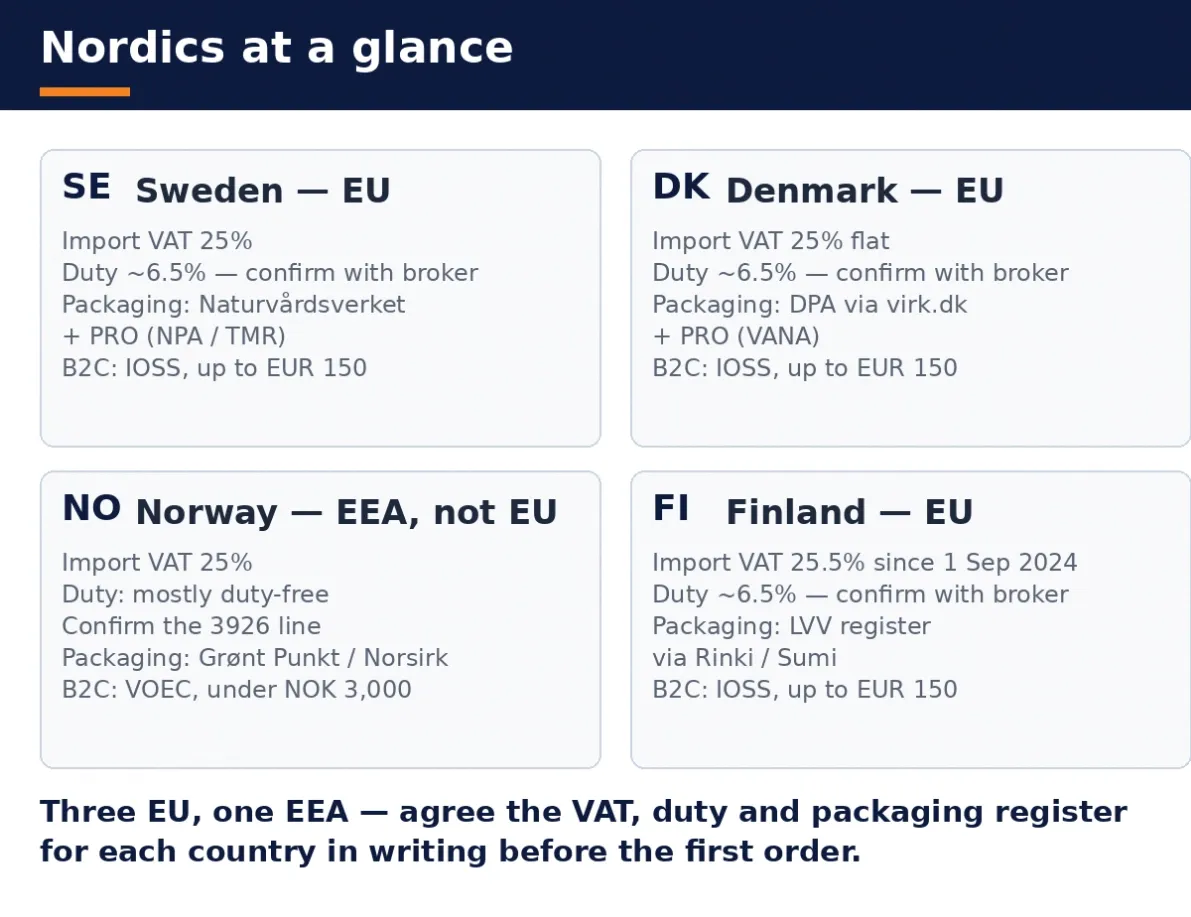
Nordics at a glance
Check | Sweden | Denmark | Norway | Finland |
|---|---|---|---|---|
EU member? | Yes | Yes | No — EEA | Yes |
Import VAT | 25% | 25% | 25% | 25.5% since 1 Sep 2024 |
Duty, plastic cases, B2B | Around 6.5% — confirm with broker | Around 6.5% — confirm with broker | Most manufactured goods duty-free — confirm the 3926 line | Around 6.5% — confirm with broker |
Packaging EPR | Naturvårdsverket + PRO (NPA / TMR) | DPA via virk.dk + PRO (VANA etc.) | Grønt Punkt Norge / Norsirk, no state register | LVV register via Rinki / Sumi |
B2C VAT scheme | IOSS, up to EUR 150 | IOSS, up to EUR 150 | VOEC, under NOK 3,000 per item | IOSS, up to EUR 150 |
Plain case in WEEE? | No | No | No | No |
Apple share (mobile traffic) | Over 56% | 62.4% | Not verified | 37.2% — lowest in the Nordics |
1. Which Nordic country is EU — and why does it matter for your order?
The first question is not about phone cases. It is about which customs territory each country belongs to, because that decides which rulebook your shipment follows. Sweden, Denmark and Finland are EU member states. Norway is in the EEA and EFTA, but it is NOT in the EU customs union. Goods sent to Norway — including goods sent from an EU country — go through Norwegian customs, with Norway's own tariff and its own VAT system. The EU rules do not apply directly in Norway; EEA incorporation happens separately and later.
The EU three. For Sweden, Denmark and Finland, the import rules start from the same EU base: an EORI number is mandatory for any business importing into the EU, a customs declaration is required for imported goods, and an Entry Summary Declaration must be presented before arrival at the first EU point of entry. The duty on plastic phone cases is the EU Common Customs Tariff, and the product sits under HS 3926 90 97 90 — the TARIC mirror shows 6.5% for China into the EU, with no anti-dumping duty shown. Confirm the 10-digit code and the rate with your broker: a mirror is not an official ruling, and only a Binding Tariff Information decision gives legal certainty.
What changed in 2026. The biggest change for the EU three is the end of the EUR 150 duty exemption. Until 30 June 2026, consignments from third countries with an intrinsic value of EUR 150 or less entered the EU duty-free. From 1 July 2026 that exemption is abolished (Council Regulation (EU) 2026/382). In its place, a temporary EUR 3 customs duty per item applies from 1 July 2026 to 1 July 2028 on low-value B2C distance sales — consignments at or under EUR 150 — and a EUR 2 Union handling fee per item applies from 1 November 2026 on every distance sale imported into the EU, whatever its value, and is not refunded if the goods are returned. Product Identifiers became mandatory from 1 November 2026 for B2C distance-sale imports at or under EUR 150.
Why this matters less than it looks — for a bulk buyer. The EUR 3 duty applies to B2C distance sales only. B2B imports are NOT covered by it: a low-value B2B import remains subject to the standard EU customs duty rates — the 6.5% above. A distributor ordering 500 pcs or more per order is a B2B importer, so the EUR 3 and EUR 2 charges are not the charges on your shipment. They matter because they change what your retail customers pay on the small parcels they order direct — and because a supplier who quotes you "EUR 3 per item" on a bulk order is quoting a B2C rule for a B2B order. The IOSS scheme, which lets a non-EU seller charge destination-country VAT at checkout for B2C distance sales, is still capped at EUR 150 per consignment: the Council agreed on 9 November 2026 to remove that cap, but the new rules apply only once the EU Customs Data Hub is operational. Do not write into your plan that IOSS now covers all values — it does not yet.
Norway is a different shipment. None of the EU changes above apply in Norway. The NOK 350 low-value limit was abolished on 1 January 2024, so import VAT and duty apply from the first krone on most goods bought from abroad — except goods handled under the VOEC scheme, which is covered in section 2. Norway's customs declaration system is Digitoll: digital reporting became mandatory from 15 September 2026, and from 1 March 2027 the customs declaration must be submitted before or at the border crossing, with the old direct-transport scheme ending. A Norwegian importer is responsible for paying and reporting duty and taxes even when a customs agent files the declaration. If your freight forwarder still talks about the old direct-clearance arrangement, it ended on 15 September 2026 — ask for the Digitoll filing instead.
What to ask. Ask your broker, in writing, which customs territory each destination belongs to and which declaration system the shipment will be filed under. For the EU three, ask for the 10-digit code and the duty rate on the quote. For Norway, ask whether the shipment will be declared through Digitoll and who holds the Norwegian VAT number. A broker who can answer per country has checked. A broker who answers "the Nordics are all the same" has not.
2. What VAT and duty does a bulk order actually pay?
VAT and duty are two different charges, and a quote that mixes them up is a quote that cannot be checked. VAT is a consumption tax charged at the destination country's rate on the customs value plus duty plus shipping and insurance up to the destination. Duty is an import tariff charged on the product type, origin and value. Both are due on a bulk B2B import — and both are due from the first euro or krone, because there is no low-value VAT exemption left in any of the four countries.
Sweden — 25%. Import VAT is 25% on most goods, calculated on the customs value plus customs duty plus shipping and insurance up to the destination in the EU, and usually also on the handling fee. VAT is always due on goods from outside the EU, regardless of value. VAT-registered businesses report import VAT to the Swedish Tax Agency (Skatteverket) in their VAT return; non-registered importers pay VAT to Swedish Customs (Tullverket). The Swedish equivalent of the EUR 150 threshold is SEK 1,655.30 — the figure that matters only for B2C distance sales, not for your bulk order. Duty on the bulk order is the EU tariff: around 6.5% for plastic cases under HS 3926 90 97 90, from the TARIC mirror — confirm with your broker.
Denmark — 25%, flat. Denmark has had a single 25% VAT rate since 1992, with no reduced categories — food, books and medicine are all 25% too. Import VAT is calculated on the customs value (CIF) plus customs duty plus other charges up to the first place of destination in the EU. Since 1 January 2022, Danish VAT-registered businesses can use postponed accounting for import VAT — reporting it on the VAT return as both output and input VAT instead of paying it at the border. The VAT registration threshold is DKK 50,000 of taxable turnover in any 12-month period, and a non-EU operator must appoint a fiscal representative to register for Danish VAT. All new import declarations have been filed in DMS Import since 14 March 2026. Duty is the same EU tariff as Sweden — around 6.5% from the TARIC mirror, confirm with your broker.
Finland — 25.5%, the highest in the Nordics. Finland's general VAT rate has been 25.5% since 1 September 2024, raised from 24%. The reduced rates of 13.5% and 10% apply to other categories, not to phone cases. The VAT registration threshold is EUR 20,000 a year, raised from EUR 15,000 on 1 January 2025. Duty is the same EU tariff — around 6.5% from the TARIC mirror, confirm with your broker. The half point of VAT is small on one shipment and real across a year of shipments: a distributor who prices Finland like Sweden will under-collect on every order.
Norway — 25%, and duty is the open question. Norwegian import VAT is 25% standard (15% on foodstuffs), charged on the customs value plus any duty plus special taxes and fees plus shipping and insurance. VAT-registered importers report import VAT in their ordinary VAT return instead of paying at the border; non-registered importers pay at customs clearance. Duty is where Norway differs: Norwegian Customs says most manufactured goods enter duty-free, and duty applies mainly to textiles, clothing, agricultural products and foodstuffs. The specific duty line for HS 3926 plastic phone cases in the Norwegian tariff was NOT verified line by line in the research for this guide — so this guide does not state a Norwegian duty rate for phone cases. Ask your broker to check the 3926 line in Tolltariffen in writing before the first shipment. Do not let a supplier quote you a Norwegian duty rate from a chat message.
VOEC — B2C only, and not for your bulk order. Norway's VOEC scheme is the Norwegian equivalent of the EU's IOSS, but it is separate and it is B2C only. A VOEC-registered seller charges 25% Norwegian VAT at checkout for goods to Norwegian consumers, per item under NOK 3,000 excluding shipping and insurance, and files quarterly VOEC returns. Registration is required at NOK 50,000 of sales to Norwegian consumers in a 12-month period. VOEC goods are exempt from customs duty and clear without extra charges at the door. None of that applies to a B2B bulk order: do not charge VAT under VOEC on business sales. A B2B shipment goes through normal Norwegian import — customs declaration, VAT through the importer's VAT return. If a supplier tells you a bulk order to Norway is "VOEC-covered", it is quoting a consumer scheme for a business shipment.
What to ask. Ask for the VAT rate, the duty rate and the 10-digit code for each country, in writing, on the quote — and ask whether the duty figure is a TARIC-mirror reading or a Binding Tariff Information decision. Ask who holds the EORI number for the EU three, and who holds the Norwegian VAT number for Norway. And ask how the import VAT is handled: paid at the border, reported in the VAT return, or postponed under Denmark's postponed-accounting rule. The answers belong on the quote, before the deposit.
3. Who registers the packaging — and where?
Packaging is the part of a Nordic order that catches first-time importers out, because the obligation lands on the producer — the company that places the packaging on the market — and in all four countries that means a registration before the first sale, plus membership of a producer organisation. The registers are different in each country, the deadlines are different, and in Norway there is no state register at all. The EU Packaging and Packaging Waste Regulation, PPWR (EU) 2025/40, entered into force on 11 February 2025 and applies from 12 August 2026: from that date all packaging placed on the market must be recyclable, with EPR producer registration, heavy-metals limits and Declaration of Conformity duties for packaging manufacturers. It applies in the EU three. It does NOT yet apply in Norway — it will start to apply there only after implementation in the EEA Agreement.
Sweden — Naturvårdsverket plus a PRO. Packaging producer responsibility sits under Ordinance (2022:1274), in force since 1 January 2023 and amended for PPWR. Producers register with Naturvårdsverket, the Swedish Environmental Protection Agency, through its EPR e-service before placing packaging on the Swedish market, and must also join an approved producer responsibility organisation — NPA or TMR. There is no de-minimis volume threshold: any producer placing packaging on the Swedish market must register, regardless of amount. The only relief is that producers under one tonne a year are exempt from the SEK 1,250 annual supervisory fee — not from registration. Annual reporting to Naturvårdsverket is due by 31 March. Since 12 August 2026, a producer in another EU country selling directly to Swedish end users must appoint an authorised representative established in Sweden; the agency has proposed extending this to non-EU producers, so a Chinese factory selling direct to Swedish consumers should check this with its importer or representative.
Denmark — DPA, and the clock started on 1 October 2025. Denmark's full financial responsibility for packaging took effect on 1 October 2025. Producers register with Dansk Producentansvar (DPA), the Danish producer-responsibility authority, via virk.dk at least 14 days before first placing packaging on the market. Membership of a collective scheme is mandatory for single-use packaging — VANA is the largest, with Emballageretur, ERP Denmark and others — and reusable packaging still requires DPA registration. There is no registration exemption by size: the obligation is role-based, not size-based, though producers under eight tonnes a year report total weight split by household and commercial and are not subject to fee eco-modulation unless they opt in. Annual reporting to DPA opens on 1 January and closes on 31 May, according to the more recent guides — one source says 31 March, so confirm the current deadline with DPA when you register. The DPA registration fee is a one-off DKK 1,000 per stream for packaging (DKK 500 if already registered under certain other DPA orders), plus annual DPA fees based on quantities. Foreign companies without a Danish establishment that distance-sell to Danish end users must appoint an authorised representative holding a Danish CVR number; for packaging, the treatment of non-EU producers is still evolving — confirm with DPA.
Norway — no state register, join a scheme. Norway's packaging rules sit in Chapter 7 of the Waste Regulations. There is no state register for packaging: the producer joins one of the two main packaging producer organisations, Grønt Punkt Norge (Green Point Norway) or Norsirk, and pays a scheme fee per kilogram. The producer is any company that professionally imports or manufactures packaging or packaged products for the Norwegian market — and if you sell to a Norwegian business, that Norwegian company is the importer and carries the EPR duty. If there is no Norwegian company as producer or importer, an authorised representative can fulfil the duty, but only companies with a Norwegian VAT number can register with a scheme in Norway. Since 1 July 2025 every packaging producer joins a scheme whatever the volume — the old 1,000 kg threshold is gone. There are no mandatory labelling requirements for packaging under the current Norwegian Waste Regulation. And PPWR does not yet apply in Norway, as noted above — do not assume a PPWR-compliant pack is automatically compliant in Norway, or the reverse.
Finland — LVV, and the register changed hands on 1 January 2026. Finland's packaging producer responsibility sits under the Waste Act 646/2011 and Government Decree 1029/2021, with PPWR applying since 12 August 2026. The producer register is supervised by the Permits and Supervision Authority (Lupa- ja valvontavirasto, LVV) since 1 January 2026 — it was previously the Pirkanmaa ELY Centre, and older guides still name ELY, so check which authority your registration is filed with. The normal route is to join a producer organisation — Suomen Pakkaustuottajat Oy, served by Rinki, or Sumi Oy — and the organisation registers the producer. There is no turnover threshold since 1 January 2024: the former EUR 1 million turnover limit was removed, so every business operating professionally is covered. Annual packaging data is reported to Rinki by 31 January, according to the more recent guides — one source says 28 February to the ELY Centre, so confirm the current deadline when you register. Foreign distance sellers must appoint a Finnish representative for listed single-use plastic packaging, and may do so for other packaging.
What to ask. Ask, in writing, who is the producer for your shipment in each country — you, your importer, or your distributor — and who holds the registration. A bulk order that arrives with the packaging unregistered is a shipment that cannot legally be sold on. Ask for the registration number and the scheme membership before the goods ship, not after they arrive.
4. Do plain cases fall under WEEE — and what about battery cases?
The WEEE question is the one buyers ask most often and get the most confused answer to, because the answer depends on what is inside the case. The WEEE Directive (2012/19/EU) covers electrical and electronic equipment — equipment dependent on electric currents or electromagnetic fields to work properly. A plain phone case — plastic, leather or silicone, with no electronics and no battery — is NOT electrical equipment and falls outside WEEE scope. A case with an integrated battery, charging electronics or MagSafe charging circuitry IS electrical equipment, or contains a battery, and DOES fall in scope — with the battery part also covered by the EU Battery Regulation (EU) 2023/1542, whose waste-battery rules moved to that Regulation's Chapter VIII on 18 August 2025.
The split is the same in all four countries; the registers are not. In Sweden, a producer of electrical equipment must register with Naturvårdsverket in the EEB register — the register of electrical and electronic equipment and batteries — even if it joins a collective scheme, and the approved household-EEE collective schemes are El-Kretsen AB and Recipo, with an annual report to the agency by 31 March. In Denmark, all six waste streams — packaging, electronics, batteries, vehicles, single-use plastics and fishing gear — fold into the single DPA register: one DPA registration covers all streams, each with its own timeline and fees. Electronics and batteries sold direct to Danish end users from outside the EU or EEA need a Danish authorised representative for batteries; electronics can register directly. The exact Danish WEEE ordinance number and the DPA electronics reporting deadline were not confirmed in the research for this guide — ask DPA for them when you register, and do not accept a number from a chat message. In Norway, electronics and batteries run through approved schemes and the producer is entered in Registeret Produsentansvar, the register kept by the Norwegian Environment Agency; packaging and batteries have no state register. In Finland, the WEEE system runs under the Waste Act and the WEEE Decree, with practical take-back through approved producer organisations such as SER-Tuottajayhteisö ry and Elker, and batteries through Recser Oy or another approved scheme — batteries embedded in products are included. The exact current WEEE register holder and reporting deadline in Finland, after the LVV takeover on 1 January 2026, were not confirmed — ask the scheme when you register.
GPSR is educational, not a certificate. The General Product Safety Regulation (EU) 2023/988 has applied since 13 December 2024 and replaces the old General Product Safety Directive. It applies in principle to all non-food consumer products, including phone cases. Its key duties for importers and distributors: only safe products may be placed on the market; the manufacturer must carry out an internal risk analysis and keep technical documentation for ten years; a product may not be placed on the EU market unless an economic operator established in the EU is responsible for it — the EU manufacturer, an authorised representative appointed in writing, the importer, or an EU fulfilment service provider; and online offers must show the manufacturer's name and trademark plus postal and electronic address, the EU responsible person's details if the manufacturer is outside the EU, information identifying the product, and warnings and safety information. Instructions and safety information must be in a language easily understood by consumers in the Member State of sale. This is educational information for a buyer: it tells you what to ask for in writing. It is NOT a certification, and this guide does not claim iFunSmart holds GPSR, REACH or RoHS certifications — it does not. GPSR does not apply directly in Norway, where EEA incorporation is pending — another reason Norway needs its own check, not a copy of the EU answer.
Labelling language. No country-specific law was found requiring phone-case packaging to be labelled in Swedish, Danish, Finnish or Norwegian as such. The verified rule is the GPSR one: instructions and safety information in a language easily understood in the country of sale. The practical answer is to provide instructions and safety information in the local language, and to confirm the labelling with your importer. Do not let a supplier quote you a national labelling statute for phone cases — none was verified for any of the four countries.
What to ask. Ask, in writing, whether your styles are plain cases or battery and charging cases — and if any style has a battery or charging circuitry, ask who registers it under WEEE and who holds the battery scheme membership, in each country. Ask who the EU responsible person is for the EU three, and confirm it in writing before the first shipment. A plain case needs no WEEE registration. A battery case that arrives unregistered is a shipment that cannot legally be sold on.
5. What should you stock for each Nordic market?
The four Nordic markets do not buy the same phones, so they do not buy the same cases. The shares below are shares of mobile internet traffic, not sales figures — they show what is in people's hands, not what sold last quarter — but for a distributor deciding how deep to go on each model family, they are the best public signal available.
Sweden — iPhone first, Samsung second, Google rising. As of 2025, Apple topped the ranking of mobile device vendors in Sweden with over 56 percent of the total mobile market, and Samsung came in second with close to 30 percent. The operating-system split is iOS 55.1% against Android 44.8%. Google is the third brand in mobile traffic, and its share grew from 1.7% to 9.9% over the past two years — a range worth watching, not yet worth a deep stock. Stock iPhone cases first, Samsung second, and keep the Google range narrow until the traffic turns into orders.
Denmark — the most iPhone-heavy market in the Nordics. Apple holds 62.4% of mobile internet traffic in Denmark, with iOS at 62.5% against Android at 37.3%. Samsung is second and OnePlus is third. Denmark is the market where an iPhone-first assortment is the clearest call in the region: depth on iPhone 17 and 18 Pro and Pro Max, Samsung second, and no need to spread the range thin across smaller Android brands on the first order.
Finland — the most competitive market, stock evenly. Finland is the most competitive Nordic market in the data: Apple holds 37.2% of mobile internet traffic — the lowest Apple share in Northern Europe — with Samsung second and Xiaomi third, and the Apple–Samsung gap is minimal. Stock iPhone and Samsung evenly in Finland, and keep Xiaomi models in the range — unlike Denmark and Sweden, where iPhone dominates and a Xiaomi line is a later decision. Finland is also the market where the VAT rate is highest (25.5%) and the device mix is widest, so the per-line MOQ question matters most here: the most common MOQ is 50 pcs per colour per model and it varies by product line, so a wide range in Finland is a lot of lines at the MOQ — breadth has a cost, and the order should be built line by line.
Norway — no share figure, so order by the regional pattern. No Norway-specific Apple or Samsung share was obtained in the research for this guide, so this guide states none. The safe reading is the regional one: Apple and Samsung lead across the Nordics, and Apple dominates all Northern European countries in the StatCounter data. Order iPhone first and Samsung second, and ask your Norwegian importer which models their shops actually move before going deep on a third brand.
Where the cases sell. The chains differ by country, and a distributor who knows them can place the range where it will be seen. Sweden: Elgiganten, NetOnNet, MediaMarkt, Webhallen, Amazon.se and CDON. Denmark: Elgiganten, Power, Bilka, CDON and Temu — MediaMarkt's presence in Denmark was not verified, so do not list it for Denmark, and no dedicated amazon.dk storefront was verified either. Norway: Elkjøp, Power, Komplett, NetOnNet and Clas Ohlson — no amazon.no storefront was verified. Finland: Gigantti, Power, Verkkokauppa.com, Prisma and Clas Ohlson. Elgiganten, Elkjøp and Gigantti are the same group under different national names — one buyer relationship can cover three countries, but the import paperwork still has to be done per country.
What to ask. Ask your importer in each country which models their shops move, and build the first order from that list — not from a regional average. Ask for the MOQ per line in writing, and count the lines before the deposit: a first order that covers four countries, two model families and six colours is already a large number of lines, and the bulk threshold of 500 pcs per order in total does not change the per-line MOQ.
6. What does the first order need in writing?
A Nordic first order is not one order. It is four sets of paperwork, four registrations and four stocking decisions, carried on one purchase order. The checklist below is the whole guide in one page: agree each item in writing before the deposit, and the shipment has a chance of clearing, selling and being reordered. Skip an item and the shipment will wait — at the border, at the register, or on the shelf.
1. The customs territory for each destination. Sweden, Denmark and Finland are EU; Norway is EEA, not EU. Confirm which declaration system each shipment is filed under — ICS2 and the EU system for the EU three, Digitoll for Norway — and who files it.
2. The 10-digit code and the duty rate, per country. For the EU three, the TARIC-mirror rate for plastic phone cases under HS 3926 90 97 90 is around 6.5%, with no anti-dumping duty shown — confirm both with your broker, and ask whether the figure is a mirror reading or a Binding Tariff Information decision. For Norway, ask your broker to check the 3926 line in Tolltariffen in writing: no Norwegian duty rate for phone cases is stated in this guide, because none was verified.
3. The VAT treatment, per country. Import VAT is 25% in Sweden, Denmark and Norway, and 25.5% in Finland since 1 September 2024. Ask how it is handled — paid at the border, reported in the VAT return, or postponed under Denmark's postponed-accounting rule — and who holds the EORI number for the EU three and the Norwegian VAT number for Norway.
4. The packaging producer and the registration, per country. Naturvårdsverket plus NPA or TMR in Sweden; DPA via virk.dk plus a PRO in Denmark, registered at least 14 days before the first sale; Grønt Punkt Norge or Norsirk in Norway, with no state register; the LVV register via Rinki or Sumi in Finland. Ask for the registration number and the scheme membership before the goods ship.
5. The WEEE answer, per style. Plain cases are not electrical equipment and fall outside WEEE scope in all four countries. Battery and charging cases fall in scope, with the battery part under the EU Battery Regulation. Ask who registers them, and who holds the battery scheme membership, in each country.
6. The EU responsible person, for the EU three. GPSR requires an economic operator established in the EU to be responsible for the product, and online offers must show the manufacturer, the EU responsible person, the product identification and the warnings. Confirm the responsible person in writing before the first shipment. Norway needs its own check — GPSR does not apply directly there yet.
7. The sample and the approval, before the deposit. The sample proves the case fits the phone: check it on the bench — the case seats fully with no gap at any corner, the buttons click cleanly, the camera cutout does not intrude into the lens field, the magnetic ring holds a charger firmly with the pull force the product page states for that style, the parting lines are clean, the coating adheres and the batch tolerance is even. Samples carry a fee that is refundable on orders of 500+ pcs — ask us to confirm the amount per style in writing. A 100-pc trial order can carry a logo by laser engraving — ask for the per-piece charge and the artwork position in writing. Approve the sample in writing, with the sample reference, the model, the style, the colours and the logo method stated.
8. The payment and the shipment, in writing. Payment is T/T and Western Union only. New customers may pay a 30% deposit first. After the goods are ready, the factory sends photos and video and the packing list; the customer pays the balance, then the goods ship. Ask for the current production window in writing on the quote — no day figure in this guide, because no day figure was verified — and ask which documents travel with the goods and which your broker must arrange. A document that is missing at the port is a shipment that waits at the port.
FAQs
Can I import phone cases into Sweden from China duty-free?
No. A bulk B2B import of plastic phone cases into Sweden pays the EU Common Customs Tariff — the TARIC mirror shows around 6.5% for HS 3926 90 97 90, with no anti-dumping duty shown — plus 25% import VAT. The EUR 3 per-item duty that replaced the EUR 150 exemption on 1 July 2026 applies to B2C distance sales only, not to bulk B2B orders. Confirm the 10-digit code and the rate with your broker before the first shipment.
Do I need to register for packaging EPR in Denmark before my first shipment?
Yes. Register with Dansk Producentansvar (DPA) via virk.dk at least 14 days before first placing packaging on the Danish market, and join a mandatory collective scheme such as VANA. Full financial responsibility for packaging has applied since 1 October 2025, there is no registration exemption by size, and the DPA registration fee is a one-off DKK 1,000 per stream. Annual reporting to DPA opens on 1 January — confirm the current closing date with DPA when you register, as sources differ between 31 May and 31 March.
Is Norway the same as Sweden for phone case imports?
No. Norway is in the EEA but not in the EU, so it runs its own tariff, its own VAT system and its own customs declaration system. Import VAT is 25%, most manufactured goods enter duty-free according to Norwegian Customs — but the specific duty line for plastic phone cases was not verified, so confirm the 3926 line in Tolltariffen with your broker. Online sales to Norwegian consumers use the VOEC scheme (B2C only, per item under NOK 3,000), not the EU's IOSS, and digital customs reporting through Digitoll has been mandatory since 15 September 2026. The EU packaging regulation PPWR does not yet apply in Norway.
What VAT rate applies to phone cases in Finland?
25.5% — the general Finnish VAT rate since 1 September 2024, raised from 24%. The reduced rates of 13.5% and 10% apply to other categories, not to phone cases. The VAT registration threshold is EUR 20,000 a year. Duty is the same EU tariff as Sweden and Denmark — around 6.5% for plastic cases from the TARIC mirror, confirm with your broker — and packaging producer responsibility is registered through the LVV register via Rinki or Sumi, with no turnover threshold since 1 January 2024.
Do plain phone cases need WEEE registration in the Nordics?
No. A plain phone case — plastic, leather or silicone, with no electronics and no battery — is not electrical equipment and falls outside WEEE scope in Sweden, Denmark, Norway and Finland. A case with an integrated battery, charging electronics or MagSafe charging circuitry does fall in scope, with the battery part also covered by the EU Battery Regulation, and must be registered through the national electronics and battery scheme in each country — the EEB register plus El-Kretsen or Recipo in Sweden, the DPA register in Denmark, Registeret Produsentansvar in Norway, and SER or Elker with Recser for batteries in Finland. Confirm the register and the deadlines with the scheme in each country before the first shipment.
About iFunSmart
iFunSmart — Ifun Electronics Technology Co., Ltd — has made phone cases in Guangzhou since 2010, with 1000+ designs, 500+ models and 500K+ pcs a month of capacity, exported to 30+ countries. The factory is 5,000–10,000 sqm with 50 production lines, 20 QC staff and 15 R&D staff, at Yongning Street, Zengcheng District, Guangzhou 511340. The most common MOQ is 50 pcs per colour per model and varies by product line; bulk and distributor orders start at 500 pcs per order in total. Samples carry a fee, refundable on orders of 500+ pcs — ask us to confirm the amount per style in writing. A 100-pc trial order can carry a logo by laser engraving. Payment is T/T and Western Union only, with a 30% deposit for new customers; after the goods are ready the factory sends photos and video and the packing list, the customer pays the balance, then the goods ship. We reply within 24 hours. Contact us on WhatsApp +86 13632248734 or at contact@ifunsmart.com — send your model, style, colours and quantity per line, and ask for the current production window in writing.