Business Solutions
Phone Case Factory in China: Find, Check & Compare
Audit a phone case factory in China by its address, lines, QC staff and mould list. iFunSmart, Guangzhou since 2010 — most common MOQ 50 pcs, 100-pc laser-logo trial.
BLUF
A phone case factory in China is checked by its address, its lines, its QC staff and its mould list — not by its listing. iFunSmart, Guangzhou since 2010, runs 50 lines with 20 QC staff, most common MOQ 50 pcs, and a 100-pc laser-logo trial.
Short answer
"Phone case factory in China" is a distributor's search, not a shopper's search. A shopper wants one case for one phone. A distributor wants a factory that can make the same case again next month, in the same colour, with the same logo, at the same quality — and that is a different question from "who has the lowest price on this listing?".
This guide answers it in the order a buyer should work: how to find a factory, how to check that it is a factory and not a trading company with a catalogue, how to compare two factories on the same questions, the red flags that end the conversation, and the five questions to ask in writing before the deposit. The worked example is one manufacturer: iFunSmart — Ifun Electronics Technology Co., Ltd, in Guangzhou, making phone cases since 2010. Every factory fact in this guide was confirmed in November 2026; every check a buyer should make is a fact that can be verified in writing, not a claim that has to be taken on trust.
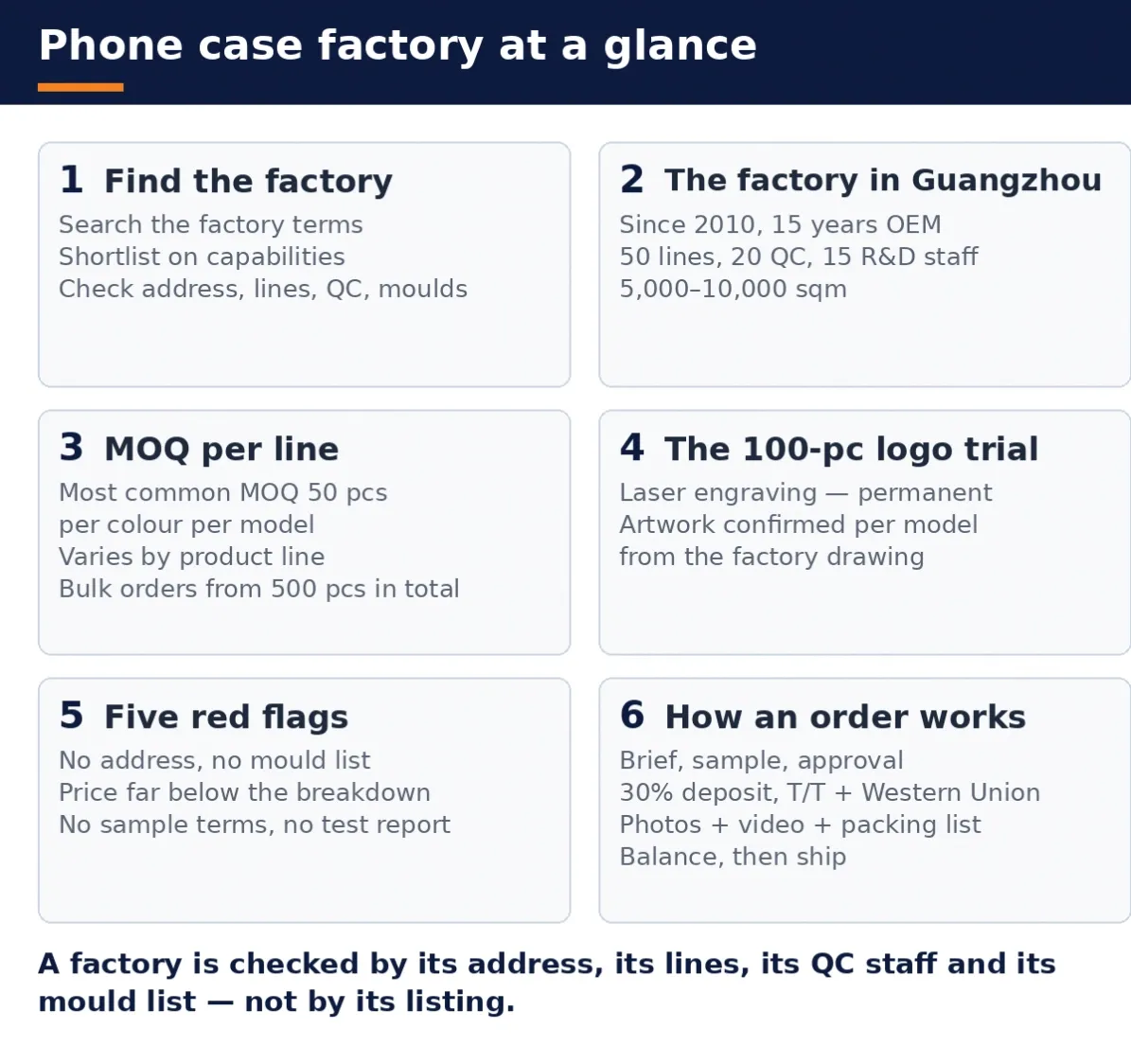
Phone case factory at a glance
1. Why "factory" is the search that matters
Type "phone case factory in China" into a search engine and the first page is a mix of three things: a third-party shortlist of suppliers, marketplace listing pages with thousands of factories, and one or two factory home pages. That mix is the whole problem in one screen. A marketplace page can list 6,000+ verified factories under mobile cases — Made-in-China's figure for the category — and a shortlist can name eight suppliers and explain what each one says it specialises in. Neither of those tells you which factory can make your case, in your colours, with your logo, at your quantity, and make it again next month.
The word "factory" is doing the work in the search, and it is worth being precise about what it means:
- A direct factory makes the case: it holds the mould, runs the injection-moulding machines, prints or engraves the design, checks the goods on its own QC bench and packs them. A quality problem is resolved on the shop floor.
- A trading company does not make the case: it buys the case from a factory and resells it. It can offer a broad catalogue, but it has no direct control over line priority, material consistency or tooling changes. A quality problem is resolved by asking someone else.
Both can have a listing, both can quote a price, and both can call themselves a manufacturer. The difference only shows up after the order — when a colour runs out, when a mould needs a change, when a batch comes back with a fault, when the next order needs the same case again.
A listing is where you find candidates, never where you choose one. A listing shows a price and a minimum; a factory shows a building, a set of tools, a QC bench and a record. And neither a shortlist position nor a marketplace badge is proof of manufacturing capability: a shortlist ranks suppliers by what they say about themselves — its own disclaimer says it is "not an independently audited ranking or a guarantee of performance" — and a marketplace ranks listings by response time, reorder rate and online revenue, which measures how a listing performs, not how a factory performs. The factory check in section 3 is the replacement for both.
2. How to find a factory: the search, the shortlist, the check
Finding a factory has three steps, in this order: search the factory terms, shortlist on capabilities, then check the factory. Skip the second step and the shortlist is a list of names. Skip the third and the shortlist is a list of claims.
Search the factory terms. The search that finds factories is not the search that finds products. "iPhone 18 Pro Max case" finds listings. "Phone case factory in China", "phone case manufacturer Guangzhou", "custom phone case factory China", "phone case OEM factory China" find factories — because they are the terms a factory uses to describe itself. Add the model to the factory term when the model matters: "iPhone 17 Pro case manufacturer Guangzhou" finds the factories that hold that model's moulds; "Samsung Galaxy A-series case factory" finds the ones that hold those. Add the process when the process matters: "phone case factory low MOQ" finds the factories that will talk to a first order; "phone case factory sample order" finds the ones that will send a sample before a bulk order. Each of those search terms is a different buyer question, and each one is answered in this guide.
Shortlist on capabilities. A shortlist is a comparison, not a collection. Take three to five candidates and ask the same six questions of each: what materials and styles does the factory actually make — TPU, PC, liquid silicone, leather, clear, rugged, wallet, folio — and which of those are on live product pages, not just in a catalogue? Which models does it hold moulds for, style by style? What is the MOQ per line — and is it per colour per model, or per order? What are the sample terms — fee or free, refundable on what size of order? What are the payment terms — which methods, what deposit, what the balance depends on? And what is the reply time — hours, or days? A candidate that cannot answer one of those six has not been shortlisted; it has been filed. Section 4 turns the six questions into a comparison table the buyer can fill in for each candidate.
Check the factory. The check is four facts, and they are the same four facts for every candidate. First, the address: a published factory address in an industrial district, not a serviced office and not a residential block. Second, the lines: how many production lines the factory runs, because a factory with one line can only run one model at a time and your order waits behind the order before it. Third, the QC staff: how many people check the goods as they are made, because a factory that checks after packing is a factory that ships its mistakes. Fourth, the mould list: which models the factory holds moulds for, style by style, because a factory that holds the mould can name the models it holds moulds for. Section 3 works those four facts through one factory — iFunSmart — so the buyer can see what a check looks like when it is done properly.
Two cautions about the search itself. The first is about age: a guide updated in November 2026 is current; a guide from two years ago describes a factory as it was two years ago, and factories change moulds, lines and ranges every season. Check the update date on anything the search returns, and treat an undated page as unverified. The second is about the marketplace numbers: a listing's "reorder rate" or "response time" is a marketplace metric, and it measures the listing, not the factory. A fast reply from a trading company is still a reply from a trading company. The factory check is the only check that answers the factory question.
3. The factory check, worked through: iFunSmart, Guangzhou
This section is the check from section 2, done once, in full, on one factory — so a buyer can see what each fact looks like when it is verified, and can ask the same questions of any other candidate.
- The address. iFunSmart is Ifun Electronics Technology Co., Ltd, in Guangzhou, China, at Yongning Street, Zengcheng District, Guangzhou, Guangdong, postal code 511340. The address is published on the company's own contact page, and the facility there is the primary manufacturing hub and R&D centre. An industrial-district address in Zengcheng is a manufacturing address. Ask any candidate for its address in writing, and check that it is a street in an industrial district — not a serviced office in a commercial tower, and not a residential block. A manufacturer that will not publish a factory address is a manufacturer whose factory you cannot verify, and a factory you cannot verify is a factory you should not pay a deposit to.
- The size and the lines. The factory is 5,000 to 10,000 square metres, and it runs 50 production lines. Floor area and line count are the two numbers that tell a buyer whether a factory can run several models at once. Fifty lines means the factory can run the iPhone 17 Pro, the iPhone 18 Pro Max and the Samsung Galaxy S26 Ultra at the same time, on different lines, without one order waiting behind another. A factory with one line runs one model at a time, and a distributor's reorder waits behind the order before it. Ask how many lines the factory runs, and whether your model runs on a line of its own — and ask it in writing, because a line count stated in a chat message cannot be attached to the order.
- The people. Twenty QC staff and 15 R&D staff. Those two numbers are the factory's quality system and its design system, stated as headcount. Twenty QC staff means the factory checks the goods as they are made — fit, construction, lips, corners, parting lines, coating adhesion, batch tolerance, magnet pull force, carton integrity — not after they are packed. Fifteen R&D staff means the factory designs its own range: 1000+ designs and 500+ models, and the mould list below is a design record, not a bought-in catalogue. Ask any candidate for its QC headcount and its R&D headcount, and ask what the QC process covers — because a factory that cannot describe its QC process does not have one to describe.
- The mould list. The factory holds the moulds for 500+ models, and the mould list is what turns that number into a buying decision. A mould list names the models, style by style: two styles name the iPhone 17 Pro outright on their product pages, twelve more cover the iPhone 17 series as a family; the iPhone 18 re-tool shares the iPhone 17 mould and is not finished yet, so an 18 Pro order is a pre-order that holds allocation while the fit is confirmed on a sample; the iPhone 18e needs a new mould and the factory is still deciding whether to open it; the Samsung A38 and A58 have no tooling data yet. That is a mould list with gaps in it — and the gaps are the honest part. A factory that says "we have all models" and cannot list the styles for your model by name does not hold the moulds; it holds a catalogue. The mould-coverage guide in this series lists the range model by model; the point here is the method: ask for the list, in writing, and compare it with the product pages.
The capacity and the reach. The capacity is 500K+ pieces a month, the range is 1000+ designs and 500+ models, and the cases are exported to 30+ countries. Capacity is the number that tells a distributor whether a 500-pc order and a 5,000-pc order are both routine for the factory — and for a factory at 500K+ pieces a month, both are. Reach is the number that tells a buyer whether the factory already ships to markets like theirs — 30+ countries means the factory has already dealt with the import, labelling and packaging questions a new market raises, even if it has not dealt with yours. Neither number is a promise about a specific order; both are facts about the factory, and both are worth checking against any other candidate's numbers on the same basis.
The reply. We reply within 24 hours. A manufacturer that takes a week to answer a first enquiry will take a week to answer a problem with a bulk order. Send the brief, count the hours, and keep the reply time in mind when you choose. It is the cheapest check in this guide, and it is the one buyers most often skip.
4. Comparing factories: the same six questions, asked of every candidate
A comparison only works if every candidate is asked the same questions. Ask one factory about its MOQ and another about its price, and the answers cannot be compared — they are answers to different questions. Ask both the same six questions, and the comparison writes itself.
The table is the framework; the detail is in the answers. Take the mould list first. A factory that holds the mould for your model can name the styles for that model — and it can name the styles that do not exist for it. iFunSmart's list for the iPhone 17 Pro names fourteen styles and names the gaps beside them: no leather wallet naming the Pro, no liquid silicone naming the Pro, n o aramid anywhere on the site. A candidate whose list has no gaps has not been checked; it has been copied. Gaps are not a weakness. A list with no gaps is.
Take the MOQ next. The most common MOQ is 50 pcs per colour per model, and it varies by product line — so the MOQ is counted per colour per model, not per order, and it is confirmed per line on the quote, never assumed. Across the iFunSmart catalogue the lines differ: the IPDK Duo line is 100 pcs, the ISF Samsung line is 50, the IP leather line is 50 for IP001–007 and 30 for IP008–018, the IQ line is mostly 30, and the IPD line runs 20, 30 or 50 by style. A factory that quotes one MOQ for its whole catalogue is quoting a number that cannot be true for every line — and a buyer who assumes 50 everywhere will under-order a Duo line and over-order a leather line. Bulk distributor orders start at 500 pcs per order in total, counted across the order's lines. Ask each candidate for the MOQ per line, and get it on the quote.
Take the sample terms next. Samples carry a fee that is refundable on orders of 500+ pcs — ask us to confirm the amount per style in writing. The sample is where the fit is confirmed, and the sample terms are where a factory shows whether it stands behind its own goods: a factory that charges a fee and refunds it on a bulk order is a factory that expects the sample to lead to an order. A factory that offers a free sample with no terms attached is offering something it has not thought through — and a factory that will not send a sample at all is a factory that does not want its goods checked. The sampling guide in this series covers the bench checks in full: fit at every corner, buttons that click cleanly, a camera cutout that does not intrude into the lens field, a magnetic ring that holds a charger firmly, parting lines, coating adhesion, batch tolerance, magnet pull force against the figure the product page states for that style.
Take the custom logo next. A 100-pc trial order can carry a logo by laser engraving, which is permanent — the logo is cut into the surface, not printed onto it. The print methods are UV printing, IMD, silk screening, heat transfer and sublimation, which needs a compatible coated blank. Each method has its own limits: UV carries full colour and photographic detail; IMD seals the graphic inside the moulded wall so it cannot peel or scratch off; silk screening lays the graphic through a mesh stencil in spot colours, with no gradients; heat transfer moves a graphic layer onto the case with heat and pressure. The right method is the one that fits the design, and the factory should be able to say which method fits which design — in writing, before the deposit. A candidate that promises any logo, on any quantity, by any method, has not read the design.
Take the payment terms last, because they are the terms the deposit depends on. Payment is T/T and Western Union only. New customers may pay 30% deposit first. After the goods are ready, the factory sends photos and video and the packing list; the customer pays the balance, then the goods ship. Get the deposit terms on the quote, in writing, with the balance terms beside them, before the deposit is sent. A quote that shows the style, the model, the colours, the logo method, the quantity per line, the deposit terms and the sample terms is a quote that has been finished. A quote that does not show the sample terms is a quote that has not been finished — and a price far below the quote breakdown is a price that has cut something out of it: the material, the magnet, the QC check, or the packaging.
- Red flags: when to walk away from a factory
Five red flags end the conversation with any manufacturer, and they are worth listing plainly because each one is a shortcut that costs more than it saves.
No factory address. A manufacturer that will not publish a factory address — or that gives a serviced office, a residential block, or an address that does not exist on a map — is a manufacturer whose factory you cannot verify. Ask for the address in writing. If it does not come, stop.
No mould list. A manufacturer that says "we have all models" and cannot list the styles for your model by name does not hold the moulds. Ask for the list in writing. If the list does not come, or if it comes as a catalogue with no model beside each style, stop. The 17 Pro example in section 3 shows what a real list looks like: fourteen styles, two tiers, and the gaps named beside them.
A price far below the quote breakdown. A quote should show the style, the model, the colours, the logo method, the quantity per line, the deposit terms and the sample terms. A price that undercuts every line of that breakdown is a price that has cut something out of it — the material, the magnet, the QC check, or the packaging. The too-cheap-quote guide in this series covers the same logic in full: a quote that cannot be broken down cannot be trusted, and a price with no breakdown behind it is a claim, not a fact. No price is stated in this guide, and no price should be stated in any guide: ask for the quote, read the breakdown, and compare breakdowns, not headlines.
No sample, or no sample terms. A factory that will not send a sample before a bulk order does not want its goods checked. A factory that sends a sample with no terms — no fee, no refund condition, no per-style amount — has not thought through what the sample is for. The sample is the only check that happens on the real goods, and a factory that skips it is asking the buyer to skip the only check that matters.
A drop claim with no test report. Product pages carry drop wording — "military-grade", a height in feet, a count of tests — and a factory that repeats a drop figure without a test report behind it is repeating a claim, not a fact. The drop-protection guide in this series explains how to read those figures: what MIL-STD-810H actually tests, what a test report should show, and what to ask for in writing. A factory that can show the report has a figure. A factory that cannot show the report has a slogan. Never accept a drop rating, a drop height or a military standard for a case whose test report you have not seen.
One more flag, because it is the one that shows up after the goods arrive: a factory that will not put anything in writing. A mould confirmation in a chat message cannot be found later, cannot be attached to the order, and cannot be shown to the factory when the goods arrive wrong. Every answer in this guide — the mould list, the MOQ per line, the sample terms, the logo method, the deposit terms — is an answer that belongs on the quote, in writing, before the deposit. A manufacturer that will only talk in chat is a manufacturer that will only answer in chat when the problem arrives
6. From first contact to first order
An order has five steps, in this order: the brief, the sample, the approval, the deposit, and the shipment. Each step has one document, and the document is what the next step runs on. Skip a step, and the step after it has nothing to run on.
The brief. Send the model, the style, the colours, the logo method and the quantity — in writing, on the RFQ. The model is the exact model: iPhone 17 Pro, not "iPhone 17" and not "the Pro". The style is the style by name. The colours are the colours by name, from the product page's list. The logo method is the method: laser engraving, UV printing, IMD, silk screening. The quantity is the quantity per colour per model, because the most common MOQ is 50 pcs per colour per model and it varies by product line — so the quantity is stated per line, not per order. A brief that says "500 cases" has not said how many of which model, in which colours, and the factory cannot quote it. The RFQ guide in this series lists everything the brief should carry.
The sample. Samples carry a fee that is refundable on orders of 500+ pcs — ask us to confirm the amount per style in writing. Check the sample the way a factory QC bench checks it: the case seats fully on the phone, the corners wrap with no gap, the buttons click cleanly, the camera cutout does not intrude into the lens field, the magnetic ring holds a charger firmly, and the documents that came with it are complete. Check the stand the same way: cycle the camera stand and the ring stand open and shut on the bench sample and check each sits flush when closed and holds the phone at its working angle when open, and check the hinge friction is even. The sampling guide in this series covers the bench checks in full.
The approval. Approve the sample in writing — the style, the colour, the logo position, the packaging — before the deposit. An approval in a chat message is not an approval: it cannot be found later, it cannot be attached to the order, and it cannot be shown to the factory. Approve by email, with the sample reference, the model, the style, the colours and the logo method stated. If the sample is wrong, say so in the same email, with the correction stated — a new colour, a moved logo, a different style — and wait for the corrected sample. A correction after the deposit is a rework, and a rework is charged.
The deposit. Payment is T/T and Western Union only. New customers may pay 30% deposit first. The deposit is paid after the approval, not before it — the approval is what the deposit is paying for. No other payment methods are offered. Get the deposit terms on the quote, in writing, with the balance terms beside them, before the deposit is sent.
The shipment. After the goods are ready, the factory sends photos and video and the packing list. The customer pays the balance, then the goods ship. Check the photos and the video against the approved sample — the style, the colour, the logo, the packaging — and check the packing list against the order: the model, the style, the colours and the quantities, line by line. If something does not match, say so before the balance is paid, because the balance is the last point at which a correction is cheap. After the balance, the goods ship, and the shipment is the order as it was made.
One note on timing, because it is the question every buyer asks and the one this guide will not answer with a number. How long an order takes
depends on whether the mould is ready, whether the material is in stock, how large the order is, and how the QC and freight are arranged — and every one of those varies by order. The lead-time planning guide in this series covers the factors in full. For this guide, the rule is one sentence: ask us for the current production window in writing, for your model and your quantity, and do not accept a date that is not on the quote.
- Five questions to ask any phone case factory in writing
A first order is only as strong as the answers behind it. Ask these five questions in writing — on the RFQ, not in a chat message — and keep the answers with the order. A factory that holds the moulds will answer all five without difficulty. A factory that cannot answer them has told you what its "we have all models" claim is worth.
- What is your factory address, and how many production lines, QC staff and R&D staff do you have? The address, the lines and the headcount are the factory check. A factory that will not state them in writing has not been checked.
- Which styles exist for my model by name — and which do not? Ask for the mould list with the model beside each style. A style that exists for the Pro Max does not exist for the Pro until the factory says so. If a style is not on the list, it is not on the order.
- What is the MOQ per line, and what counts toward the bulk threshold? The most common MOQ is 50 pcs per colour per model, and it varies by product line — so ask per line. Ask what counts toward the 500-pc bulk threshold, and get the answer on the quote.
- What does the quote show — and what does the sample cost? A quote should show the style, the model, the colours, the logo method, the quantity per line, the deposit terms and the sample terms. Ask for the sample fee per style in writing, and whether it is refundable on orders of 500+ pcs. A quote that does not show the sample terms is a quote that has not been finished.
- What does the 100-pc trial cover — and what does it not? Ask whether a 100-pc trial order can carry your logo by laser engraving, what the per-piece charge is, and where the logo sits on the case. A trial covers design, fit and colour — it does not set the bulk unit price. Get the trial terms on the quote, in writing, before the deposit.
Finding a phone case factory in China is not hard — the search returns thousands of them. Finding the right one is a check, not a search: an address in an industrial district, lines that can run your model, QC staff who check the goods as they are made, a mould list that names your model style by style, and five answers in writing before the deposit. A distributor that does the check has bought a case that fits the phone it was made for, from a factory that can make it again next month. A distributor that buys the listing has bought a shortcut — and a shortcut is the most expensive thing in a bulk order, because it is paid for twice: once in the deposit, and once in the dead stock.
FAQs
Q1: How do I find a phone case factory in China? Search the factory terms — “phone case factory in China”, “phone case manufacturer Guangzhou”, “custom phone case factory China”, “phone case OEM factory China” — and add your model when it matters: “iPhone 17 Pro case manufacturer Guangzhou” finds the factories that hold that model's moulds. Shortlist three to five candidates on the same six questions: styles on live product pages, mould list by model, MOQ per line, sample terms, payment terms and reply time. Then check the factory: a published address in an industrial district, the number of production lines, the QC headcount and the mould list, style by style. iFunSmart — Ifun Electronics Technology Co., Ltd, Guangzhou — has made phone cases since 2010, runs 50 production lines with 20 QC staff and 15 R&D staff at Yongning Street, Zengcheng District, and holds the moulds for 500+ models. Send a written brief — model, style, colours, logo method and quantity per line — and ask for the tooling status, the MOQ per line and the sample terms on the quote. We reply within 24 hours.
Q2: How can I tell if a phone case supplier is a real factory? Four facts, all verifiable in writing: a published factory address in an industrial district, the number of production lines, the QC headcount and the R&D headcount, and a mould list that names the styles for your model by name. A factory makes the case — it holds the mould, runs the machines, prints or engraves the design, checks the goods and packs them. A trading company buys the case from a factory and resells it, and the difference shows up after the order: when a colour runs out, when a mould needs a change, when a batch comes back with a fault. A shortlist position or a marketplace badge is not proof of manufacturing capability — both measure how a listing performs, not how a factory performs. Ask for the address, the lines, the QC staff and the mould list in writing; a factory that cannot give them has told you what its “manufacturer” claim is worth.
Q3: What is the MOQ from a phone case factory in China? The most common MOQ is 50 pcs per colour per model, and it varies by product line — so the MOQ is counted per colour per model, not per order, and it is confirmed per line on the quote, never assumed. Across the iFunSmart catalogue the lines differ: the IPDK Duo line is 100 pcs, the ISF Samsung line is 50, the IP leather line is 50 for IP001–007 and 30 for IP008–018, the IQ line is mostly 30, and the IPD line runs 20, 30 or 50 by style. Bulk distributor orders start at 500 pcs per order in total, counted across the order's lines. A 100-pc trial order can already carry a logo by laser engraving — confirm the per-piece charge and the artwork position in writing. Samples carry a fee that is refundable on orders of 500+ pcs — ask us to confirm the amount per style in writing. No price is stated in this guide; ask us for a quote with the style, model, colours, logo method and quantity stated.
Q4: Can I order custom phone cases from a factory in Guangzhou? Yes — a custom case is a standard shell with your design on it, and the design is where the order starts. The print methods are UV printing, IMD, silk screening, heat transfer and sublimation, which needs a compatible coated blank — and laser engraving for the logo trial. A 100-pc trial order can carry a logo by laser engraving, which is permanent; the per-piece charge and the artwork position are confirmed in writing per order. The printable area is confirmed per model from the factory drawing, never guessed. Send a written brief — model, style, colours, logo method and quantity per line — and ask for the tooling status, the MOQ per line and the sample terms on the quote. Check the sample on the bench: fit at every corner, buttons that click cleanly, a camera cutout that does not intrude into the lens field, and a magnetic ring that holds a charger firmly. Approve the sample in writing before the deposit. Payment is T/T and Western Union only; new customers may pay 30% deposit first; after the goods are ready the factory sends photos and video and the packing list, the customer pays the balance, and then the goods ship. We reply within 24 hours.
Q5: How much does it cost to order phone cases wholesale from a factory in China? No price is stated in this guide, because a price without a breakdown behind it is a claim, not a fact. What a quote should show is the style, the model, the colours, the logo method, the quantity per line, the deposit terms and the sample terms — and the unit price moves with the quantity, so a 100-pc trial does not set the price of a 5,000-pc order. Ask us for a quote with the style, model, colours, logo method and quantity stated, and compare quotes by their breakdowns, not by their headlines: a price far below the breakdown has cut something out of it — the material, the magnet, the QC check, or the packaging. The most common MOQ is 50 pcs per colour per model, bulk distributor orders start at 500 pcs per order in total, samples carry a fee refundable on orders of 500+ pcs, and payment is T/T and Western Union only with 30% deposit for new customers. We reply within 24 hours.
About iFunSmart
iFunSmart — Ifun Electronics Technology Co., Ltd, Guangzhou, China — has made phone cases since 2010: 1000+ designs, 500+ models, 500K+ pieces a month, exported to 30+ countries. We reply within 24 hours. Send your brief — model, material, colours, logo and quantity — and we will quote it line by line, send a sample (fee refundable on orders of 500+ pcs), and confirm the fit, the MOQ and the inspection records in writing before your deposit. WhatsApp: +86 13632248734 — https://wa.me/8613632248734 — or email contact@ifunsmart.com — or visit www.ifunsmart.com.
Read more
Phone Case Factory vs Trading Company: How to Tell Before You Order — https://www.ifunsmart.com/posts/phone-case-factory-vs-trading-company
How to Source Phone Cases from China: First-Order Checks — https://www.ifunsmart.com/posts/how-to-source-phone-cases-from-china-first-order-checks
Top Wholesale Phone Case Suppliers in China Compared — https://www.ifunsmart.com/posts/top-wholesale-phone-case-suppliers-china-how-distributors-compare
iPhone 17 Pro Case Manufacturer in Guangzhou — https://www.ifunsmart.com/posts/iphone-17-pro-case-manufacturer-in-guangzhou
Custom iPhone 18 Pro Cases: Same Shell as the 17 Pro? — https://www.ifunsmart.com/posts/custom-iphone-18-pro-cases-same-shell-as-17-pro
Phone Case RFQ: What to Send a Factory in Your First Enquiry — https://www.ifunsmart.com/posts/phone-case-rfq-what-to-send-a-factory-in-your-first-enquiry
Phone Case Sampling: How to Evaluate a Sample Before a Bulk Order — https://www.ifunsmart.com/posts/phone-case-sampling-how-to-evaluate-a-sample-before-bulk
Mixed-Model Phone Case Orders: How to Combine Models — https://www.ifunsmart.com/posts/mixed-model-phone-case-orders-how-to-combine-models