Business Solutions
Phone Case Factory Lead Times: What Actually Sets the Date
A phone case factory lead time is set by mould readiness, material stock, order size, QC and freight — not by one number. What to ask for in writing, and how to plan around it.
BLUF
A phone case lead time is not one number. It is the sum of mould readiness, material stock, order size, sample approval, QC and freight — and the slowest of them sets the date. Ask for the current production window in writing, and plan backwards from your selling date.
Short answer
A buyer who asks "how long will my order take" is asking the wrong question, because there is no single answer. A phone case order moves through six stages, and each stage has its own condition: the mould must exist, the material must be in stock, the order must fit the line schedule, the sample must be approved, the goods must pass QC and be packed, and the freight must be booked. The date the goods arrive is the date the slowest stage finishes — not the date the fastest stage promises.
That is why two orders that look identical on paper can arrive weeks apart. One uses a mould that already exists and a material that is already in stock. The other needs a new mould, a custom colour, a logo method the factory has not run for that style, and a retail pack the buyer designed last week. The factory did not get slower. The order got longer.
The six stages below are worked through one manufacturer — iFunSmart, Ifun Electronics Technology Co., Ltd, in Guangzhou, making phone cases since 2010 — so a buyer can see what each stage looks like when it is done properly. This guide states no day figures anywhere: no sample days, no production days, no transit days. Every timing is a condition to check and a question to ask on the quote, because a number given in a chat message is a promise the factory has not made, and a window given on the quote is one the buyer can hold it to.
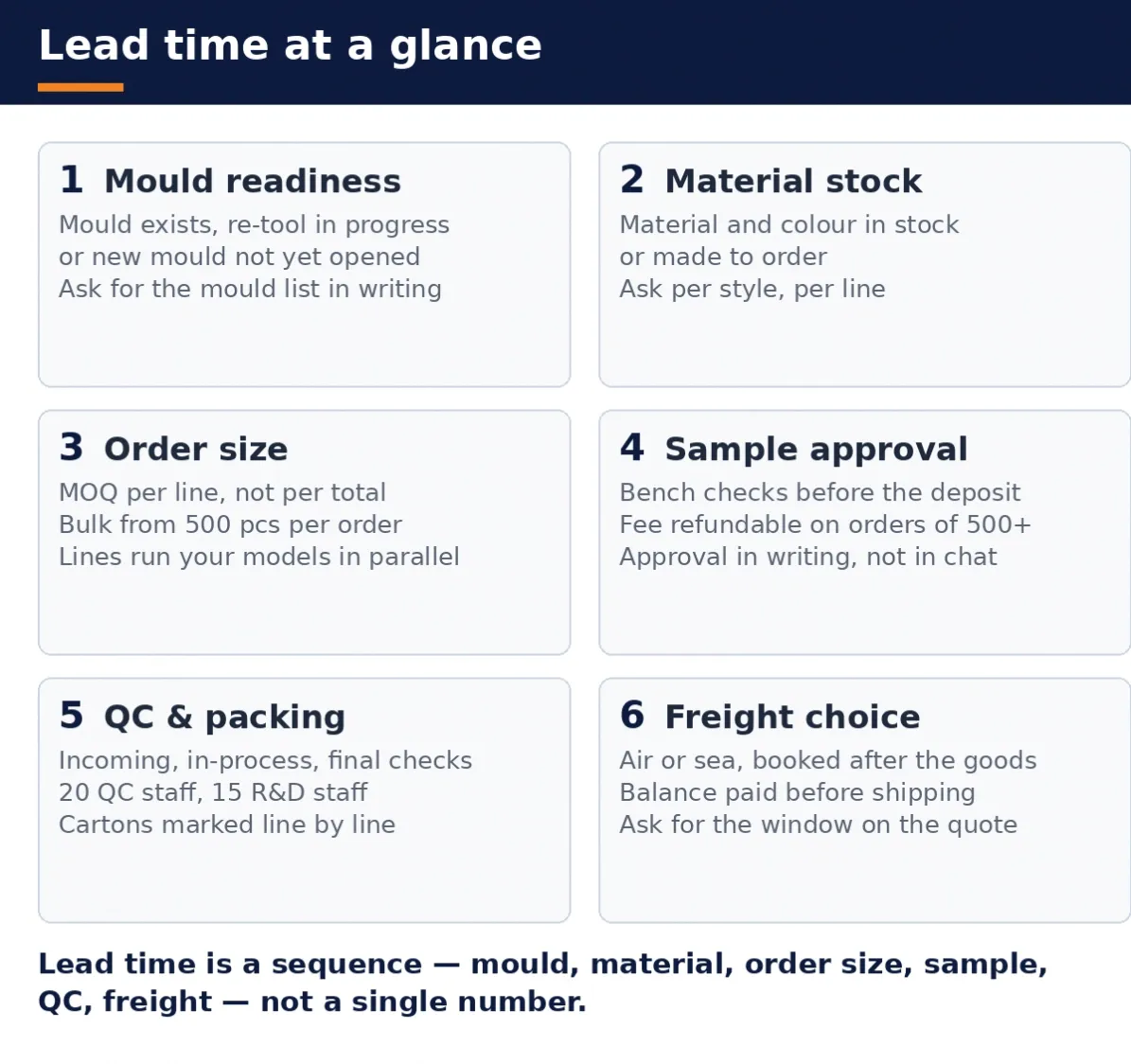
Lead time at a glance
Stage | What sets it | What to ask for |
|---|---|---|
Mould readiness | The mould exists, is being re-tooled, or is new | Mould list for your model, in writing |
Material stock | The material and colour are in stock or made to order | Material and colour availability per style |
Order size | Lines, quantity per line, mixed models | Line schedule and MOQ per line, on the quote |
Sample approval | The sample is approved before production | Sample terms and approval in writing |
QC and packing | Checks, records, carton marking | QC process and packing list in writing |
Freight | The freight method and booking | Current window and method, in writing |
1. What does "lead time" actually cover?
Lead time is the whole order, not the production run. A buyer who counts only the days the machines run is counting the shortest part of the job and missing the rest of it. The order starts when the brief is sent and ends when the goods arrive — and between those two points there are six stages, each with its own condition and its own delay.
The brief and the quote. The order starts with a brief: model, style, colours, logo method and quantity per line. The factory answers with a quote that shows the style, the model, the colours, the logo method, the quantity per line, the deposit terms and the sample terms. A quote that does not show the sample terms is a quote that has not been finished. The brief is also where the first delay hides: a brief that does not name the model, or that names a style without a colour, or that asks for a logo without saying which method, goes back for questions before anything else happens. Send the brief once, completely, and the quote comes back once, completely.
The sample. Before the bulk order, the sample proves the case fits the phone. It is made on the same mould, from the same material, by the same factory that will make the bulk order, and it is checked on the bench before the deposit. The sample carries a fee that is refundable on orders of 500+ pcs — ask us to confirm the amount per style in writing. The sample stage ends when the buyer approves it in writing, with the sample reference, the model, the style, the colours and the logo method stated. Section 5 covers the bench checks and the approval in full.
Production. Production is the stage buyers picture when they hear "lead time", and it is the stage the other five stages feed into. Production cannot start until the mould exists, the material is in stock, the sample is approved and the deposit is paid. A factory that starts production before the sample is approved is a factory that will rework the order — and a rework is charged.
QC and packing. After production, the goods are checked — incoming, in-process and final — and packed. The packing line is where the goods are counted and boxed, and where the cartons are marked with the model, the style, the colours and the quantities, line by line, so the carton that arrives can be checked against the order that was placed. A mixed-model order is packed one row per model, style and colour, from the order row to the carton, because a mixed order packed as one mixed carton cannot be checked on arrival.
Freight. Freight is the last stage and the one the buyer controls least. The freight method — air or sea — and the booking are set after the goods are ready, and the goods are not shipped until the balance is paid. Payment is T/T and Western Union only. New customers may pay 30% deposit first. After the goods are ready, the factory sends photos and video and the packing list; the customer pays the balance, then the goods ship. The balance is paid after the goods are checked, not before — and the goods ship after the balance, not before it.
The date. The date the goods arrive is the date the slowest stage finishes. A buyer who plans from the fastest stage plans from a date that does not exist. Plan from the slowest stage, ask for the current production window in writing, and plan backwards from the selling date — not forwards from the order date.
2. Is your model already tooled?
Mould readiness is the first stage and the longest variable in a custom case programme. Tooling is usually the largest fixed cost and the longest lead item, so it deserves specific questions rather than a general assurance. A mould that already exists costs the order nothing in time. A mould that is being re-tooled costs the order the re-tool. A mould that does not exist yet costs the order the whole tool — and the tool is cut, trialled, corrected and approved before a single sellable case is made.
Existing moulds. iFunSmart holds the moulds for 500+ models, with 1000+ designs and 15 R&D staff behind them. An existing mould means the style for your model can go straight to the sample stage: the mould list names the styles for your model by name, with the gaps named beside them. A mould list with gaps in it is an honest list. A candidate whose list has no gaps has not been checked; it has been copied. Compare the list with the live product pages: a style that exists on a product page should be on the list, and a style on the list should exist on a product page. If the two do not match, ask which one is wrong.
Re-tools. A re-tool shares the mould of an earlier model and adapts it to the new one. The iPhone 18 re-tool shares the iPhone 17 mould — and it is NOT done yet. Pre-orders are open, and a pre-order holds allocation while the fit is confirmed on a sample. The iPhone Air 2 re-tool shares the iPhone Air mould, on the same terms: pre-order open, fit confirmed on a sample. A re-tool is not a finished mould, and a buyer who orders on the assumption that it is has ordered a date that does not exist yet. Ask whether the re-tool is finished, in writing, and ask what the pre-order holds: allocation, or a shipping date. The answer is allocation. The shipping date is set when the fit is confirmed on the sample.
New moulds. A new mould is cut for a model the factory has not tooled before. The iPhone 18e needs a NEW mould, and the factory is still deciding whether to open it — so an 18e order is a question, not a date, and no date should be promised for it. The Samsung A38 and A58 have no tooling data yet: no mould, no re-tool, no decision. A buyer who needs a model with no tooling data should ask the factory to confirm, in writing, whether the mould will be opened and what the decision depends on — and should not plan a selling date around an answer that has not been given.
What to ask. Ask for the mould list for your model, in writing, with the status of each style: existing, re-tool in progress, or new mould not yet opened. Ask who owns the tool if you pay for it, and what happens to it when the order ends. And ask whether the mould is shared or reserved: a shared mould is cheaper because the tooling cost is spread across customers, while a reserved mould costs more but keeps your geometry, surface texture and colour standard out of another brand's order. Either can be correct — what matters is that you know which one you are buying, and that it is written down.
3. Is the material in stock?
Material stock is the second stage, and it is the one buyers most often forget to ask about — because the material is named on the product page, and a name on a page looks like a promise. It is not. A material is in stock, or it is made to order, and the difference is the difference between starting production and waiting for the material to arrive.
Standard materials. The four materials in this series are TPU, PC, liquid silicone and leather. Each one behaves differently, and each one is stocked differently. TPU and PC are the workhorses: the moulding material for most styles, held in the grades the factory runs every week. Liquid silicone is a different process — a softer, skin-feel material that is moulded and finished separately. Leather is a different supply chain again: a folio or wallet case is cut, stitched and assembled, and the leather grade and colour are a separate stock line. A style that uses a standard material in a standard colour starts from stock. A style that uses a non-standard material, or a standard material in a custom colour, starts from an order — and the order has its own window.
Colours. Colour is a material question, not a design question. The most common MOQ is 50 pcs per colour per model, and it varies by product line — so a colour that is not in stock is a colour that must be made, and a colour that must be made is a colour with its own window. The colour charts in this series show the range: liquid silicone in ten named colours, the Star Grid R2 in six, the Litchi Two-Tone in eight, the Tech Fabric in nine. A colour on the chart is a colour the factory has run. A colour off the chart is a colour the buyer should ask about in writing — whether it can be matched, what the minimum is, and whether it changes the window. Never assume a colour is in stock because it is on the chart: the chart shows what the factory can make, not what it holds today.
Magnets and hardware. A magnetic case is not just a case with a magnet in it. The magnetic ring, the stand, the hinge, the card slot and the metal camera frame are each a component with its own stock line. The magnetic figures differ by style — the product pages state them per style, and no single Gauss figure should be accepted as a factory-wide fact — and the ring material, the hinge friction and the stand mechanism are each checked on the bench sample. A style with a metal camera frame or a rotating ring stand has more components than a plain clear case, and more components means more stock lines to check. Ask which components are in stock for your style, in writing, and ask what happens if one is not: is the order held, or is the component substituted? The answer should be that the order is held and the buyer is told — a substitution without telling the buyer is a change to the order the buyer did not approve.
What to ask. Ask for the material and the colour availability for your style, in writing, per line. Ask whether the material is in stock today or made to order, and ask what the current production window is for that material and colour. A factory that can answer per line has checked its stock. A factory that answers "we have all materials" has not.
4. How big is the order?
Order size is the third stage, and it is the one that looks simplest and misleads most. A bigger order does not take proportionally longer — it takes longer in steps, because a factory runs lines, not hours. iFunSmart's factory is 5,000 to 10,000 square metres and runs 50 production lines, which means it can run the iPhone 17 Pro, the iPhone 18 Pro Max and the Samsung Galaxy S26 Ultra at the same time, on different lines, without one order waiting behind another. A factory with one line runs one model at a time, and a distributor's reorder waits behind the order before it.
MOQ per line. The most common MOQ is 50 pcs per colour per model, and it varies by product line: the IPDK Duo line is 100, the ISF Samsung line is 50, the IP leather line is 30 to 50, the IQ line is mostly 30, the IPD line is 20, 30 or 50 by line. The MOQ applies per line — per model, per style, per colour — not per order in total. A buyer who orders five colours of one style has ordered five lines, not one. The mixed-model guide in this series covers this in full: one row per model, style and colour, from the order row to the carton, because a mixed order that is packed as one mixed carton cannot be checked on arrival.
Bulk orders. Bulk and distributor orders start at 500 pcs per order in total. A 500-pc order is not ten 50-pc orders run one after another: it is one order run on the lines the factory assigns to it, with one PI, one freight booking and one packing list. The bulk threshold is a total, not a line — and the question to ask is not "how long does 500 pcs take" but "which lines will run my order, and what is the current production window for those lines". A factory that can name the lines can name the window. A factory that cannot name the lines has not scheduled the order.
Too many SKUs. The opposite problem is an order with too many lines and too few pieces per line. A distributor who orders twenty styles in five colours each has ordered a hundred lines at the MOQ — and a hundred lines is a hundred setups, a hundred material checks and a hundred packing rows. The order is not wrong, but it is long, and the buyer should know it is long before the deposit is paid. The reorder guide in this series covers the other side of the same question: a reorder of a best seller is one line, one colour, one style — and it moves faster than a first order of the same size, because the mould exists, the material is known, the sample is approved and the line has run it before.
What to ask. Ask for the MOQ per line, in writing, on the quote — and ask what counts toward the 500-pc bulk threshold. Ask which lines will run the order and what the current production window is. And ask what happens if the order grows after the quote: does the window move, or does the factory add a line? The answer belongs on the quote, in writing, before the deposit.
5. What does the sample add to the calendar?
The sample is the fourth stage, and it is the stage that buyers most often try to skip — because it looks like a delay, and it is a delay, but it is the delay that prevents the longer one. A sample that is skipped is a bulk order that is made on an unapproved design, and a bulk order made on an unapproved design is a bulk order that is reworked. A rework is charged, and a rework takes longer than the sample did.
What the sample proves. The sample proves the case fits the phone. Check it the way a factory QC bench checks it: the case seats fully with no gap at any corner, the buttons click cleanly, the camera cutout does not intrude into the lens field, the magnetic ring holds a charger firmly with the pull force the product page states for that style, the parting lines are clean, the coating adheres, the batch tolerance is even, and the carton is intact and marked with the model, the style and the colour. Check the moving parts the same way: cycle the camera stand, the ring stand and the slide cover open and shut on the bench sample and check each sits flush when closed, holds the phone at its working angle when open, and runs with even hinge friction.
What the sample costs. Samples carry a fee that is refundable on orders of 500+ pcs — ask us to confirm the amount per style in writing. A 100-pc trial order can carry a logo by laser engraving — ask for the per-piece charge and the artwork position in writing. The trial covers design, fit and colour: it does not set the bulk unit price, and it does not prove the factory can make the same case again next month. Get the trial terms on the quote, in writing, before the deposit.
What the approval covers. Two questions belong with the sample, and both must be answered in writing before the deposit. First: is the sample made on the same mould, from the same material, by the same factory that will make the bulk order — and if any of those three changes between the sample and the bulk order, who tells the buyer, and when? Second: what does the sample approval cover — the style, the colour, the logo position, the packaging — and is the approval recorded in writing, with the sample reference, the model, the style, the colours and the logo method stated? A sample from a different mould is not a sample of the order. A sample from a different factory is not a sample at all.
What a correction costs. If the sample is wrong, say so in the same email, with the correction stated — a new colour, a moved logo, a different style — and wait for the corrected sample. A correction after the deposit is a rework, and a rework is charged. The sampling guide in this series covers the bench checks in full. The point here is narrower: the sample is a stage, not a formality, and the calendar should show it as one. A buyer who plans the order without the sample stage has planned a date that the factory cannot meet, because the factory will not start production on an unapproved sample.
6. What do QC and packing add?
QC and packing are the fifth stage, and they are the stage that buyers see least — because they happen after production, inside the factory, and the buyer sees only the result: the photos, the video and the packing list that arrive with the goods-ready notice. But QC and packing are a stage, not a moment, and they have their own window.
Three checks. The goods are checked three times: incoming material, in-process checks as the cases are moulded and printed, and final checks before packing. Ask how the factory checks the goods and what happens when a batch fails. A dependable factory keeps records, investigates the root cause and shows corrective-action history instead of brushing a problem aside. Ask who checks what: incoming inspection covers the material lot, in-process checks cover the moulding and printing as they happen, final checks cover the finished case before it is packed. iFunSmart has 20 QC staff and 15 R&D staff — ask any candidate for the same two numbers, in writing, because a factory that cannot say how many people check the goods is a factory whose checks happen after packing, if they happen at all. Never accept a defect rate, a pass rate or an inspection standard as a number in a chat message: ask for the process in writing, and ask what the records show.
The goods-ready notice. After the goods are ready, the factory sends photos and video and the packing list; the customer pays the balance, then the goods ship. The photos and video are the buyer's last check before the balance: the goods, the colours, the logo position, the packing. Read them the way the bench sample was read — the case seats, the buttons click, the camera cutout clears the lens, the magnetic ring holds — and read the packing list the way the order was written: one row per model, style and colour, from the order row to the carton. If the packing list does not match the order, say so before the balance is paid. After the balance, the goods ship — and a correction after shipping is a return, not a rework.
Packing. The packing line is where the goods are checked, counted and boxed, and it is the part of the factory buyers most often forget to ask about. Ask to see the packing line on the video walk, and ask how the cartons are marked: the model, the style, the colours and the quantities, line by line, so the carton that arrives can be checked against the order that was placed. Ask how a mixed-model order is packed — one row per model, style and colour, from the order row to the carton — because a mixed order that is packed as one mixed carton cannot be checked on arrival. Ask about the retail pack too: the box, the barcode and the dieline are part of the order, and a retail pack that is designed after production has started is a pack that holds the shipment. The packaging guide in this series covers the box, the barcode and the dieline in full.
What to ask. Ask for the QC process in steps, in writing — incoming, in-process and final — and ask what the defect records show. Ask for the packing list format in writing, and ask when the photos, the video and the packing list will arrive. The answers belong on the quote, before the deposit.
7. What does freight add?
Freight is the sixth stage and the last one, and it is the stage the buyer controls least. The freight method and the booking are set after the goods are ready, and the goods are not shipped until the balance is paid. A buyer who plans the freight before the goods are ready has planned a booking the factory cannot keep — because the booking depends on the date the goods are ready, and the date the goods are ready depends on the five stages before it.
Air or sea. The freight choice is a trade-off the buyer makes once, at the end: air is the faster leg and sea is the cheaper one, and the choice depends on the order size, the selling date and the margin the buyer needs. The sea-vs-air guide in this series covers the choice in full, including the import documents and the customs checks that travel with the goods. The point here is narrower: the freight method is chosen after the goods are ready, and the booking is made after the balance is paid. A buyer who asks for a freight date before the goods are ready is asking for a date the factory cannot give — because the factory cannot book a shipment for goods that do not exist yet.
Documents travel with the goods. The import documents are part of the freight stage, not an afterthought: the commercial invoice, the packing list, the certificate of origin where the buyer's market requires one, and the import declaration the buyer's broker files. The importing guide in this series covers the documents and the checks in full, market by market. The buyer should ask, in writing, which documents the factory provides with the shipment and which the buyer must arrange — and should confirm the answer with the broker before the goods ship, because a document that is missing at the port is a shipment that waits at the port.
What to ask. Ask which freight methods the factory can book, in writing, and ask when the booking is made — after the goods are ready, after the balance. Ask which documents travel with the goods and which the buyer must arrange. And ask for the current window in writing: not a transit time from a guide, but the window for this order, on this quote, from this factory. A transit time quoted from a guide is a number from another order. A window quoted on the order is a date the buyer can plan from.
8. How do you plan backwards from a selling date?
Planning backwards is the whole of this guide in one habit. Start from the selling date — the launch, the season, the shelf date — and work backwards through the six stages. Each stage takes the time it takes, and the order date is the date that is left when all six stages have been counted. A buyer who plans forwards from the order date plans from a date that does not exist. A buyer who plans backwards from the selling date plans from the only date that matters.
The order date is the output, not the input. The selling date is fixed: a launch, a Black Friday, a Christmas shelf, a distributor's season. The six stages are not fixed: the mould may exist or not, the material may be in stock or not, the sample may be approved first time or corrected, the QC may pass or fail a batch. The order date is whatever is left when the six stages are counted backwards from the selling date — and if the order date that is left is in the past, the selling date moves, or the order changes. That is the decision the plan exists to force, and it is better forced in the planning week than in the shipping week.
What changes the plan. Three things change the plan after it is made. A new mould, a custom colour or a custom pack each add a stage the plan did not have. A correction to the sample adds a sample. A failed batch adds a rework. None of these is a failure of the plan — they are the plan working, because the plan was built from the six stages and the six stages are where the time goes. A buyer who has the mould list, the material availability, the sample terms, the QC process and the freight method on the quote can see which stage moved and by how much.
The reorder is the shortest plan. A reorder of a best seller is the shortest plan in this guide: the mould exists, the material is known, the sample is approved, the line has run it before. The reorder guide in this series covers the timing, the colour continuity and the mixed-model reorder in full. The point here is the comparison: a first order is long because it carries all six stages. A reorder is short because it carries three. A distributor who plans the first order and the reorder as the same job has planned the reorder too long and the first order too short.
What to put in writing. Put the selling date in the brief, and ask the factory to work backwards from it: the mould status, the material availability, the sample terms, the QC process, the packing list and the freight method — each in writing, each on the quote, each with the current production window beside it. We reply within 24 hours. Send the brief — model, style, colours, logo method and quantity per line — and ask for the window in writing, and plan backwards from the date that matters.
FAQs
Q1: How long does it take a phone case factory to make an order?
There is no single number, because the order moves through six stages and the slowest of them sets the date: mould readiness, material stock, order size, sample approval, QC and packing, and freight. A reorder of an existing style — mould ready, material in stock, sample already approved — is the shortest order. A new style that needs a new mould, a custom colour and a retail pack is the longest. The only timing that matters is the current production window for your order, on your quote, in writing. Send your brief — model, style, colours, logo method and quantity per line — and ask for the window in writing. We reply within 24 hours.
Q2: What makes a custom phone case order take longer than a standard one?
Four things, each a stage the standard order does not have. A new mould, where the tool must be cut, trialled, corrected and approved before a sellable case is made — the iPhone 18e needs a new mould the factory is still deciding whether to open, so no date should be promised for it. A custom colour or material, where the colour must be matched and the material made to order. A logo method the factory has not run for that style — the four confirmed print methods are UV printing, IMD, silk screening and heat transfer, plus laser engraving for the 100-pc trial. And a retail pack designed after production has started. A custom order is not a slower standard order; it is a longer order, because it carries more stages. Ask for the mould status, the material availability and the sample terms in writing, and the window will follow. We reply within 24 hours.
Q3: How long does a phone case sample take?
The sample is a stage, not a formality, and its timing is set by the same conditions as the order: whether the mould exists, whether the material and colour are in stock, and whether the logo method has been run for that style. The sample is made on the same mould, from the same material, by the same factory that will make the bulk order, and it is checked on the bench before the deposit — fit at every corner, buttons that click cleanly, a camera cutout that does not intrude into the lens field, and a magnetic ring that holds a charger firmly. Samples carry a fee that is refundable on orders of 500+ pcs — ask us to confirm the amount per style in writing. If the sample is wrong, say so in the same email, with the correction stated, and wait for the corrected sample. A correction after the deposit is a rework, and a rework is charged. We reply within 24 hours.
Q4: Can a phone case factory make my order faster for a launch or a season?
The fastest order is the one with the fewest stages: an existing mould, a material and colour in stock, a sample already approved, and a style the line has run before. If your launch date is fixed, say so in the brief and ask the factory to work backwards from it — the mould status, the material availability, the sample terms, the QC process, the packing list and the freight method, each in writing, each on the quote, each with the current production window beside it. A factory that can name the window for your order can be held to it. A factory that answers with a date from a guide has not scheduled your order. Never accept a rushed date that skips the sample: a bulk order made on an unapproved sample is a bulk order that is reworked, and a rework takes longer than the sample did. We reply within 24 hours.
Q5: How do I plan a bulk phone case order lead time as a distributor?
Plan backwards from your selling date, through the six stages, and put every answer in writing on the quote. Bulk and distributor orders start at 500 pcs per order in total, and the MOQ applies per line — the most common is 50 pcs per colour per model and it varies by product line — so a mixed-model order is planned line by line, one row per model, style and colour, from the order row to the carton. A reorder of a best seller is the shortest plan: the mould exists, the material is known, the sample is approved and the line has run it before. Ask for the current production window in writing for each line, and ask what happens if the order grows after the quote — does the window move, or does the factory add a line? Payment is T/T and Western Union only; new customers may pay 30% deposit first; after the goods are ready the factory sends photos and video and the packing list, the customer pays the balance, then the goods ship. We reply within 24 hours.
About iFunSmart
iFunSmart — Ifun Electronics Technology Co., Ltd, Guangzhou, China — has made phone cases since 2010: 1000+ designs, 500+ models, 500K+ pieces a month, exported to 30+ countries. We reply within 24 hours. Send your brief — model, material, colours, logo and quantity — and we will quote it line by line, send a sample (fee refundable on orders of 500+ pcs), and confirm the fit, the MOQ, the mould status and the current production window in writing before your deposit.
WhatsApp: +86 13632248734 — https://wa.me/8613632248734 — or email contact@ifunsmart.com — or visit www.ifunsmart.com.
Read more
- Phone Case Factory in China: Find, Check & Compare — https://www.ifunsmart.com/posts/phone-case-factory-in-china-find-check-compare
- How to Verify a Phone Case Factory Before Ordering — https://www.ifunsmart.com/posts/how-to-verify-a-phone-case-factory-before-ordering
- Phone Case Order Lead Time Planning Guide — https://www.ifunsmart.com/posts/phone-case-order-lead-time-planning-guide
- Phone Case Sampling: How to Evaluate a Sample Before a Bulk Order — https://www.ifunsmart.com/posts/phone-case-sampling-how-to-evaluate-a-sample-before-bulk
- Bulk Phone Case Orders: How Volume Changes the Order — https://www.ifunsmart.com/posts/bulk-phone-case-orders-volume-guide
- Reordering Phone Cases: Keep Best Sellers in Stock — https://www.ifunsmart.com/posts/reordering-phone-cases-keep-best-sellers-in-stock
- Mixed-Model Phone Case Orders: How to Combine Models — https://www.ifunsmart.com/posts/mixed-model-phone-case-orders-how-to-combine-models
- Phone Case RFQ: What to Send a Factory in Your First Enquiry — https://www.ifunsmart.com/posts/phone-case-rfq-what-to-send-a-factory-in-your-first-enquiry