Business Solutions
How to Verify a Phone Case Factory Before Ordering
Verify a phone case factory before your first order: licence, video walk, mould list, QC process, sample and certificate checks. iFunSmart, Guangzhou since 2010 — most common MOQ 50 pcs.
BLUF
Verify a phone case factory by its licence, an unannounced video walk, its mould list, its QC process and a sample — in that order. iFunSmart, Guangzhou since 2010, runs 50 lines with 20 QC staff, most common MOQ 50 pcs, and a 100-pc laser-logo trial.
Short answer
Verification is a sequence, not a single document. A business licence proves a company exists. A video walk proves a factory exists. A mould list proves the factory can make your model. A QC process proves the goods are checked as they are made. A sample proves the case fits the phone. A quote with the deposit and sample terms in writing proves the order is agreed. Each check answers a different question, and no one check answers them all — a licence does not prove a mould exists, and a sample does not prove a factory can make the same case again next month.
This guide works the sequence through one manufacturer — iFunSmart, Ifun Electronics Technology Co., Ltd, in Guangzhou, making phone cases since 2010 — so a buyer can see what each check looks like when it is done properly, and can run the same checks on any other candidate. The checks are the same for every factory. Only the answers differ.
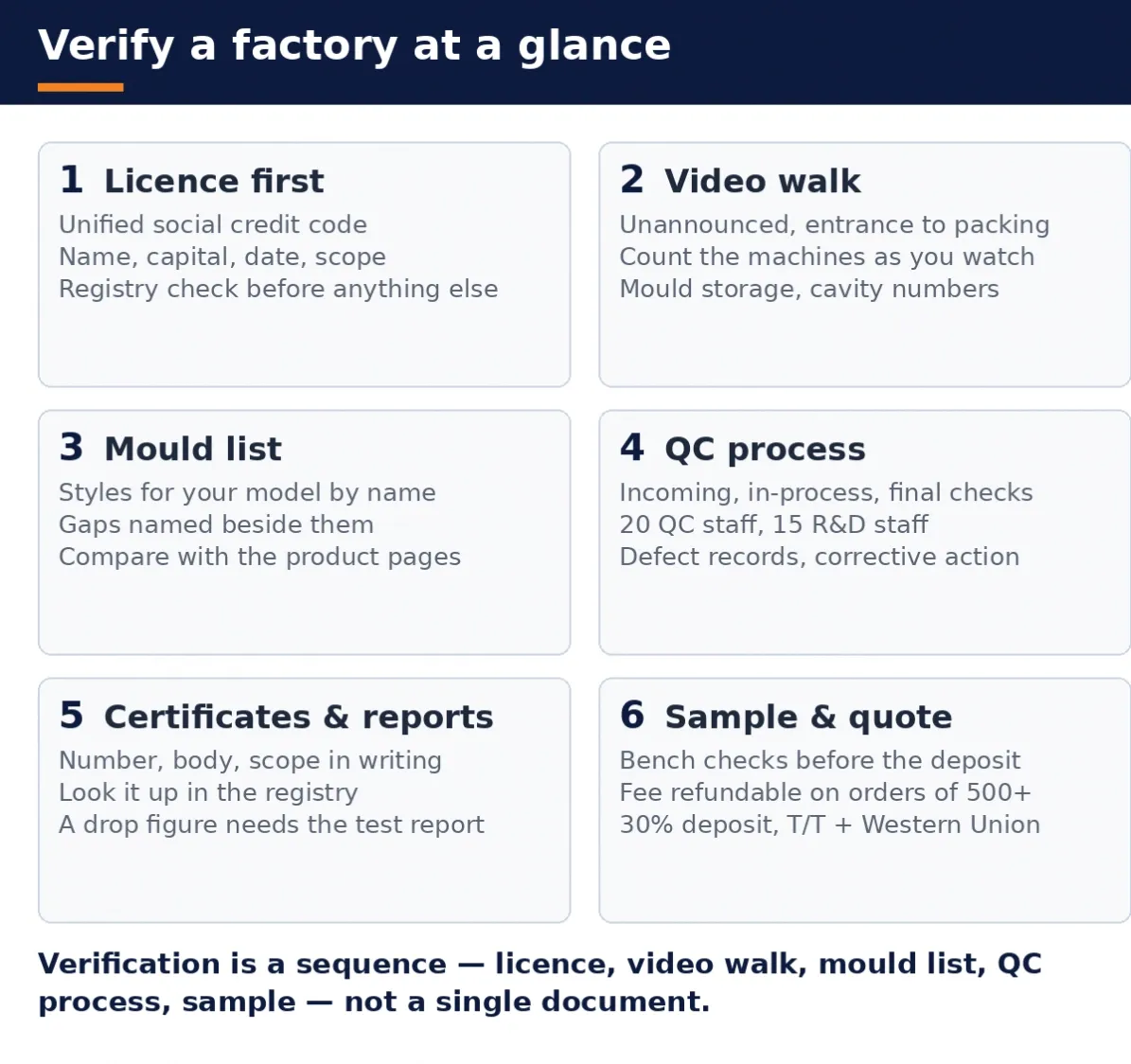
Verify a factory at a glance
Check | What it proves | What to ask for |
|---|---|---|
Business licence | The company exists and may export | Unified social credit code, business scope, establishment date |
Video walk | The factory exists and runs lines | Unannounced walk, entrance to packing line, machines counted |
Mould list | The factory can make your model | Styles for your model by name, with the gaps named |
QC process | The goods are checked as they are made | Incoming, in-process and final checks, defect records |
Certificates | A claim can be looked up, not just read | Certificate number, certifying body, scope, registry lookup |
Sample | The case fits the phone | Bench checks on the real goods before the deposit |
Quote terms | The order is agreed in writing | Style, model, colours, logo method, MOQ per line, deposit, sample terms |
- What does factory verification actually prove?
A listing proves a listing exists. A marketplace badge proves a listing performs well. A shortlist position proves a supplier says the right things about itself. A fast reply proves a sales team answers quickly. A low price proves a number was written down. None of those proves a factory exists, and none of them proves the factory can make your case.
Verification answers four questions, and only four:
- Does the company exist? A registered company with a published address, a business scope that includes manufacturing and import/export, and an establishment date that matches how long it says it has been trading.
- Does the factory exist? A building with machines running, a packing line, mould storage and people checking goods — seen on a live video walk, not in a pre-recorded tour.
- Can it make your model? A mould list that names the styles for your model, style by style, with the gaps named beside them — not "we have all models".
- Will it stand behind the order? A QC process that can be described, a sample that can be checked on the bench, and a quote that shows the deposit and sample terms in writing before the deposit is sent.
Everything else a supplier shows you is supporting evidence, not verification. A catalogue is a list of styles a factory says it makes. A product page is a style the factory says it sells. A certificate is a document that says a system was audited — and the certificate is only worth what the registry behind it is worth, which is why section 4 checks the registry, not the PDF. A sample is the only check that happens on the real goods, and it is the last check in the sequence, not the first — because a sample from a trading company can look identical to a sample from a factory, and only the checks before it tell you which one sent it.
One more distinction, because it is the one buyers most often get wrong: verification is not a score. A factory does not pass or fail on a single number. A factory with 50 lines and a factory with 5 lines can both be real factories; the question is whether the lines can run your model, at your quantity, with your logo, and make it again next month. The checklist in section 7 is a comparison tool, not a pass mark — use it the same way on every candidate, and the comparison writes itself.
- How do you check a phone case factory in six steps?
Run the checks in this order. Each one is cheap, each one can be done without flying to China, and each one can end the conversation early — which is the point. A factory that fails the first check has saved you the cost of the other five.
1. The business licence. Ask for the unified social credit code and check four things on the public registry: the company name, the registered capital, the establishment date and the stated business scope. The name on the licence must match the name on the quote and the name that receives the payment — if the quote comes from one name and the payment goes to another, stop and ask why. The establishment date must match how long the supplier says it has been trading: a company registered last year that describes itself as a long-established factory is a discrepancy worth asking about. The business scope must include manufacturing and import/export — a scope that covers only trading is a trading company, whatever its website says. iFunSmart is Ifun Electronics Technology Co., Ltd, in Guangzhou, making phone cases since 2010, and its address — Yongning Street, Zengcheng District, Guangzhou, Guangdong, postal code 511340 — is published on its own contact page. Ask any candidate for the same four facts in writing, and check them against the registry before anything else.
2. The unannounced video walk. Not a pre-recorded tour, not a scheduled walkthrough with the floor prepared. Ask the supplier to walk from the entrance to the packing line while you watch, on a live call, at a time you choose. Factories can do this; resellers cannot — a reseller has no floor to walk. Count the injection-moulding machines as you watch: they are large and countable, and the count is the capacity check. Ask how many are running your type of part, and ask to see the mould storage with the cavity numbers visible — the mould list in check 3 is specific and checkable, and the storage room is where it stops being a claim. Ask to see the packing line, not just the moulding line: the packing line is where the goods are checked, counted and boxed, and a factory that will only show the moulding line is a factory that does not want you to see how its goods leave the building. If the supplier says a video walk is not possible, ask why — and treat the answer as part of the check.
3. The mould list. Ask for the list — which models, which styles for each model, how many cavities each mould has. This is the single hardest thing to fake, because it is specific and it can be checked against the models the supplier claims. A mould list with gaps in it is an honest list: iFunSmart's list for the iPhone 17 Pro names fourteen styles and names the gaps beside them — no leather wallet naming the Pro, no liquid silicone naming the Pro, no aramid anywhere on the site — and the iPhone 18 re-tool shares the iPhone 17 mould and is not finished yet, so an 18 Pro order is a pre-order that holds allocation while the fit is confirmed on a sample, while the iPhone 18e needs a new mould the factory is still deciding whether to open, and the Samsung A38 and A58 have no tooling data yet. A candidate whose list has no gaps has not been checked; it has been copied. Compare the list with the live product pages: a style that exists on a product page should be on the list, and a style on the list should exist on a product page. If the two do not match, ask which one is wrong.
4. The QC process. Ask how the factory checks the goods — incoming material, in-process checks and final checks before packing — and ask what happens when a batch fails. A dependable factory keeps records, investigates the root cause and shows corrective-action history instead of brushing a problem aside. Ask who checks what: incoming inspection covers the material lot, in-process checks cover the moulding and printing as they happen, final checks cover the finished case before it is packed. The bench checks are the same ones the sampling guide in this series covers in full: the case seats fully on the phone, the corners wrap with no gap, the buttons click cleanly, the camera cutout does not intrude into the lens field, the magnetic ring holds a charger firmly, and the documents that came with it are complete. Ask for the QC headcount and the R&D headcount — iFunSmart has 20 QC staff and 15 R&D staff — because a factory that cannot describe its QC process does not have one to describe, and a factory that cannot say how many people check the goods is a factory whose checks happen after packing, if they happen at all. Never accept a defect rate, a pass rate or an inspection standard as a number in a chat message: ask for the process in writing, and ask what the records show.
5. The sample. The sample is the only check that happens on the real goods, and it is the last verification check, not the first. Check it the way a factory QC bench checks it: fit at every corner, buttons that click cleanly, a camera cutout that does not intrude into the lens field, a magnetic ring that holds a charger firmly, parting lines, coating adhesion, batch tolerance, magnet pull force against the figure the product page states for that style, and carton integrity. Cycle the camera stand and the ring stand open and shut on the bench sample and check each sits flush when closed and holds the phone at its working angle when open, and check the hinge friction is even. Samples carry a fee that is refundable on orders of 500+ pcs — ask us to confirm the amount per style in writing. Two questions belong with the sample, and both must be answered in writing: is the sample made on the same mould, from the same material, by the same factory that will make the bulk order — and if any of those three changes between the sample and the bulk order, who tells the buyer, and when? A sample from a different mould is not a sample of the order. A sample from a different factory is not a sample at all.
6. The quote and the payment terms. A quote should show the style, the model, the colours, the logo method, the quantity per line, the deposit terms and the sample terms. Payment is T/T and Western Union only. New customers may pay 30% deposit first. After the goods are ready, the factory sends photos and video and the packing list; the customer pays the balance, then the goods ship. Get the deposit terms on the quote, in writing, with the balance terms beside them, before the deposit is sent. A quote that does not show the sample terms is a quote that has not been finished — and a price far below the quote breakdown is a price that has cut something out of it: the material, the magnet, the QC check, or the packaging. No price is stated in this guide, and no price should be stated in any guide: ask for the quote, read the breakdown, and compare breakdowns, not headlines.
3. What four things prove a supplier is a real factory?
A real operation owns four things, and the four are the quickest way to tell a factory from a reseller with a catalogue. Ask for each one, in writing, and check the answer against what the video walk showed.
Tooling and moulds. Tooling is usually the largest fixed cost and the longest lead item in a custom case programme, so it deserves specific questions rather than a general assurance. Ask which generations are already covered — the model list the supplier's existing moulds support, and whether each tool was cut for that device or adapted from a previous generation. Ask who handles a new release: phone generations arrive on a schedule the buyer does not control, so ask what happens when a new model ships — who initiates the tool, who approves the drawing, and whether the cost is carried by the supplier, shared, or charged per project. A supplier who has done this repeatedly will answer in steps. One who has not will answer in reassurance. Ask whether the mould is shared or reserved: a shared mould is cheaper because the tooling cost is spread across customers, while a reserved mould costs more but keeps your geometry, surface texture and colour standard out of another brand's order. Either can be correct — what matters is that you know which one you are buying, and that it is written down. And if you pay for a tool, confirm in writing who owns it, and what happens to it when the order ends. iFunSmart holds the moulds for 500+ models, with 1000+ designs and 15 R&D staff behind them — the mould list is a design record, not a bought-in catalogue.
The production floor. The floor is the capacity check. iFunSmart's factory is 5,000 to 10,000 square metres and runs 50 production lines, which means it can run the iPhone 17 Pro, the iPhone 18 Pro Max and the Samsung Galaxy S26 Ultra at the same time, on different lines, without one order waiting behind another. A factory with one line runs one model at a time, and a distributor's reorder waits behind the order before it. Ask how many lines the factory runs, what tonnage the machines are, and how many are running your type of part — and ask it in writing, because a line count stated in a chat message cannot be attached to the order. Ask which processes are in-house and which use approved subcontractors: injection moulding may happen at one site while coating, printing, magnet assembly, sewing or retail packaging is completed elsewhere, even by factories that mould their own cases. Record which processes are in-house, which use subcontractors, who selects and audits those subcontractors, who owns incoming and outgoing inspection, and how subcontracted lots remain traceable. A factory that moulds in-house controls the variables that matter — mould condition, machine settings, material lot and trimming — but it should still be able to say which steps leave the building.
Assembly and packing. The packing line is where the goods are checked, counted and boxed, and it is the part of the factory buyers most often forget to ask about. Ask to see the packing line on the video walk, and ask how the cartons are marked: the model, the style, the colours and the quantities, line by line, so the carton that arrives can be checked against the order that was placed. Ask how a mixed-model order is packed — one row per model, style and colour, from the order row to the carton — because a mixed order that is packed as one mixed carton cannot be checked on arrival. The quality-problems guide in this series covers what to do when the goods arrive wrong; the check here is simpler: a factory that can describe its packing can be held to it, and a factory that cannot describe its packing has not thought about how its goods leave the building.
Export rights. The business licence scope must include import and export, and the supplier must be able to ship under its own name — ask for the customs registration number. A supplier that ships through another company's export licence is a supplier whose shipment depends on a company you have not verified. iFunSmart exports to 30+ countries, which means it has already dealt with the import, labelling and packaging questions a new market raises, even if it has not dealt with yours. Ask any candidate whether it ships under its own name, and ask what happens to the shipment if the export licence holder changes — because a factory that owns all four things is a manufacturer, and a supplier that owns fewer than four is a supplier whose missing piece is someone else's factory.
- How do you check a certificate or a test report?
A certificate is a document that says a system was audited. It is not a document that says a product passes. That distinction is the whole of this section, and it is the distinction most often blurred in a supplier's sales material.
What a management-system certificate proves. ISO 9001 is the most cited credential in Chinese manufacturing and the most misunderstood. It certifies a quality management system: documented processes, defined responsibilities, internal audits and corrective-action procedures. It does not certify that a phone case fits, that a magnet holds, or that a coating adheres. A factory can hold the certificate and still ship a batch with a fault — the certificate says the factory has a process for finding the fault, not that the fault never happens. This article does not state whether iFunSmart holds any certificate, because a certificate is a claim that must be checked, not a fact to be taken from a guide. Ask any candidate for the certificate number, the certifying body and the scope statement — then look the certificate up in the certifying body's own online registry. The International Accreditation Forum provides certification search tools where buyers can check the status of accredited management-system certifications. A certificate that cannot be found in the registry is a certificate that has not been verified, and a supplier that will only show a PDF or a scanned copy has not given you a certificate — it has given you a picture of one.
What a test report proves. Product pages carry drop wording — “military-grade”, a height in feet, a count of tests — and a factory that repeats a drop figure without a test report behind it is repeating a claim, not a fact. Ask for the report: which standard was tested against, how many drops, from what height, onto what surface, and which laboratory ran it. The drop-protection guide in this series explains how to read those figures: MIL-STD-810G tests 26 drops from 4 feet onto plywood over concrete, and MIL-STD-810H tests 26 drops from 5 feet onto steel plate over concrete — and a figure that does not name the standard, the count, the height and the surface is a slogan, not a test. The same rule applies to any other claim on a product page: a magnet figure is only a figure if it is stated per style — per-style figures differ, so never accept a single Gauss figure as a factory-wide fact — and a coating claim is only a claim if the factory can say which test it passed and show the report. Never accept a drop rating, a drop height or a military standard for a case whose test report you have not seen.
What no certificate proves. No certificate proves a phone case is compliant with a market's product rules, because compliance is a property of the product and the market, not of the factory. This article does not claim iFunSmart holds GPSR, REACH or RoHS certifications — it does not — and no supplier's certificate should be read as one. Ask what the supplier can document for your market, in writing, and ask your compliance adviser whether that documentation is the right one. The EU guides in this series are educational only: they explain what the rules require of the importer, not what the factory certifies.
- How do you evaluate a sample before paying a deposit?
The sample is where verification stops being paper and starts being goods. Everything before it — the licence, the video walk, the mould list, the QC process, the certificate — is a check on what the supplier says. The sample is a check on what the supplier makes.
Check the sample the way section 2 describes — on the bench, not in use: the case seats fully with no gap at any corner, the buttons click cleanly, the camera cutout does not intrude into the lens field, the magnetic ring holds a charger firmly with the pull force the product page states for that style, the parting lines are clean, the coating adheres, the batch tolerance is even, and the carton is intact and marked with the model, the style and the colour. Check the moving parts the same way: cycle the camera stand, the ring stand and the slide cover open and shut on the bench sample and check each sits flush when closed, holds the phone at its working angle when open, and runs with even hinge friction.
Two questions belong with the sample, and both must be answered in writing before the deposit. First: is the sample made on the same mould, from the same material, by the same factory that will make the bulk order — and if any of those three changes between the sample and the bulk order, who tells the buyer, and when? Second: what does the sample approval cover — the style, the colour, the logo position, the packaging — and is the approval recorded in writing, with the sample reference, the model, the style, the colours and the logo method stated? An approval in a chat message is not an approval: it cannot be found later, it cannot be attached to the order, and it cannot be shown to the factory when the goods arrive wrong. Approve by email, and if the sample is wrong, say so in the same email, with the correction stated — a new colour, a moved logo, a different style — and wait for the corrected sample. A correction after the deposit is a rework, and a rework is charged.
The sampling guide in this series covers the bench checks in full. The point here is narrower: the sample is the last verification, and a factory that will not send one — or that sends one with no terms, no fee and no refund condition — is a factory that does not want its goods checked. Samples carry a fee that is refundable on orders of 500+ pcs — ask us to confirm the amount per style in writing.
- Which red flags should stop a factory order?
Six red flags end the conversation with any manufacturer. Each one is a check that failed, and a failed check is not a negotiation point — it is the answer.
1. No factory address, or an address that does not exist. A manufacturer that will not publish a factory address — or that gives a serviced office, a residential block, or an address that does not exist on a map — is a manufacturer whose factory you cannot verify. Ask for the address in writing. If it does not come, stop.
2. A mould list that does not match the product pages. A style that exists on a product page should be on the mould list, and a style on the mould list should exist on a product page. If the two do not match, one of them is wrong — and a supplier that cannot say which one is a supplier whose range is a catalogue, not a factory record. “We have all models” with no list is the same flag in shorter words.
3. A QC process that cannot be described. Ask how the goods are checked — incoming, in-process, final — and what happens when a batch fails. A factory that answers in reassurance instead of steps has no process to describe. A factory that cannot say how many people check the goods, or what the checks cover, is a factory whose checks happen after packing, if they happen at all.
4. A certificate that cannot be looked up. Ask for the certificate number, the certifying body and the scope, then look it up in the body's own registry. A certificate that is not in the registry, or a supplier that will only show a PDF, has not given you a certificate. The same applies to a test report: a drop figure with no report behind it is a slogan.
5. No sample, or a sample with no terms. A factory that will not send a sample before a bulk order does not want its goods checked. A factory that sends a sample with no fee, no refund condition and no per-style amount has not thought through what the sample is for. The sample is the only check that happens on the real goods, and a factory that skips it is asking the buyer to skip the only check that matters.
6. A deposit before the approval. The approval is what the deposit is paying for, so the deposit is paid after the approval, not before it. A supplier that asks for the deposit before the sample is approved is a supplier that wants the money before the goods are checked. Payment is T/T and Western Union only; new customers may pay 30% deposit first; after the goods are ready the factory sends photos and video and the packing list, the customer pays the balance, then the goods ship. Get the deposit terms on the quote, in writing, with the balance terms beside them, before the deposit is sent.
One more flag, because it is the one that shows up after the goods arrive: a factory that will not put anything in writing. A mould confirmation in a chat message cannot be found later, cannot be attached to the order, and cannot be shown to the factory when the goods arrive wrong. Every answer in this guide — the address, the lines, the QC staff, the mould list, the sample terms, the logo method, the deposit terms — is an answer that belongs on the quote, in writing, before the deposit. A manufacturer that will only talk in chat is a manufacturer that will only answer in chat when the problem arrives.
- What verification checklist should you send in your first enquiry?
Copy this checklist into your first enquiry. Ask for the answers in writing, on the quote — not in a chat message — and keep the answers with the order. A factory that holds the moulds will answer all eight without difficulty. A factory that cannot answer them has told you what its “we have all models” claim is worth.
1. What is your factory address, your unified social credit code, and how many production lines, QC staff and R&D staff do you have? The address, the licence and the headcount are the factory check. A factory that will not state them in writing has not been checked.
2. Can we do an unannounced video walk, entrance to packing line, at a time we choose? A factory can do this; a reseller cannot. Count the machines as you watch, and ask to see the mould storage and the packing line.
3. Which styles exist for my model by name — and which do not? Ask for the mould list with the model beside each style, and compare it with the live product pages. If a style is not on the list, it is not on the order.
4. How are the goods checked — incoming, in-process, final — and what happens when a batch fails? Ask for the process in steps, the defect records and the corrective-action history. A process that cannot be described does not exist.
5. Which certificates and test reports can you show, with the number, the certifying body and the scope — and can I look them up in the registry? A certificate that cannot be looked up has not been verified. A drop figure with no report behind it is a slogan.
6. What is the MOQ per line, and what counts toward the bulk threshold? The most common MOQ is 50 pcs per colour per model, and it varies by product line — so ask per line. Bulk distributor orders start at 500 pcs per order in total. Get the answer on the quote.
7. What does the quote show — and what does the sample cost? A quote should show the style, the model, the colours, the logo method, the quantity per line, the deposit terms and the sample terms. Ask for the sample fee per style in writing, and whether it is refundable on orders of 500+ pcs. A 100-pc trial order can carry a logo by laser engraving — ask for the per-piece charge and the artwork position in writing.
8. What does the 100-pc trial cover — and what does it not? A trial covers design, fit and colour — it does not set the bulk unit price, and it does not prove the factory can make the same case again next month. Get the trial terms on the quote, in writing, before the deposit.
Verifying a phone case factory is not hard — the checks are six, they are all cheap, and they can all be done without flying to China. What is hard is skipping them: a listing is not a factory, a badge is not a mould list, a fast reply is not a QC process, and a sample is not proof of anything until the checks before it have been done. A distributor that does the check has bought a case that fits the phone it was made for, from a factory that can make it again next month. A distributor that buys the listing has bought a shortcut — and a shortcut is the most expensive thing in a bulk order, because it is paid for twice: once in the deposit, and once in the dead stock.
FAQs
Q1: How do I verify a phone case factory in China before ordering?
Run six checks, in order: the business licence (unified social credit code, company name, registered capital, establishment date, business scope including manufacturing and import/export — checked on the public registry); an unannounced video walk from the entrance to the packing line, counting the machines as you watch; the mould list, naming the styles for your model by name with the gaps named beside them; the QC process in steps — incoming, in-process and final checks, defect records and corrective action; the certificates and test reports, looked up in the certifying body's own registry, not just read from a PDF; and a sample, checked on the bench before the deposit. iFunSmart — Ifun Electronics Technology Co., Ltd, Guangzhou — has made phone cases since 2010, runs 50 production lines with 20 QC staff and 15 R&D staff at Yongning Street, Zengcheng District, and holds the moulds for 500+ models. Send a written brief — model, style, colours, logo method and quantity per line — and ask for the licence facts, the mould list and the sample terms on the quote. We reply within 24 hours.
Q2: How can I check a phone case factory without visiting China?
A remote factory check catches most of what an on-site visit would. Ask for the unified social credit code and check the company name, registered capital, establishment date and business scope on the public registry. Ask for an unannounced video call — not a pre-recorded tour, not a scheduled walkthrough with the floor prepared — and ask the supplier to walk from the entrance to the packing line while you watch, counting the injection-moulding machines and asking to see the mould storage with the cavity numbers visible. Ask for the mould list in writing and compare it with the live product pages. Ask for the certificate number, the certifying body and the scope, then look the certificate up in the body's own registry. And ask for a sample, checked on the bench before the deposit — fit at every corner, buttons that click cleanly, a camera cutout that does not intrude into the lens field, and a magnetic ring that holds a charger firmly. A factory can do all of this; a reseller cannot. Samples carry a fee that is refundable on orders of 500+ pcs — ask us to confirm the amount per style in writing. We reply within 24 hours.
Q3: What does ISO 9001 prove about a phone case factory?
ISO 9001 certifies a quality management system: documented processes, defined responsibilities, internal audits and corrective-action procedures. It does not certify that a phone case fits, that a magnet holds, or that a coating adheres. A factory can hold the certificate and still ship a batch with a fault — the certificate says the factory has a process for finding the fault, not that the fault never happens. To check a certificate, ask for the certificate number, the certifying body and the scope statement, then look it up in the certifying body's own online registry — the International Accreditation Forum provides certification search tools for accredited management-system certifications. A certificate that cannot be found in the registry has not been verified, and a supplier that will only show a PDF or a scanned copy has not given you a certificate. This article does not state whether iFunSmart holds any certificate, because a certificate is a claim that must be checked, not a fact to be taken from a guide — ask us in writing, and check the registry.
Q4: How can I tell if a phone case supplier is a real factory or a trading company?
Four things, all verifiable in writing: tooling and moulds the supplier owns, a production floor with machines running, an assembly and packing line, and export rights under its own name. A factory makes the case — it holds the mould, runs the machines, prints or engraves the design, checks the goods and packs them. A trading company buys the case from a factory and resells it, and the difference shows up after the order: when a colour runs out, when a mould needs a change, when a batch comes back with a fault. Ask which processes are in-house and which use approved subcontractors — injection moulding may happen at one site while coating, printing, magnet assembly, sewing or retail packaging is completed elsewhere, even by factories that mould their own cases. Ask whether the mould is shared or reserved, and if you pay for a tool, confirm in writing who owns it and what happens to it when the order ends. A factory that owns all four things is a manufacturer; a supplier that owns fewer than four is a supplier whose missing piece is someone else's factory.
Q5: What should I ask a phone case factory before paying a deposit?
Eight answers, in writing, on the quote — not in a chat message: (1) the factory address, the unified social credit code, and the number of production lines, QC staff and R&D staff; (2) an unannounced video walk at a time you choose; (3) the mould list with the model beside each style; (4) the QC process in steps, with the defect records and corrective action; (5) the certificates and test reports, with the number, the certifying body and the scope, looked up in the registry; (6) the MOQ per line — the most common is 50 pcs per colour per model and it varies by product line — and what counts toward the 500-pc bulk threshold; (7) the quote breakdown — style, model, colours, logo method, quantity per line, deposit terms and sample terms — and the sample fee per style, refundable on orders of 500+ pcs; (8) the 100-pc trial terms, including the laser-engraving logo, the per-piece charge and the artwork position. Payment is T/T and Western Union only; new customers may pay 30% deposit first; after the goods are ready the factory sends photos and video and the packing list, the customer pays the balance, then the goods ship. The deposit is paid after the sample is approved, not before it. We reply within 24 hours.
About iFunSmart
iFunSmart — Ifun Electronics Technology Co., Ltd, Guangzhou, China — has made phone cases since 2010: 1000+ designs, 500+ models, 500K+ pieces a month, exported to 30+ countries. We reply within 24 hours. Send your brief — model, material, colours, logo and quantity — and we will quote it line by line, send a sample (fee refundable on orders of 500+ pcs), and confirm the fit, the MOQ and the inspection records in writing before your deposit.
WhatsApp: +86 13632248734 — https://wa.me/8613632248734 — or email contact@ifunsmart.com — or visit www.ifunsmart.com.
Read more
- Phone Case Factory in China: Find, Check & Compare — https://www.ifunsmart.com/posts/phone-case-factory-in-china-find-check-compare
- Phone Case Factory vs Trading Company: How to Tell Before You Order — https://www.ifunsmart.com/posts/phone-case-factory-vs-trading-company
- How to Source Phone Cases from China: First-Order Checks — https://www.ifunsmart.com/posts/how-to-source-phone-cases-from-china-first-order-checks
- Top Wholesale Phone Case Suppliers in China Compared — https://www.ifunsmart.com/posts/top-wholesale-phone-case-suppliers-china-how-distributors-compare
- iPhone 17 Pro Case Manufacturer in Guangzhou — https://www.ifunsmart.com/posts/iphone-17-pro-case-manufacturer-in-guangzhou
- Phone Case RFQ: What to Send a Factory in Your First Enquiry — https://www.ifunsmart.com/posts/phone-case-rfq-what-to-send-a-factory-in-your-first-enquiry
- Phone Case Sampling: How to Evaluate a Sample Before a Bulk Order — https://www.ifunsmart.com/posts/phone-case-sampling-how-to-evaluate-a-sample-before-bulk
- Mixed-Model Phone Case Orders: How to Combine Models — https://www.ifunsmart.com/posts/mixed-model-phone-case-orders-how-to-combine-models