Business Solutions
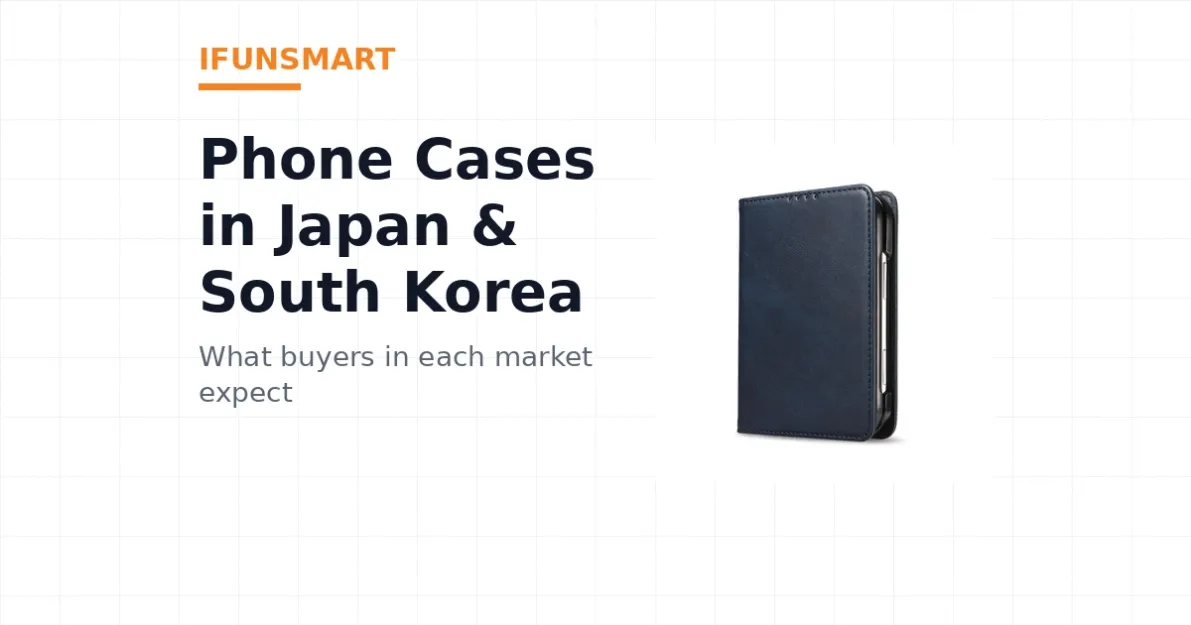
Phone Cases in Japan & South Korea: What Buyers Expect
Japan and South Korea buy phone cases differently — iPhone-heavy Japan, Galaxy-led Korea. What each market expects, what to check before you import, and how to shape a first order for both.
BLUF
Japan and South Korea look similar on a map and buy phone cases very differently. Japan is iPhone-heavy and quality-obsessed; Korea is Galaxy-led, trend-fast and platform-driven. Stock the wrong model mix for either market and the order sits. This guide covers both.
Short answer
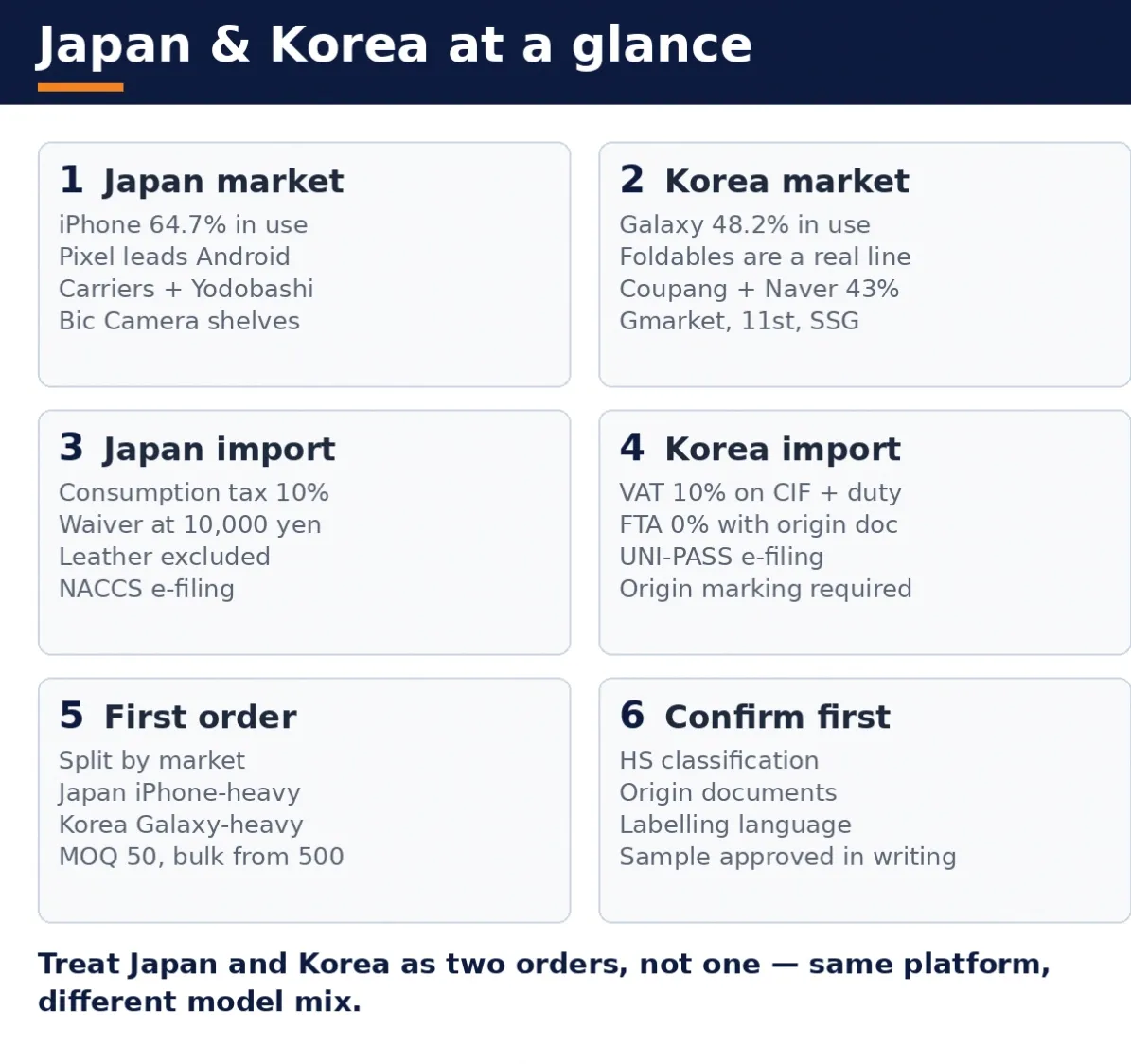
Japan and South Korea are the two most demanding phone-case markets in East Asia, and they reward different assortments. In Japan, Apple dominates the phones in use — StatCounter put Apple at 64.74% of in-use smartphones in August 2026, with Google second at 9.33% and Samsung at 5.01% — so an iPhone-first range is the default, and buyers judge finish, fit and packaging with unusual care. In South Korea, Samsung leads at home — 48.21% in-use share against Apple's 35.5% in the same StatCounter data, and a Gallup Korea usage survey in July 2026 put Galaxy at 81% against iPhone at 19% — so a Galaxy-first range, led by the S series and the foldables, is the starting point, and trend cycles move fast. Both markets import under clear rules — Japan's 10% consumption tax and Korea's 10% VAT, each with its own duty, documentation and labelling requirements — and both punish the same mistake: treating the two markets as one order. This guide works through what buyers in each market expect, what to check before you ship, and how to shape a first order that serves both without doubling the risk.
1. Two markets, two model mixes
The first decision is the model mix, and it is different in each country. Get it wrong and the best case in the range is the one nobody in that market owns the phone for.
Japan is iPhone-first. Apple's 64.74% in-use share (StatCounter, August 2026) makes Japan the most iPhone-heavy major market in the world, and the newest iPhone models dominate new sales — the iPhone 18 Pro and Pro Max went on sale on 18 September 2026, and the iPhone Duo followed in October. A Japan range should therefore lead with the current iPhone Pro models, cover the previous generation as a second tier, and treat Android as a smaller, deliberate line: Google Pixel first, since Pixel is Japan's leading Android brand at 9.33%, ahead of Samsung at 5.01%, then Samsung's S series. Sony still holds a small loyal base at 3.21% — worth a line only if the buyer asks for it by name. Surveys differ on the exact split — MMD Labo's August 2026 survey of 40,000 people put Android slightly ahead of iPhone as the main device, at 54.1% against 45.6% — but every measure agrees on the same commercial fact: no other major market is this concentrated on one brand, and that brand is Apple.
South Korea is Galaxy-first. Samsung's home market is the mirror image: 48.21% in-use share for Samsung against 35.5% for Apple (StatCounter, August 2026), and the two brands together account for 83.71% of phones in use — the highest two-brand concentration anywhere. The Gallup Korea usage survey from July 2026 is starker still, with Galaxy at 81% and iPhone at 19% among the people surveyed. The practical consequence is a Galaxy-first range: the S series and the Z Fold and Z Flip lines lead, the A series covers the volume tier, and iPhone is a real second line — Apple holds a record share in Korea and its newest models sell fast — not an afterthought. Foldables deserve a line of their own in Korea in a way they do not in Japan: the Z Fold 8 and Z Flip 8 were unveiled on 22 July 2026, and Korea is where foldable cases move first.
One order, two mixes. A buyer serving both markets should not place one blended order and split it at the warehouse. Split the order at the factory: an iPhone-heavy Japan allocation and a Galaxy-heavy Korea allocation, each with its own colours and finishes, so a slow line in one market never strands stock meant for the other. Our mould-coverage guide lists the models we hold tooling for — 93 iPhone designs in the IQ line including iPhone 18 Pro and Pro Max, 60 Samsung foldable designs in the ISF line, and leather lines across 14 brands — so ask us to confirm the exact models against our mould list before you finalise the mix.
2. Japan: what Japanese buyers expect
Japanese buyers are the most exacting in this guide, and their expectations are specific. They are also consistent: the same buyer who checks a stitch will check the packaging, the labelling and the invoice.
Finish and fit are judged first. A Japanese buyer will hold the case, flex it, check the edges, and look at the colour in daylight — the same discipline our sampling guide recommends, applied as a matter of course. Stitching on a leather folio must be even, a magnetic ring must sit flush, a clear case must be free of haze and visible particles. A case that is almost right is not right; it is a return. That is why the sample stage matters more for Japan than for any other market in this series: approve the sample in writing against the brief, keep the approved sample as the reference, and inspect the bulk order against it. Our pre-shipment QC checklist explains the seven checks to run before goods leave the factory.
Design is restrained. Japanese buyers favour clean, quiet design — solid colours, subtle texture, a small logo rather than a large one, a folio or a slim magnetic case rather than a loud print. Decorative finishes sell, but the ones that move in Japan are the restrained ones: a matte leather, a frosted clear case, a two-tone folio. A buyer who wants a glitter or printed range for Japan will say so explicitly; do not assume it. Packaging matters in the same way: a clean box, a straight label, a barcode that scans first time. Our packaging guide covers boxes, barcodes and the dieline in detail.
Channels shape the range. Phones in Japan are sold mainly through the three carriers — NTT Docomo, KDDI (au) and SoftBank — and through the big electronics retailers Yodobashi Camera and Bic Camera, whose accessory walls are organised by phone model, material and brand. Online, Amazon Japan, Rakuten and Yahoo! Shopping carry the volume, and Don Quijote moves the value tier late at night. A distributor selling into those channels needs depth in the current iPhone models first, because that is where the shelf space is, and needs the packaging and labelling right, because a listing rejected for a labelling error costs the slot.
Import: consumption tax first, duty second. Japan charges consum
ption tax at 10% on the CIF value plus any duty — the tax is charged on the duty as well as the goods. Shipments valued at 10,000 yen or less are generally waived from both duty and consumption tax, but leather goods are excluded from that small-value waiver, so a leather-case shipment should not be planned around it — confirm the treatment with your broker. Duty itself depends on the tariff classification: Japan adds its own digits to the international 6-digit HS code, producing a 9-digit line, and the rate follows the material and construction of the case. Do not plan a Japan order around a duty rate quoted for a different product. RCEP covers both Japan and China, so origin documentation may affect the rate — again, confirm with your broker before you quote your customer. Declarations are filed electronically through NACCS, the customs clearance system, usually by the importer's broker.
3. South Korea: what Korean buyers expect
Korean buyers move faster and forgive less. Trends arrive quickly, platforms decide what sells, and a range that was right last season can be wrong this season.
Galaxy first, and foldables are a real line. The model mix in section 1 is the starting point, but the Korean buyer will also ask about the foldables by name — the Z Fold and Z Flip lines — and about the newest S series the moment it is announced. Samsung's launch pattern runs January to February, so a Korean buyer plans the year around that window and expects the case range to be ready when the phone lands, not weeks after. Ask us to confirm mould coverage for the newest Galaxy models before you commit a launch order; a case that arrives after the launch window is a case that competes with every other late case.
Trend cycles are short, so the range must turn. Korea's e-commerce is concentrated on two platforms — Coupang at about 23% and Naver Shopping at about 20.7% of the market, about 43% combined — with Gmarket, 11st and SSG behind them. On those platforms a new colour, a new finish or a new card-wallet design can move fast, and a stale listing sinks fast. That favours a range with a fast core — the proven sellers in the current Galaxy and iPhone models — plus a small rotating set of new designs each season. A Korean buyer who asks for a new design is usually asking for it now, and the sample and approval process in our sampling guide is the way to move quickly without approving the wrong case.
Customisation is expected, not exceptional. Korean buyers ask for custom logos, custom colours and custom packaging as a matter of course, and they judge the print the way Japanese buyers judge the stitch: size, position, colour, clarity and adhesion, checked in daylight against the approved artwork. Our private-label guide covers the three routes to a branded case and what to settle before the first order. For Korea, settle the artwork version in writing on the sample approval — a print that is almost right is a print the platform's customers will photograph.
Import: VAT, FTA origin and labelling. South Korea charges VAT at 10% on the customs value plus duty, and the basic duty rate for industrial goods is typically 8%. The China–Korea free trade agreement can reduce the duty to zero, but only with a valid certificate of origin held by the importer — without the document, the preferential rate does not apply, so the origin paperwork is part of the order, not an afterthought. Personal parcels up to 150 US dollars are generally cleared without duty; commercial orders are not personal parcels and should not be planned as if they were. Declarations are filed through UNI-PASS, the Korea Customs Service electronic system, by the importer or a licensed broker. Two labelling points matter for cases: country-of-origin marking is required, and the KC safety certification that Korea requires for electrical goods and children's products applies to cases with a battery or charging electronics — a plain phone case is not an electrical good, but a battery case or a case with built-in charging is a different product, so confirm with your broker before you ship anything with electronics inside.
4. What to confirm before you ship to either market
The two markets share one discipline: nothing about the import should be discovered at the border. Confirm these five points in writing before the goods leave the factory.
- Classification. Confirm the HS code and the national digits with your broker for the exact case — material, construction and any electronic component change the line. A leather folio, a clear TPU case and a battery case are three different classifications, and a duty rate quoted for one does not apply to the others.
- Origin documents. For Korea, the certificate of origin is what unlocks the FTA rate; for Japan, RCEP origin documents may affect the rate. Ask us for the origin documents your broker needs at the time of order, not at the time of shipment.
- Labelling language. Labels for consumer goods sold in Korea must be in Korean, and Japanese buyers expect Japanese labelling on the packaging and the documentation that accompanies the goods. English-only labelling is a listing problem in both markets, not a customs problem — it is the retailer's customer who cannot read it.
- Certification — what not to claim. A plain phone case needs no PSE mark in Japan and no KC mark in Korea, because it is not an electrical good. Do not print either mark on a plain case, and do not claim any certification the product does not hold. iFunSmart does not hold GPSR, REACH or RoHS certifications, and no article or listing of ours claims otherwise. If a case contains a battery or charging electronics, that is a separate product with separate requirements — ask us and your broker before you order it.
- The sample and the approval. Both markets punish the same failure: a bulk order approved from a photograph. Hold the sample, run the seven checks in our sampling guide, and approve it in writing with the model, material, colour, artwork version and tolerances recorded. The approval is the specification the bulk order is judged against, and it is the document that protects both sides when a shipment is questioned.
5. Shaping a first order for both markets
A first order that serves Japan and Korea is a split order, not a single order. The shape below is a starting point — adjust the model split to your own customers, and ask us for a written quote on the exact mix.
Split the mix, share the platform. Order the Japan allocation iPhone-heavy and the Korea allocation Galaxy-heavy, but keep the finishes and the packaging platform common where the buyer allows it — the same magnetic system, the same print process, the same box structure — so the factory runs one platform with two model mixes instead of two unrelated orders. That keeps the order efficient while each market gets the models its customers actually own.
Use the confirmed order terms. The minimum order is 50 pieces per colour per model, and distributor and bulk orders start from 500 pieces per order in total — the 500 is the order total, not per model — so a split Japan/Korea order can reach the distributor tier with a modest allocation to each market. Distributors receive free samples, which is the right way to start in both markets: hold the case, approve it, then order. Payment is by T/T or Western Union; new customers may pay a 30% deposit first, and after the goods are ready we send photos, a video and the packing list before the balance is paid and the goods ship. Ask us for the sample cost and timing for your model, and for a written quote on your first order — both depend on the style and the customisation, so they are confirmed per order.
Plan around the launch calendar. Japan's year turns on the iPhone launch in September and the iPhone Duo in October; Korea's turns on the Galaxy S launch in January or February and the foldables in July. A buyer who orders the case range in the same window as the phone launch sells into the peak; a buyer who orders a month later sells into the discount. Our pre-launch ordering guide explains how to time the fit check, the mould confirmation and the first order around a launch.
Keep a fast core and a rotating set. In both markets, the proven sellers in the current flagship models are the core of the range, and a small rotating set of new designs each season is what keeps the listings fresh — especially in Korea, where the platforms reward the new. Do not rotate the core: a colour that sells in Japan and a design that sells in Korea should stay in the range until the buyer says otherwise.
6. The mistakes that cost money in both markets
Most failed Japan and Korea orders fail the same way, and none of the failures is about the case itself.
Treating the two markets as one order. One blended mix, split at the warehouse, leaves iPhone cases stranded in Korea and Galaxy cases stranded in Japan. Split the order at the factory, by market, with each allocation matched to the phones in use there.
Planning around a duty rate for the wrong product. A rate quoted for a different material, a different construction or a different country does not apply to your shipment. Confirm the classification and the origin documents with your broker before you quote your customer, and never build a retail price on a rate you have not confirmed.
Approving from photographs. A photo cannot test fit on the real phone, button feel, magnetic attachment or print adhesion. Both markets return cases that were approved from a photo, and the return costs more than the sample ever did.
English-only labelling and packaging. A case that cannot be read by the retailer's customer is a case the retailer will not reorder. Confirm the labelling language with the buyer before the packaging is printed, not after.
Ordering after the launch window. In Japan the window opens with the iPhone launch in September; in Korea it opens with the Galaxy S launch in January or February and the foldables in July. A case range that arrives after the window competes on price alone, and that is a competition no new supplier wins.
Claiming a certification the product does not hold. Neither market requires a safety mark on a plain phone case, and claiming one invites a question no supplier wants to answer. State what the product is, what it is made of and what it was tested against — and nothing more.
FAQs
- Can I serve Japan and Korea from a single order?
Yes, if the order is split by market at the factory: an iPhone-heavy allocation for Japan and a Galaxy-heavy allocation for Korea, on a common finishes and packaging platform. Do not place one blended mix and divide it at the warehouse — the model split is the point of the order, and it should be decided before production, not after.
- What duty will I pay on phone cases into Japan or Korea?
It depends on the classification and the origin documents, so do not plan around a single number. Japan charges consumption tax at 10% on the CIF value plus duty, and the duty follows the 9-digit tariff line for the exact case. Korea charges VAT at 10% on the customs value plus duty, the basic duty rate for industrial goods is typically 8%, and the China–Korea FTA can reduce duty to zero with a valid certificate of origin. Confirm both with your broker before you quote your customer.
- Do phone cases need KC certification for Korea or a PSE mark for Japan?
A plain phone case does not — it is not an electrical good. KC certification in Korea and the PSE mark in Japan apply to electrical goods, so a case with a battery or built-in charging electronics is a different product with different requirements. Confirm with your broker before you ship anything with electronics inside, and do not print a safety mark on a plain case.
- Which models should a first Japan or Korea order lead with?
Japan leads with the current iPhone Pro models, then the previous iPhone generation, with Google Pixel first among Android lines. Korea leads with the Galaxy S series and the Z Fold and Z Flip lines, with the A series for volume and iPhone as a real second line. Ask us to confirm mould coverage for the exact models before you finalise the mix.
- How do I start if I have never ordered from China before?
Start with samples — distributors receive free samples — hold the case, run the seven checks in our sampling guide, and approve it in writing. Then place a first order at the confirmed terms: 50 pieces per colour per model, distributor and bulk orders from 500 pieces per order in total, 30% deposit first for new customers, photos, video and packing list before the balance, then shipment. Our RFQ guide explains what to send a factory in your first enquiry.
About iFunSmart
iFunSmart has made phone cases in Guangzhou since 2010, with more than 1,000 designs, more than 500 models and a monthly capacity of more than 500,000 pieces, supplying buyers in more than 30 countries. Our magnetic lines use N52 magnets at 2700 Gauss. The minimum order is 50 pieces per colour per model, distributor and bulk orders start from 500 pieces per order in total, and distributors receive free samples. Payment is by T/T or Western Union; new customers may pay a 30% deposit first, and after the goods are ready we send photos, a video and the packing list before the balance is paid and the goods ship. Ask us for a written quote on your first Japan or Korea order.
Contact us on WhatsApp at +86 13632248734, or click “Contact Us” now to get our full model range and latest price list!
Read more
Selling Phone Cases in the UK: UKCA, VAT & Import Checks — https://www.ifunsmart.com/posts/phone-cases-uk-ukca-vat-import-guide
Phone Cases in Southeast Asia: Form E & Import Guide — https://www.ifunsmart.com/posts/phone-cases-in-southeast-asia-form-e-import-guide
Phone Cases in Latin America: DDP & Import Guide — https://www.ifunsmart.com/posts/phone-cases-in-latin-america-ddp-import-guide
Phone Cases in Australia: Sea vs Air Shipping Guide — https://www.ifunsmart.com/posts/phone-cases-in-australia-sea-vs-air-shipping-guide
Phone Case Sampling: How to Evaluate a Sample Before a Bulk Order — https://www.ifunsmart.com/posts/phone-case-sampling-how-to-evaluate-a-sample-before-bulk
Ordering Before a New iPhone or Samsung Launch: Fit, Moulds & Timing — https://www.ifunsmart.com/posts/ordering-before-a-new-iphone-or-samsung-launch
Phone Case RFQ: What to Send a Factory in Your First Enquiry — https://www.ifunsmart.com/posts/phone-case-rfq-what-to-send-a-factory-in-your-first-enquiry
Which Phone Models Do We Hold Moulds For? — https://www.ifunsmart.com/posts/phone-case-model-mould-coverage