Business Solutions
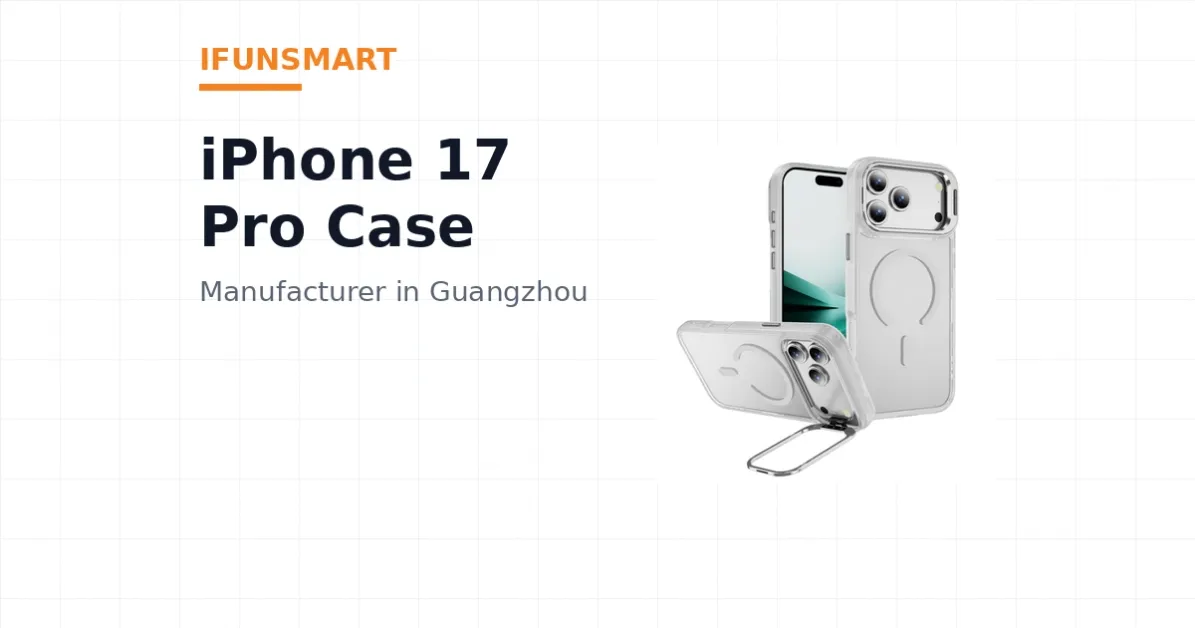
iPhone 17 Pro Case Manufacturer in Guangzhou
Find an iPhone 17 Pro case manufacturer in Guangzhou: moulds ready, most common MOQ 50 pcs, 100-pc laser-logo trial, samples fee refundable on 500+ pcs. What to check before the deposit.
BLUF
The iPhone 17 Pro's moulds are ready: two iFunSmart styles name the Pro and twelve more cover the 17 series. Most common MOQ is 50 pcs per colour per model, a 100-pc trial order can carry a laser-engraved logo, and samples carry a fee refundable on orders of 500+ pcs.
Short answer
Finding a manufacturer for the iPhone 17 Pro is a different job from finding one for the iPhone 18 Pro, and the difference is the mould. The 17 Pro has been on sale since 19 September 2025 — a year into its cycle at the time of writing — and its moulds are ready. The 18 Pro's re-tool shares the 17 Pro mould and is not finished yet. So the question for the 17 Pro is not "is the tool ready?" — it is "which manufacturer holds the mould, what is the MOQ per line, and what does the first order look like?"
This guide answers that question for one manufacturer: iFunSmart, in Guangzhou. The factory has made phone cases since 2010, runs 50 production lines with 20 QC staff and 15 R&D staff, and holds the moulds for the 17 Pro range — two styles name the Pro outright on their product pages, and twelve more cover the iPhone 17 series as a family. The most common MOQ is 50 pcs per colour per model, bulk distributor orders start at 500 pcs per order in total, a 100-pc trial order can already carry a logo by laser engraving, and samples carry a fee that is refundable on orders of 500+ pcs. Sections 2 to 7 turn those facts into a buying procedure: what to check about the factory, which styles are confirmed for the Pro, how the MOQ is counted per line, how the logo trial works, and the five questions to ask any manufacturer in writing before the deposit.
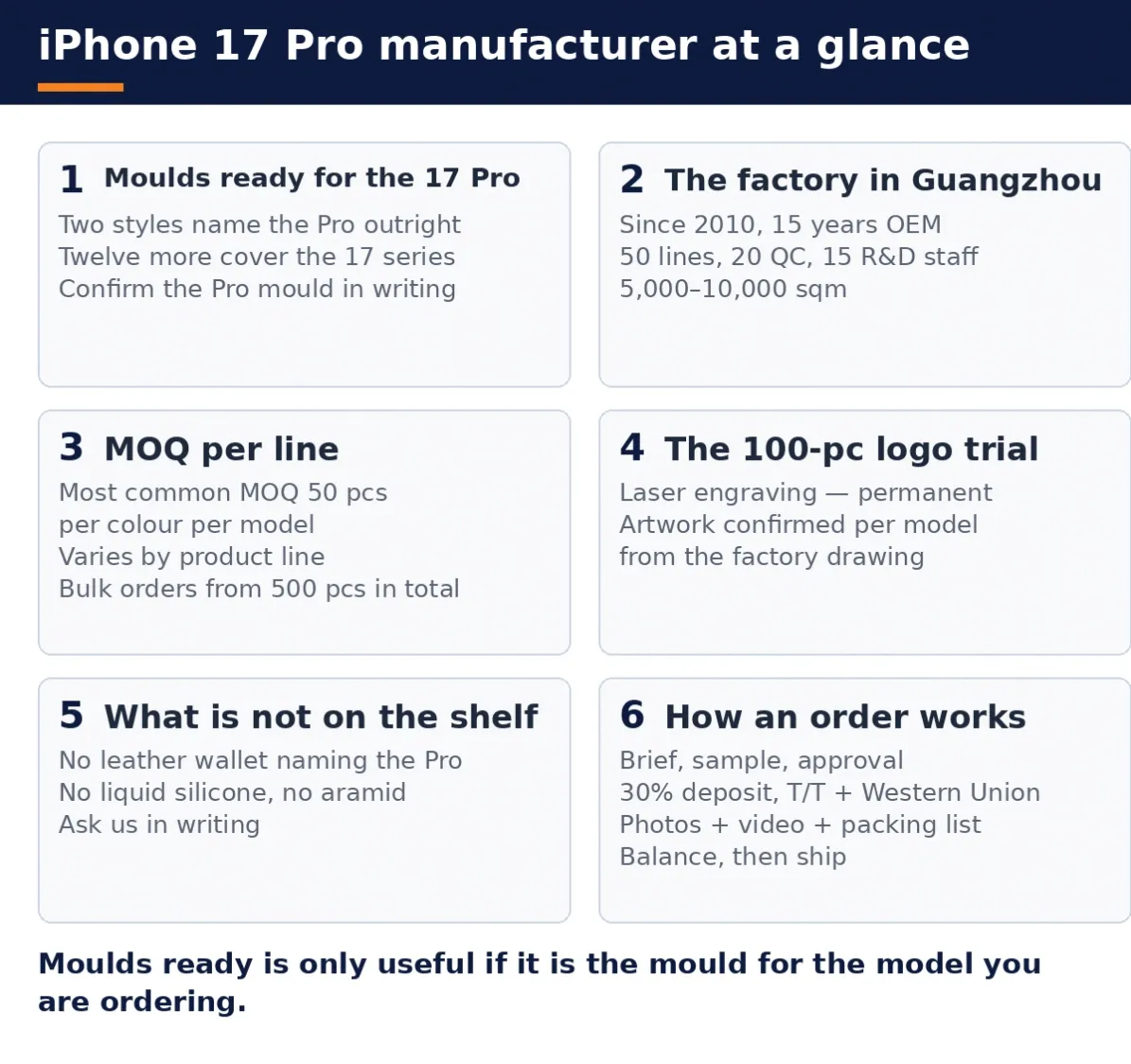
iPhone 17 Pro manufacturer at a glance
Question | The short answer |
|---|---|
Is the mould ready for the 17 Pro? | Yes — two styles name the Pro, twelve more cover the 17 series |
Who is the manufacturer? | iFunSmart, Guangzhou, since 2010 — 50 lines, 20 QC staff, 15 R&D staff |
What is the MOQ? | Most common 50 pcs per colour per model, varies by product line |
Can I order a trial with my logo? | Yes — 100 pcs can carry a logo by laser engraving |
What do samples cost? | Fee charged, refundable on orders of 500+ pcs — confirm per style in writing |
How do I pay? | T/T and Western Union only; 30% deposit for new customers |
How fast is the reply? | Within 24 hours |
1. Why the 17 Pro is the model to order now
The iPhone 17 Pro is the 6.3-inch Pro in the 17 family. Apple announced it on 9 September 2025 and put it on sale on 19 September 2025. It measures 150.0 x 71.9 x 8.75 mm and weighs 206 g, with a 6.3-inch Super Retina XDR OLED display, an A19 Pro chip, IP68 water and dust resistance, an aluminium unibody and Ceramic Shield 2 on the front. It comes in three colours: Silver, Cosmic Orange and Deep Blue.
Those numbers matter because the Pro sits between two phones that look like it and do not fit like it. The standard iPhone 17 is 149.6 x 71.5 x 7.95 mm and 177 g — close in footprint, nearly a millimetre thinner, with a different camera arrangement. The iPhone 17 Pro Max is 163.4 x 78.0 x 8.75 mm and 233 g — the same thickness, but 13.4 mm taller, 6.1 mm wider and 27 g heavier, with the larger camera plateau. A case moulded for either of those two will not sit right on the Pro: the camera cut-out, the button positions and the corner radius are all model-specific, and a case that is a millimetre out at the camera plateau is a case that rocks on the desk and leaves the lens edge exposed.
That is the fit argument. The timing argument is just as strong. The 17 Pro is a year into its cycle, which is exactly when it moves at volume: the launch rush is over, the price has settled at retail, and the installed base is large. A distributor ordering the 17 Pro now is ordering for the phone people already own, not for the phone people are about to buy. The contrast with the 18 Pro makes the point: the 18 Pro's re-tool shares the 17 Pro mould and is not finished yet, so an 18 Pro order is a pre-order that holds allocation while the fit is confirmed on a sample. A 17 Pro order is an order against a mould that is already running. The two models serve different buying decisions — the 18 Pro is the forward order, the 17 Pro is the volume order — and this guide is about the volume order.
One caution belongs in this section, because it is the mistake that shows up after the goods arrive. "Moulds ready" does not mean "every style fits the Pro". Two styles name the iPhone 17 Pro outright on their product pages, and twelve more cover the iPhone 17 series as a family — the Pro sits inside that family, but the page never names it, so the Pro mould has to be confirmed in writing before the order. Section 3 ranks the fourteen styles by what the page actually promises, and section 7 turns that ranking into five questions to ask in writing. A mould that is ready is only useful if it is the mould for the model you are ordering.
- The factory: what to check before you trust a manufacturer
A manufacturer is a factory, not a listing. The listing shows a price and a minimum; the factory shows a building, a set of tools, a QC bench and a record. Before the deposit, check the factory — and check it against facts that can be verified, not against claims that cannot.
Here is what iFunSmart is, stated plainly. The company is Ifun Electronics Technology Co., Ltd, in Guangzhou, China, and it has made phone cases since 2010 — fifteen years of OEM experience. The factory is 5,000 to 10,000 square metres, at Yongning Street, Zengcheng District, Guangzhou, Guangdong, postal code 511340 — the address is published on the company's own contact page, and the facility there is the primary manufacturing hub and R&D centre. It runs 50 production lines, with 20 QC staff and 15 R&D staff. The range is 1000+ designs and 500+ models, the capacity is 500K+ pieces a month, and the cases are exported to 30+ countries. Those are the figures Kelly confirmed in November 2026, and they are the figures to check any manufacturer against: years in the trade, floor area, number of lines, QC headcount, R&D headcount, designs, models, monthly capacity, and the countries the cases already go to.
Four checks turn those figures into a decision. First, the address. A manufacturer that will not publish a factory address is a manufacturer whose factory you cannot verify. Ask for the address in writing, and check that it is a manufacturing address — a street in an industrial district — not a serviced office. Second, the lines. Fifty production lines means the factory can run several models at once; a factory with one line can only run one model at a time, and your order waits behind the order before it. Ask how many lines the factory runs, and whether the 17 Pro runs on a line of its own. Third, the QC staff. Twenty QC staff means the factory checks the goods as they are made, not after they are packed — and the QC bench is where the sample is checked, as section 6 describes. Ask what the QC process covers: fit, construction, lips, corners, magnet pull force, carton integrity. Fourth, the mould list. A factory that holds the mould can name the models it holds moulds for, style by style. Ask for the mould list for the iPhone 17 Pro in writing — which styles, for which models — and compare it with the product pages, as section 3 does.
Two red flags end the conversation with any manufacturer. The first is a price far below the quote breakdown: a quote should show the style, the model, the colours, the logo method, the quantity per line, the deposit terms and the sample terms, and a price that undercuts every line of that breakdown is a price that has cut something out of it — the material, the magnet, the QC check, or the packaging. The second is a mould that cannot be named: a manufacturer that says "we have all models" and cannot list the styles for the 17 Pro by name does not hold the moulds, it holds a catalogue. The drop-protection guide in this series explains the same logic for drop claims: a figure without a test report behind it is a claim, not a fact. A mould without a style list behind it is the same.
One more check belongs here, because it is the one buyers forget: the reply. We reply within 24 hours. A manufacturer that takes a week to answer a first enquiry will take a week to answer a problem with a bulk order. Send the brief, count the hours, and keep the reply time in mind when you choose. The sourcing guide in this series covers the full first-order workflow; this section is the factory half of it.
3. Moulds: ready for the 17 Pro, and what "ready" covers
The 17 Pro's moulds are ready, and "ready" has a precise meaning here: fourteen styles cover the iPhone 17 Pro range on live product pages, and they split into two tiers. Two styles name the iPhone 17 Pro outright, so the Pro fit is written on the page. Twelve more styles are listed for the iPhone 17 series as a family — the Pro sits inside that range, but the page never names it, so the Pro mould has to be confirmed in writing before the order. That two-tier split is the whole buying decision for this model.
The two A-tier styles are the safest first order. The Two-Tone MagSafe Case with Camera Stand names the iPhone 17 Pro first in its compatibility line — "iPhone 17 Pro, iPhone 16/15 Series, Samsung Series" — and it is a two-tone magnetic case with a camera stand that folds out from the camera area, so the phone props up without a separate accessory. Its page states no magnet figure — it describes strong magnetic charging and says the case works with all MagSafe accessories — and that is the honest statement to repeat: no Gauss figure, no Newton figure, because the page gives none. The 360° Rotating Ring Stand MagSafe Case names the iPhone 17 Pro in its body text and states the only Newton figure in the fourteen: built-in N50 magnets with an 18N magnetic force. Its ring stand rotates a full 360°, and the case carries an anti-fingerprint coating. Both styles state the most common MOQ of 50 pcs per colour per model, with logo customisation and custom packaging supported.
The twelve B-tier styles fall into three builds. The clear magnetic build has four styles: the Clear Magnetic Case at 12N; the 3D Color Bar Clear MagSafe Case at N52, 2600 Gauss and 12N, the anti-yellow clear case in the range; the Pure Collection Clear MagSafe Case at N52 grade; and the clear MagSafe case with metal buttons and lens guard at N52 ring. Four clear styles, four different magnet statements — and the anti-yellowing claim belongs only to the 3D Color Bar, not to the other three. The ring-stand and armor build has four styles: the Flat Kickstand Magnetic Case with no figure stated; the Magnetic Stand Case at 2400 Gauss; the 360° Rotating Rugged Kickstand Armor Case at N52 grade; and the Mech Armor MagSafe Case with a zinc alloy camera stand, model IB25-017, at N52 ring. The touch and decorative build has three styles: the Silky Touch MagSafe Case at N52 magnets — note the wording, a baby-skin silicone feel on a PC and TPU case, not a liquid-silicone material; the Bling MagSafe Case with no figure stated; and the MagSafe Case with Removable Lanyard Corners at 2600 Gauss, N52 grade. The fourteenth style sits outside the three builds: the RFID Blocking Clear Card Holder Case, with a metal stand and a card holder, and no magnet figure because it is not a magnetic style.
The magnet figures differ by style and are stated per style where the product page states them — so never quote a single Gauss figure for the whole 17 Pro range. The figures are not interchangeable, and a buyer who quotes one figure for all fourteen styles is quoting a figure that most of the pages never state. Quote the figure from the page of the style you are ordering, and ask us to confirm the pull force in writing for any style whose page states no figure.
The contrast with the 18 Pro is worth one paragraph, because it is the reason this guide exists as a separate article. The iPhone 18 re-tool shares the iPhone 17 mould and is not finished yet — pre-orders are open, a pre-order holds allocation while the fit is confirmed on a sample, and no date is promised for a tool that is still being cut. The iPhone 18e needs a new mould, and the factory is still deciding whether to open it, so no date is promised for it at all. The Samsung A38 and A58 have no tooling data yet. The 17 Pro is the model whose tooling is already done. That is the whole of the difference, and it is the difference that makes the 17 Pro the volume order.
What is not on the shelf yet matters just as much, and each gap is verified by a site search that returned nothing. There is no leather wallet case naming the 17 Pro — the nine leather-wallet pages are for the iPhone Duo, the iPhone 18 Pro, the iPhone 18 Pro Max and Samsung. There is no liquid silicone case naming the 17 Pro — only two liquid-silicone pages exist site-wide, for the iPhone Duo and the iPhone 18 Pro Max. There is no aramid case anywhere on the site. There is no slide camera cover naming the 17 Pro, and no card holder naming the 17 Pro outright — the series-level RFID card holder is the one to confirm. Each gap is a written question in the same enquiry, not a reason not to order: model, style and quantity in writing, so the factory answers on the record.
- MOQ per line: what a low MOQ really means
The most common MOQ is 50 pcs per colour per model, and it varies by product line — so the MOQ is counted per colour per model, not per order, and it is confirmed per line on the quote, never assumed. That sentence is the whole of the MOQ rule, and this section is what it means in practice for the 17 Pro.
All fourteen styles in the 17 Pro range state 50 pcs per colour per model on their product pages. That is the range's figure, not the factory's figure: the MOQ varies by product line across the catalogue — the IPDK Duo line is 100 pcs, the ISF Samsung line is 50, the IP leather line is 50 for IP001–007 and 30 for IP008–018, the IQ line is mostly 30, and the IPD line runs 20, 30 or 50 by style. A buyer who assumes 50 everywhere will under-order a Duo line and over-order a leather line. For the 17 Pro, the fourteen styles are all 50 — but the quote still confirms the MOQ per line, because the line is what the MOQ belongs to.
The maths is the same for every first order. The MOQ is per colour per model: one style in one colour for one model is 50 pcs. Two styles in two colours is 200 pcs. Three builds in three colours is 450 pcs. Bulk distributor orders start at 500 pcs per order in total, counted across the order's lines — so a first order that crosses 500 pcs in total is already a distributor order with distributor terms. A distributor that orders 50 pcs of ten colours of one style has ordered 500 pcs and met the threshold; a distributor that orders 50 pcs of one colour of one style has ordered 50 pcs and has not. Count the total, and count it per line.
A low MOQ is not the same as a low commitment, and it is worth saying why. Fifty pieces per colour per model is low enough to test a style without filling a warehouse — and it is high enough that the factory runs the style properly, with the right material, the right magnet and the right QC check. A supplier that offers five pieces per colour per model is not offering a better deal; it is offering a sample quantity at a bulk price, or a bulk quantity without the QC. The MOQ guide in this series covers the first-order maths in full; the point here is narrower: for the 17 Pro, 50 pcs per colour per model is the figure on every page in the range, and it is the figure the quote will confirm per line.5. Custom logo: the 100-pc trial order
A custom iPhone 17 Pro case is a standard shell with your design on it, and the design is where the order starts. The shell is the starting point, not the product: the same 17 Pro shell can carry a printed graphic, a laser-engraved logo, a moulded-in design or a plain finish, and the method you choose decides the minimum, the look and the durability.
The four print methods this series has confirmed are UV printing, IMD, silk screening and heat transfer — and sublimation, which needs a compatible coated blank. UV printing cures the graphic with UV light and carries full colour and photographic detail; it is the way to test a design on a short run. IMD seals the graphic inside the moulded wall, so it cannot peel or scratch off; it is the default for high-volume branded work. Silk screening lays the graphic through a mesh stencil in spot colours — no gradients — and suits a small logo in one or two colours. Heat transfer moves a graphic layer onto the case with heat and pressure. Each method has its own limits, and the right method is the one that fits the design: a photographic design goes to UV, a logo that must survive daily handling goes to IMD or laser, a gradient goes anywhere except silk screen.
The logo trial is the smallest custom order that makes sense, and it is confirmed: a 100-pc trial order can carry a logo by laser engraving. Laser engraving is permanent — the logo is cut into the surface, not printed onto it — which is why it suits a trial: the buyer gets a branded case that will not fade, on an order small enough to test the design. The per-piece charge for the engraving is confirmed in writing per order; no figure is stated in this guide, because a figure stated here would go stale. A trial order is also the cheapest way to check the artwork: the printable area is confirmed per model from the factory drawing, never guessed, and the trial shows whether the logo sits where the buyer intended it to — on the lower back, clear of the camera plateau and the magnetic ring.
Artwork is the part of the order buyers most often get wrong, and it is the part the factory cannot fix after the deposit. Send the artwork as a print-ready file, at the resolution the factory asks for, in the format it asks for — and ask for the format in writing if it is not on the quote. A low-resolution file prints soft; a file with the wrong colour profile prints the wrong colour; a file that has not been checked against the printable area prints across the camera cutout. The factory will check the file before production, but the check is only as good as the file. Send the final artwork, not a draft, and get the factory's confirmation that the file is print-ready before the deposit.
Custom packaging follows the same rule as the case: it is confirmed per order, in writing. The case can ship in a plain polybag, a printed retail box with a barcode, or a custom box the buyer designed — and the packaging is part of the product on a retail shelf, not an afterthought. Ask for the packaging options on the quote, with the barcode and labelling requirements for the market the cases will sell in. The packaging guide in this series covers the box, the barcode and the dieline in full.
One last point on the trial order: it is a trial of the design and the fit, not a trial of the price. A 100-pc trial tells you whether the logo looks right, whether the case fits the phone, and whether the colour reads the way the buyer expected. It does not tell you the unit price of a 5,000-pc order, because the unit price moves with the quantity. Use the trial for what it is for — design, fit and colour — and negotiate the bulk price on the bulk order.
Two more rules from the earlier guides. First, a mixed-model order is quoted and counted separately per model, because each model has its own tooling and its own minimum — a Pro line and a Pro Max line are two lines, not one. Second, the 100-pc trial order is separate from the MOQ: a trial order can carry a logo by laser engraving at 100 pcs, which is above the 50-pc MOQ for the style but below the 500-pc bulk threshold, and it is the smallest custom order that makes sense. Section 5 covers the trial in full.
6. How an order works, step by step
An order has five steps, in this order: the brief, the sample, the approval, the deposit, and the shipment. Each step has one document, and the document is what the next step runs on. Skip a step, and the step after it has nothing to run on.
The brief. Send the model, the style, the colours, the logo method and the quantity — in writing, on the RFQ. The model is the exact model: iPhone 17 Pro, not "iPhone 17" and not "the Pro". The style is the style by name: two-tone camera stand, 360° rotating ring stand, clear magnetic, Mech Armor. The colours are the colours by name, from the product page's list. The logo method is the method: laser engraving, UV printing, IMD, silk screening. The quantity is the quantity per colour per model, because the most common MOQ is 50 pcs per colour per model and it varies by product line — so the quantity is stated per line, not per order. A brief that says "500 cases" has not said how many of which model, in which colours, and the factory cannot quote it. The RFQ guide in this series lists everything the brief should carry.
The sample. Samples carry a fee that is refundable on orders of 500+ pcs — ask us to confirm the amount per style in writing. The sample is where the fit is confirmed: the case seats fully on the phone, the corners wrap with no gap, the buttons click cleanly, the camera cutout does not intrude into the lens field, and the magnetic ring holds a charger firmly. Check the sample the way a factory QC bench checks it — fit, construction, lips, corners, parting lines, coating adhesion, batch tolerance, magnet pull force against the figure the product page states for that style, and the documents that came with it — not by dropping it on the floor. Check the stand the same way: cycle the camera stand and the ring stand open and shut on the bench sample and check each sits flush when closed and holds the phone at its working angle when open, and check the hinge friction is even. The sampling guide in this series covers the bench checks in full.
The approval. Approve the sample in writing — the style, the colour, the logo position, the packaging — before the deposit. An approval in a chat message is not an approval: it cannot be found later, it cannot be attached to the order, and it cannot be shown to the factory. Approve by email, with the sample reference, the model, the style, the colours and the logo method stated. If the sample is wrong, say so in the same email, with the correction stated — a new colour, a moved logo, a different style — and wait for the corrected sample. A correction after the deposit is a rework, and a rework is charged.
The deposit. Payment is T/T and Western Union only. New customers may pay 30% deposit first. The deposit is paid after the approval, not before it — the approval is what the deposit is paying for. No other payment methods are offered. Get the deposit terms on the quote, in writing, with the balance terms beside them, before the deposit is sent.
The shipment. After the goods are ready, the factory sends photos and video and the packing list. The customer pays the balance, then the goods ship. Check the photos and the video against the approved sample — the style, the colour, the logo, the packaging — and check the packing list against the order: the model, the style, the colours and the quantities, line by line. If something does not match, say so before the balance is paid, because the balance is the last point at which a correction is cheap. After the balance, the goods ship, and the shipment is the order as it was made.
7. Five questions to ask any manufacturer in writing
A 17 Pro order is only as strong as the answers behind it. Ask these five questions in writing — on the RFQ, not in a chat message — and keep the answers with the order. A manufacturer that holds the moulds will answer all five without difficulty. A manufacturer that cannot answer them has told you what its "we have all models" claim is worth.
- What is the tooling status for the iPhone 17 Pro — and for the Pro Max separately? The two models take different moulds. Ask whether the tool is ready, whether it is a re-tool or a new mould, and when the fit was last confirmed on a sample. "Moulds ready" means the fit has been confirmed on a sample — ask for the status in writing.
- Which styles exist for the 17 Pro by name — and which do not? Ask for the style list with the model beside each style. Two styles name the Pro outright; twelve more cover the 17 series as a family. A style that exists for the Pro Max does not exist for the Pro until the factory says so. If a style is not on the list, it is not on the order.
- What is the MOQ per line, and what counts toward the bulk threshold? The most common MOQ is 50 pcs per colour per model, and it varies by product line — so ask per line. Ask what counts toward the 500-pc bulk threshold, and get the answer on the quote.
- What does the quote show — and what does the sample cost? A quote should show the style, the model, the colours, the logo method, the quantity per line, the deposit terms and the sample terms. Ask for the sample fee per style in writing, and whether it is refundable on orders of 500+ pcs. A quote that does not show the sample terms is a quote that has not been finished.
- What does the 100-pc trial cover — and what does it not? Ask whether a 100-pc trial order can carry your logo by laser engraving, what the per-piece charge is, and where the logo sits on the case. A trial covers design, fit and colour — it does not set the bulk unit price. Get the trial terms on the quote, in writing, before the deposit.FAQs
Q1: How do I find an iPhone 17 Pro case manufacturer in Guangzhou?
Start with the factory, not the listing: a published factory address, the number of production lines, the QC headcount, and a mould list that names the iPhone 17 Pro styles by name. iFunSmart — Ifun Electronics Technology Co., Ltd, Guangzhou — has made phone cases since 2010, runs 50 production lines with 20 QC staff and 15 R&D staff at Yongning Street, Zengcheng District, and holds the moulds for the 17 Pro range: two styles name the Pro outright and twelve more cover the iPhone 17 series. Send a written brief — model, style, colours, logo method and quantity per line — and ask for the tooling status, the MOQ per line and the sample terms on the quote. We reply within 24 hours.
Q2: What is the MOQ for iPhone 17 Pro cases from a Guangzhou factory?
The most common MOQ is 50 pcs per colour per model, and it varies by product line — all fourteen styles in the 17 Pro range state 50 pcs per colour per model on their pages, but the quote confirms the MOQ per line, never assumes it. Bulk distributor orders start at 500 pcs per order in total, counted across the order's lines. A 100-pc trial order can already carry a logo by laser engraving — confirm the per-piece charge and the artwork position in writing. Samples carry a fee that is refundable on orders of 500+ pcs — ask us to confirm the amount per style in writing. No price is stated in this guide; ask us for a quote with the style, model, colours, logo method and quantity stated.
Q3: Can I order iPhone 17 Pro clear cases in bulk?
Yes — clear is the volume build for the Pro. Four clear magnetic styles are confirmed on live product pages: the Clear Magnetic Case at 12N, the 3D Color Bar Clear MagSafe Case at N52, 2600 Gauss and 12N — the anti-yellow clear case in the range — the Pure Collection Clear MagSafe Case at N52 grade, and the clear MagSafe case with metal buttons and lens guard at N52 ring. Each style's magnet figure is quoted only as its page states it, and the anti-yellowing claim belongs only to the 3D Color Bar. All four state the most common MOQ of 50 pcs per colour per model. Order the clear build in the colours the channel actually sells, not in every colour the page lists — depth in two or three colours beats one piece in eight.
Q4: Can I get a leather wallet case for the iPhone 17 Pro?
Not off the shelf. No leather wallet page names the 17 Pro — the nine leather-wallet pages are for the iPhone Duo, the iPhone 18 Pro, the iPhone 18 Pro Max and Samsung. The leather wallet range exists, but no page in it names the 17 Pro. The same applies to liquid silicone — only two liquid-silicone pages exist site-wide, for the iPhone Duo and the iPhone 18 Pro Max — and to aramid, which has no page anywhere on the site. For any of the three, send the model, the style and the quantity in writing and ask us to confirm whether the factory can make it — do not promise a customer a style that is not in the range.
Q5: How do I order custom-logo iPhone 17 Pro cases wholesale?
Send a written brief — model, style, colours, logo method and quantity per line — and ask for the tooling status, the MOQ per line and the sample terms on the quote. A 100-pc trial order can carry a logo by laser engraving, which is permanent; the per-piece charge and the artwork position are confirmed in writing per order. The print methods are UV printing, IMD, silk screening, heat transfer and sublimation (which needs a compatible coated blank). Check the sample on the bench: fit at every corner, buttons that click cleanly, a camera cutout that does not intrude into the lens field, and a magnetic ring that holds a cAbout iFunSmart
iFunSmart — Ifun Electronics Technology Co., Ltd, Guangzhou, China — has made phone cases since 2010: 1000+ designs, 500+ models, 500K+ pieces a month, exported to 30+ countries. We reply within 24 hours. Send your brief — model, material, colours, logo and quantity — and we will quote it line by line, send a sample (fee refundable on orders of 500+ pcs), and confirm the fit, the MOQ and the inspection records in writing before your deposit.
WhatsApp: +86 13632248734 — https://wa.me/8613632248734 — or email contact@ifunsmart.com — or visit www.ifunsmart.com.
Read more
- iPhone 17 Pro Cases: What Buyers Order First — https://www.ifunsmart.com/posts/iphone-17-pro-cases-what-buyers-order-first
- Custom iPhone 18 Pro Cases: Same Shell as the 17 Pro? — https://www.ifunsmart.com/posts/custom-iphone-18-pro-cases-same-shell-as-17-pro
- iPhone 18, 18e, Air 2, Galaxy A38 & A58: Mould Update — https://www.ifunsmart.com/posts/iphone-18-18e-air-2-galaxy-a38-a58-mould-update
- iPhone 17 & iPhone 17 Air Cases: What Buyers Order First — https://www.ifunsmart.com/posts/iphone-17-iphone-17-air-cases-what-buyers-order-first
- Phone Case RFQ: What to Send a Factory in Your First Enquiry — https://www.ifunsmart.com/posts/phone-case-rfq-what-to-send-a-factory-in-your-first-enquiry
- Phone Case Sampling: How to Evaluate a Sample Before a Bulk Order — https://www.ifunsmart.com/posts/phone-case-sampling-how-to-evaluate-a-sample-before-bulk
- Mixed-Model Phone Case Orders: How to Combine Models — https://www.ifunsmart.com/posts/mixed-model-phone-case-orders-how-to-combine-models
How to Source Phone Cases from China: First-Order Checks — https://www.ifunsmart.com/posts/how-to-source-phone-cases-from-china-first-order-checksharger firmly. Approve the sample in writing before the deposit. Payment is T/T and Western Union only; new customers may pay 30% deposit first; after the goods are ready the factory sends photos and video and the packing list, the customer pays the balance, and then the goods ship. We reply within 24 hours.
One honest note closes the guide. The iPhone 17 Pro is the easiest model in the 17 family to order well, because the moulds are ready and the range is confirmed — and it is the easiest model to order badly, because "the 17 series" is not the same as "the 17 Pro". A distributor that asks the five questions, checks the bench sample and keeps the mould confirmation in writing has bought a case that fits the phone it was made for. A distributor that buys the family listing has bought a shortcut — and a shortcut is the most expensive thing in a bulk order, because it is paid for twice: once in the deposit, and once in the dead stock.