Business Solutions
iPhone 18 Pro Case Trends 2026: 5 Directions to Stock
iPhone 18 Pro is here — and the case range around it has moved on. Five directions worth space in your 2026 assortment, what changed on the phone, and the sample checks that approve a bulk order.
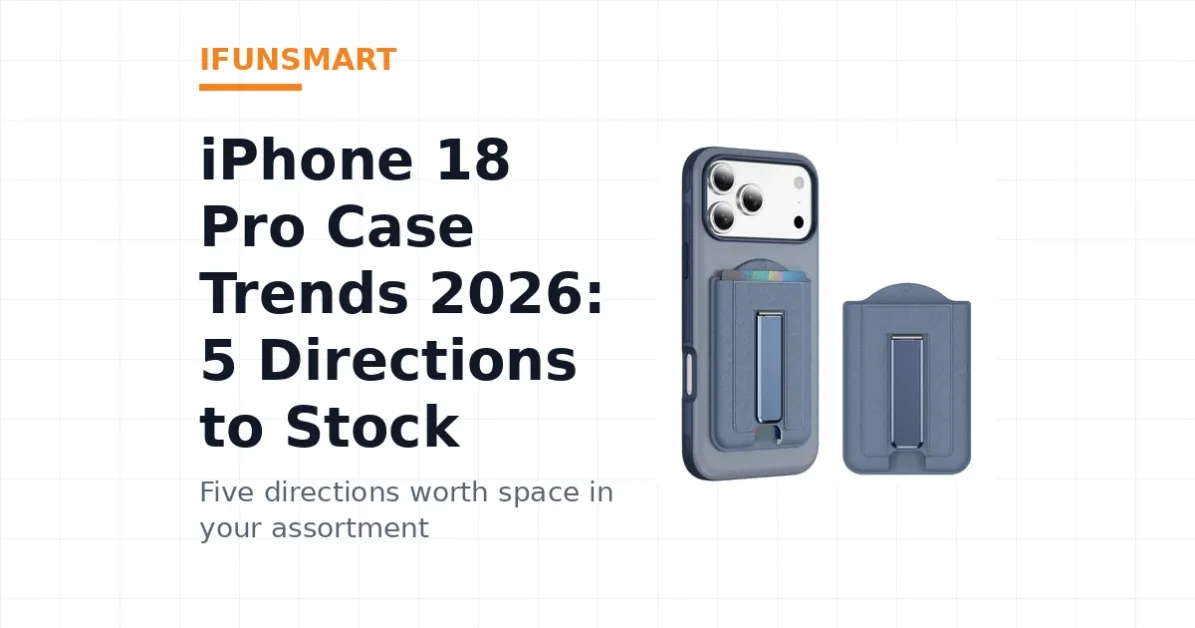
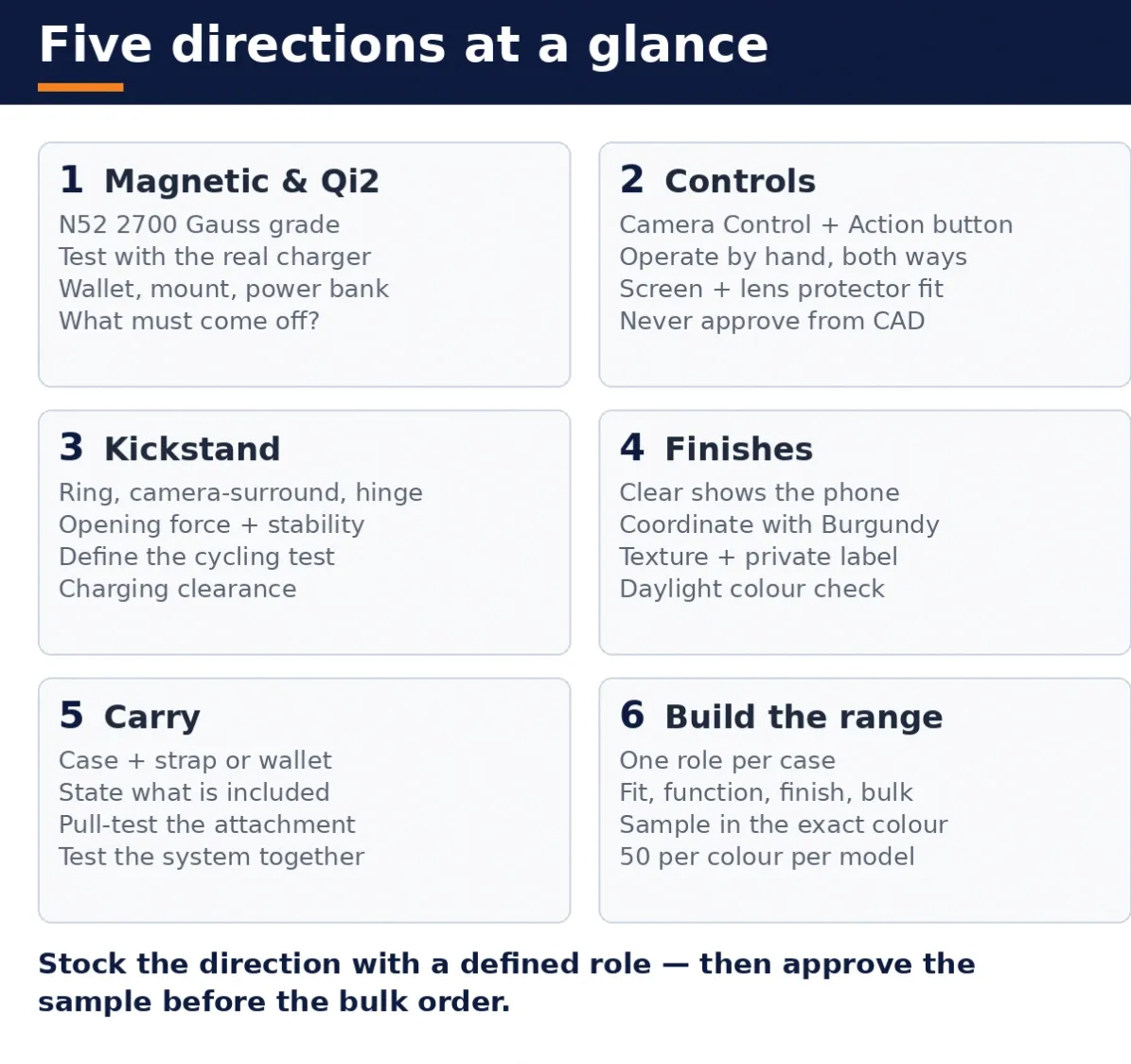
iPhone 18 Pro changed the phone, not just the camera cutout. Five directions deserve space in a 2026 assortment: magnetic and Qi2-ready cases, control-friendly construction, integrated kickstands, differentiated finishes, and coordinated carrying accessories. Each one needs its own sample check before a bulk order.
Short answer
Apple announced iPhone 18 Pro and iPhone 18 Pro Max on 9 September 2026, and both went on sale on 18 September. For a case buyer, the launch matters because the phone itself changed in ways a case has to answer: new dimensions, a Camera Control button next to the Action button, and wireless charging listed at up to 25W over both MagSafe and Qi2. A case that only fits the phone dimensionally is no longer enough — it also has to let the buyer use the controls, charge at the expected speed, hold a stand steady, and look right next to the four phone finishes. This guide works through the five directions that deserve space in a 2026 assortment, what to check on a sample for each one, and how to build the range without multiplying SKUs faster than sales.
- What changed on iPhone 18 Pro — and why it changes the case
Start with the phone, because every case decision follows from it. The published specifications give a buyer four facts that matter directly for tooling and fit.
Size and weight. iPhone 18 Pro measures 150.0 by 71.9 by 8.75 millimetres and weighs 211 grams. iPhone 18 Pro Max measures 163.4 by 78 by 8.75 millimetres and weighs 249 grams. Both sizes are 8.75 millimetres thick. The practical point for a buyer is simple: do not assume a previous-generation shell, drawing or mould is interchangeable. A case approved for one generation needs a fresh fit check against the real device, not against a dimension table. Our mould-coverage guide explains how to confirm which models a factory actually holds tooling for — ask us to confirm the iPhone 18 Pro and Pro Max moulds against our list before you order.
Controls. The phone carries an Action button, a Camera Control button, a side button and USB-C. The controls are the reason "fit" is no longer a purely dimensional question, and section 3 covers the interaction test in full. A case can measure correctly and still make a control awkward to reach or press.
Wireless charging. Apple lists MagSafe and Qi2 wireless charging at up to 25W for iPhone 18 Pro. The original Qi2 standard introduced 15W charging, and Qi2 25W launched in July 2025 at the higher 25W level. That distinction matters for listings: a magnetic case is not itself a 25W charger, and the power a phone actually receives depends on the device, the adapter and the conditions. What a buyer should verify is whether the finished case charges correctly with the charger the customer will actually use — section 2 covers that test.
Finishes. iPhone 18 Pro comes in Black, Silver, Glacier and Burgundy, in an aluminium unibody with Ceramic Shield 2 on the front. Four phone finishes create four merchandising stories for cases: clear cases that show the phone, coordinated colours that complement a finish, and opaque finishes that create a branded look of their own. Section 5 works through which of those stories deserves stock.
The warning that covers all four facts. "Fits a 6.3-inch phone" is not evidence of compatibility. Approve the case on the real iPhone 18 Pro — its corners, its camera area, its controls, its USB-C opening — before accepting any cross-generation compatibility claim. A drawing can verify geometry. It cannot tell you whether a control is comfortable to operate with the production case in hand.
- Magnetic and Qi2-ready: the accessory question, not just the magnet
Magnetic cases are no longer judged only by whether a phone sticks to a charger. Charging power, alignment, wallets, stands, power banks and mounts increasingly belong to the same ecosystem, and a buyer should evaluate the case against the whole ecosystem, not against one magnet test.
The magnet grade is the starting point, not the answer. Our MagSafe lines use N52 magnets at 2700 Gauss, and that grade is the proof to ask for on any magnetic style you order. But the grade alone does not tell you whether the case centres on a charger every time, holds a wallet through a day in a bag, or keeps working when a stand is attached. Ask for the grade, then test the finished case with the accessories that will actually be sold alongside it.
Test with the real charger and the real adapter. Record the charger, the adapter, the phone and the case used in the test, because a charging result without that record cannot be repeated or compared. Test alignment first: does the case centre on the charger repeatedly, or does it sit slightly off and need adjusting? Then test attachment stability with the wallet, the mount and the power bank the range will actually sell. A case that holds a charger but drops a wallet is a case that will come back as a complaint about the wallet, not about the case.
Check the conflicts before the listing goes live. A stand, a decorative plate or a wallet may need to come off before the phone charges. Find that out on the sample, not from a customer. The listing should say what must be removed, because a lifestyle photo that implies everything works together is a return waiting to happen. And remember the warning that applies to every wallet-style product: do not place cards, security badges, passports or key fobs between an iPhone and a MagSafe charger — Apple advises against it, and a wallet case that invites that mistake needs its use instructions written clearly. The sourcing question to ask is not "how many magnets are inside?" but "which complete use cases have been verified with this finished case?" A supplier who can answer that with a test record is selling a verified product. One who can only quote a magnet grade is selling a component.
- Control-friendly construction: fit is now an interaction test
Camera Control sits on the side of iPhone 18 Pro alongside the Action button, and the camera system is a central part of the phone's 2026 launch. That makes the case around the camera and the controls a functional question, not a cosmetic one. A case can fit the phone dimensionally and still produce an awkward experience every time the customer opens the camera.
Run the four-step sample check. First, install the case: confirm corner retention, screen edge alignment and the position of the camera surround. Second, operate the controls: use Camera Control, the Action button and the side button with the case installed, instead of judging them from a product photo. Press each control the way a customer would — quickly, one-handed, without looking. Third, test both orientations: hold the device vertically and horizontally, and look for edges that interfere with normal camera use. A case edge that is fine in portrait can dig into a finger in landscape. Fourth, add the intended accessories: check the screen protector, the lens protector and the USB-C cable clearance as a complete combination, because a case that fits alone and fails with a screen protector fitted is a case that fails in the customer's hand.
Do not approve from CAD alone. A drawing helps verify geometry, but it cannot tell a buyer whether a control is comfortable to operate with the production case in hand. The approval sample must be the finished production case, on the real phone, operated by hand. If a supplier offers a drawing instead of a sample for the controls check, that is a reason to slow down, not a reason to approve faster.
The camera surround deserves its own check. The camera area is the most visible part of the case and the part most likely to be wrong. Inspect the lens, the flash and the surrounding clearance on the sample, and check that the surround sits flat and does not catch on a pocket or a bag. A surround that rocks or lifts will be noticed on the first day of use.
- Integrated kickstands: a product role, not an extra feature
A kickstand can move a case into a different position in the assortment: desk use, video viewing, hands-free calls, or a combined ring-holder function. The important point is that stand designs are not interchangeable. The position of the hinge changes the way the case interacts with charging accessories, the camera module and the user's hand — so the stand needs to be bought as a role in the range, not as a feature added to a case you already stock.
Three stand structures, three different roles. A magnetic ring stand gives a multi-function everyday case: it rotates, it holds, and it works as a grip. The sample checks are rotation, hinge resistance and magnetic accessory clearance — does the ring still let a wallet or a charger attach? A camera-surround stand gives a slim stand design that folds into the camera area. The checks are camera clearance, opening force and stability on a flat surface — does it open with one finger and hold the phone steady? A separate back hinge gives a viewing-focused case, built for watching video. The checks are closed thickness, protrusion, hinge cycling and charging clearance — does the case still sit flat, charge normally, and close flush after repeated use?
Define the durability test before you use a durability claim. A stand described as durable needs a test with conditions: how many opening and closing cycles, at what opening angle, with which phone installed, what counts as a failure, and whether stability is checked again after cycling. Without those conditions, a large lifecycle number is difficult to interpret — and we do not publish cycle counts for any stand, because the test conditions are what make the number meaningful.
Check the stand against the charger. A kickstand that blocks wireless charging, or that has to be removed before the phone charges, changes the product. Test the case on a MagSafe charger and on a magnetic mount with the stand open and closed, and write down what must be removed before charging. That note belongs in the listing, not in a customer complaint.
- Finishes: clear, coordinated and textured — with evidence, not promises
Apple launched iPhone 18 Pro in Black, Silver, Glacier and Burgundy, and its own accessory range runs to TechWoven, Silicone and Clear cases in coordinated colours. That does not prove every retailer needs the same mix. It does show three distinct merchandising routes a buyer can evaluate — and each one needs its own sample evidence.
Show the phone. Clear or lightly tinted cases let the device finish remain part of the purchase decision. A customer who chose Burgundy wants to see Burgundy, and a clear case is how the retailer sells that choice. The check for a clear case is the anti-yellowing evidence: ask for the material tested, the sample identification, the ageing or exposure method, the test duration and conditions, and before-and-after records under comparable lighting. A finite laboratory test should not be converted into an unlimited promise that a case never yellows — and we do not publish a yellowing figure for any finish. Ask us for the evidence for the style you order, and judge the sample in daylight.
Coordinate the colour. A case can complement Burgundy, Glacier or another phone finish instead of hiding it completely. This is the route for a retailer who wants a colour story across the range: a case colour for each phone finish, or one accent colour that works with all four. The sample check is colour match under daylight, piece to piece — hold three samples side by side and look for variation, because a colour that drifts between batches will be photographed and sent back.
Create a branded look. Opaque finishes, textures and private-label decoration can separate an OEM range from generic retail cases. This is the route for a brand or a distributor building an exclusive line: a woven texture, a matte finish, a leather look, or a printed pattern that belongs to one territory. The sample check is the decoration itself — registration against the artwork file, scratch resistance on the surface, and colour match under daylight — the same three checks our decorative-finishes guide sets out for every printed case.
One rule covers all three routes. Do not stock a finish because it photographs well. Stock it because it has a defined role in the range and a sample that passed its checks. A finish without a role is a SKU without a customer.
- Carrying accessories: sell a scenario, not a pile of parts
Apple's 2026 accessory launch runs to cases, wallets, wrist straps and crossbody straps, and its Clear Case is described as compatible with wrist and crossbody carrying options. For a B2B buyer, that suggests a different assortment strategy: sell a coordinated use scenario rather than adding every function to one case. A case with a strap, a wallet and a stand built into it is heavier, thicker and harder to approve than a case sold with the right accessories alongside it.
A bundle needs four clear answers. What is included — case only, case plus strap, or case plus wallet? What is optional — and do not let a lifestyle image imply that every accessory in the photo is in the box. What must be removed — identify charging or attachment conflicts before publishing the listing, because a strap that has to come off before the phone charges is a fact the customer should know before buying. And what was tested together — test the assembled system, not just each component separately. A strap that holds on its own and a case that charges on its own do not prove that the strap and the case work together.
Check the attachment the way a customer will use it. A wrist strap or a crossbody strap is a retention product: if it fails, the phone falls. Check the attachment point on the sample by pulling it firmly, repeatedly, at the angle the strap actually pulls. Check the card wallet the same way: load it with cards, carry it for a day, and see whether the cards stay put and the wallet stays attached. Our card-wallet pivot stand case pairs the wallet with a magnetic kickstand, so the sample check covers both at once.
Keep the bundle honest. The most common bundle mistake is a photo that shows more than the box contains. State the contents in the listing, in words, and check the packaging sample against that list. A customer who opens a box and finds one accessory missing will not read the small print — they will send the box back.
- Build the assortment around different customer jobs
The easiest way to create unnecessary SKUs is to source several cases that look different but solve the same problem. A more useful approach is to give each case a clearly defined role, and to let the roles decide the range.
Five roles, five directions. A core everyday case — slim, magnetic — is the simple daily-use option, and its priority checks are fit, controls, magnet alignment and finish. A functional upgrade — a ring-holder or kickstand case — is the hands-free viewing or grip option, and its checks are stand stability, cycling and accessory conflict. A protection-focused option — a reinforced case — is the protection positioning, and its checks are the test method, the report scope and bulk consistency. A lifestyle option — a strap-ready case or a coordinated finish — is the fashion and carrying scenario, and its checks are attachment retention, colour and package contents. And a clear case — the show-the-phone option — is the finish story, and its checks are the anti-yellowing evidence and the colour match.
Watch the SKU multiplier. A small range becomes complex quickly. Two phone models, three case structures and four colours is 24 SKUs — and that is before packaging. Add a case-only version and a case-plus-strap bundle to every combination and the same range becomes 48 sellable configurations. That is not a recommended SKU count. It is the reason to decide which combinations deserve separate inventory before committing to packaging, samples and production quantities.
The order arithmetic decides the range. Our standard order is 50 pieces per colour per model, so two models in three structures in four colours is 24 runs and 1,200 pieces at standard MOQ. Distributor and bulk orders start at 500 pieces per order in total, across the models, structures and colours you choose. The arithmetic is the reason to order narrow first: one structure, in the colours your customer already asks for, in the two models — and add the second structure only when the first one sells. Order the sample before the bulk, in the exact model, structure and colour you plan to sell, and approve it against the checks in this guide.
- The 10-point iPhone 18 Pro sample checklist
Before approving a bulk order, record each of these against the exact sample revision. A check that is not recorded cannot be compared with the bulk run, and a bulk run that differs from the sample is a bulk run that needs to be stopped.
- Exact model fit. Approve on the real iPhone 18 Pro, not by inference from a dimension table. Check the corners, the screen edge and the camera surround.
- Installation and removal. Check retention without deformation. A case that stretches on removal will loosen over time.
- Camera area. Inspect the lens, the flash and the surrounding clearance. Check that the surround sits flat and does not catch.
- Controls and buttons. Operate every control with the finished case installed — Camera Control, Action button and side button — in both orientations.
- USB-C clearance. Use the cable types expected in the market, and check the opening with the case installed.
- Magnetic accessories. Test the charger, the mount, the wallet or the power bank the range will actually sell, and record the charger and adapter used.
- Kickstand operation. Verify opening, positioning and stability — with the phone installed, on a flat surface, at the angle the customer will use.
- Surface and colour. Approve the final physical finish under daylight, and compare three samples side by side for variation.
- Logo and decoration. Evaluate a decorated production sample, not a blank one. Registration, scratch resistance and colour match, against the artwork file.
- Packaging and labelling. Confirm the device name, the contents and the claims on the packaging sample — and that the contents list matches the listing.
Approve in order: fit, function, finish, then bulk order. Approve fit and function before final decoration, packaging and bulk production. A decoration approved on a case that does not fit is a decoration on a case you cannot sell.
FAQs
Q1. Which iPhone 18 Pro case direction should I stock first?
A slim magnetic case is the safest first direction, because it suits the widest buyer — everyday retail, distributors who need a core line, and private-label brands that want a clean base for their own decoration. It is also the direction with the simplest sample checks: fit, controls, magnet alignment and finish. Start with one magnetic style in two colours, check the samples, and add a kickstand or a carrying bundle only when the first direction sells.
Q2. Will my existing iPhone 17 Pro cases fit iPhone 18 Pro?
Do not assume so. iPhone 18 Pro measures 150.0 by 71.9 by 8.75 millimetres, and the controls and camera area have changed. A case approved for one generation needs a fresh fit check against the real iPhone 18 Pro — its corners, its camera surround, its controls and its USB-C opening — before you accept any cross-generation compatibility claim. Ask us to confirm the moulds for iPhone 18 Pro and Pro Max against our list.
Q3. Does a magnetic case charge at 25W?
A magnetic case is not itself a 25W charger. Apple lists MagSafe and Qi2 wireless charging at up to 25W for iPhone 18 Pro, and the power the phone actually receives depends on the device, the adapter and the conditions. What matters is whether the finished case charges correctly with the charger your customer will use — test it on the sample with the real charger and adapter, and record both.
Q4. How do I choose between a kickstand case and a ring-holder case?
Choose by the job, not by the feature list. A ring-holder suits everyday use — grip, a quick stand, a magnetic mount — while a separate back hinge suits viewing, and a camera-surround stand suits a slim case that still needs a stand. Test the stand you choose on the sample: opening force, stability on a flat surface, and whether it blocks charging. The wrong stand is the one that solves a job your customer does not have.
Q5. What should I send with my first enquiry for iPhone 18 Pro cases?
The model — Pro or Pro Max — the case direction, the colours, the quantity range, and the artwork file if the design is yours. That is the same first message our RFQ guide asks for, and it is enough for us to confirm the moulds, the construction and the minimum quantity for your range — and to send you the right samples. Send the enquiry, and we will reply within 24 hours.
About iFunSmart
iFunSmart has made phone cases in Guangzhou since 2010, with 1000+ designs, 500+ models and capacity of 500K+ pieces a month, shipped to buyers in 30+ countries. Our standard order is 50 pieces per colour per model, and distributor and bulk orders start at 500 pieces per order in total, with free samples for distributors. Our MagSafe lines use N52 magnets at 2700 Gauss — send us your model list and the case directions you want, and we will confirm the moulds and send the samples. We reply within 24 hours.
Read more: Ordering Before a New iPhone or Samsung Launch: Fit, Moulds & Timing — https://www.ifunsmart.com/posts/ordering-before-a-new-iphone-or-samsung-launch ; Qi2 and Android Magnetic Cases: What to Order — https://www.ifunsmart.com/posts/qi2-android-magnetic-cases-guide ; MagSafe Cases in 2026: N52 vs N45, 2700 Gauss, and How to Test the Magnet Before You Order — https://www.ifunsmart.com/posts/magsafe-cases-2026-n52-2700-gauss-test-magnet ; TPU vs PC vs Liquid Silicone vs Leather — Which Phone Case Material Should You Order? — https://www.ifunsmart.com/posts/phone-case-materials-tpu-pc-silicone-leather ; Decorative Phone Case Finishes: What to Check on a Sample — https://www.ifunsmart.com/posts/decorative-phone-case-finishes-what-to-check-on-a-sample ; Phone Cases + Accessories That Sell With Them — https://www.ifunsmart.com/posts/phone-case-accessories-bundles ; Phone Case RFQ: What to Send a Factory in Your First Enquiry — https://www.ifunsmart.com/posts/phone-case-rfq-what-to-send-a-factory-in-your-first-enquiry ; Phone Case MOQ: 50 Pieces per Colour for Your First Order — https://www.ifunsmart.com/posts/phone-case-moq-50-per-colour-first-order