Business Solutions
Decorative Phone Case Finishes: What to Check on a Sample
Glitter, epoxy, mother-of-pearl and printed cases sell on looks — and fail on the finish. The four finishes, who each one suits, and the sample checks that catch failures before your order ships.
A decorative case sells on its finish — and fails on it too. Glitter sheds, resin domes bubble, shell inlays lift, and prints scratch off — all of it visible on a sample if you know where to look. Check the finish first. The case underneath is the easy part.
A buyer orders a decorative case for how it looks in a photo, on a shelf, and in a customer's hand. The finish is the product. Four finishes do most of the work in this part of the range: glitter sealed into a clear case, a clear epoxy dome poured over artwork, mother-of-pearl or shell pieces set into the back, and a printed pattern applied by UV printing, IMD film, silk screening or heat transfer. Each one suits a different buyer, fails in a different place, and needs a different check on the sample. The expensive mistake is ordering on a catalogue photo. The photo shows the finish at its best, once, under studio light. The sample shows it the way your customer will see it. Order the sample, run the checks in this guide, and only then place the bulk order.
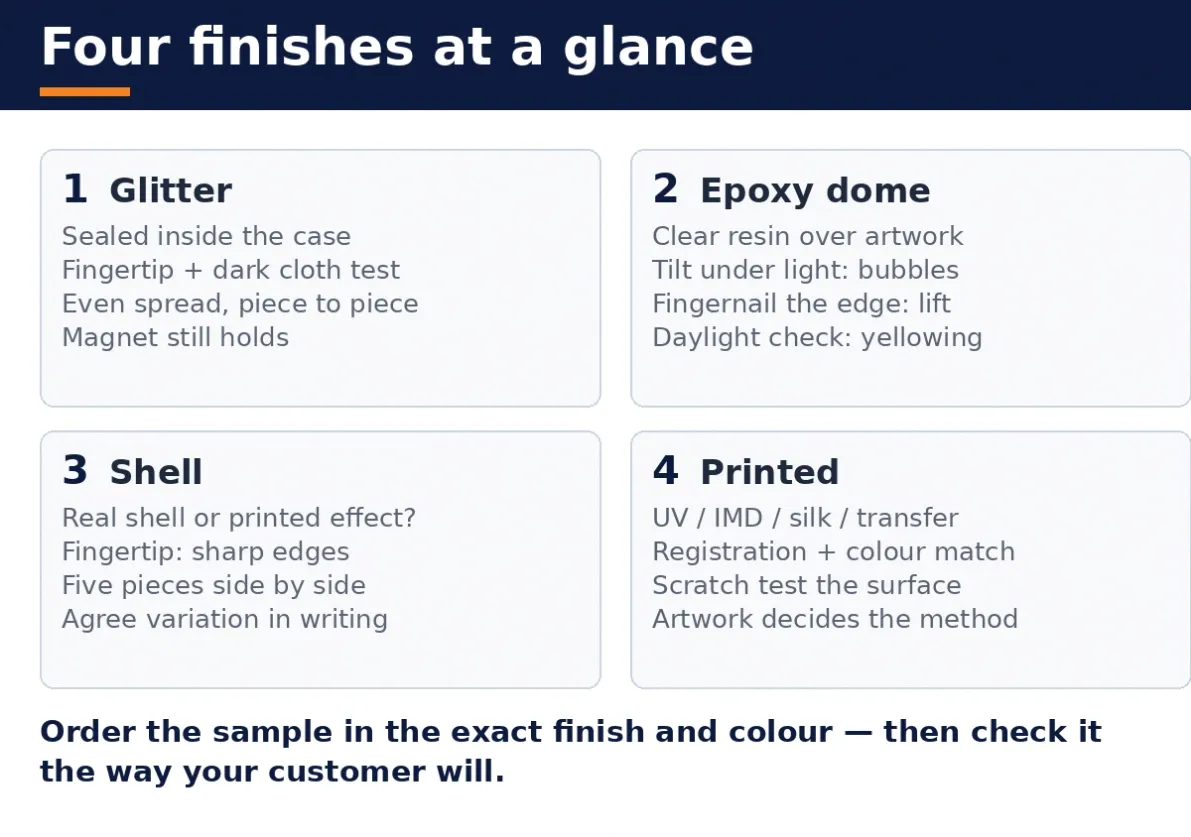
- Four finishes, four different buyers
Match the finish to the buyer, not to the catalogue. A finish that sells well in one channel can sit unsold in another — the difference is who is buying it and why.
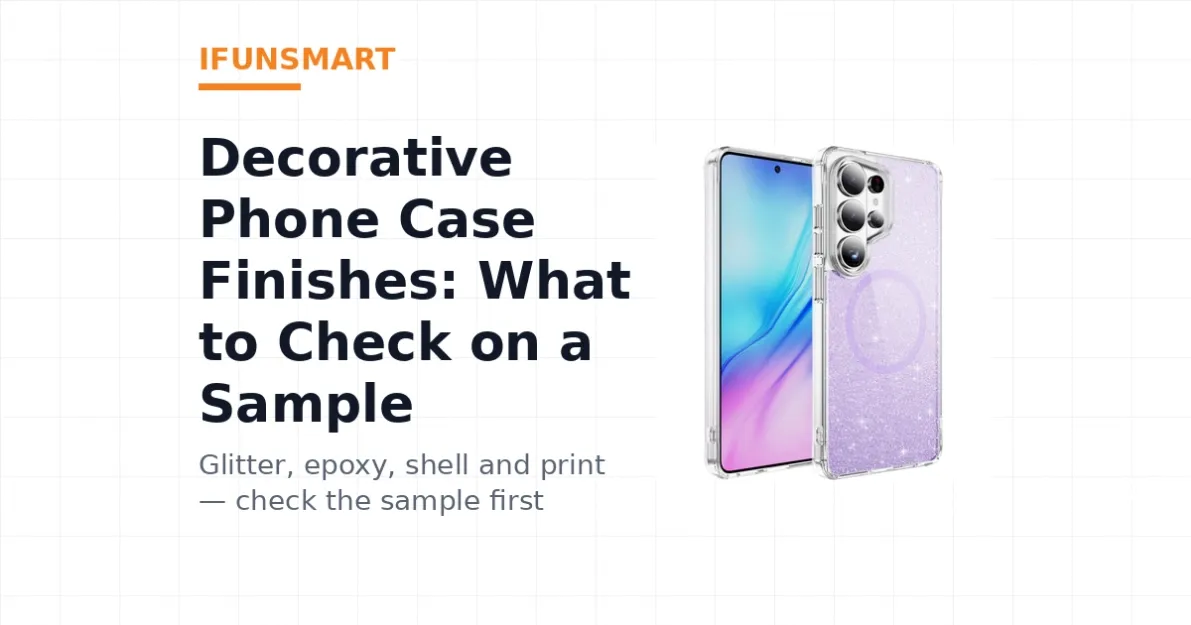
Glitter. Flakes sealed into or under a clear case, so the sparkle sits inside the product rather than on top of it. The buyer is usually a fashion or gift retailer, or a distributor whose range needs one bright line next to the plain ones. It is the easiest decorative finish to order first: the glitter is protected by the case material itself, and the colour range is wide. iFunSmart's live glitter range is the proof — the Clear Glitter MagSafe case runs in PC and TPU with the glitter sealed in, for iPhone models and the Samsung Galaxy S26 Ultra, and the Bling MagSafe case runs in Silver, Red, Blue, Gold and Pink.
Epoxy dome. A clear resin layer poured over artwork on the back of the case, which gives the design depth and a smooth, glassy surface. The buyer is usually a brand that wants its own artwork to look deep and finished, or a gift buyer who wants a design to feel premium in the hand. The artwork is the product here: the resin only protects it and makes it look deeper.
Mother-of-pearl and shell. Real shell pieces, or a printed effect that copies them, set into the back of the case. The buyer is usually a premium or gift retailer, or a brand whose range needs one piece that reads as jewellery rather than electronics. The look is the selling point, and the consistency from piece to piece is the risk.
Printed. A pattern or artwork applied to the case — by UV printing, IMD embedded film, silk screening or heat transfer. The buyer is anyone who needs a design on a case: a brand with its own artwork, a retailer with a seasonal pattern, a distributor who wants an exclusive print for one territory. Printing is the most flexible finish, because the artwork can change while the case stays the same.
Four finishes, four buyers. Pick the finish your customer already asks for, and check the sample for the failure that finish is known for.
- Glitter: check that the sparkle stays in the case
Glitter fails in one way: it comes out. The check is whether the glitter is sealed inside the case material, or sitting on the surface where hands, pockets and bags can pull it off.
Sealed in, not glued on. On a good glitter case the flakes sit inside the material or under a clear layer, so the back feels smooth and nothing comes off on your fingertip. Run your fingertip across the back of the sample, then look at your finger. Then rub the sample against a dark cloth and look at the cloth. A case that sheds glitter in your hand will shed it in your customer's bag, and the complaint will arrive as a photo of a bag full of sparkle. iFunSmart's glitter cases are built this way — the Clear Glitter MagSafe case is PC and TPU with the glitter in the construction, not a coating on the outside — but confirm the construction for the style you order. Ask us for the spec sheet for this style.
Even spread, piece to piece. Glitter that pools in one corner and thins out in another looks like a fault, even when it is only uneven mixing. Hold three samples side by side under the same light and compare the density of the flakes. If one piece is noticeably denser than the others, ask how the run is mixed and checked. A distributor who puts three pieces on one shelf needs them to match.
The clear base underneath. The yellowing question is covered in our anti-yellowing guide, and the rule is the same here: ask what grade the clear material is, and check the sample against a new piece after it has sat in daylight.
The magnet still works. A glitter MagSafe case still has to hold a charger and a wallet. Put the sample on a MagSafe charger and on a magnetic mount, and check that it holds and charges. The magnet grade on iFunSmart MagSafe lines is N52 at 2700 Gauss — ask us to confirm the grade for the glitter style you order, and test it on the sample.
- Epoxy dome: check for bubbles, lift and yellowing
An epoxy dome is a clear resin layer over artwork. It looks simple. Its failures are all visible if you look at the sample the right way.
Bubbles under the resin. Air trapped under the dome shows as small round spots, usually near the artwork edges and the camera cutout. Hold the sample at an angle under a bright light and tilt it slowly — bubbles catch the light as you move it. One bubble on a sample means the pouring and curing step needs checking before a bulk run.
Lift at the edge. The dome meets the case at an edge, and that edge is where it lifts first. Run a fingernail gently along the edge of the dome, all the way around, and feel for a lip or a gap. Then press the centre of the dome lightly and watch the edge. A dome that has lifted will show a fine line of air at the border. A lifted dome collects dust under it and peels further — and a customer who finds the edge with a fingernail will keep pulling at it.
The resin yellows before the case does. Clear resin yellows with light and heat, and a yellowed dome turns white artwork cream and blue artwork green. Ask what resin the dome uses, then compare the sample with a new piece after daylight exposure. We do not publish a yellowing figure for any finish — ask us for the spec sheet for this style, and judge the sample in daylight, not under a shop light.
Thickness where it matters. A dome adds thickness to the back of the case. Check that the buttons still press cleanly, the camera cutout still clears the lens, and the case still sits flat on a table without rocking. A dome that is thick in the middle and thin at the edge will rock — none of it shows in a catalogue photo taken from above.
- Mother-of-pearl and shell: check the edges and the match
Shell finishes sell on the way light moves across the pieces. They fail on the edges and on the match between pieces.
Real shell or printed effect. Ask which one you are ordering. Real shell is pieces of shell set into the back; a printed effect is a pattern that copies the look of shell. Both sell — but they are different products, with different checks. A printed effect is checked like any other print: registration, colour, scratch resistance. Real shell is checked piece by piece, because no two pieces of shell are identical.
Sharp edges at the inlay borders. Shell pieces have edges, and an edge that stands proud of the surface will catch on fabric and on skin. Run a fingertip across the whole back of the sample, slowly, in every direction. Then run a fine cloth over it and see whether the cloth snags. A shell case that snags a pocket lining will come back as a complaint about the lining, not about the case.
Consistency across the run. Shell is a natural material, so the colour and pattern vary from piece to piece. That variation is part of the appeal — but only within limits. Ask the factory what the acceptable variation is, and hold five samples side by side. If one piece is noticeably darker, lighter or sparser than the rest, that is the piece your customer will photograph and send back — so agree the variation range in writing before the bulk run, with the samples as the reference.
Weight and thickness. Shell adds weight and thickness to the back of the case. Hold the sample next to a plain case for the same model and feel the difference, then check the camera cutout and the buttons the same way as for an epoxy dome. A shell case too thick for a car mount or a wireless charger is a case that will be returned for a reason nobody mentions in the listing.
- Printed cases: match the method to the artwork
Printing is the most flexible decorative finish, and the one where the wrong method is the most common mistake. iFunSmart prints in four methods — UV printing, IMD embedded film, silk screening and heat transfer — and a given design may suit one better than another. We do not claim every design can run in every method. The artwork and the placement decide that.
UV printing. Ink cured with ultraviolet light, printed directly onto the case. It suits detailed, full-colour artwork and small runs, because the design goes straight from file to case. Check the registration — whether the print sits exactly where the artwork file says it should, especially around the camera cutout and the edges. Check the ink layer with a fingernail: a print that sits on the surface can be scratched, and a print under a clear coat cannot. Ask whether your design prints under a clear finish or on the surface, because the answer decides how it wears.
IMD embedded film. The design is printed on a film that is embedded inside the case during moulding, so the artwork sits under the surface rather than on it. It suits designs that need to survive handling — the print cannot scratch off, because it is inside the case. Check the film edges for wrinkles or trapped air, and check that the design has not shifted during moulding. IMD is the method to ask about when the print has to last as long as the case.
Silk screening. Ink pushed through a screen, one colour at a time. It suits bold, simple designs with few colours — a logo, a single-colour pattern, a block of colour. It does not suit a photograph or a gradient, because each colour is a separate pass and the passes have to line up. Check the alignment between colours on the sample: a second colour that sits a fraction off the first is visible at arm's length.
Heat transfer. A printed film transferred onto the case with heat, which suits full-colour designs that wrap around the case. Check the transfer at the edges and the curves, where the film has to stretch — that is where it lifts, wrinkles or goes pale. Check the colour against your artwork file under daylight, because heat transfer shifts some colours more than others.
The check that covers all four methods. Whatever the method, the checks are the same three: registration against the artwork file, scratch resistance on the surface, and colour match under daylight. Send the artwork as a vector file or a high-resolution image, state where the design sits and how many colours it carries, and ask the factory which method fits the mark. That is the same first message our custom-logo guide asks for, and it works for a full print exactly as it works for a logo.
- Ordering decorative finishes: sample first, narrow second
Decorative finishes multiply the order. Every finish is a production run, every colour inside a finish is another run, and the MOQ applies per colour per model. Two finishes in three colours is six runs and 300 pieces at our standard MOQ of 50 pieces per colour per model. Three finishes in four colours is twelve runs and 600 pieces. The arithmetic is the reason to order narrow: one finish, in the colours your customer already asks for, before you add a second finish.
Order the sample before the bulk. A decorative finish cannot be judged from a photo, and the sample is where every check in this guide happens. Order samples in the exact finish and colour you plan to sell, not in the closest available one — a pink glitter sample tells you nothing about how a blue glitter run will look. For distributors, samples are free; ask us which samples we can send for the finishes on your list.
Ask for the spec sheet for the style. Each finish has its own construction, its own material grade and its own checks. There is no single spec sheet for "decorative cases". Send us the model, the finish, the colours and the artwork file, and we will confirm what we can make, what the construction is, and what the minimum quantity is for your finish. We reply within 24 hours.
Then place the bulk order the same way as any other. Distributor and bulk orders start at 500 pieces per order in total, across the finishes and colours you choose. Payment is by T/T or Western Union, and new customers may pay a 30 percent deposit first; after the goods are ready we send photos, a video and the packing list, you pay the balance, and the goods ship. The finish does not change the terms — only what you check on the sample.
FAQs
Q1. Which decorative finish should I order first?
Glitter is the safest first decorative finish, because it suits the widest buyer — fashion and gift retailers, and distributors who need one bright line in the range — and the construction is the most forgiving. It is also the finish we hold in a live range, so you can order a sample in a real colour today. Start with one glitter style in two colours, check the samples, and add a second finish only when the first one sells.
Q2. Can I put my own artwork under an epoxy dome or as a print?
Yes — send us the artwork file, the model, and where the design should sit. For a print, tell us how many colours the design carries, and we will confirm which of our four methods — UV printing, IMD embedded film, silk screening or heat transfer — fits it. For an epoxy dome, send the artwork and ask us for the spec sheet for that style.
Q3. Will the glitter come off the case?
Not if the glitter is sealed inside the case material or under a clear layer — that is the construction to ask for. Surface glitter, glued or coated on the outside, will shed with handling. The check is simple: rub the sample with your fingertip and against a dark cloth. If nothing comes off, the construction is right. If glitter comes off the sample, it will come off in your customer's bag.
Q4. Does a decorative finish affect MagSafe charging?
It can, if the finish sits over the magnetic ring or adds thickness where the charger meets the case. A glitter case with a magnetic ring built in works the same way as a plain MagSafe case — our MagSafe lines use N52 magnets at 2700 Gauss — but a thick dome or a shell inlay over the ring area can weaken the hold. Test the sample on a real MagSafe charger and a magnetic mount before you order, and ask us to confirm the magnet grade for the style you choose.
Q5. What should I send with my first enquiry for a decorative case?
The model, the finish, the colours, the quantity range, and the artwork file if the design is yours. That is the same first message our RFQ guide asks for, and it is enough for us to confirm the construction, the method and the minimum quantity for your finish — and to send you the right samples. Send the enquiry, and we will reply within 24 hours.
About iFunSmart
iFunSmart has made phone cases in Guangzhou since 2010, with 1000+ designs, 500+ models and capacity of 500K+ pieces a month, shipped to buyers in 30+ countries. Our standard order is 50 pieces per colour per model, and distributor and bulk orders start at 500 pieces per order in total, with free samples for distributors. Glitter and printed cases are in our live range — send us your model list and the finish you want, and we will confirm the construction and send the samples. We reply within 24 hours.
Read more: TPU vs PC vs Liquid Silicone vs Leather — Which Phone Case Material Should You Order? (https://www.ifunsmart.com/posts/phone-case-materials-tpu-pc-silicone-leather) · Phone Cases for Private-Label & E-Commerce Brands (https://www.ifunsmart.com/posts/phone-cases-for-private-label-e-commerce-brands) · Phone Case RFQ: What to Send a Factory in Your First Enquiry (https://www.ifunsmart.com/posts/phone-case-rfq-what-to-send-a-factory-in-your-first-enquiry) · Phone Case Quality Check Before Shipment: A Wholesale Buyer's Checklist (https://www.ifunsmart.com/posts/phone-case-quality-check-before-shipment-checklist) · Phone Case MOQ: 50 Pieces per Colour for Your First Order (https://www.ifunsmart.com/posts/phone-case-moq-50-per-colour-first-order) · Custom Phone Case OEM/ODM: Logo, Colour & Packaging (https://www.ifunsmart.com/posts/custom-phone-case-oem-odm-logo-colour-packaging) · Clear Cases That Stay Clear: Why Phone Cases Yellow and How to Test Anti-Yellowing (https://www.ifunsmart.com/posts/clear-phone-case-anti-yellowing-test) · MagSafe Cases in 2026: N52 vs N45, 2700 Gauss, and How to Test the Magnet Before You Order (https://www.ifunsmart.com/posts/magsafe-cases-2026-n52-2700-gauss-test-magnet)