Business Solutions
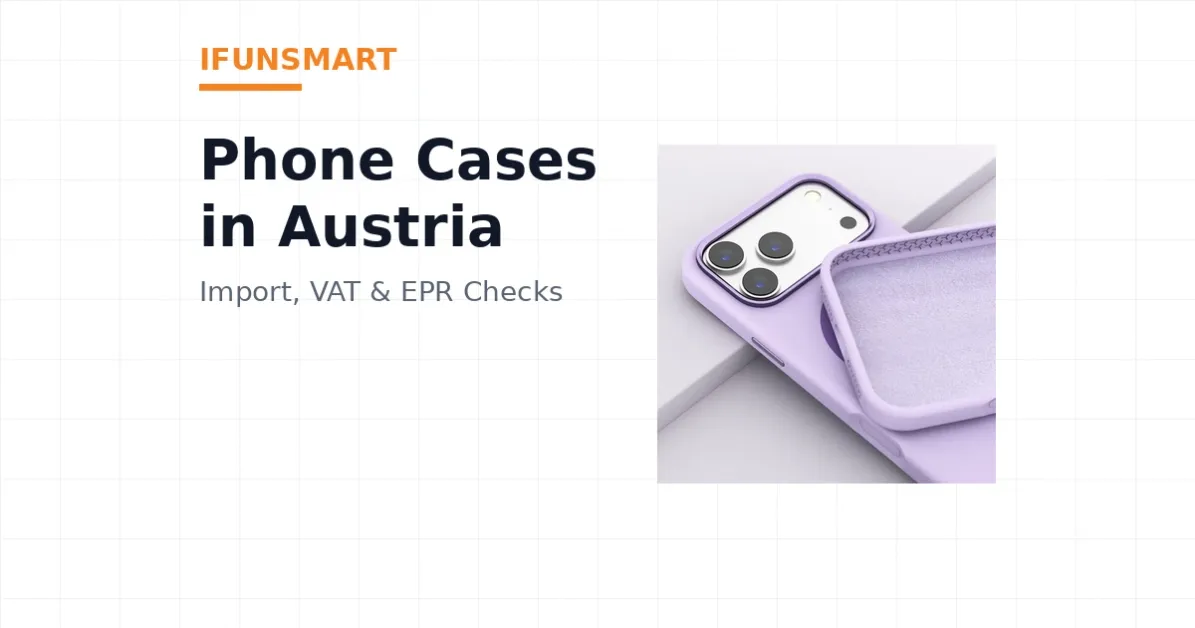
Phone Cases in Austria: Import, VAT & EPR Checks
Austria charges 20% import VAT plus around 6.5% duty on phone cases from China, and the Austrian importer holds the packaging EPR. The border, VAT, EPR and labelling checks to agree first.
BLUF
Austria charges 20% import VAT and around 6.5% duty on plain phone cases from China, and the Austrian importer — not the factory — holds the packaging EPR. Get the VAT, the duty line, the ARA licence and the German label agreed in writing before the first order ships.
Short answer
Austria is an EU member state, so a phone-case shipment from China clears under EU customs law — but the Austrian importer carries the obligations. Import VAT is 20% on the customs value plus the duty, charged from the first cent. Duty on a plain plastic case is around 6.5% under CN code 3926 90 97, and the exact 10-digit TARIC line is confirmed per SKU with your broker. The €150 duty-free threshold for low-value consignments ended on 1 July 2026, so a bulk B2B shipment pays the normal duty on every unit. Packaging EPR sits with the Austrian importer, who licenses the packaging with an approved system — ARA is the largest — and files an annual statement by 15 March. Under the GPSR, the Austrian importer is normally the EU responsible operator for a Chinese factory with no EU establishment. The label and safety information must be in German. None of this is a reason not to order — it is a checklist to agree before the deposit, so the goods clear on the first attempt.
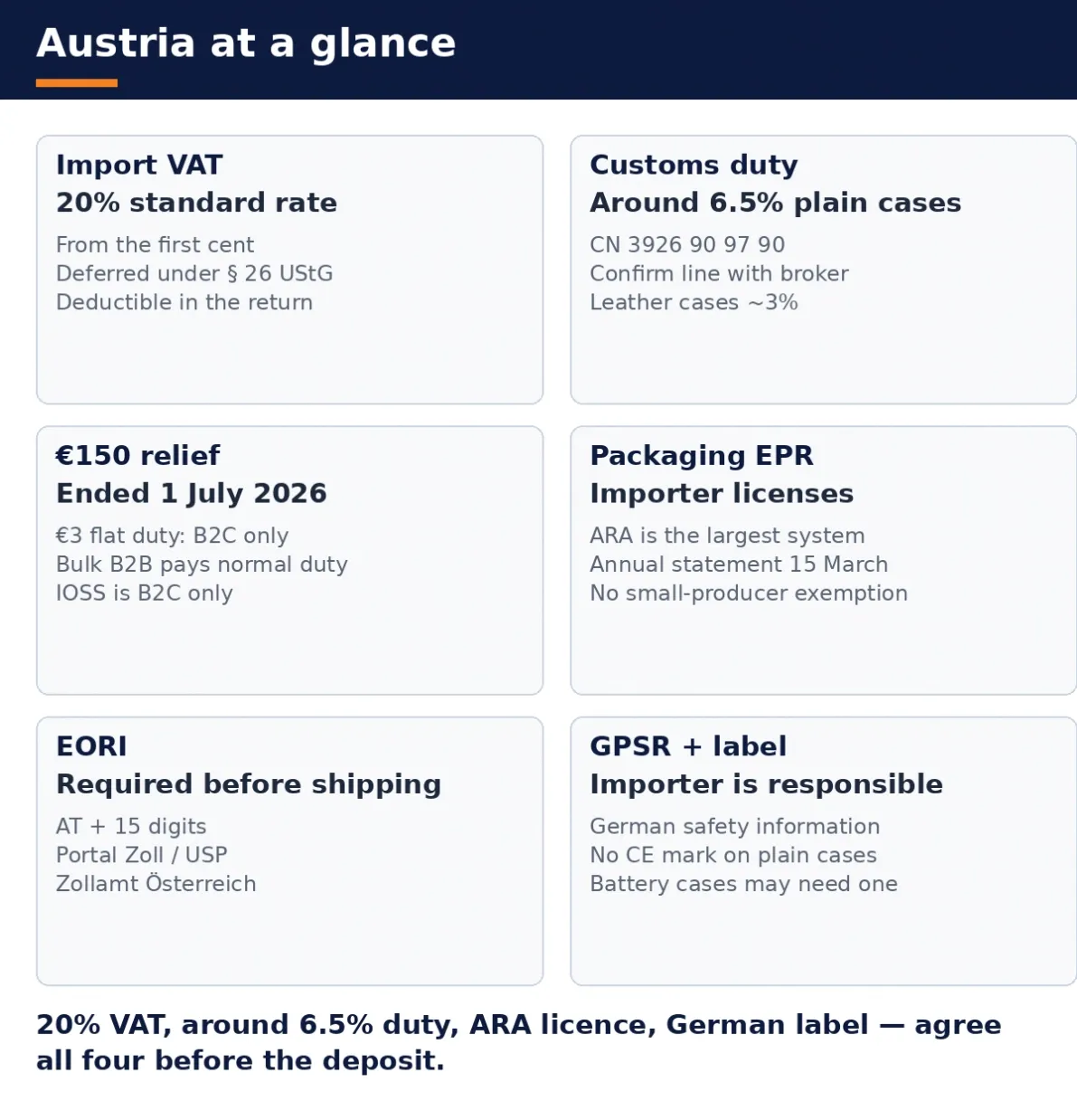
Austria at a glance
Check | What applies in Austria |
|---|---|
Import VAT | 20% standard rate, from the first cent; deferred settlement possible under § 26 UStG for VAT-registered importers |
Customs duty | Around 6.5% on a plain plastic case (CN 3926 90 97 90) — confirm the exact 10-digit TARIC line per SKU with your broker |
€150 duty relief | Ended 1 July 2026, EU-wide; €3 per item flat duty applies only to low-value B2C distance sales, until 1 July 2028 |
Packaging EPR | Austrian importer licenses with an approved system (ARA is the largest); annual statement by 15 March |
EORI | Required; self-registration via BMF Portal Zoll (USP for companies, FinanzOnline for sole traders) |
GPSR | Austrian importer is normally the EU responsible operator; German-language instructions and safety information |
CE mark | No CE mark on a plain case; battery and charging cases may need one |
First order | Most common MOQ 50 pcs per colour per model, varies by product line; bulk from 500 pcs per order in total |
1. What you pay at the border: 20% VAT plus around 6.5% duty
The first question an Austrian buyer asks is what the shipment costs at the border, and the answer has two layers: duty first, then VAT on top of the duty.
Import VAT is 20%. Austria's standard VAT rate is 20%, and phone cases fall under it — the reduced rates of 13%, 10% and the newer 4.9% cover food, books, medicines, rent and culture, not phone cases. Import VAT has applied from the first cent of merchandise value since 1 July 2021, when the old €22 exemption was abolished. The VAT is charged on the customs (CIF) value plus the customs duty, plus transport, insurance and packing costs up to the first destination in the EU. For a VAT-registered Austrian importer the 20% is a cash-flow item, not a cost: the import VAT is deductible in the VAT return. Under § 26 of the Austrian VAT Act, a VAT-registered importer can also have the import VAT posted to its tax account and settled through the return instead of paying cash at customs — ask your tax adviser whether that deferred settlement fits your filings, because it changes the cash you need on the day the goods arrive.
Duty on a plain plastic case is around 6.5%. A plain TPU, silicone or PC phone case classifies under CN code 3926 90 97 90 — "other articles of plastics, other" — and the most-favoured-nation rate on that line is around 6.5% of the CIF value. Two cautions belong on that figure. First, it comes from TARIC mirrors and secondary tariff services, not from a direct lookup in the official TARIC database — confirm the exact 10-digit TARIC line per SKU with your broker before the first order, and ask for a Binding Tariff Information decision if you want legal certainty on the classification. Second, the line changes with the product: a leather wallet or folio case classifies separately under CN 4202 31 00, at around 3% on the same mirror basis, and a case with electronics — a battery, LEDs, charging features — may classify elsewhere again. Never accept a lump-sum landed quote. Insist on separate line items for CIF value, HS code, duty and VAT, so each layer can be checked and so a wrong classification shows up before the goods ship, not at the port.
The duty is charged on the CIF value, and the VAT is then charged on the CIF value plus the duty. That stacking is why a small error in the declared value or the classification compounds: it moves both layers. The commercial invoice, the packing list and the certificate of origin should agree with each other and with the declaration, line by line. If your broker asks for a product description that matches the tariff line — "plastic phone case, TPU" rather than "phone accessory" — give it exactly; a vague description is what triggers a customs query and a hold.
2. The €150 change: why bulk B2B beats small parcels now
Until 30 June 2026, consignments with an intrinsic value of €150 or less were exempt from customs duty across the EU. From 1 July 2026 that relief is abolished — Council Regulation (EU) 2026/382 — and it applies in Austria exactly as it applies in Germany, because it is EU law, not Austrian law.
The replacement is a temporary flat customs duty of €3 per item on qualifying low-value consignments — distance sales of imported goods, business-to-consumer, intrinsic value €150 or less — running until 1 July 2028, when normal tariff rates under the EU Customs Data Hub are expected to apply. The €3 duty is charged to the business (the seller, the importer or the IOSS holder), not collected from the consumer at the door, and it applies regardless of the VAT scheme used. A separate €2 Union handling fee per item from 1 November 2026 has been reported in secondary sources, but it was not confirmed against an official Commission text at the time of writing — ask your broker whether it is in force for your shipment rather than budgeting on it either way.
For a distributor, the important point is that bulk B2B was never covered by the €150 relief. It applied to low-value consignments; a distributor importing stock in bulk pays the normal duty on every unit, and always did. What changed is the small-parcel channel: a buyer who used to split orders into sub-€150 parcels to avoid duty now pays duty on every parcel, plus the €3 flat duty on the B2C ones. That makes the bulk order the cheaper route per unit, not just the simpler one — one declaration, one duty line, one VAT settlement, instead of a parcel-by-parcel cost that now carries duty on each.
IOSS does not change this. The Import One-Stop Shop is a VAT scheme for business-to-consumer distance sales of goods imported from outside the EU in consignments of €150 or less: the seller charges VAT at the destination country's rate at checkout and declares it in a single monthly return filed in one member state. It is live since 1 July 2021 and one registration covers all 27 member states. A B2B bulk import does not use IOSS — the Austrian importer clears customs with its EORI and accounts for import VAT, possibly deferred under § 26 UStG. IOSS only matters if the buyer also sells direct to Austrian consumers in sub-€150 parcels, and IOSS does not exempt a parcel from the €3 duty introduced on 1 July 2026 — duty and VAT are separate. There is no Austrian equivalent of Norway's VOEC scheme; IOSS is the EU mechanism for low-value B2C imports.
3. Packaging EPR: the importer licenses, not the factory
Extended producer responsibility for packaging is where first-time Austria buyers most often get caught, because the obligation sits in a different place from the one they expect. The factory in China does not hold the Austrian packaging licence. The Austrian importer does.
The legal basis is the Waste Management Act 2002 and the Packaging Ordinance 2014 (VerpackV). The obligated party — the "primary obligated party" — is the producer or importer that first places packaging or packaged goods on the Austrian market, the packer, and the foreign distance seller delivering packaged goods directly to Austrian private consumers. In practice, for a China-to-Austria shipment, the Austrian importer is the obligated party for the shipment's packaging: the retail box, the insert, the polybag, the shipping carton.
What the importer does is license the packaging with an approved collection and recycling system. ARA — Altstoff Recycling Austria — is the largest and is a non-profit organisation; Interzero, Reclay and ERP are the other licensed systems. There is no separate public packaging register to join in Austria: the contract with the licensed system fulfils the licensing requirement, the system uploads the participant data to the packaging coordination body (VKS) register, and it issues a licence number — which marketplaces such as Amazon ask for. The importer then files periodic quantity reports (monthly, quarterly or annual, depending on volume) plus a consolidated annual statement by 15 March of the following year. There is no broad de-minimis exemption: even small volumes can trigger the obligation. A simplified flat-rate option exists for small quantities — up to 1,500 kg of household packaging and up to 1,500 kg of commercial packaging per calendar year — instead of material-specific tariffs; ask the system for the current tariff rather than budgeting on a figure from a guide. Since 1 January 2023, a non-Austrian business selling packaged goods directly to Austrian end-users must appoint an authorised representative established in Austria to fulfil the EPR duties on its behalf; for a normal B2B distributor import the Austrian importer itself is the obligated party and no foreign representative is needed — the representative rule bites on direct B2C distance sales. Unlicensed packaging must be filed directly in the EDM portal, the federal ministry's electronic data management register.
The EU Packaging and Packaging Waste Regulation sits alongside the Austrian system, not instead of it. Regulation (EU) 2025/40 is in force since 11 February 2025 and generally applicable since 12 August 2026. ARA licensing, volume declarations and eco-fees are unchanged — but since 12 August 2026 packaging also needs an EU Declaration of Conformity and technical documentation, which is the manufacturer's duty, plus substance restrictions and manufacturer identification on the packaging or via a QR code or data carrier. Harmonised EU labelling of material composition follows from 12 August 2028. The practical point for the buyer: ask the Chinese factory for the PPWR Declaration of Conformity and the technical documentation for the retail packaging, and keep it on file — the Austrian importer is the one who has to produce it.
Austria has no plastic packaging tax of the Spanish kind. No Austrian plastic packaging tax was found in the research for this guide — do not import Spain's €0.45 per kg figure into an Austria order. And the €0.25 deposit on single-use plastic bottles and metal cans since 1 January 2025 is a drinks scheme; it has nothing to do with phone cases.
4. GPSR: the responsible operator, and what it means for a plain case
The General Product Safety Regulation, Regulation (EU) 2023/988, has applied since 13 December 2024 and replaced the old General Product Safety Directive. It is the safety net for consumer products with no sector-specific EU legislation — and a plain phone case is one of them. This section is educational only: it describes the importer's duties, it does not claim iFunSmart holds GPSR, REACH or RoHS certifications — it does not.
The importer has duties before the product goes on the market. Under Article 11 of the GPSR, the importer must verify that the manufacturer carried out its own duties — an internal risk analysis and technical documentation, and product identification — put the importer's own name, trade name or trademark and postal and electronic address on the product (or on the packaging or an accompanying document if that is not possible), ensure instructions and safety information accompany the product in a language easily understood by consumers in the member state of sale, keep the technical documentation available to market surveillance authorities, keep a register of complaints, recalls and non-compliant products, take corrective action and notify through the Safety Business Gateway when a product presents a risk, and cooperate with the authorities. The traceability chain is the point: a type, batch or serial number or other identifier on the product, the manufacturer's details, and the importer's details alongside them — never instead of them.
There must be an EU-established responsible operator. Under Article 16, a product may not be placed on the EU market unless an economic operator established in the EU is responsible for the tasks in Article 4(3) of Regulation (EU) 2019/1020 — in order, the EU manufacturer, an authorised representative, the importer, or an EU fulfilment service provider. For a Chinese factory with no EU establishment, the Austrian importer is normally the responsible operator. That is a role to agree in writing on the order, not a label to add after the goods arrive: who holds the technical documentation, who answers a market-surveillance request, who runs a recall if one is ever needed.
A plain case needs no CE mark — and should not carry one. CE marking follows from matching the product against the EU directives one at a time. A plain plastic, silicone, TPU or leather case has no drive, no electronics and no live parts, so the Machinery, EMC, Low Voltage and RoHS directives do not reach it, and there is no directive to declare conformity with. Do not put a CE mark on a plain case just because a buyer asks: a CE declaration for a product outside every directive has no legal hook and becomes a liability. CE marking is required when the case has electronics — LEDs, a battery, speakers, charging features, wireless or NFC functions — and then an EU Declaration of Conformity is needed covering every applicable directive, and a battery case must also carry the CE mark, the crossed-out bin symbol and the required battery labelling under the Batteries Regulation.
The same split applies to WEEE and batteries. Plain cases are not electrical equipment and fall outside the WEEE scope — the Austrian Elektroaltgeräteverordnung (EAG-VO) covers equipment dependent on electric currents or electromagnetic fields to operate. A case only enters WEEE scope when it contains electrical or electronic functions: a battery case, a case with LEDs, charging electronics or wireless features. The same split applies to the EU Batteries Regulation for built-in batteries. If a style is in scope, the producer or importer must register with an approved collection and recovery system — ARA also offers WEEE and batteries licensing — report the quantities placed on the market, and finance collection and treatment. From 1 October 2026, Austrian retailers with at least 25 square metres of retail sales area must also accept very small battery-containing electrical devices without requiring a replacement purchase — relevant only if the distributor also retails battery cases. REACH sits alongside all of this for the material itself: the SVHC limits and the 0.1% threshold, with SCIP notification where applicable. Ask the factory for the material and test documentation for the style you order; a plain case is not certified by being described as compliant.
- What to stock first, and where it sells
Austria is a small, high-income market: 9,215,956 people at 1 January 2026, on final figures from Statistics Austria, with growth driven exclusively by immigration — Vienna alone holds 2,040,914 of them. A distributor does not need a deep range to cover it; it needs the right models in the right styles.
Apple leads, Samsung second, Xiaomi third. That is the vendor order in Austria on the available 2026 evidence: in all Central-Western European countries except Luxembourg the top vendors are Apple, Samsung, Xiaomi, Google and the rest, with Apple leading in every country. Android took 52.65% of mobile page views in Austria in October 2026, which puts iOS at roughly the other half — the two systems split the market almost evenly, so a range that is iPhone-only leaves half the buyers unserved. Do not read European shipment figures as Austrian ones: European smartphone shipments fell in the third quarter of 2026, with Samsung and Apple leading the continent, but Austria-specific shipment shares were not published — the order above is the Austria evidence, and it is enough to plan the first order on.
Build the first order from the models the importer actually moves. The current iPhone Pro and Pro Max, the standard iPhone, and the Samsung Galaxy S and A series, in clear magnetic, rugged, leather wallet and card-holder styles — the same four styles that anchor the rest of the range, because they cover the buyer who wants the phone visible, the buyer who wants it protected, and the buyer who wants a wallet in one piece. The most common MOQ is 50 pcs per colour per model, and it varies by product line, so count the lines before the deposit: a first order of four styles in three colours across three models is already a large line count at 50 pcs a line. Bulk and distributor orders start at 500 pcs per order in total — the threshold that turns a trial into a distributor order, with the sample fee refundable on orders of 500+ pcs. A 100-pc trial order can already carry a logo by laser engraving, which is how a distributor tests a branded line without committing to a full run.
Sell through the channels the importer already supplies. Austria is landlocked, and goods typically arrive via German or North Sea ports or Vienna airport and clear in Austria — but no transit-time or freight-rate claim belongs in this guide, because none was verified. What matters for the first order is that the styles match the channel: clear magnetic and rugged for the electronics chains and the mobile operators' shops, leather wallet and card-holder for the accessory counters, and the full range for the marketplaces the importer already sells through. Ask the importer which styles move in which channel before the order is placed, and let that answer set the colour split — not a guess made in Guangzhou.
- The paperwork: EORI, invoice, packing list, ENS and the declaration
A shipment clears or waits on its paperwork. Four documents and one number decide it.
The EORI number comes first. An EORI number is required for any economic operator that lodges customs declarations in the EU: one EORI per legal entity, valid across the whole EU, and Austrian EORI numbers start with “AT” followed by 15 digits. Since 6 June 2024, Austria runs self-registration through the BMF's Portal Zoll — companies through the Unternehmensserviceportal (USP), sole traders and natural persons through FinanzOnline — and a professional representative such as a tax adviser or customs agent can file the registration on a client's behalf. No EORI, no release: goods are not released by Zollamt Österreich, the single national customs office, until the importer of record's EORI is confirmed. Register before the goods ship, not while they are at the border — the BMF recommends requesting FinanzOnline access early because it can take time, and no processing time is stated in this guide because none was confirmed by the BMF.
The declaration is filed electronically, and the summary comes before arrival. Declarations go into the BMF's ACCS and e-zoll system, and the Entry Summary Declaration is filed in ICS2 before the goods arrive. The commercial invoice, the packing list and the certificate of origin travel with the goods, and the packing list should match the invoice line by line — model, style, colour, quantity, weight — because a mismatch between the packing list and the declaration is the most common reason a shipment is held for inspection. Ask the factory for the current production window in writing on the quote, and ask which documents travel with the goods and which your broker must arrange: a document that is missing at the port is a shipment that waits at the port.
Confirm the tariff item before the first order, not after. The EU TARIC database is the authoritative source for the duty line, and a Binding Tariff Information decision gives legal certainty on the classification. A broker who has the product description, the material and the photos can confirm the line in advance; a broker who is asked after the goods have shipped can only report what customs decided. The same discipline applies to the packaging: confirm the ARA licence and the reporting rhythm before the first shipment, so the first annual statement is a filing, not a reconstruction.
- The label in German — and the first-order checklist
The last check is the one the buyer sees: the label. Under the GPSR, instructions and safety information must be in a language easily understood by consumers in the member state of sale — for Austria that means German. The manufacturer and importer name, postal and electronic address must appear on the product, its packaging or an accompanying document — on the product where possible, and a sticker is allowed if it does not obscure required manufacturer information. Both a postal and an electronic address are required; a website with no way to make contact does not count. There is no general Austrian national sorting label, unlike France's Triman mark — the only mandatory mark of that kind is the Pfand logo on single-use beverage bottles and cans, which has nothing to do with phone cases. The PPWR's harmonised material-composition labelling follows from 12 August 2028. Agree the label artwork before the goods ship — not after they arrive — because a label fixed in Guangzhou costs nothing and a label fixed in Vienna costs a rework.
The first-order checklist — seven items to agree in writing before the deposit:
1. The landed cost, line by line. CIF value, HS code, duty at around 6.5% on a plain case, and 20% import VAT on the CIF value plus the duty. No lump-sum landed quote.
2. The EPR, with the importer named. Who licenses the packaging with ARA or another approved system, who files the quantity reports, and who signs the annual statement by 15 March.
3. The product rules, by style. Plain cases need no CE mark and sit outside WEEE; battery and charging cases may need both, and the PPWR Declaration of Conformity for the retail packaging travels with the order.
4. The label, in German. Importer and manufacturer details, batch or type identifier, and safety information in German — artwork agreed before shipment.
5. The documents, matched. Commercial invoice, packing list, certificate of origin, EORI confirmed, ENS filed before arrival, tariff line confirmed with the broker.
6. The sample and the approval, before the deposit. The sample proves the case fits the phone: check it on the bench — the case seats fully with no gap at any corner, the buttons click cleanly, the camera cutout does not intrude into the lens field, the magnetic ring holds a charger firmly with the pull force the product page states for that style, the parting lines are clean, the coating adheres and the batch tolerance is even. Samples carry a fee that is refundable on orders of 500+ pcs — ask us to confirm the amount per style in writing. A 100-pc trial order can carry a logo by laser engraving — ask for the per-piece charge and the artwork position in writing. Approve the sample in writing, with the sample reference, the model, the style, the colours and the logo method stated.
7. The payment and the shipment, in writing. Payment is T/T and Western Union only. New customers may pay a 30% deposit first. After the goods are ready, the factory sends photos and video and the packing list; the customer pays the balance, then the goods ship. Ask for the current production window in writing on the quote — no day figure in this guide, because no day figure was verified — and ask which documents travel with the goods and which your broker must arrange. A document that is missing at the port is a shipment that waits at the port.
Frequently asked questions
What is the import VAT on phone cases in Austria?
20% — the standard Austrian VAT rate — charged on the customs value plus the customs duty, from the first cent of merchandise value. The reduced rates of 13%, 10% and 4.9% cover food, books, medicines, rent and culture; they do not apply to phone cases. A VAT-registered Austrian importer can deduct the import VAT in its VAT return, so for a registered distributor the 20% is a cash-flow item, not a cost, and under § 26 of the VAT Act the import VAT can be posted to the importer's tax account and settled through the return instead of being paid in cash at customs.
How much customs duty do phone cases pay into Austria?
Around 6.5% on a plain plastic phone case, under CN code 3926 90 97 — the most-favoured-nation rate for “other articles of plastics”. The duty is charged on the CIF value, and the import VAT is then charged on the CIF value plus the duty. Confirm the exact 10-digit TARIC line per SKU before the first order: leather cases fall under a different heading at around 3%, and cases with electronics may classify elsewhere. The €150 duty-free threshold ended on 1 July 2026, so a bulk B2B shipment pays the normal duty on every unit — the €3 flat rate that replaced it applies only to low-value business-to-consumer distance sales.
Who has to register for packaging EPR in Austria?
The entity that first places packaged goods on the Austrian market — for a Chinese factory selling to an Austrian importer, that is the Austrian importer. It must license the packaging with an approved collection and recycling system — ARA is the largest, alongside Interzero, Reclay and ERP — file periodic quantity reports, and submit a consolidated annual statement by 15 March each year. There is no broad small-producer exemption: even small volumes can trigger the obligation, though a simplified flat-rate option exists for small quantities. The EU Packaging and Packaging Waste Regulation, Regulation (EU) 2025/40, generally applies from 12 August 2026 and adds a Declaration of Conformity and technical documentation for the packaging.
Do phone cases need a CE mark or a responsible operator in Austria?
No CE mark on a plain case — a plain phone case is not in the scope of any CE directive. A battery or wireless-charging case may fall under the radio-equipment or electromagnetic-compatibility rules, and that is a question for the importer and the test house. The GPSR does require an EU-established responsible economic operator for each product — for a Chinese factory selling through an Austrian importer, the importer normally fills that role — and the operator's details, the manufacturer's details and a batch or type identifier must appear on the product, the packaging or an accompanying document. This guide does not claim iFunSmart holds GPSR, REACH or RoHS certifications — it does not.
Which phone cases should I stock first in Austria?
Apple leads the Austrian smartphone market, followed by Samsung and then Xiaomi, and Android took 52.65% of mobile page views in October 2026 — so iPhone cases are the volume line, Samsung Galaxy cases second, Xiaomi third, with the two systems splitting the market almost evenly. Build the first order from the list your Austrian importer actually moves: the current iPhone Pro and Pro Max, the standard iPhone, and the Samsung Galaxy S and A series, in clear magnetic, rugged, leather wallet and card-holder styles, with the most common MOQ of 50 pcs per colour per model — and it varies by product line, so count the lines before the deposit. Sell through the channels the importer already supplies, and let the importer's channel answer set the colour split.
About iFunSmart
iFunSmart — Ifun Electronics Technology Co., Ltd, Guangzhou, China — has made phone cases as an OEM and ODM manufacturer since 2010, with 1000+ designs, 500+ models and 500K+ pcs a month capacity, exported to 30+ countries. The factory is at Yongning Street, Zengcheng District, Guangzhou, Guangdong 511340. The most common MOQ is 50 pcs per colour per model and it varies by product line. Bulk and distributor orders start at 500 pcs per order in total. Samples carry a fee, refundable on orders of 500+ pcs — ask us to confirm the amount per style in writing. A 100-pc trial order can carry a logo by laser engraving. Payment is T/T and Western Union only, with a 30% deposit for new customers, photos and video and the packing list after the goods are ready, then the balance, then the goods ship. We reply within 24 hours.
To start an Austrian order, send the models, the styles, the colours and the quantities, and the destination in Austria: contact@ifunsmart.com or WhatsApp +86 13632248734.
Read more
- Phone Case Factory in China: Find, Check & Compare — https://www.ifunsmart.com/posts/phone-case-factory-in-china-find-check-compare
- How to Verify a Phone Case Factory Before Ordering — https://www.ifunsmart.com/posts/how-to-verify-a-phone-case-factory-before-ordering
- Phone Cases in Germany: VerpackDG, WEEE & Import Checks — https://www.ifunsmart.com/posts/phone-cases-in-germany-verpackdg-weee-import-checks
- Phone Cases in Switzerland: Import, VAT & EPR Checks — https://www.ifunsmart.com/posts/phone-cases-in-switzerland-import-vat-epr-checks
- Phone Cases in the Nordics: Import, VAT & EPR Checks — https://www.ifunsmart.com/posts/phone-cases-in-nordics-import-vat-epr-checks
- Phone Cases in Belgium: Import, VAT & EPR Checks — https://www.ifunsmart.com/posts/phone-cases-in-belgium-import-vat-epr-checks
- Importing Phone Cases: Documents & Checks First — https://www.ifunsmart.com/posts/importing-phone-cases-documents-checklist
- Phone Case Payment Terms: What to Agree Before the First Order — https://www.ifunsmart.com/posts/phone-case-payment-terms-first-order