Business Solutions
Phone Cases in Switzerland: Import, VAT & EPR Checks
Switzerland is not the EU: plastic phone cases enter duty-free since 2024, import VAT is 8.1%, and a new packaging law starts in 2027. The checks to agree in writing before your first Swiss order.
BLUF
Switzerland is not the EU: plastic cases have entered duty-free since 1 January 2024, so the only border cost is 8.1% import VAT. The work is elsewhere — VAT registration, the 2027 packaging law, and three-language labelling. Agree it all in writing first.
Short answer
A Swiss order looks like a German order until you read the paperwork. Switzerland is in EFTA, not the EU, and it is not in the EU customs union — so the EU rulebook does not apply directly: no EU import VAT system, no EU packaging register, no GPSR, no CE marking as EU law. What applies instead is a Swiss rulebook that is, in one important way, simpler than the EU's. Since 1 January 2024 Switzerland charges no customs duty at all on industrial products, including phone cases. The border cost on a bulk order is therefore one line: 8.1% import VAT on the CIF value plus the costs to the destination in Switzerland, recoverable by a VAT-registered importer as input tax.
That does not mean there is nothing to check. A foreign seller who sells direct to Swiss consumers can fall into Swiss VAT registration — the threshold is worldwide turnover of CHF 100,000, and a fiscal representative is mandatory. A packaging law adopted in June 2026 takes effect on 1 January 2027 and will, over the next five years, turn Switzerland's voluntary packaging system into a binding one. And safety text on the pack must be in German, French and Italian — English alone is not enough for mandatory safety information. The six sections below work through each of these in turn, then the stocking question and the first-order checklist. Every figure in this guide comes from a public source read on 26 November 2026 — a Swiss federal authority, a Swiss customs or tax guide, or an EU regulation — and every figure that could not be verified is marked as one to confirm with your broker, not stated as a fact.
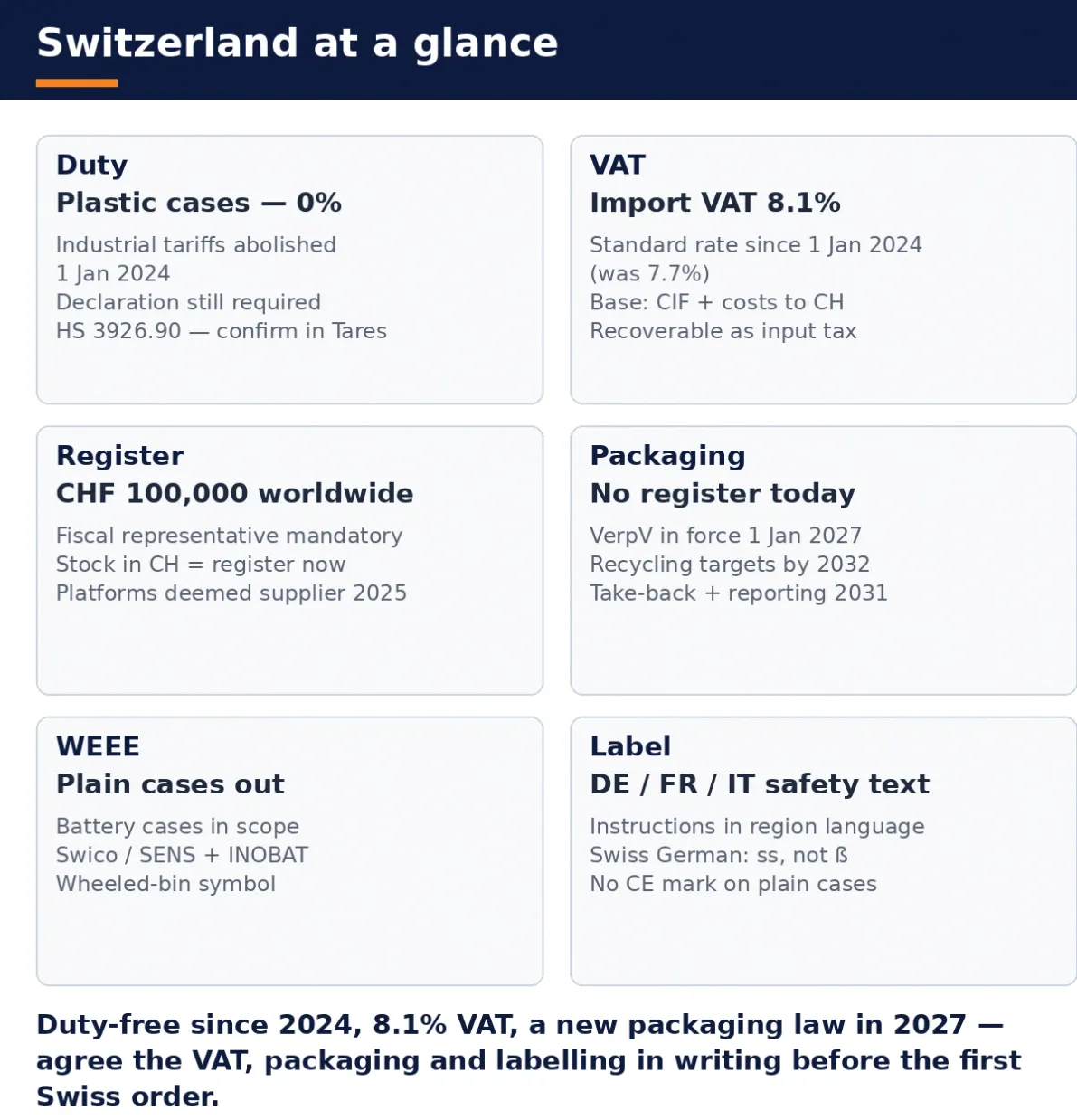
Switzerland at a glance
EU member? No — EFTA, not in the EU customs union
Duty, plastic phone cases 0% since 1 Jan 2024 — industrial tariffs abolished
Import VAT 8.1% standard since 1 Jan 2024 (was 7.7%)
De minimis Import VAT of CHF 5 or less not levied (about CHF 62 goods value)
HS code, plastic cases 3926.90 (moulded shell 3926 90 97) — confirm the 8-digit Swiss number in Tares
VAT registration, foreign seller CHF 100,000 worldwide turnover; fiscal representative mandatory
Packaging EPR No register today — new Packaging Ordinance in force 1 Jan 2027
Plain case in WEEE? No — VREG covers electrical equipment; battery cases are in scope
Labelling Safety text in German, French and Italian; instructions in the region's language
Main channels Galaxus, Digitec, amazon.de (no amazon.ch), Microspot, Brack
1. Switzerland is not the EU — and why that changes your order
The first question is not about phone cases. It is about which customs territory Switzerland belongs to, because that decides which rulebook your shipment follows. Switzerland is not an EU member state and it is not in the EU customs union. It is a member of EFTA and linked to the EU by a set of bilateral agreements — and those agreements do not make Swiss law the same as EU law. The EU rules that fill the other regional guides in this series do not apply directly in Switzerland: the EU Packaging and Packaging Waste Regulation (PPWR), the General Product Safety Regulation (GPSR), the German VerpackG and its successor VerpackDG, the EU VAT One Stop Shop, and the EU CE-marking directives as EU law. Switzerland has its own version of each — and in one case it has nothing at all yet.
What Switzerland shares with the EU. The link that matters most for a buyer is the Mutual Recognition Agreement on conformity assessment, in force since 1 June 2002: Switzerland and the EU mutually accept each other's conformity-assessment reports, certificates and authorisations for the listed sectors, including radio equipment, telecom terminal equipment, electrical equipment and electromagnetic compatibility. Switzerland also applies the Cassis de Dijon principle unilaterally: a product lawfully marketed in the EU must generally be admitted in Switzerland without further examination, with a few exceptions. And the Swiss Product Safety Act largely adopted the provisions of the old EU General Product Safety Directive. So a case that is lawfully sold in Germany will not normally be stopped at the Swiss border for a product-safety reason — but the paperwork, the VAT and the packaging obligations are still Swiss, and they still have to be done.
The one way Switzerland is simpler than the EU. On 1 January 2024 Switzerland abolished all customs duties on industrial products. Every import tariff in HS Chapters 25 to 97 was set to zero, regardless of the origin of the goods or their shipping route. Phone cases are plastics — Chapter 39 — so they are duty-free on import into Switzerland. Duty remains only on agricultural products, in Chapters 1 to 24 and some agricultural items in Chapters 35 and 38, and where it still applies Switzerland levies it on gross weight, not value. The abolition is a unilateral Swiss measure: it does not change the duties other countries charge on Swiss exports, and it simplified the tariff from 9,114 lines to 7,511. For a buyer, the practical consequence is that the landed-cost calculation for phone cases into Switzerland has no duty line at all: goods plus freight and insurance to Switzerland, plus 8.1% import VAT. Compare that with the EU guides in this series, where the duty figure is around 6.5% and has to be confirmed per shipment — in Switzerland the duty question is already answered, and the answer is zero.
What the abolition does not change. A customs declaration is still required for every consignment crossing the Swiss border. Import VAT still applies. Non-tariff restrictions — permits and licensed goods — continue to apply in full. And the classification still matters: the tariff number decides which rules are observed at assessment, and classification is the responsibility of the importer, not the carrier. A code supplied by a foreign supplier stops at the international six-digit level and cannot simply be copied across — the Swiss tariff number is eight digits, and the last two are a Swiss subdivision. A moulded-plastic phone shell sits under 3926 90 97 in the EU classification; silicone and TPU protective cases are generally 3926.90; a leather wallet or folio case falls under heading 4202, where the outer surface decides; a case with an electronic function — a battery, wireless charging, an LED — falls under 8517.79. The exact 8-digit Swiss number for a plastic phone case was not checked line by line in the research for this guide, so this guide does not state one: confirm it in the Swiss Tares tariff database, or ask your broker to, before the first shipment. Proof of origin is no longer required at import for industrial products if it is clear the goods will remain or be consumed in Switzerland — it is still needed if the goods will be processed in Switzerland and re-exported under a free-trade agreement.
Customs is going digital — and the deadline is 2027. Switzerland's customs digitalisation programme, DaziT, is replacing the old e-dec system with Passar. Passar 1.0, covering transit and export, has been live since early 2024 and is mandatory for authorised consignors under NCTS Phase 5. Passar 2.0, covering imports, is in pilot from the second quarter of 2026 and runs in parallel with e-dec Import until 30 September 2027; from 1 October 2027 all import declarations must go through Passar. Separately, the ZAZ centralised customs settlement account is being abolished in September 2027 and replaced by a GP-ID — a business partner ID linked to the UID number — with businesses registering once in the BAZG ePortal; import documents will be retrieved through the ePortal or a B2B interface, and the import VAT payment term remains 60 days. None of this changes what a distributor pays. It changes what the distributor's broker must already be doing: if your broker is still filing only in e-dec and has not started the Passar migration, ask when it starts, before the first order of 2027.
What to ask. Ask your broker, in writing, for the 8-digit Swiss tariff number for each case type you order — plastic, leather, battery — and for confirmation that the duty is zero on each of them. Ask which declaration system the shipment will be filed under, and whether the broker has migrated to Passar. A broker who can answer per case type has checked. A broker who answers "Switzerland is like the EU" has not.
2. What VAT and duty does a bulk order actually pay?
VAT and duty are two different charges, and the Swiss answer is unusual because one of them is zero. Duty is an import tariff charged on the product type, origin and value — and for a plastic phone case into Switzerland, it is 0% since 1 January 2024, as section 1 sets out. VAT is a consumption tax charged at the destination country's rate on the customs value plus duty plus shipping and insurance up to the destination — and for Switzerland that rate is 8.1% on most goods, including phone cases. A quote that mixes the two up, or that quotes a duty figure for a Swiss shipment, is a quote that cannot be checked.
The 8.1% rate. The standard Swiss import VAT rate is 8.1%. It has applied since 1 January 2024, raised from 7.7% to fund the AHV 21 pension reform. The reduced rate of 2.6% covers food, books and medicines, and a special rate of 3.8% covers accommodation — neither applies to phone cases. Import VAT is charged on the CIF value plus all costs to the destination in Switzerland — transport, insurance and clearance charges — plus any customs duties. Since the duty on a plastic case is zero, the taxable base on a bulk order is the goods plus the freight and insurance to Switzerland. A Swiss VAT-registered importer can recover the import VAT as input tax in its VAT return, so for a registered distributor the 8.1% is a cash-flow item, not a cost. A non-registered importer pays it at the border and cannot recover it — one more reason the registration question in section 3 matters before the first order, not after it.
The de minimis is a tax amount, not a goods value. This is the figure most often quoted wrong. Swiss law does not set a goods-value threshold for import VAT. It sets a tax threshold: import VAT of CHF 5 or less is not levied. At the 8.1% standard rate that corresponds to a taxable base of about CHF 62; at the 2.6% reduced rate, about CHF 193. The often-quoted "CHF 65" is the pre-2019 rule of thumb — roughly CHF 65 including shipping at the old 7.7% rate — and it is not the current legal threshold. There is no CHF 200 import threshold for goods: CHF 200 appears in some guides as the reduced-rate equivalent rounded up, and it should not be used. For a bulk order none of this matters — a distributor's shipment is far above CHF 62 — but it matters when a supplier quotes a small-parcel rule for a bulk shipment, or when a retail customer asks why a single case ordered direct still attracted VAT at the door. The answer is that the de minimis is a tax amount of CHF 5, and a single case plus shipping is already above it.
Two allowances that do not apply to your order. The CHF 150 traveller allowance is a separate rule for people carrying goods for private use across the border — it never applies to a commercial consignment. The CHF 100 gift allowance applies only to private-to-private gifts, excluding tobacco and alcohol. Neither has any bearing on a wholesale shipment, and a supplier who cites either one as the reason a bulk order is "duty-free" is confusing a private-use rule with a commercial one. The reason a bulk order of plastic cases is duty-free is the 2024 abolition of industrial tariffs, not an allowance.
What to ask. Ask for the VAT rate, the duty rate and the 8-digit tariff number for each case type, in writing, on the quote — and ask whether the duty figure is a Tares reading or a binding tariff ruling from the Federal Office for Customs and Border Security. Ask who holds the Swiss VAT number and whether the import VAT will be recovered as input tax. And ask how the freight and insurance to Switzerland are stated on the invoice, because they form part of the VAT base. The answers belong on the quote, before the deposit.
3. Do you need Swiss VAT registration — and a fiscal representative?
For a normal wholesale shipment the answer is usually no — but "usually" is doing a lot of work, and the exceptions are the ones that catch a first-time importer. In a normal DAP or DDP shipment to a Swiss distributor, the Swiss importer is the importer of record and pays the import VAT at the border. The Chinese factory does not need Swiss VAT registration for that shipment. The factory needs it when it steps outside that pattern: selling direct to Swiss consumers above the thresholds, storing stock in Switzerland, or sending a large volume of low-value parcels direct to Swiss buyers. This section is about those three cases, because a distributor who understands them can also tell when a supplier's Swiss VAT claim is real and when it is not.
The threshold is worldwide turnover. A foreign business must register for Swiss VAT once its worldwide annual turnover from taxable supplies exceeds CHF 100,000 and it makes taxable supplies in Switzerland. The threshold is worldwide turnover, not Swiss-only turnover — a business with CHF 90,000 of Swiss sales and CHF 20,000 elsewhere is already over it. There is no separate distance-selling threshold, unlike the EU's One Stop Shop: the Swiss system has one threshold and it counts everything. Voluntary registration below CHF 100,000 is possible, and registration typically takes two to four weeks. The VAT number format is CHE-123.456.789-MWST, with TVA or IVA in place of MWST by language region.
The low-value-consignment rule — the 2019 mail-order rule. Since 1 January 2019, a foreign seller whose annual turnover from low-value consignments into Switzerland exceeds CHF 100,000 must register for Swiss VAT, charge Swiss VAT at the point of sale, and is treated as the importer — its supplies count as domestic Swiss supplies. A low-value consignment is one where the import VAT is CHF 5 or less per consignment, roughly CHF 65 including shipping at the old rate. The rule was written for mail-order sellers shipping single items direct to Swiss consumers. It does not apply to a bulk B2B shipment to a Swiss distributor, because that shipment is not a low-value consignment and the distributor is the importer of record. But it does apply to a factory that sells single cases direct to Swiss consumers through its own webshop: once its low-value turnover passes CHF 100,000 a year, it must register, charge 8.1% at checkout, and act as the importer. Since 1 January 2025, online platforms and marketplaces that bring sellers and buyers together are treated as the supplier — the deemed supplier — for VAT under Article 20a of the VAT Act, so a platform sale is the platform's VAT problem, not the individual seller's. That matters for a distributor selling into Galaxus or through amazon.de: the platform handles the VAT on the consumer sale, while the distributor's own import is a separate B2B matter.
Storing stock in Switzerland means registering immediately. Storing inventory in Switzerland triggers VAT registration with no threshold at all. A factory that holds stock in a Swiss warehouse — its own, a third-party logistics warehouse, or a distributor's warehouse on consignment — is making taxable supplies in Switzerland from the first unit, and must register before the stock arrives. This is the case that catches suppliers who think the CHF 100,000 threshold protects them: it does not, once there is stock on Swiss soil. If a supplier offers you "stock held in Switzerland" as a selling point, ask who holds the Swiss VAT number for that stock and who the fiscal representative is. If there is no answer, the stock is not held compliantly.
The fiscal representative is mandatory — with a narrow waiver. All non-Swiss businesses must appoint a Swiss-based fiscal representative to register for VAT, and the representative is jointly and severally liable for unpaid VAT, penalties and interest. Online registration is not possible without one, and the requirement applies regardless of whether the business is EU-based or not — Switzerland is non-EU and non-EEA, so there is no EU exemption. Since 2025 the Swiss Federal Tax Administration has been able to waive the representative requirement in some cases, where the foreign business can show it can manage VAT compliance independently and receive the Administration's communications directly — but the exemption is limited and subject to the Administration's approval, not automatic. Do not let a supplier tell you the representative requirement has been abolished: it has not. The most the Administration will do is waive it for a business that proves it can comply alone.
What to ask. Ask, in writing, who is the importer of record for your shipment and who holds the Swiss VAT number. If the factory sells direct to Swiss consumers as well as to you, ask whether it is registered for Swiss VAT and who its fiscal representative is — a registered supplier will answer in one line. If the factory holds stock in Switzerland, ask for the registration before the first order, not after the stock arrives. And ask your own adviser whether your Swiss entity needs to register: if you are the importer of record and VAT-registered, the import VAT is recoverable as input tax, and the registration is what makes that possible.
4. Packaging: nothing to register today, a new law from 2027
Packaging is the part of a Swiss order where the answer changes depending on when you ask it. Today — at the end of 2026 — Switzerland has no EU-style packaging EPR register. There is no single national packaging register like Germany's LUCID, no universal registration threshold, and no producer number to put on an invoice. Packaging waste has been handled mainly through voluntary industry schemes, plus the Beverage Containers Ordinance, in force since 2000, which covers PET, aluminium and glass beverage packaging. From 1 January 2027 that changes: a new Packaging Ordinance adopted by the Federal Council on 24 June 2026 introduces, for the first time, binding recycling targets and a mandatory EPR framework for all packaging types, not just beverages. A distributor ordering now is ordering into the last weeks of the voluntary system — and the first order should already be written for the system that follows it.
What the new ordinance requires. The Packaging Ordinance (Verpackungsverordnung, VerpV) enters into force on 1 January 2027 and replaces the Beverage Containers Ordinance. It sets binding recycling targets to be met by 2032: 55% for single-use plastic packaging, 70% for beverage cartons, and 75% each for glass, PET and aluminium beverage packaging. If the targets are missed, the Federal Council may introduce an advance recycling levy or a deposit-return scheme. The phase-in runs over five years: the ordinance enters into force on 1 January 2027; an advance disposal fee for glass packaging of 1 to 10 centimes per pack, for food and cosmetic glass, begins on 1 January 2028; eco-design and recycled-content requirements apply from 1 January 2030; subsidiary take-back obligations and mandatory annual electronic reporting begin on 1 January 2031; and the minimum recycling rates are enforced from 1 January 2032. From 2030, packaging must be limited to the minimum mass and volume needed for safety and hygiene, designed for collection and material recycling, contain the maximum possible recycled content, and omit Substances of Very High Concern. From 2031, traders and manufacturers with turnover over CHF 1,000,000 that placed more than 500 kg of packaging on the market over two consecutive years must offer free take-back points at or near sales outlets, unless they join an approved industry-organisation scheme — for plastic packaging, RecyPac is the scheme named in the guidance.
What that means for a phone-case order. A plain case's retail box and shipping carton are packaging under the new ordinance; the case itself is the product, not packaging. Until 2031 the practical obligations on a foreign supplier are limited — the binding duties fall first on the Swiss trader or manufacturer that places the packaging on the market — but Swiss distributors will increasingly ask their suppliers about recyclable, minimal packaging and recycled content, because the 2030 design rules will land on their shelves. The questions to agree in writing now are the ones the ordinance will make mandatory later: what the retail box is made of, whether it is designed for recycling, how much recycled content it carries, and whether the supplier can provide a packaging weight breakdown per shipment. A supplier who cannot answer those questions today is not breaking the law — the ordinance is not yet in force — but a supplier who can answer them is the one whose packaging will still be compliant when the 2030 design rules arrive. Do not accept a promise of "fully recyclable packaging" as a fact without a material specification: recyclable means a specific material in a specific recycling stream, and the claim belongs in the specification, not in a chat message.
What exists today — the voluntary schemes. Until the ordinance takes effect, the system is voluntary industry schemes coordinated through Swiss Recycling and PRS. PET-Recycling Schweiz handles PET, IGORA handles aluminium, VetroSwiss handles glass, and companies placing packaged goods on the Swiss market are generally expected to contribute financially to the relevant scheme. There is no register to join and no number to quote — but there is a contribution to pay, and a distributor who asks which scheme the supplier contributes to is asking a reasonable question. The Beverage Containers Ordinance that the new ordinance replaces covered only beverage packaging; phone-case packaging was never in its scope. The new ordinance is the first Swiss law that covers a phone case's box.
What to ask. Ask, in writing, what the retail box and the shipping carton are made of, and whether the supplier can state the material and the recycled content per shipment. Ask whether the supplier contributes to a Swiss packaging scheme, and which one. And ask who will hold the take-back and reporting duties from 2031 — you, your importer, or your distributor — and get the answer in writing before the first order, so the 2027 law does not arrive as a surprise on a shipment that is already on the water.
5. Plain cases, battery cases and the label: VREG, PrSG and three languages
The compliance question buyers ask most often about Switzerland is whether a phone case needs a CE mark, a WEEE registration or a German label. The answer is three different answers, and they depend on what is inside the case and what is on the box. A plain case — plastic, leather or silicone, with no electronics and no battery — is the simplest product in Swiss compliance: no WEEE registration, no CE marking, and the only labelling rule is the language of the safety text. A case with a battery or wireless-charging electronics is a different product for compliance purposes, and it carries the duties of an electrical product. This section takes the two apart.
Plain cases are outside the VREG. Switzerland's WEEE-equivalent is the Ordinance on the Return, Take-back and Disposal of Electrical and Electronic Equipment — the VREG, SR 814.620, in force since 1 January 2022, in substance since 1998, under the Environmental Protection Act. Its duties are familiar from the EU guides in this series: consumers must return end-of-life equipment rather than put it in household waste; producers take back equipment of the brands they manufacture or import free of charge; retailers take back equipment of the type they stock free of charge, even without a new purchase; and producers must affix the crossed-out wheeled-bin symbol visibly and permanently. Financing runs through a voluntary advance recycling contribution paid to Swico Recycling, for ICT and consumer electronics, or SENS eRecycling, for household appliances and lamps — the contribution is charged on to the trade and the end customer. There is no state producer register under the VREG: a producer that does not join a scheme still owes the take-back duty and must dispose of returns at its own expense and keep five years of records. Batteries are regulated separately, with a state advance disposal fee collected through INOBAT — although for equipment imported through Swico the battery fee is included in the advance recycling contribution, so no separate INOBAT settlement is needed.
A plain phone case, with no electronics and no battery, is not electrical or electronic equipment, so the VREG take-back and wheeled-bin duties do not arise from the case itself. That is a scope inference from the VREG's equipment categories, not a quoted ruling — so this guide states it with the caveat that a battery case is different, and that the Swiss importer or a Swiss adviser should confirm the position for any style with a battery or charging circuitry. A case with a battery or wireless-charging electronics is electrical equipment and falls under the VREG, in the Swico and SENS scope for communications and consumer electronics: the importer or manufacturer then owes free take-back and the advance recycling contribution, and the battery fee through INOBAT or Swico. The practical test is simple: if the case has a battery, a charging coil or an LED, it is an electrical product for Swiss purposes, and the take-back duty, the wheeled-bin symbol and the contribution all apply. If it has none of those, it is a plain case, and none of them do. Ask which of your styles fall on which side before the first order, and get the answer per style, in writing — a mixed order that contains one battery style cannot be cleared as if it were all plain cases.
Product safety is the PrSG, not the GPSR. The EU General Product Safety Regulation does not apply in Switzerland. The Swiss equivalent is the Federal Act on Product Safety — the Produktsicherheitsgesetz, PrSG, SR 930.111, in force since 1 July 2010, with its Product Safety Ordinance. It covers all ready-to-use movable products and says a product may be marketed only if it does not endanger the safety or health of users and third parties, or only to a slight extent, when used normally or in a reasonably foreseeable way. It also imposes post-market monitoring duties on manufacturers, importers and distributors. It largely adopted the provisions of the old EU General Product Safety Directive, and it was introduced together with the unilateral Swiss adoption of the Cassis de Dijon principle. Product liability is governed separately by the Product Liability Act, closely modelled on the EU Product Liability Directive. None of this is a certification, and this guide does not claim iFunSmart holds GPSR, REACH or RoHS certifications — it does not. The PrSG is educational information for a buyer: it tells you what to ask for in writing — a risk analysis, technical documentation, and a named responsible party — not a mark to look for on the box.
No CE marking on a plain case. Switzerland and the EU have a Mutual Recognition Agreement on conformity assessment, in force since 1 June 2002, under which the parties mutually accept each other's conformity-assessment reports, certificates, authorisations and conformity marks for the listed sectors, including radio equipment, telecom terminal equipment, electrical equipment and electromagnetic compatibility. Conformity marks required by one party's legislation must still be affixed to products placed on that party's market. But a plain phone case is not in the scope of any CE directive — it has no electronics — so no CE marking applies to a plain case at all. A battery or wireless-charging case may fall under the radio-equipment or electromagnetic-compatibility chapters of the MRA, and that is a question for the importer and the test house, not for a guide. Do not let a supplier put a CE mark on a plain case to make it look compliant: a mark that does not apply is worse than no mark, because it invites a question nobody can answer.
Three languages on the label. The labelling rule is the one most likely to surprise a first-time Swiss buyer, because it is stricter than the EU's. Under the Product Safety Ordinance, Articles 8 and 11, written warnings and safety information must be in all three official languages — German, French and Italian — where symbols alone are insufficient, and instructions for use must be in the official language of the region where the product is expected to be used. Symbols may replace text if they provide sufficient information. The language split, from the Federal Statistical Office in 2023, is about 61% German, about 23% French and about 8% Italian as main language; Romansh is a fourth official language but is not required on product labels in practice. For a nationwide listing, German plus French is the practical minimum, and German, French and Italian is the full standard. Swiss German uses "ss" instead of "ß", so a German text copied from a German listing needs that one change. Retail packaging with only English text is generally not enough for mandatory safety text; many brands use a multilingual sticker or leaflet for Switzerland. The practical answer is to agree the label with your importer before the first order: which languages, on the box or on a leaflet, and who prints it. A label that is agreed after the goods ship is a label that is applied by hand at the warehouse, and that is where mistakes happen.
What to ask. Ask, in writing, whether each style is a plain case or a battery or charging case — and if any style has a battery or charging circuitry, ask who registers it under the VREG, who pays the advance recycling contribution, and who holds the INOBAT battery settlement, in writing, before the first shipment. Ask who the responsible party is under the PrSG for your shipment. And ask for the label artwork in German, French and Italian before the goods ship, with the "ss" spelling checked. A plain case needs no VREG registration and no CE mark. A battery case that arrives unregistered is a shipment that cannot legally be sold on.
6. What to stock, where it sells — and the first-order checklist
Switzerland is a small market that buys like a large one. Swiss online retail was CHF 14.9 billion in 2024, up 3.5% on 2023, about 17% of all retail sales, and Swiss consumers spent CHF 2.6 billion with foreign online retailers in 2024, up 18% — so the cross-border channel is growing faster than the domestic one. The market is structurally import-dependent, and a distributor who can land cases duty-free and recover the import VAT has a cost advantage that a German or French distributor does not have. The question is not whether Switzerland is worth stocking. It is what to stock, where it sells, and what has to be in writing before the deposit.
Where the cases sell. Galaxus is Switzerland's largest online shop, with CHF 2.3 billion revenue in 2025, ahead of Zalando at CHF 1.82 billion and Digitec at CHF 1.05 billion. Digitec Galaxus AG, 70% owned by Migros, is the biggest online retailer in the country: Digitec specialises in IT and electronics, Galaxus is the general online department store. Amazon has no amazon.ch — Swiss customers are reached through amazon.de, amazon.fr or amazon.it cross-border, and Amazon's Swiss sales were about EUR 1.03 billion in 2025. Microspot, in the Coop ecosystem and sister to Interdiscount's 190-plus stores, is a leading consumer-electronics channel; Brack, part of Competec, is strong in B2B tech and office; Ricardo, part of the TX Group, dominates classifieds and auctions. The top 50 Swiss online shops captured CHF 14.2 billion combined, roughly 90% of a total market estimated at CHF 15.8 billion. A distributor sells into these channels, not around them: the listing, the language and the packaging have to fit Galaxus and Digitec first, and the import paperwork has to be right before the listing goes live.
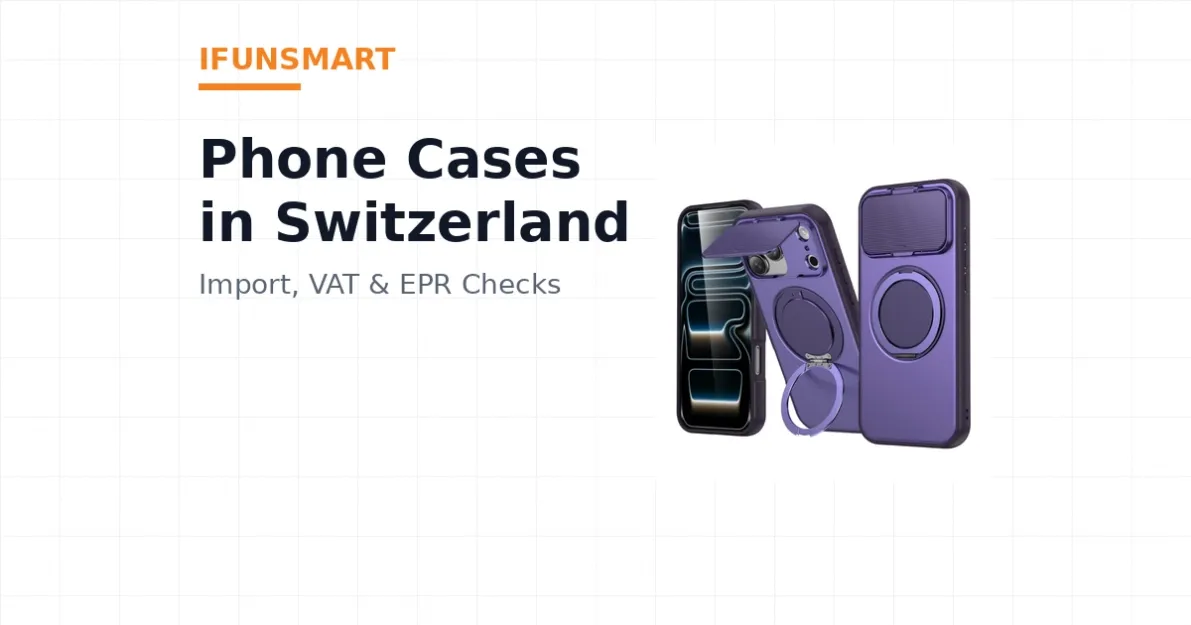
What to stock — and what this guide does not claim. No smartphone brand-share figure for Switzerland was verified in the research for this guide — the search returned no usable source — so this guide states none. Do not build a first order on a claimed Apple or Samsung share for Switzerland, because no such figure is in this guide. The safe reading is the one your Swiss importer gives you: ask which models their shops actually move, and build the first order from that list. What the range itself should contain is a question the earlier guides in this series already answer: a first order that covers the current iPhone Pro and Pro Max, the standard iPhone, and the Samsung Galaxy S and A series, in clear magnetic, rugged, leather wallet and card-holder styles, with the most common MOQ of 50 pcs per colour per model — and it varies by product line, so count the lines before the deposit. A wide range in a small market is a lot of lines at the MOQ, and breadth has a cost: the bulk threshold of 500 pcs per order in total does not change the per-line MOQ. The cover product for this guide is one example of what a Swiss first order can carry: a 360-degree magnetic ring case with a lens flip cover for the iPhone 17 Pro Max, in purple, with N50 magnets, a TPU and PC hybrid build, five colours, MOQ 50 pcs per colour per model, and logo customisation and custom packaging available — confirm the model, the style and the colours in writing for your own order, because the cover is an example, not a quotation.
The first-order checklist. A Swiss first order is one shipment, but it carries four kinds of paperwork: customs, VAT, packaging and labelling. The checklist below is the whole guide in one page. Agree each item in writing before the deposit, and the shipment has a chance of clearing, selling and being reordered. Skip an item and the shipment will wait — at the border, at the register, or on the shelf.
1. The 8-digit tariff number and the duty, per case type. Plastic cases 3926.90, leather 4202, battery cases 8517.79 — confirm the full Swiss number in Tares or with your broker, and confirm the duty is zero on each type. A broker who quotes a duty figure for a Swiss shipment of plastic cases has not checked the 2024 abolition.
2. The VAT treatment. Import VAT is 8.1% on the CIF value plus the costs to the destination in Switzerland. Ask who holds the Swiss VAT number, whether the import VAT is recovered as input tax, and who is the importer of record. If the factory sells direct to Swiss consumers, ask whether it is registered and who its fiscal representative is.
3. The registration question. If the factory stores stock in Switzerland, it must register immediately — no threshold. If it sells low-value parcels direct to Swiss consumers, the CHF 100,000 worldwide-turnover rule applies. Get the registration position in writing before the first order.
4. The packaging position. No register exists today, but the Packaging Ordinance enters into force on 1 January 2027, with eco-design from 2030 and take-back and reporting from 2031. Ask what the retail box and the shipping carton are made of, what recycled content they carry, and who will hold the take-back and reporting duties from 2031.
5. The VREG answer, per style. Plain cases are not electrical equipment and fall outside the VREG. Battery and charging cases fall in scope, with free take-back, the wheeled-bin symbol, the advance recycling contribution and the INOBAT battery fee. Ask who registers them, and who pays, in writing.
6. The label, in three languages. Safety text in German, French and Italian; instructions in the language of the sales region; "ss" not "ß" in the German text. Agree the label artwork before the goods ship — not after they arrive.
7. The sample and the approval, before the deposit. The sample proves the case fits the phone: check it on the bench — the case seats fully with no gap at any corner, the buttons click cleanly, the camera cutout does not intrude into the lens field, the magnetic ring holds a charger firmly with the pull force the product page states for that style, the lens flip cover opens and closes cleanly and sits flush, the parting lines are clean, the coating adheres and the batch tolerance is even. Samples carry a fee that is refundable on orders of 500+ pcs — ask us to confirm the amount per style in writing. A 100-pc trial order can carry a logo by laser engraving — ask for the per-piece charge and the artwork position in writing. Approve the sample in writing, with the sample reference, the model, the style, the colours and the logo method stated.
8. The payment and the shipment, in writing. Payment is T/T and Western Union only. New customers may pay a 30% deposit first. After the goods are ready, the factory sends photos and video and the packing list; the customer pays the balance, then the goods ship. Ask for the current production window in writing on the quote — no day figure in this guide, because no day figure was verified — and ask which documents travel with the goods and which your broker must arrange. A document that is missing at the port is a shipment that waits at the port.
Frequently asked questions
Do phone cases pay customs duty in Switzerland?
No — not since 1 January 2024. Switzerland abolished all customs duties on industrial products, in HS Chapters 25 to 97, regardless of origin or shipping route, so plastic phone cases enter duty-free. A customs declaration is still required for every consignment, and the 8-digit Swiss tariff number still has to be stated — the duty is zero, the paperwork is not. Leather cases fall under heading 4202 and electronic or battery cases under 8517.79; confirm the number for each type with your broker in Tares.
What is the Swiss import VAT on phone cases?
8.1% on most goods, including phone cases, since 1 January 2024 — raised from 7.7%. It is charged on the CIF value plus all costs to the destination in Switzerland, plus any duty — and since the duty on a plastic case is zero, the base is the goods plus freight and insurance. A Swiss VAT-registered importer recovers the import VAT as input tax in its VAT return. The de minimis is a tax amount, not a goods value: import VAT of CHF 5 or less is not levied, which is about CHF 62 of goods at 8.1%. There is no CHF 200 threshold, and the CHF 150 traveller allowance never applies to a commercial shipment.
Do I need a Swiss VAT number to import phone cases?
As the Swiss importer of record, you need one to recover the import VAT as input tax — and if you are not VAT-registered, you pay the 8.1% at the border and cannot recover it. A foreign seller must register once its worldwide turnover from taxable supplies exceeds CHF 100,000 and it makes taxable supplies in Switzerland, and it must appoint a Swiss-based fiscal representative — jointly liable for unpaid VAT — although the Federal Tax Administration has been able to waive the representative requirement in some cases since 2025. Storing stock in Switzerland triggers registration immediately, with no threshold. In a normal wholesale shipment the Swiss distributor is the importer of record and the factory needs no Swiss registration for that shipment.
Do I need to register packaging in Switzerland?
Not today — Switzerland has no packaging EPR register, and no producer number to quote. But the Packaging Ordinance adopted on 24 June 2026 enters into force on 1 January 2027, with binding recycling targets by 2032, eco-design and recycled-content requirements from 2030, and take-back obligations and annual electronic reporting from 2031 for traders and manufacturers over CHF 1,000,000 turnover and 500 kg of packaging over two consecutive years. Until then the system is voluntary industry schemes — PET-Recycling Schweiz, IGORA, VetroSwiss and RecyPac for plastic packaging. Agree the packaging material and recycled content in writing now, and who holds the take-back duty from 2031.
Do phone cases need a CE mark or a German, French and Italian label in Switzerland?
No CE mark on a plain case — a plain phone case is not in the scope of any CE directive, and the EU–Swiss Mutual Recognition Agreement does not change that. A battery or wireless-charging case may fall under the radio-equipment or electromagnetic-compatibility chapters, and that is a question for the importer and the test house. The label is different: under the Product Safety Ordinance, safety text must be in German, French and Italian where symbols alone are insufficient, and instructions must be in the official language of the region where the product is expected to be used. English alone is not enough for mandatory safety information — agree the three-language label artwork before the goods ship.
About iFunSmart
iFunSmart — Ifun Electronics Technology Co., Ltd, Guangzhou, China — has made phone cases as an OEM and ODM manufacturer since 2010, with 1000+ designs, 500+ models and 500K+ pcs a month capacity, exported to 30+ countries. The factory is at Yongning Street, Zengcheng District, Guangzhou, Guangdong 511340. The most common MOQ is 50 pcs per colour per model and it varies by product line. Bulk and distributor orders start at 500 pcs per order in total. Samples carry a fee, refundable on orders of 500+ pcs — ask us to confirm the amount per style in writing. A 100-pc trial order can carry a logo by laser engraving. Payment is T/T and Western Union only, with a 30% deposit for new customers, photos and video and the packing list after the goods are ready, then the balance, then the goods ship. We reply within 24 hours.
To start a Swiss order, send the models, the styles, the colours and the quantities, and the destination in Switzerland: contact@ifunsmart.com or WhatsApp +86 13632248734.
Read more
- Phone Case Factory in China: Find, Check & Compare — https://www.ifunsmart.com/posts/phone-case-factory-in-china-find-check-compare
- How to Verify a Phone Case Factory Before Ordering — https://www.ifunsmart.com/posts/how-to-verify-a-phone-case-factory-before-ordering
- Phone Cases in the Nordics: Import, VAT & EPR Checks — https://www.ifunsmart.com/posts/phone-cases-in-nordics-import-vat-epr-checks
- Phone Cases in Belgium: Import, VAT & EPR Checks — https://www.ifunsmart.com/posts/phone-cases-in-belgium-import-vat-epr-checks
- Phone Cases in Poland: Import, VAT & EPR Checks — https://www.ifunsmart.com/posts/phone-cases-in-poland-import-vat-epr-checks
- Importing Phone Cases: Documents & Checks First — https://www.ifunsmart.com/posts/importing-phone-cases-documents-checklist
- Phone Case Payment Terms: What to Agree Before the First Order — https://www.ifunsmart.com/posts/phone-case-payment-terms-first-order
- Bulk Phone Case Orders: How Volume Changes the Order — https://www.ifunsmart.com/posts/bulk-phone-case-orders-volume-guide