Business Solutions
iPhone 17 Pro Max Cases: What Buyers Order First
The iPhone 17 Pro Max is still a high-volume case model. Which styles to stock first, how to check fit on the camera plateau, and what a first wholesale order should look like.
BLUF (44 words)
The iPhone 17 Pro Max is still a high-volume case model, and the first order should be small, exact and tested. Start with a clear magnetic case, add a second style only after the sample passes, and order the Pro Max version by name.
Short answer
The iPhone 17 Pro Max launched on 19 September 2025 and was discontinued on 9 September 2026, when the iPhone 18 Pro and Pro Max were announced. That does not make it a dead model for a case buyer. Millions of 17 Pro Max phones are in use, they are the phone their owners keep for years, and they need cases, replacements and new styles long after the launch event. The buyers who do well with this model are the ones who treat it as a steady range, not a launch spike: a small first order of the styles that sell, a sample checked on the real phone, and a reorder plan for the colours that move.
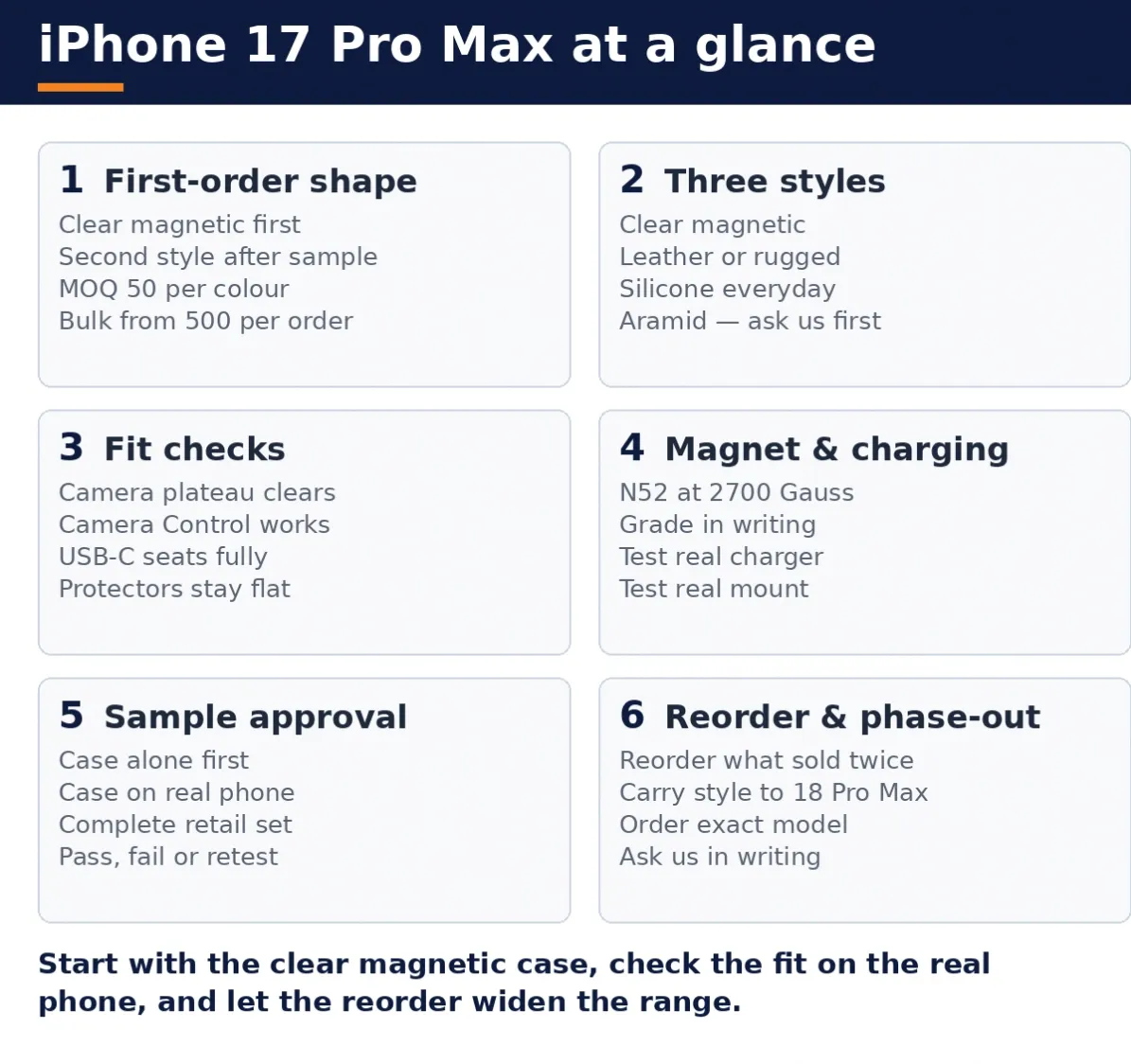
The first order has a shape. Start with a clear magnetic case, because it shows the phone's colour, works with chargers and mounts, and sells in every channel. Add a second style only when you know which channel you are selling through: a leather case for a premium counter, a rugged case for a buyer who sells on protection, a silicone case for a soft-touch everyday range. Do not open with five styles. Open with two, learn which one your customers ask for, and let the reorder widen the range.
This guide covers what the case must do before you ask for a sample, the three styles to compare first, the fit checks the camera plateau forces on you, the magnet and charging test, how to score and approve a sample, and what the first order should look like.
- Decide what the case must do before you ask for a sample
A sample request that says "send me your iPhone 17 Pro Max cases" comes back as a box of everything, and most of it will not suit your channel. Write down three things before you ask, and put all three in the request.
First, whether the phone's colour should show. The iPhone 17 Pro Max comes in three colours — Silver, Cosmic Orange and Deep Blue — and Cosmic Orange is the colour buyers notice. A clear case shows that colour; a solid case hides it. If your customers buy the phone for its colour, the clear case is the first style. If they buy for grip, warmth or a premium feel, a solid leather or silicone case is the first style. The answer decides the whole first order, so do not leave it open.
Second, which accessory must fit. A case sold with a magnetic charger, a car mount or a card wallet is a different case from a case sold on its own. The magnetic ring, the camera clearance and the thickness all change with the accessory. Name the accessory in the sample request — the charger model, the mount, the wallet — and test the exact combination on the real phone. A case that holds on a charger but rocks on a mount is a case that earns a return from the customer who bought the bundle.
Third, which controls must stay easy to use. The 17 Pro Max has a Camera Control button as well as the volume and power buttons, and a case that covers the Camera Control button badly makes the phone harder to use, not easier. Put the controls in the request: buttons, Camera Control and the USB-C port must all work with the case on, without shifting the case or pressing the wrong control. That is a fit check, and it belongs on the sample sheet before anything else.
Put the exact model on every line. Write "iPhone 17 Pro Max" on the sample request, the order and the box label. A listing that says only "iPhone 17 series" is not a Pro Max case, and a case for the iPhone 17 Pro does not fit the Pro Max — the Pro Max is 163.4 mm tall and 78.0 mm wide against the Pro's 150.0 mm by 71.9 mm, and the camera plateau is wider. The same applies the other way: do not assume a 17 Pro Max case fits the iPhone 18 Pro Max. The two phones share the same footprint on paper, 163.4 by 78.0 mm, but the camera plateau and the button positions differ, so order the exact model and confirm the fit on the real phone.
- The three styles to sample first — clear magnetic, leather, rugged
Three styles cover almost every first order for the iPhone 17 Pro Max. Sample them side by side on the same phone, and let the sample decide — not the catalogue photo.
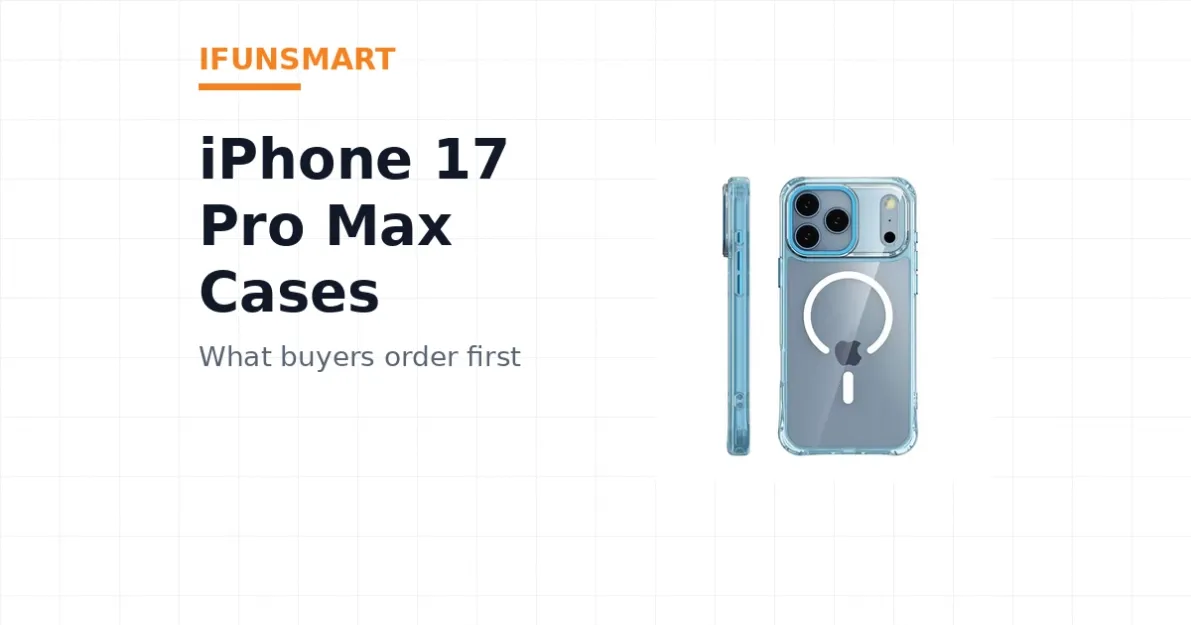
Clear magnetic — the first style for almost every buyer. A clear case with a magnetic ring is the style that sells in every channel: it shows the phone's colour, it takes a magnetic charger, mount or wallet, and it is the case a phone shop can put on a display phone without hiding what the customer came to see. Our Two-Tone Clear MagSafe Case for iPhone 17 Pro Max is built this way — a clear PC back with a soft TPU frame, aluminium buttons, a magnetic ring aligned with the charging coil, a raised camera edge and a raised front lip, with an anti-oxidant treatment on the clear frame to slow the yellowing that clear cases usually develop. It comes in six colours, and the colour panel sits inside the clear frame so the colour reads from the back while the edges stay transparent. For a first wholesale order, this is the style to put deepest: ask us for an iPhone 17 Pro Max clear case in bulk and start here.
Leather — the premium counter style. A leather case sells on feel and on the way it ages, and it suits a premium counter or a private-label buyer who wants a case that looks like it costs more than it does. Check three things on the sample: whether the leather is the material the listing claims, whether the case still takes a magnetic charger with the leather in place, and whether the camera opening clears the full-width plateau without the leather edge lifting. If you are buying iPhone 17 Pro Max leather cases from a supplier, ask for the material in writing — a leather-look finish is not leather, and a listing that says "leather style" is telling you it is not. We do not list a leather case made specifically for the iPhone 17 Pro Max — our leather folio covers the iPhone 17 series generally — so ask us to confirm the Pro Max fit in writing before you list a leather case for this model.
Rugged — the protection buyer. A rugged case sells to the buyer who asks about protection first and looks second. It is thicker by design, with reinforced corners and a deeper camera surround, and it suits a channel that sells on durability — a phone repair shop, an outdoor retailer, a buyer whose customers work with their hands. Check the sample for the trade-off that matters: the case must still sit flat on a magnetic charger, the buttons must still press cleanly, and the USB-C port must take a cable without the case forcing it at an angle. Our rugged line for this model is "The Explorer" Heavy Duty Rugged MagSafe Case — PC and TPU with a zinc alloy stand and an N52 magnet — and a 360° Magnetic Ring Case with a lens flip cover in a TPU and PC hybrid. If you are buying iPhone 17 Pro Max rugged cases as a distributor, sample the rugged case beside the clear magnetic one on the same phone and compare the grip, the pocket test and the charger test side by side — the customer who buys rugged still charges the phone every night.
Silicone — the soft-touch everyday case. A silicone case is the everyday style: soft in the hand, easy to grip, and the case a buyer orders when the customer wants comfort rather than a statement. It is also the style where the sample matters most, because a silicone case that is too soft stretches, collects lint, or lets the phone slide inside it. Ask for a sample, check the fit after a week of use if you can, and check the magnetic hold if the case is sold as magnetic — a silicone case without a magnetic ring will not hold a charger, and a listing that says "magnetic" without a ring in the build is a listing to question. We do not list a liquid silicone case made specifically for the iPhone 17 Pro Max — our Liquid Silicone Magnetic Case is listed for the iPhone Duo and the iPhone 18 Pro Max — so if silicone is the style you need for the 17 Pro Max, ask us to confirm what we can make for this model in writing before you list it.
The confirmed 17 Pro Max range on our site. Beyond the two clear styles above, our site lists four more cases made for the iPhone 17 Pro Max: the Two-Tone 360° Rotating Ring Stand Case, a micro-matte PC back with a flexible TPU frame and a metal rotating ring stand; the Matte MagSafe Case with a Mechanical Gear Ring Stand, a matte translucent back with an aluminium alloy stand; the Smoke MagSafe Anti-Fingerprint Soft Slim Case in PC and TPU; and the 360° Magnetic Ring Case with a lens flip cover in a TPU and PC hybrid. Every one of them carries the same minimum order — 50 pieces per colour per model. Ask us for the current list in writing for the model you are ordering, and build the first order from the list that is current, not from a catalogue that has moved on.
Aramid-style — ask before you list it. A woven, aramid-style back is the thin premium style for this model, and it is also the style where a photo proves nothing: a weave pattern does not identify the fibre. If you want to list an aramid case for the iPhone 17 Pro Max, ask the supplier for the material declaration for the woven layer and its backing before you print any claim on the box or the listing — and ask us whether we carry an aramid-style case for the 17 Pro Max before you promise it to a customer.
- Fit on the real phone — the camera plateau decides it
The iPhone 17 Pro Max is the phone that made the camera plateau a fit problem. The full-width plateau runs across the top of the back, it stands proud of the body, and a case that is cut for the previous generation's camera bump will not sit right on it. Fit is not a dimension on a drawing. It is a check on the real phone, with the case on.
Check the plateau first. Put the case on the phone and look at the camera opening from the side. The raised edge should run around the whole plateau, not only the outer corners, and the plateau should sit inside the opening without the case edge pressing on it. Lay the phone face down: the camera lenses should not touch the surface. Lay it face up: the front lip should stand above the screen. If the case rocks on a flat surface, the plateau is not clearing — reject it.
Check the Camera Control button. The Camera Control button sits on the side of the phone, and a case that covers it with a stiff flap or a loose cutout makes the button hard to press or easy to press by accident. With the case on, press the button the way a customer would — a light press, a firm press, a slide — and check that the phone responds the same way it does without the case. Then check the volume and power buttons the same way, and check the USB-C port takes a cable fully, without the case forcing the plug at an angle.
Check it with the protectors your customers use. A case that fits the bare phone and fails with a screen protector or a lens protector on it is a case that fails in the customer's hand. Put the intended screen protector and lens protector on the sample phone, fit the case, and check that the case seats fully, the corners sit down, and the protectors stay flat. If the case lifts a protector edge, the case is too tight for that combination — and the combination is what you are selling, so the combination is what you test.
Check the magnet ring against the plateau. The magnetic ring sits on the back of the case, and on this phone it sits close to the plateau. Put the case on a magnetic charger and on a magnetic mount, and check that both sit flat and hold without rocking against the camera edge. A mount that touches the raised camera edge will rock, and a charger that sits at an angle will charge badly or not at all. The test takes a minute, and it is the test that decides whether the bundle you sell actually works.
- Magnet and charging — grade in writing, test on the real charger
A magnetic case is only as good as its magnet, and the magnet is only as good as the test behind it. Our magnetic lines use N52 magnets at 2700 Gauss, and that grade is the number to ask for in writing — on the quotation, on the order, and on the specification that travels with the goods. A listing that says “strong magnets” without a grade is a claim, not a specification, and a grade you cannot check on the sample is a grade you should not print on your box.
Test the hold, not the picture. A photo of a magnetic ring proves a ring exists. It does not prove the case holds, charges, or mounts. Put the case on the real phone, put the phone on the real charger, and check that it snaps into alignment, stays put, and charges. Then put it on the mount you sell, and check that it holds through a shake — the way a car mount holds on a bad road, not the way it holds on a desk. If the hold is weak, the grade is wrong, the ring is in the wrong place, or the case is too thick between the magnet and the charger. Any of those is a reason to ask for a different sample, not a reason to accept the case and hope.
Do not use the phone's own specification as case certification. The iPhone 17 Pro Max supports MagSafe charging, and that is a fact about the phone, not about the case. A case that sits between the phone and the charger can block the charge, weaken the hold, or misalign the coil — and the phone's specification will not tell you. The charging test is a test of the phone, the case and the charger together, and it has to be run on that combination. Our MagSafe guide covers how to test the magnet before you order, including the grade to ask for and the hold test to run on the sample.
Keep the grade the same across the reorder. The magnetic case that sold was a case with a specific magnet grade. A reorder with a weaker magnet is a case that holds less well and earns a complaint from the customer who bought the first one. Ask for the magnet grade in writing on the reorder, the same as on the first order, and check it on the sample the way our sampling guide describes it.
- Score the samples, approve in three steps
Two samples on the same phone, scored the same way, tell you more than ten samples scored by feeling. Score each sample out of 100, and stop the order if a sample fails on fit, controls or the accessory you intend to bundle — a good finish cannot make up for a failed fit.
Score the sample. Give the points where the sample earns them: model fit 30, controls 20, accessory fit 25, finish 15, retail pack 10. Full points only when the sample meets the requirement outright; half when a change is needed; zero when it fails or stays unverified. A sample that scores well on finish and badly on fit is a sample to reject, not a sample to negotiate over — the finish is what the customer sees first, and the fit is what the customer discovers second.
Approve in three steps. First, the case alone: confirm the model and the colour, inspect the corners, the inner surface and the camera opening. Second, the case on the phone: fit it to a real iPhone 17 Pro Max, check the buttons, the Camera Control button and the USB-C port, and fit it with the screen and lens protectors your customers use. Third, the complete retail set: test the exact mount, wallet or charger you will sell with it, check the grip and the charging separately, then verify that the packed case has the right label, the right model wording and the right barcode. Record pass, fail or retest against the case and accessory models, and keep the record with the order — it is the document that decides whether the bulk order runs.
Ask for the exact version you will receive. Ask the supplier to name the exact case version, back material and camera trim that will ship, and to confirm whether the sample is stock or a custom prototype. If the supplier changes the case, the magnet or the trim, ask which checks need to be repeated. Record a sample reference or a dated photo, and ask the supplier to flag changes to the tooling, finish, ring or packaging before production runs. A sample that is not the version that ships is a sample that proves nothing.
- The first order — MOQ, colours, bulk level and the RFQ
A first order for the iPhone 17 Pro Max should be small enough to learn from and large enough to matter. The shape is the same shape as every first order in this series, and it works because it matches the way distributors actually sell. If you are buying iPhone 17 Pro Max cases in bulk from a supplier in China, this is the shape to ask for: the model and the style named exactly, the magnet grade in writing, the sample approved before production, and one order that reaches the bulk level without over-committing to any single line.
The minimum is 50 pieces per colour per model. That is the smallest order we take for one colour of one model, and it is the right size for a style you are testing: 50 of the clear magnetic case in the colour that sells, 50 of the second style in its best colour, and nothing else until the sample has passed and the first 50 have sold. A new colour is a test, like a first order — put it on the order only in the minimum quantity, and let it earn depth by selling out twice before you order it deeply.
Distributor and bulk orders start from 500 pieces per order in total. That 500 is the whole order, not 500 of one model — so a mixed order across models, styles and colours reaches it without over-committing to any single line. A first order for the 17 Pro Max that reaches the bulk level might be the clear magnetic case in three colours, the rugged case in two colours, and the ring-stand case in the colour that sells there. One order, one proforma invoice, one payment and one freight to plan — and the mix is built from the sample results, not from the catalogue.
Colours follow the phone, not the catalogue. The iPhone 17 Pro Max comes in Silver, Cosmic Orange and Deep Blue, and the case colours that sell are the ones that match the phone in the customer's hand. Cosmic Orange is the colour buyers notice, and a clear case that shows it is the case to stock deepest. Ask us for the current colour list in writing for the 17 Pro Max before you promise a colour to your customer — colours are discontinued, and a colour that was available last month may not be available on this order.
Send one RFQ, with every line filled in. The first enquiry should name the exact model, the style, the colour and the quantity for every line; the magnet grade you want in writing; the logo position and the packaging; and the delivery address and freight terms. Our RFQ guide covers the full list. Put the sample reference in the same message, so the factory knows which sample the order must match — and get the written confirmation of every line before production runs. Payment is by T/T or Western Union; new customers may pay a 30% deposit first, and after the goods are ready we send photos, a video and the packing list before the balance is paid and the goods ship.
Plan the phase-out while you order. The iPhone 18 Pro Max has been on sale since September 2026, and each new launch moves a share of buyers to the new phone. The 17 Pro Max range is a steady range, not a growing one: order it in depth while it sells out, keep the colours that move, and carry the best-selling style across to the 18 Pro Max as its own case, cut for its own dimensions. Our pre-launch ordering guide covers how to order before a launch, and our reordering guide covers when to wind a model down. Do not reorder the 17 Pro Max in depth after its buyers have moved — the stock that remains is money on a shelf that no one wants.
FAQs
1. What iPhone 17 Pro Max cases should I stock first? Start with a clear magnetic case, because it shows the phone's colour, works with chargers and mounts, and sells in every channel. Add one second style for your channel — leather for a premium counter, rugged for a protection buyer, silicone for an everyday range — only after the sample passes on the real phone. Do not open with five styles; open with two, and let the reorder widen the range.
2. Will an iPhone 17 Pro Max case fit the iPhone 18 Pro Max? No — do not assume it. The two phones share the same footprint on paper, 163.4 by 78.0 mm, but the camera plateau and the button positions differ, so a case cut for one will not sit right on the other. Order the exact model by name, and confirm the fit on the real phone before the bulk order runs.
3. Do I need a magnetic case for the iPhone 17 Pro Max? If you sell a charger, a mount or a card wallet with the case, yes — the case must carry a magnetic ring aligned with the charging coil, or the accessory will not hold. Ask for the magnet grade in writing — our magnetic lines use N52 magnets at 2700 Gauss — and test the hold and the charging on the real phone, case and charger together before you order.
4. What is the MOQ for iPhone 17 Pro Max cases? The minimum order is 50 pieces per colour per model. That is the smallest order for one colour of one model, and it is the right size for a style you are testing. Distributor and bulk orders start from 500 pieces per order in total — the order total, not 500 of one model — so a mixed order across models, styles and colours reaches the bulk level.
5. Can I get a custom logo on an iPhone 17 Pro Max case? Yes — custom logo, colour and packaging are available on our cases, and a 100-piece trial order can carry a logo by laser engraving. Send us the artwork and the position you want, and we will confirm the method and the placement in writing before the sample is made. For a custom logo on an iPhone 17 Pro Max case, ask us for the current options in writing with the model and the quantity.
About iFunSmart
iFunSmart has made phone cases in Guangzhou since 2010, with more than 1,000 designs, more than 500 models and a monthly capacity of more than 500,000 pieces, supplying buyers in more than 30 countries. Our magnetic lines use N52 magnets at 2700 Gauss. The minimum order is 50 pieces per colour per model, distributor and bulk orders start from 500 pieces per order in total, and distributors receive free samples. Payment is by T/T or Western Union; new customers may pay a 30% deposit first, and after the goods are ready we send photos, a video and the packing list before the balance is paid and the goods ship. Ask us for a written quote on your first order.
Contact us on WhatsApp at +86 13632248734, or click “Contact Us” now to get our full model range and latest price list!
Read more
- Bulk Phone Case Orders: How Volume Changes the Order — https://www.ifunsmart.com/posts/bulk-phone-case-orders-volume-guide
- Phone Case Sampling: How to Evaluate a Sample Before a Bulk Order — https://www.ifunsmart.com/posts/phone-case-sampling-how-to-evaluate-a-sample-before-bulk
- Phone Case MOQ Explained: What 50 Pcs per Colour Really Means for Your First Order — https://www.ifunsmart.com/posts/phone-case-moq-50-per-colour-first-order
- Phone Case RFQ: What to Send a Factory in Your First Enquiry — https://www.ifunsmart.com/posts/phone-case-rfq-what-to-send-a-factory-in-your-first-enquiry
- Ordering Before a New iPhone or Samsung Launch: Fit, Moulds & Timing — https://www.ifunsmart.com/posts/ordering-before-a-new-iphone-or-samsung-launch
- Which Phone Models Do We Hold Moulds For? — https://www.ifunsmart.com/posts/phone-case-model-mould-coverage
- MagSafe Cases in 2026: N52 vs N45, 2700 Gauss, and How to Test the Magnet Before You Order — https://www.ifunsmart.com/posts/magsafe-cases-2026-n52-2700-gauss-test-magnet
- Phone Case Printable Area: What Your Artwork Can Cover — https://www.ifunsmart.com/posts/phone-case-printable-area-what-your-artwork-can-cover