Business Solutions
iPad & Tablet Cases: What Distributors Order First
Two tablet styles are live on the site — a rugged Galaxy Tab case and a clear iPad Pro 11 stand case. What each one covers, what to check on a sample, and what to ask before your first tablet order.
BLUF
iFunSmart sells two tablet cases: a rugged TPU+PC case for five Galaxy Tab models and a clear stand case for the iPad Pro 11 (2020). Both carry the phone range's terms: most common MOQ 50 pcs per colour per model, logo and custom packaging available. Ask the rest in writing.
Short answer
Tablet cases are a smaller range than phone cases on this site — two live styles, not twenty. That is the first fact a distributor should know, because it changes how you order: you are not choosing from a catalogue of tablet styles, you are checking whether the two styles that exist cover the models your customers actually buy, and then you order those two well. The rugged case covers five Galaxy Tab models — Tab A8, Tab S6 Lite, Tab S7, Tab S8 and Tab A7 Lite — in a TPU+PC two-piece armor shell with a front frame, a folding stand and a screen protector in the set. The clear case covers one model only, the iPad Pro 11 from 2020, with an invisible holder that holds the tablet at various angles and a cushioned airbag back. Both carry the same commercial terms as the phone range: the most common MOQ is 50 pcs per colour per model, logo customisation and custom packaging are available, samples carry a fee refundable on orders of 500+ pcs, and payment is T/T or Western Union with a 30% deposit for new customers. Everything else — other iPad models, other Galaxy Tab generations, keyboard cases, folios, kids cases — is a question to ask in writing before you order, not a product to assume. The six sections below work through the two confirmed styles, the sample checks for each, the fit discipline that decides whether a tablet order sells or sits, the shape of a first order, and the written terms to agree before you pay.
Tablet cases at a glance
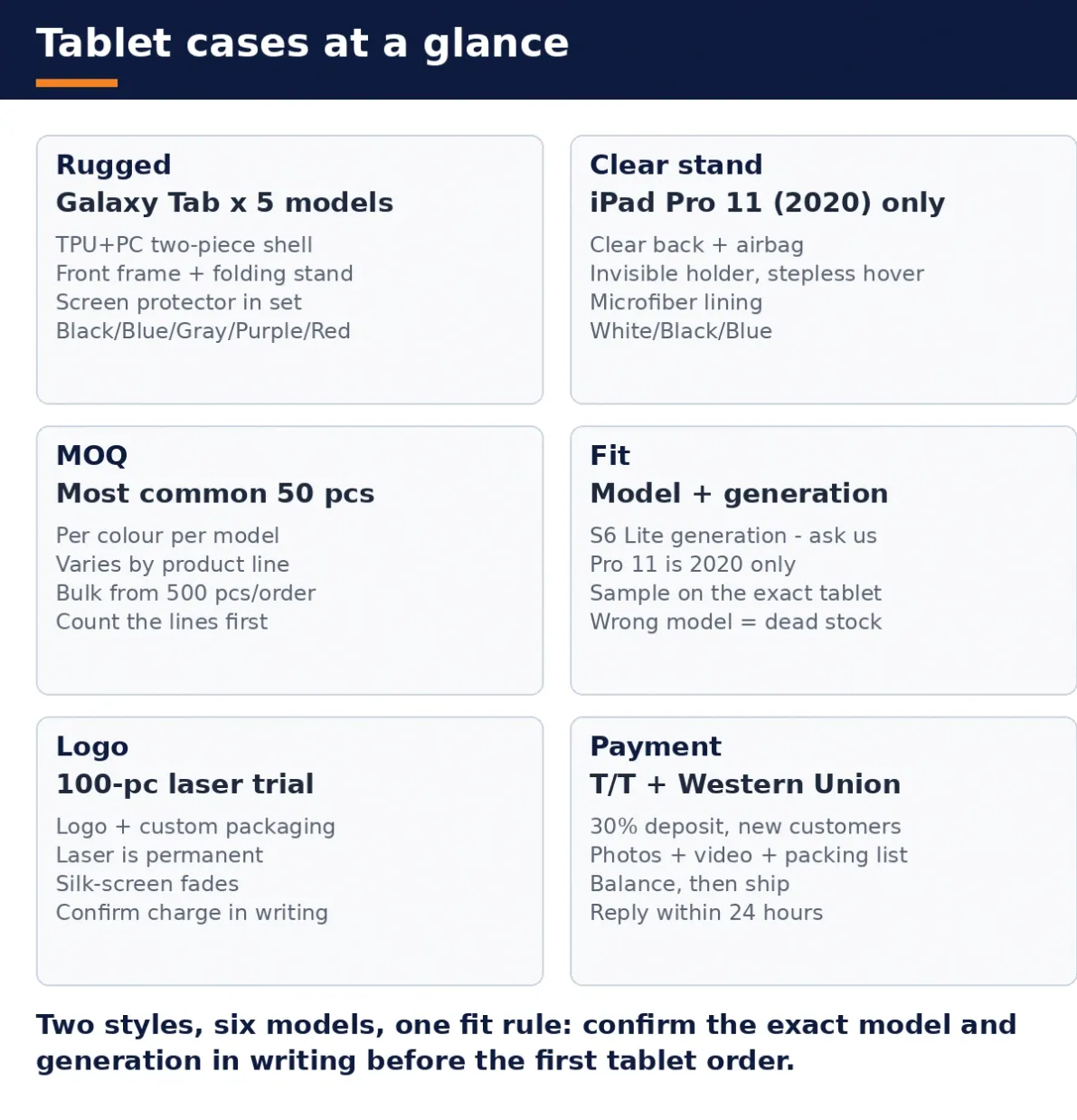
Style | Models covered | Most common MOQ | Sample terms |
|---|---|---|---|
Rugged tablet case — TPU+PC, front frame, folding stand, screen protector in set | Galaxy Tab A8, S6 Lite, S7, S8, A7 Lite | 50 pcs per colour per model | Fee charged, refundable on orders of 500+ pcs — ask us to confirm the amount per style in writing |
Clear anti-bend stand case — invisible holder, stepless hover, cushioned airbag | iPad Pro 11 (2020) only | 50 pcs per colour per model | Fee charged, refundable on orders of 500+ pcs — ask us to confirm the amount per style in writing |
Folio, keyboard, sleeve, kids styles | Not on a live product page — ask us | Ask us | Ask us |
1. Which tablet cases does iFunSmart actually sell today?
Two styles, on two live product pages. Start there, because every other tablet question in this guide is answered against that list — and the list is short enough that a buyer who skips it will order a style that does not exist.
The first is the Heavy Duty Rugged Tablet Case with Front Frame and Folding Stand. A Galaxy Tab case wholesale order starts with the model list on the page — Tab A8, S6 Lite, S7, S8, A7 Lite — and every line on the order names one of those models. It is a tablet case in the same sense as the rugged phone cases in this series: a two-piece armor shell in TPU and PC, a black TPU bumper, reinforced corners and carbon-fibre textured bars, a front frame that clips over the edge of the screen, a folding kickstand on the back, and a screen protector included in the set. It comes in five colours — Black, Blue, Gray, Purple and Red — and it covers five Galaxy Tab models: Tab A8, Tab S6 Lite, Tab S7, Tab S8 and Tab A7 Lite. The page states the MOQ as 50 pcs per colour per model and states "Support Logo Customization & Custom Packaging", with the body adding that custom logo, colour and packaging are available on an OEM/ODM basis.
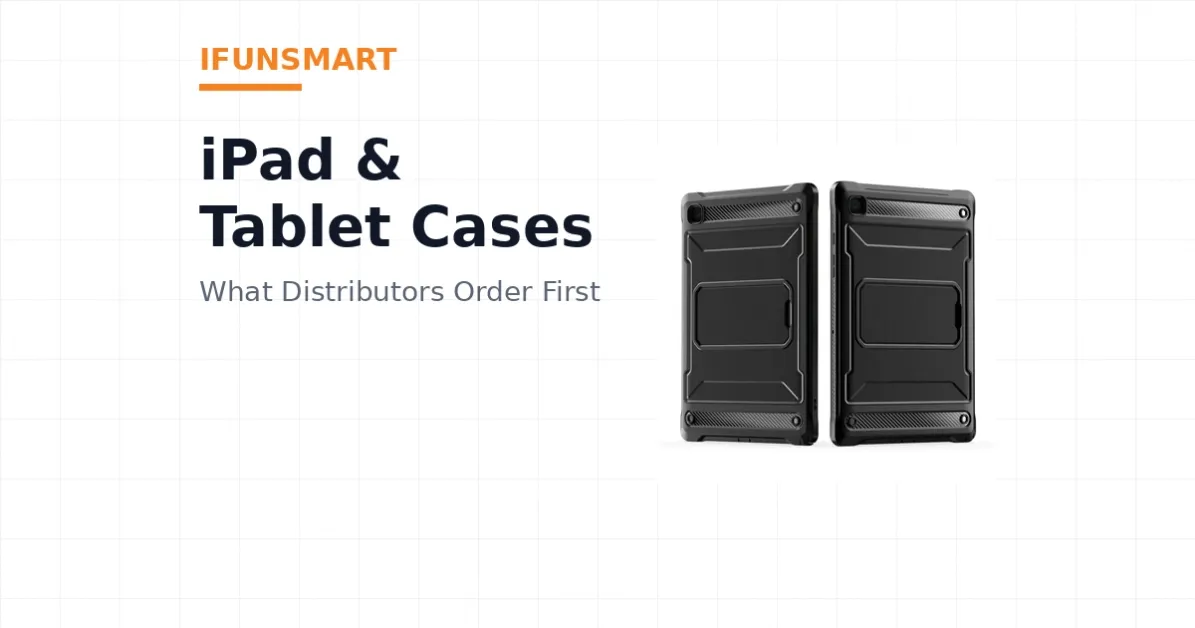
The second is the Invisible Stand Case for iPad Pro 11 2020, an anti-bend clear cover. It is the only iPad case on a live product page. The page describes an aviation bending special material with a clear back and a cushioned airbag, an invisible holder with stepless hover at various angles, an invisible double support, a microfiber lining and a super thin profile, built around a core fulcrum design. It comes in three colours — white, black and blue — and it covers one model only: the iPad Pro 11 from 2020. The MOQ and the customisation wording are the same as the rugged case: 50 pcs per colour per model, logo customisation and custom packaging supported.
That is the whole confirmed range. What is not on a live page is just as important, and this guide states it plainly rather than leaving it to be discovered after an order: no iPad Air case, no iPad mini case, no iPad Pro 12.9 case, no iPad 10th or 11th generation case, no Galaxy Tab S9 or S10 case, no Tab A9 or A11 case, no Xiaomi or Huawei tablet case, and no keyboard case, leather folio, sleeve or kids case on any live page found. For a buyer comparing a tablet case supplier China listing against the live product pages, the model list is the first check: two styles, six models between them, every line verifiable. The product listing runs to 175 products across 15 pages and tablet pages are absent from the sitemap, so this guide does not claim the two pages are the only tablet pages that could ever exist — but it does claim that these are the two a buyer can verify today, and that every other tablet style is a question to ask the factory in writing. If your customers ask for a tablet model or style that is not on one of these two pages, do not assume it is orderable. Ask, get the answer in writing, and only then put it in an order.
2. What does the rugged Galaxy Tab case cover — and what should you check on a sample?
The rugged case is the workhorse of the two styles, and it is the one a distributor should understand first, because it covers five models and therefore carries five separate fit decisions. For a buyer vetting a Samsung tablet case supplier, the rugged case is the test: five models, one style, and every line confirmed on a live page. A rugged tablet case bulk order is five separate fit decisions, not one order — each model is its own tooling, not one shell stretched across five tablets. A tablet case that fits the Tab S8 does not fit the Tab A7 Lite, and a case ordered against the wrong model is dead stock in the same way a phone case ordered against the wrong model is — except the unit is bigger, the carton is bigger, and the mistake costs more per piece. The five models the page names are the Tab A8, the Tab S6 Lite, the Tab S7, the Tab S8 and the Tab A7 Lite. Their screen sizes are different — the A8 is 10.5 inches, the S6 Lite is 10.4, the S7 and S8 are 11, and the A7 Lite is 8.7 — so the case for each model is a different tooling, not one shell stretched across five tablets. Order by model, not by "Galaxy Tab".
What the case is, in the page's own terms: a two-piece armor shell in TPU and PC, with a black TPU bumper, reinforced corners and carbon-fibre textured bars. The front frame clips over the edge of the screen, which matters for a tablet because the screen is the part that breaks first and the part that costs the most to replace — the frame is the case's answer to that, not a decoration. The folding kickstand on the back holds the tablet up for video and for counter display, and the screen protector is included in the set, so the buyer is ordering a set, not a shell alone. Five colours are listed: Black, Blue, Gray, Purple and Red.
What the page does not state is equally specific, and this guide does not fill the gap with an invented figure. The page states no drop-test height, no drop standard and no magnet figure — only the qualitative line that the case "protects the tablet from drops and bumps". Do not repeat a drop claim as a number, and do not treat a qualitative line as a test result. If your customer needs a drop rating, ask for the test report in writing and read what it actually says — which heights, which surfaces, how many drops, and which lab — before you put the figure in your own listing. A distributor who copies "protects from drops" into a retail listing as a drop height is inventing a number, and the return that follows is the distributor's, not the factory's.
On the sample, check the case the way a factory checks it, not the way a consumer uses it. The sample checks below are bench checks — they belong on a workbench, not in a pocket. First, fit the case to the exact tablet model on the order, not to a tablet of a similar size: the shell should seat fully, the front frame should clip over the screen edge without lifting at the corners, and the camera cutout, the charging port, the speaker grilles and the buttons should line up with the tablet's own layout. Second, check the parting lines and the moulded edges for flash and for sharpness — a tablet case is handled with two hands and held for long sessions, so a rough edge is a defect, not a cosmetic note. Third, cycle the folding stand and check that it holds the tablet at the angles the page claims and that it sits flush when folded flat — a stand that creeps shut or will not stay open is a return. Fourth, check the screen protector in the set for fit and for adhesion at the edges, and check the carton: the set ships as a shell, a frame and a protector, so confirm the set is complete in the carton and that the carton count matches the packing list. Fifth, check the colour against the order — the five colours are distinct, and a grey case shipped against a blue order is a picking error to catch on the sample, not after 500 pieces land. And sixth, confirm the generation question in writing: the page names "S6 Lite" with no generation, and the 2020 and 2022 refresh share the same dimensions, so ask the factory to confirm which generation the tooling covers before you order the S6 Lite line. That one written confirmation is worth more than any other check on this style, because it is the one ambiguity the page itself leaves open.
3. What does the clear iPad Pro 11 stand case cover — and what should you check?
The clear case is the opposite of the rugged case in almost every respect that matters to a buyer: one model, one job, and a narrower buyer. For an iPad Pro case wholesale buyer, the decision is a single-model one: the 2020 Pro 11, in white, black or blue. It covers the iPad Pro 11 from 2020 — the 11-inch Liquid Retina model, 2388×1668, 247.6×178.5×5.9 mm, 471 g on Wi-Fi, A12Z Bionic, announced 18 March 2020 — and no other iPad. That narrowness is the whole point of the style: it is a stand case for a tablet that is used on a desk, on a counter or on a stand, and its value is the holder, not the armor.
The page describes an aviation bending special material with a clear back and a cushioned airbag, an invisible holder with stepless hover at various angles, an invisible double support, a microfiber lining and a super thin profile, built around a core fulcrum design. Read that as a buyer, not as a marketing reader: the clear back shows the tablet, the airbag is the cushioning layer, the invisible holder is the stand, and "stepless hover at various angles" means the holder is not locked to two or three fixed positions — it holds where you put it. The microfiber lining is the layer that sits against the tablet, and the thin profile is the reason the case does not turn a thin tablet into a thick one. Three colours are listed: white, black and blue.
The same honesty rule applies here as on the rugged case. The page states no drop-test height, no drop standard and no magnet figure — only the qualitative line that "bumps and falls do not hurt the iPad". This guide repeats no number for that line, because there is no number on the page to repeat. If your customer asks for a drop rating for this case, the answer is the same as for the rugged case: ask for the test report in writing, and do not put a figure in your listing until you have read one.
On the sample, the checks are different from the rugged case because the failure modes are different. First, fit it to an iPad Pro 11 from 2020 — not to a later Pro 11, not to an iPad Air, not to a 10th-generation iPad. The 2020 Pro 11 is a specific generation, and a case cut for it will not necessarily fit a later model with the same screen size. Confirm the generation in writing before you order, and check the fit on the sample against the exact tablet. Second, check the clear back for clarity and for mould marks: a clear case shows every defect, so check the back panel against the light for haze, for bubbles in the material and for scratches from the mould. Third, cycle the invisible holder through its angles and check that it holds at each one without slipping — a holder that drifts shut under the tablet's own weight is a defect, and it is the defect this style exists to avoid. Fourth, check the cushioned airbag layer for adhesion and for even thickness, and check the microfiber lining for coverage — the lining should cover the surfaces that touch the tablet, with no bare edge where the tablet meets the shell. Fifth, check the camera cutout and the port and button alignment against the 2020 Pro 11 layout, and check the parting lines for flash, as on the rugged case. And sixth, check the colour: the white colourway shows dirt and mould marks more readily than the black or blue, so if you are ordering white, check the white sample, not the black one — the sample should be the colour you are ordering, because that is the colour your customer will hold.
A note on what this style is not. It is not a keyboard case, it is not a folio, and it is not a kids case — the page claims none of those, and this guide claims none of them either. If your customer wants a keyboard case for the iPad Pro 11, that is a different product, and whether iFunSmart makes one is a question to ask in writing. Do not sell the stand case as a keyboard case, and do not order it expecting a folio to arrive.
4. How do you order tablet cases without dead stock?
Tablet cases punish a sloppy order more than phone cases do, for three reasons that are all about size. First, the unit is bigger: a tablet case takes more shelf space, more carton space and more freight volume than a phone case, so a wrong model sits longer and costs more to move. Second, the model range is wider in the ways that matter: five Galaxy Tab models in one style means five separate fit decisions, and the iPad side is split by generation as well as by screen size — the Pro 11 from 2020 is not the same fit as a later Pro 11, even though the screen size looks the same on a listing. Third, the buyer is often buying for a narrower customer: a tablet case goes to a school, a field team, a retail counter or a business that issues tablets to staff, and those buyers order one model in depth rather than five models in breadth. A tablet case distributor who orders the wrong model for that customer does not get a second chance to swap it — the customer buys once, and the wrong case is the distributor's stock.
So the ordering discipline for tablet cases is the same discipline as for phone cases, applied more strictly. For a tablet case wholesale buyer, that means three rules that are easy to state and easy to skip: order by exact model and generation, count the lines before you send the order, and confirm the ambiguous generation in writing. Order by exact model and generation, in writing, on the order itself — "Galaxy Tab S8" is not enough if the generation is ambiguous, and "iPad Pro 11" is not enough without the year. The S6 Lite question is the live example: the rugged page names the model with no generation, so the order should state the generation you want and the factory should confirm it in writing before production. Do the same for the iPad side: state "iPad Pro 11 (2020)" on the order, not "iPad Pro 11", and confirm it in writing.
Then apply the MOQ the same way. The most common MOQ is 50 pcs per colour per model, and it varies by product line — that is the same wording this series uses for phone cases, and it means the same thing here: the MOQ applies per line, per colour, per model, not per order. A buyer who wants to buy tablet cases in bulk should count the lines first: every colour on every model is a separate line at the most common MOQ. A bulk or distributor order starts at 500 pcs per order in total, which means a 500-piece tablet order is, in practice, a small number of lines at 50 pieces each — ten lines at the most common MOQ, fewer if a line takes more. That is a useful shape for a first tablet order: two styles, a handful of models, a handful of colours, and a total that clears the bulk threshold without turning into a warehouse of one model. Do not order 500 pieces of one model in one colour unless that model is the one your customer has already committed to — the dead-stock warning in this series exists because distributors do exactly that, and the warning is worth more on tablet cases than on phone cases, because the stock is bigger and slower to clear.
Colour deserves its own line in the order, for the same reason. The rugged case comes in five colours and the clear case in three, and the MOQ is per colour — so a five-colour rugged order across five models is twenty-five lines, not five. Decide the colour depth before you order: a tablet case for resellers selling into retail needs breadth on the shelf, because the shelf needs choice; a case for a school or a field team needs depth in one or two colours, because the buyer wants uniformity. Either is a valid order. What is not valid is ordering breadth by accident — five colours on every model, because the order form listed them all — and discovering at the warehouse that you hold twenty-five lines of slow stock. Write the colour list on the order, count the lines, and check the total before you send it.
Finally, the channel question. Tablet cases sell through the same channels as phone cases — retail, e-commerce, corporate and education — but the mix is different: a tablet case is more often a business or education purchase than an impulse retail purchase, which means the buyer asks more questions before ordering and returns more slowly when the fit is wrong. That is another reason to confirm the model and the generation in writing and to check the sample on the bench before the bulk order: the customer who buys 500 tablet cases for a school or a field team will check the fit on the first unit, and if it does not fit, the whole order comes back.
5. What should the first tablet order look like?
A first tablet order should be small enough to learn from and big enough to be a real order — and for this range, that shape is already written by the terms. The most common MOQ is 50 pcs per colour per model, and a bulk or distributor order starts at 500 pcs per order in total. So a first order that clears the bulk threshold is, at the most common MOQ, ten lines: for example, the rugged case in two colours across the three Galaxy Tab models your customers actually buy, plus the clear iPad Pro 11 case in two colours — six rugged lines and two clear lines is eight lines and 400 pieces, so add one more model or one more colour to reach ten lines and 500 pieces. That is a real first order: it tests both styles, it tests the models that matter, it leaves a paper trail on fit and colour, and it does not commit the distributor to a warehouse of one model.
Before that order, order samples — and treat the sample the way this series has always treated it: as the negotiation core, not as a formality. An iPad case bulk order follows the same shape as the rugged lines: the clear case in two colours is two lines at 50 pieces each, and the rest of the 500 comes from the rugged lines. Samples carry a fee, refundable on orders of 500+ pcs, and the amount is confirmed per style in writing — ask us to confirm the amount for the tablet style you are sampling before you pay it, because the sample fee is a per-style figure, not a site-wide one. Sample both styles if you are ordering both, and sample the colour you intend to order, because a black sample does not prove a white case. Check the sample on the bench against the checks in sections 2 and 3 — fit on the exact model, parting lines, stand function, screen-protector adhesion, carton completeness — and approve the sample in writing before the bulk order goes ahead. A distributor who skips the sample to save a fee is buying the risk instead, and the risk on a tablet order is larger than on a phone order for the same reasons section 4 gives: bigger units, bigger cartons, slower clearance.
Logo and packaging are available on both styles — both product pages state "Support Logo Customization & Custom Packaging" — and the logo question is worth settling on the first order, not the second. A custom logo tablet case order should settle the method, the artwork and the per-piece charge in writing before production, not after. A 100-pc trial order can already carry a logo by laser engraving, which is the confirmed route for a small first run: laser is permanent, while silk-screen fades and needs a higher MOQ. Ask us to confirm the logo method, the artwork requirement and the per-piece charge in writing before you order — the charge is confirmed per style, and this guide does not state a figure, because a figure stated here would go stale. Custom packaging is the same: ask what the retail box carries, what languages the safety text needs for your market, and whether the packaging MOQ differs from the case MOQ, and get the answer in writing. A distributor who agrees the packaging after the cases are made is agreeing it too late.
Payment follows the same terms as the phone range, and they should be agreed in writing on the first order, not assumed. Payment is T/T and Western Union only. New customers may pay a 30% deposit first; after the goods are ready the factory sends photos and video and the packing list; the customer pays the balance, then the goods ship. That sequence — deposit, photos and video and packing list, balance, ship — is the whole payment story for a first tablet order, and it is worth writing into the order confirmation so that both sides are working from the same sequence. Do not add a payment method that is not in that list, and do not agree a different sequence verbally: if it is not written, it is not agreed.
6. What to get in writing before you pay
A tablet order is a small order in the phone-case world and a large order in the tablet world, and the written terms should match the second fact, not the first. Before you pay, check the supplier the same way you would check any tablet case supplier China listing: the model list on the live page, the MOQ per line, and the written terms. Before you pay the deposit, get six things in writing. First, the exact model and generation for every line — "Galaxy Tab S8" and "iPad Pro 11 (2020)", with the S6 Lite generation confirmed, not assumed. Second, the style and the set contents for every line — the rugged case ships as a shell, a front frame and a screen protector, and the clear case ships as a case with an invisible holder; confirm the set contents on the order, so the carton that arrives is the carton you ordered. Third, the colour list and the line count — every colour is a separate line at the most common MOQ, so the order should list the lines and the total, and the total should clear 500 pieces if it is meant to be a bulk order. Fourth, the sample approval — which sample was approved, in which colour, for which model, and on what date — because the bulk order should match the approved sample, not a different colour or a different model. Fifth, the logo and packaging terms — the logo method, the artwork requirement, the per-piece charge, and what the retail box carries, all confirmed in writing before production. And sixth, the payment sequence — 30% deposit, photos and video and packing list after the goods are ready, balance, then ship — with the reply time: iFunSmart replies within 24 hours, and a first order should not wait longer than that for a confirmation.
Two things that should not be in the written terms are worth naming, because buyers ask for them and this guide will not invent them. The first is a drop-test figure: neither product page states one, and this guide states none, so do not write a drop height into your order or your listing until you have read a test report in writing. The second is a production or transit day figure: this guide states no sample days, no production days and no transit days, and the correct line on the order is "ask us for the current production window in writing" — the window depends on the mould, the material stock and the order size, and a figure written into the order without that check is a promise neither side can keep. Get the window in writing, on the order, before you pay the deposit, and plan your customer's date from that written window, not from a figure in a guide.
Frequently asked questions
1. What is the tablet case MOQ for a wholesale order?
The most common MOQ is 50 pcs per colour per model, and it varies by product line — that is the same wording as the phone range, and it means the MOQ applies per line, per colour, per model. A bulk or distributor order starts at 500 pcs per order in total, so a first tablet order is usually a small number of lines at 50 pieces each. Confirm the MOQ for the exact style and model in writing before you order, because the per-line figure is the one that decides your line count.
2. Do you sell iPad Air, iPad mini or iPad Pro 12.9 cases?
Not on any live product page found. The only iPad case wholesale listing on the site is the clear stand case for the iPad Pro 11 from 2020. No iPad Air, iPad mini, iPad Pro 12.9 or iPad 10th or 11th generation case was found on a live page, and this guide does not claim iFunSmart sells them. If your customers ask for one of those models, ask us in writing — the answer may be a tooling question, and a tooling question deserves a written answer, not an assumption.
3. Can I put my logo on a tablet case?
Yes. Both live tablet pages state "Support Logo Customization & Custom Packaging", and custom logo, colour and packaging are available on an OEM/ODM basis. A 100-pc trial order can already carry a logo by laser engraving — laser is permanent, while silk-screen fades and needs a higher MOQ. Ask us to confirm the logo method, the artwork requirement and the per-piece charge for the tablet style you are ordering, in writing, before you order.
4. Does the rugged tablet case come with a screen protector?
Yes. The screen protector is included in the set, along with the two-piece armor shell, the front frame that clips over the screen edge and the folding kickstand. Check the set on the sample: the carton should contain the shell, the frame and the protector, and the carton count should match the packing list. If a line on your order is meant to ship without the protector, say so in writing — otherwise the set is what arrives.
5. How do I confirm the case fits my tablet?
State the exact model and generation on the order, confirm it in writing, and check the fit on a sample against the exact tablet before the bulk order. The rugged case covers five Galaxy Tab models, each with its own tooling, and the clear case covers the iPad Pro 11 from 2020 only — a case for one model does not fit another. Two generation questions need a written answer: the rugged page names "S6 Lite" with no generation, and the clear case is cut for the 2020 Pro 11, not for a later Pro 11. Get both answers in writing before you pay the deposit.
About iFunSmart
iFunSmart — Ifun Electronics Technology Co., Ltd — has made phone cases as an OEM and ODM manufacturer since 2010, with 1000+ designs, 500+ models and 500K+ pcs a month capacity, exported to 30+ countries. The factory is at Yongning Street, Zengcheng District, Guangzhou, Guangdong 511340. The most common MOQ is 50 pcs per colour per model and it varies by product line. Bulk and distributor orders start at 500 pcs per order in total. Samples carry a fee, refundable on orders of 500+ pcs — ask us to confirm the amount per style in writing. A 100-pc trial order can carry a logo by laser engraving. Payment is T/T and Western Union only, with a 30% deposit for new customers, photos and video and the packing list after the goods are ready, then the balance, then the goods ship. We reply within 24 hours.
To start a tablet order, send the tablet models and generations, the styles, the colours and the quantities, and the destination: contact@ifunsmart.com or WhatsApp +86 13632248734.
Read more
- Phone Case Factory in China: Find, Check & Compare — https://www.ifunsmart.com/posts/phone-case-factory-in-china-find-check-compare
- How to Verify a Phone Case Factory Before Ordering — https://www.ifunsmart.com/posts/how-to-verify-a-phone-case-factory-before-ordering
- Phone Case Sampling: How to Evaluate a Sample Before a Bulk Order — https://www.ifunsmart.com/posts/phone-case-sampling-how-to-evaluate-a-sample-before-bulk
- Bulk Phone Case Orders: How Volume Changes the Order — https://www.ifunsmart.com/posts/bulk-phone-case-orders-volume-guide
- Mixed-Model Phone Case Orders: How to Combine Models — https://www.ifunsmart.com/posts/mixed-model-phone-case-orders-how-to-combine-models
- Rugged Phone Cases: Armor Builds for Field Teams — https://www.ifunsmart.com/posts/rugged-phone-cases-armor-builds-field-teams
- Phone Case Payment Terms: What to Agree Before the First Order — https://www.ifunsmart.com/posts/phone-case-payment-terms-first-order
- Which Phone Models Do We Hold Moulds For? — https://www.ifunsmart.com/posts/phone-case-model-mould-coverage