Phone Case Sustainability: What Buyers Can Ask
We sell no case today as recycled or biodegradable. This guide explains what sustainable means for a phone case, what to ask about materials and packaging, and how to check a claim in writing.
BLUF
Short answer
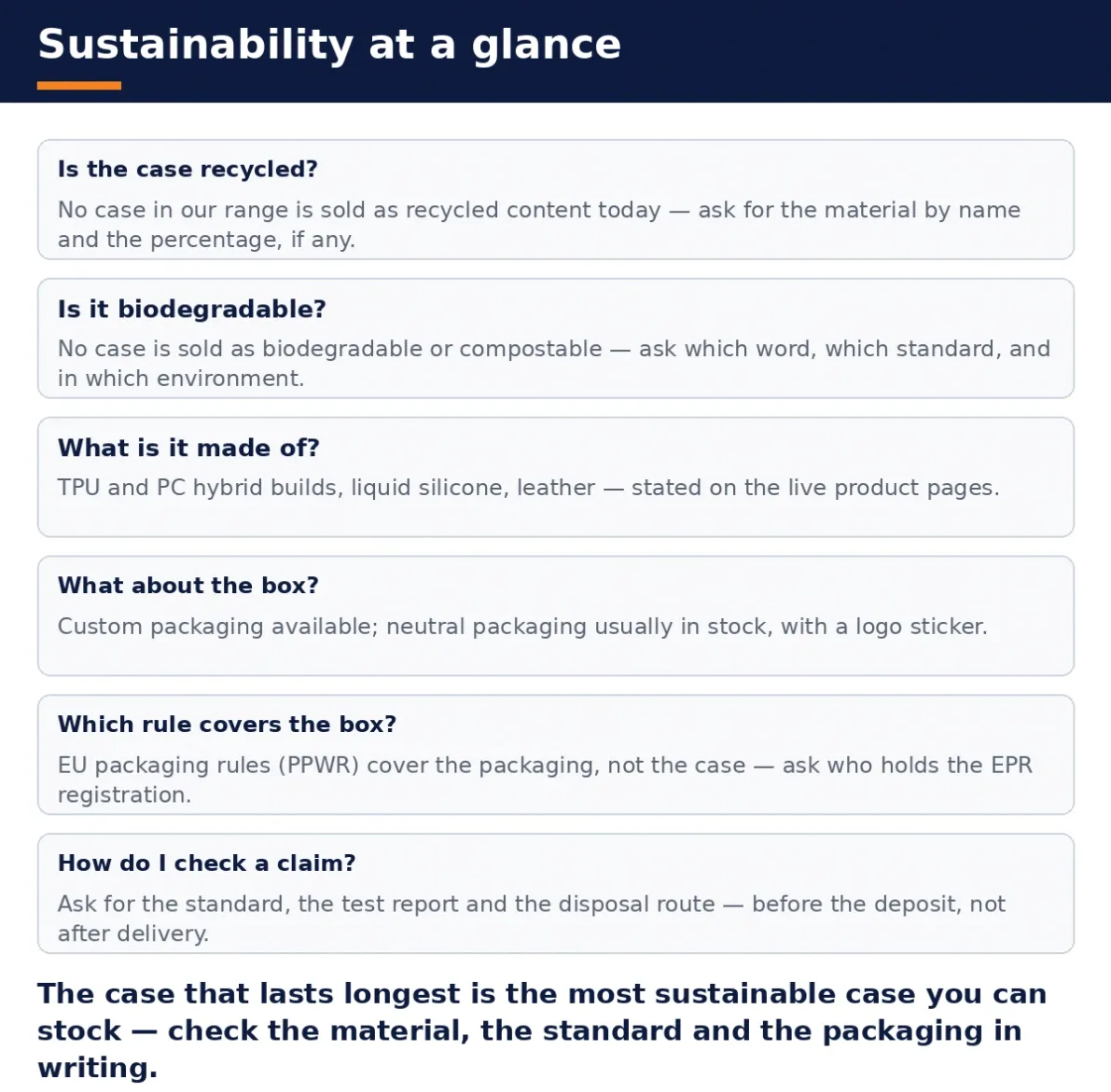
Sustainability at a glance
1. What do the words actually mean? Recyclable, biodegradable and compostable are three different claims
The first problem with sustainable phone cases is that the words sound alike and mean different things — and a buyer who orders on the wrong word orders the wrong product. Three words do almost all the work in this market, and each one is a different claim with a different test behind it.
Recyclable is a design property and a systems question at the same time. A case or a box is recyclable when it is designed so it can be collected separately, sorted into a designated waste stream without contaminating it, and reprocessed into new material. Both halves matter. A technically recyclable material is not actually recycled if no collection, sorting and end-market exists where your customer throws it away — and a mixed-material build that cannot be taken apart is not recyclable in practice even if each material alone is. When a supplier says “recyclable”, the question to ask is not whether the word is true in a laboratory — it is whether the product is designed to be taken apart, and whether the waste stream where it will be sold actually takes it.
Biodegradable is the weakest word of the three, and the one to be most careful with. It means only that microorganisms can break the material down — with no stated timeframe, no stated environment and no residue limit. A plastic that degrades over decades in the sea is technically biodegradable. A plastic that breaks into fragments too small to see, but still plastic, can be called biodegradable too. The word on its own tells you nothing about how long the breakdown takes, where it happens, or what is left behind. That is why the EU has moved against it: Directive (EU) 2024/825, on empowering consumers for the green transition, bans generic environmental claims — including a bare “biodegradable” — without demonstrated recognised excellent environmental performance. The rules apply from 27 September 2026. A claim is not “generic” if its meaning is spelled out clearly and prominently on the same medium — naming the standard, the environment and the timeframe — but a bare “biodegradable” on a listing, with nothing behind it, is a claim, not a fact. Treat it as one.
Compostable is the tested claim, and the test has a name: EN 13432, the European standard for packaging recoverable through composting and biodegradation. Certified material must disintegrate after 12 weeks and completely biodegrade after six months — at least 90% converted to carbon dioxide, the remainder to water and biomass containing no plastic — and it must pass ecotoxicity and heavy-metal tests so no harmful substances are left behind. Two cautions belong with that definition. First, most compostable packaging needs industrial-facility conditions — controlled temperature, moisture and aeration — not a garden heap: industrial compostability is not home compostability, and home compostability is a separate certification at lower temperatures over a longer period. Second, a compostable claim is a claim about the packaging format, not about the case: under the EU packaging rules, only a short list of formats must be compostable from 12 February 2028 (permeable tea and coffee bags, soft single-serve units disposed of with the product, and sticky labels on fruit and vegetables), and all other packaging — including biodegradable plastics — must be designed for material recycling. “Compostable” is not a general alternative to “recyclable” for a phone-case box or bag.
What to ask. Ask a supplier for four things, in writing, for any green word on a listing: (a) the exact word used, (b) the standard it was tested to — for compostable packaging, EN 13432 — (c) the environment it needs, industrial or home composting, and (d) the correct disposal route for your customer. If the supplier cannot name the standard, the word is marketing, and your order should be priced as if the word were not there.
2. What our range is actually made of — and what it is not
This section is short on purpose, because the honest answer is short. Our range is built from the materials our live product pages state, and it is not built from the materials our pages do not state. A buyer who wants the sustainability story to start from a material claim should know exactly where that story starts and stops.
What the pages state. Every product page we opened for this guide lists a TPU and PC hybrid build in its material field. TPU — thermoplastic polyurethane — is the soft, flexible material that takes the shock of a drop. PC — polycarbonate — is the rigid, hard material that holds a shape and stays optically clear. A hybrid case is a rigid polycarbonate back bonded to a flexible TPU bumper, so the back resists scratches while the edge absorbs impact. Four pages, four wordings, all verified live: the Two-Tone Clear MagSafe case is a “Clear PC back with a soft TPU frame and aluminum buttons”; the Slide-Window MagSafe case is a “Thickened PC back + thickened TPU frame with slide window cover”; the Magnetic Ring Stand Armor case is a “Hard back panel with a sliding lens cover, metal magnetic ring and soft TPU frame”; and the Clear Magnetic MagSafe case — the cover product of this guide — is a “Premium Anti-Yellowing PC + Flexible TPU”. Those are the materials. They are conventional plastics, honestly stated, and no page adds a recycled-content percentage or a biodegradable claim to them.
What else the range holds. Liquid silicone exists in the range — a soft-touch case in ten colours, listed for the iPhone Duo and the iPhone 18 Pro Max — and leather exists too: the R20 leather wallet case and a calfskin magnetic folio for the iPhone Duo, with a leather range covering 18 designs across 14 brands. Both are confirmed at article level from earlier guides in this series, not from a product-page material field we opened for this guide, so this guide does not cite a page URL for either. Neither is called “vegan leather” on any page we checked, and neither is sold as a recycled or biodegradable material. If your customer asks for a vegan-leather case by name, ask us whether the style you want is available in that material — do not assume it from the word “leather” on a listing.
What the range does not hold. No live product page states recycled content, a biodegradable material, a compostable material, bamboo, wheat straw or any plant-based material. Site searches for those words return nothing. The only “recycled” hit on the whole site is Apple’s 100% recycled titanium hinge in the iPhone Duo — Apple’s phone hardware, not an iFunSmart case. The only eco wording anywhere on the site is a value statement on the About page — “Sustainable Green Development”, committing to eco-friendly materials and responsible manufacturing processes — with no product, material, percentage or certification attached. It is a statement of intent, not a product claim, and this guide does not present it as one. The same About page also mentions aramid fibre as a raw material, but the series has verified site-wide that no aramid case is listed today — so do not quote the About page’s material words as current product fact, and do not let a supplier quote them to you either.
Why this matters commercially. A distributor who puts “recycled” or “biodegradable” on a retail listing without a document behind it is the one who answers for it — under the EU green-claims rules, and in front of the customer who reads the claim. The safe order is the honest one: sell the case for what it is, with the material field from the product page on the quote, and let the sustainability story rest on the next two sections — how long the case lasts, and what its packaging is — where the claims can be checked.
3. The case that lasts longest is the most sustainable case you can stock
If no case in the range is sold as recycled or biodegradable, the sustainability argument has to rest on something else — and the strongest something else is durability. A case that is replaced after three months because it yellowed, cracked or stopped fitting is two cases in the waste stream where one would have done. A case that still looks and works like new after a season is one case, one shipment and one set of packaging. Longevity is not a consolation prize for having no recycled material. It is the largest sustainability lever a distributor controls, because it is the one that decides how many units the market consumes.
Anti-yellowing is the first longevity check. Clear TPU yellows over time — that is a property of the material, not a defect in a single batch — and a buyer who sells a clear case that turns yellow in three months sells a complaint, not a case. That is why the clear builds in our range carry an anti-yellowing treatment, stated on the page: the Clear Magnetic case is a “Premium Anti-Yellowing PC” build, the Two-Tone Clear case carries “an anti-oxidant treatment on the clear frame to slow the yellowing that clear cases usually develop”, and the Bayer hybrid clear case is built the same way. Ask us which clear case on your order carries the treatment, and check it on a sample that has been handled, not just a fresh one — a treatment that works on day one and fails by month three is not a treatment. Do not accept a yellowing claim without a sample check, and do not repeat a yellowing timeframe from a listing: no timeframe was verified for this guide.
Fit is the second longevity check. A case that does not fit the phone it was sold for is waste on arrival — returned, replaced, or thrown away. The fit questions are the ones this series has covered in the model guides: confirm the mould in writing per model, confirm the camera cutout clears the phone’s camera array, confirm the magnetic ring sits exactly over the charging coil, and confirm the case on a sample fitted to the live device, not only to a drawing. The mould-status facts matter here too: the iPhone 18 re-tool shares the iPhone 17 mould and is not finished yet, so an 18 order is a pre-order with fit confirmed on a sample; the iPhone 18e needs a new mould the factory is still deciding whether to open. A case ordered against the wrong mould is a case that never reaches a customer.
Protection claims are the third check — and the one to handle most carefully. Product pages in this market carry drop wording of their own, and this series has a standing rule about it: never repeat a drop figure as fact. Ask for the test report in writing instead — which standard it was tested to, how many drops, from what height, onto what surface, and by which laboratory. The drop-protection guide in this series explains how to read those numbers; the short version is that a height without a surface, a count without a laboratory, and a standard name without a version are not a test report. A case whose protection claim you can verify is a case your customer can trust for a season; a case whose claim you cannot verify is a case you will replace.
What to ask. Put the longevity questions on the same RFQ as the material questions: which clear case carries the anti-yellowing treatment, what the material field says for each model on the order, whether the mould is confirmed for each model, and what test report backs the protection claim. The answers belong on the quote, before the deposit — because a case that lasts is a case you do not have to reorder, and a reorder you do not have to place is the cheapest sustainability win in this guide.
4. Packaging: the part the rules actually regulate
Here is the fact most sustainability guides get wrong, and the one that matters most to a distributor selling into Europe: the EU packaging rules regulate the packaging, not the phone case. A phone case is not packaging. The retail box it arrives in, the polybag or protective film around it, the insert inside the box, and the shipping carton around the boxes — those are packaging, and those are what the rules reach. A buyer who asks a case factory about the sustainability of the case and never asks about the box has asked the wrong question.
The EU rule is the PPWR. Regulation (EU) 2025/40, the Packaging and Packaging Waste Regulation, entered into force on 11 February 2025 and generally applies from 12 August 2026. It is a Regulation, directly applicable in all EU Member States without national transposition, and it binds manufacturers, producers, importers, distributors and fulfilment service providers placing packaging or packaged products on the EU market — which reaches a non-EU supplier selling into the EU, not only EU-based firms. What it requires, in the parts a phone-case buyer touches: from 1 January 2030 all packaging must be recyclable, graded A, B or C under design-for-recycling criteria, and packaging below grade C — under 70% recyclable by weight — may not be placed on the market; from 1 January 2035 packaging must also be “recyclable at scale”, actually collected, sorted and recycled in sufficient quantities through existing infrastructure; and from 1 January 2038 only grades A and B may be placed on the market. Recycled content in plastic packaging, from 1 January 2030, is 35% for “other plastic packaging” — the general category a phone-case retail box or polybag falls under. There is no phone-case-specific target, and this guide does not present 35% as one. The empty-space ratio in grouped, transport and e-commerce packaging is capped at 50% from 2030, and at least 40% of transport packaging must be reusable within a re-use system. Harmonised EU sorting labels follow from 12 August 2028, and the producer-registration and extended-producer-responsibility duties apply at Member State level, with a non-EU producer required to appoint an authorised representative in the Member State concerned. Several of these dates depend on implementing and delegated acts not yet adopted — present the dates as the Regulation’s dates, and confirm the current position with your compliance adviser before you plan a shipment around them. This section is educational, not legal advice, and it claims no certification for iFunSmart.
The UK and EU money rules are different from the packaging rules. The UK Plastic Packaging Tax, in force since 1 April 2022, is a tax on finished plastic packaging components containing less than 30% recycled plastic; businesses that expect to import or manufacture 10 tonnes or more of such components in the next 30 days, or have done so in the last 12 months, must register and file quarterly returns even if all their packaging meets the 30% threshold. The tax rate per tonne is not stated in this guide — no prices anywhere in this series. The EU plastic-packaging levy is different again: since 1 January 2021 each EU Member State pays a contribution to the EU budget based on the weight of plastic packaging waste it generates and does not recycle. It is not a direct tax on manufacturers, distributors or importers — Member States decide how to finance their contribution — and the Commission’s 2025 proposal to raise it from 2028 has not been adopted. A buyer who confuses the levy with a tax on their shipment will budget for the wrong cost; a buyer who confuses the packaging tax with a case tax will ask the factory the wrong question.
What our packaging actually is. The packaging facts in this guide come from live product pages and from earlier guides in this series, and the two sources say different amounts. On the product pages, the OEM/ODM field states “Support Logo Customization & Custom Packaging”, and the page footer states “Custom logo, colour and packaging available (OEM/ODM)” with the most common MOQ of 50 pcs per colour per model. At article level, the corporate-gifts guide states the working rule: “Neutral packaging is usually in stock and a logo sticker can be added to it; custom gift packaging is available, but ask us about it before you plan the quantities.” Custom packaging has its own MOQ, which is not the same as the case MOQ — ask us per order, before you plan the quantities, and send the box size, the artwork and the quantity together so we can confirm it in writing. The packaging guide in this series covers the box, the barcode and the dieline in full. What no page states is a recycled-content percentage for the box, a compostable polybag, or a plastic-free carton — so this guide states none of those. If your retail channel requires a specific box material, a specific polybag, or a specific sorting label, send the specification with the order and ask for it in writing; do not assume it from the word “custom packaging” on a listing.
What to ask. Ask for the box, the polybag and the carton as three separate lines on the quote: what material each one is, what its recycled content is, whether it carries a sorting label for your market, and who holds the EPR registration and the authorised representative for the country you sell into. The packaging questions are the ones that decide whether your shipment clears the rules — and they are the ones no competitor guide in our study gave a buyer a checklist for.
5. What to ask your supplier — the checklist no competitor guide gives you
The competitor guides in our study all explain materials. None of them gives a buyer a standalone checklist to send a supplier. That is the gap this section fills, and it is the most useful section in this guide for a distributor about to place a first order. Copy it into your RFQ. The questions are written so that a good supplier can answer every one of them in writing, and a supplier who cannot answer them has told you something important.
Materials — five questions. (1) What is the material of each style on the order, exactly as stated on the product page? (2) Is any recycled content in the case, and if so, what percentage, of which material, and tested how? (3) Is the case sold as biodegradable or compostable, and if so, which word, which standard, and in which environment? (4) Is the leather genuine, and is a vegan-leather option available for this style? (5) Which clear case on the order carries the anti-yellowing treatment, and what does the sample show after handling?
Packaging — five questions. (6) What is the retail box made of, and what is its recycled content? (7) What is the polybag or protective film made of, and is it recyclable in the country I sell into? (8) Is neutral packaging in stock for this order, and can a logo sticker be added to it? (9) What is the MOQ for custom packaging on this order, and what box size, artwork and quantity do you need from me to confirm it in writing? (10) Does the packaging carry the sorting label my market requires, and who holds the EPR registration and the authorised representative?
Proof — four questions. (11) What document backs each green claim on the listing — the standard, the test report, the certificate? (12) What does the drop-protection claim rest on — which standard, how many drops, from what height, onto what surface, by which laboratory? (13) Is the mould confirmed for each model on the order, in writing, and is the fit confirmed on a sample fitted to the live device? (14) What is the sample fee, refundable on orders of 500+ pcs, and what does the sample prove — material, print, fit, or all three?
The order itself — four questions. (15) What is the MOQ per line — the most common MOQ is 50 pcs per colour per model and it varies by product line — and does the logo method or the packaging change it? (16) Can a 100-pc trial order carry a logo by laser engraving, and what is the per-piece charge — confirm the current figure in writing? (17) What are the payment terms — T/T and Western Union only, 30% deposit for new customers, photos and video and the packing list after the goods are ready, balance, then ship? (18) What is the current production window in writing on the quote?
How to use the answers. A supplier who answers all eighteen in writing, with documents attached, is a supplier you can order from. A supplier who answers in slogans — “eco-friendly”, “green”, “sustainable” with no standard behind the word — is a supplier whose claims you should price at zero. And a supplier who will not answer in writing at all is a supplier to walk away from, however good the price looks. The checklist costs nothing to send, and it is the cheapest insurance in this guide.
6. The commercial trade-offs — what sustainability costs, and what it does not
Sustainability is not free, and a guide that pretends otherwise is not honest. The trade-offs are real, they sit in the same order as everything else in this series, and they are all questions to confirm in writing rather than figures to guess.
The MOQ trade-off. The most common MOQ is 50 pcs per colour per model and it varies by product line — IPDK Duo all 100, ISF Samsung all 50, IP leather 30 to 50, IQ mostly 30, IPD 20, 30 or 50 by line. Bulk and distributor orders start at 500 pcs per order in total, not per model, so a mixed order can still count as one bulk order. A sustainability requirement that splits one order into many small ones — a different material per colour, a different box per channel — multiplies the MOQ lines and the cartons. The way to hold the cost down is to keep the range tight: fewer materials, fewer box variants, one bulk order. Whether a logo method or a packaging choice changes the MOQ for a given style is a question to confirm in writing per style — this guide states no per-method MOQ.
The sample trade-off. Samples carry a fee, refundable on orders of 500+ pcs — ask us to confirm the amount per style in writing. The sample is where every claim in this guide is proved: the material against the page, the anti-yellowing treatment against handling, the fit against the live device, the print against the artwork, the box against the specification. A sample skipped to save a fee is a bulk order placed on trust, and trust is not a test report. The one confirmed shortcut is the trial order: a 100-pc trial order can already carry a logo by laser engraving — laser is permanent, silk-screen fades and needs a higher MOQ — with a small per-piece charge to confirm in writing. The laser-engraving logo methods guide in this series covers the five methods in full.
The packaging trade-off. Neutral packaging is usually in stock and a logo sticker can be added to it — the fastest, cheapest route to a branded box. Custom gift packaging is available, but it has its own MOQ, its own artwork and its own confirmation in writing, and it is the slower, more expensive route. A distributor selling into a market with a sorting-label rule or a recycled-content threshold should order the custom route and confirm it early; a distributor selling into a market with no such rule should order the neutral route and spend the saving on the sample. Either way, the decision belongs on the quote, before the deposit, with the box size, the artwork and the quantity sent together.
The payment trade-off. There is none to negotiate: payment is T/T and Western Union only, with a 30% deposit for new customers; after the goods are ready the factory sends photos and video and the packing list, the customer pays the balance, then the goods ship. No other payment method is offered, and no sustainability claim changes that. The 24-hour reply is the same for every order — send your model, style, colours and quantity per line, and ask for the current production window in writing.
FAQs
Can I buy a recycled phone case from iFunSmart?
No — not today. No case in our range is sold as recycled content: no live product page states a recycled-content percentage for any case. Our range is built from TPU and PC hybrid builds, liquid silicone and leather, stated on the product pages by material name. If recycled content matters to your retail channel, ask us whether a style can be made with recycled material — do not assume it from a listing, and do not put “recycled” on your own listing without a document behind it.
Is there a biodegradable or compostable phone case in your range?
No — not today. No case in our range is sold as biodegradable or compostable, and no live product page states either word. The words themselves need care: “biodegradable” on its own states no timeframe, no environment and no residue limit, and the EU bans a bare “biodegradable” as a generic claim without substantiation from 27 September 2026; “compostable” is the tested claim, EN 13432, needing industrial composting conditions — disintegration after 12 weeks and at least 90% biodegradation in six months. Ask any supplier for the exact word, the standard and the environment, in writing.
What is the most sustainable case to stock, then?
The case that lasts. A clear case with an anti-yellowing treatment that still looks new after a season, a hybrid TPU and PC build that survives handling, a case whose mould and fit are confirmed on a sample — that is one case in the waste stream where a short-lived case is two. Check the anti-yellowing treatment on a handled sample, confirm the mould per model in writing, and ask for the test report behind any protection claim instead of repeating a figure from a listing.
Does the EU packaging law apply to my phone case order?
It applies to the packaging, not the case. Regulation (EU) 2025/40, the PPWR, applies from 12 August 2026 and covers the retail box, the polybag, the insert and the shipping carton — their recyclability, recycled content, empty space, re-use and labelling — and the producer-registration and extended-producer-responsibility duties, with a non-EU producer required to appoint an authorised representative. Ask who holds the EPR registration and the authorised representative for your country, and ask for the box, the polybag and the carton as three separate lines on the quote. This section is educational, not legal advice.
Can I get sustainable packaging with my order?
Custom packaging is available, and neutral packaging is usually in stock with a logo sticker that can be added to it. Custom packaging has its own MOQ, which is not the same as the case MOQ — ask us per order, before you plan the quantities, and send the box size, the artwork and the quantity together so we can confirm it in writing. No page states a recycled-content percentage for the box or a compostable polybag, so this guide states none. If your channel requires a specific box material or sorting label, send the specification with the order.
About iFunSmart
iFunSmart — Ifun Electronics Technology Co., Ltd — has made phone cases in Guangzhou since 2010, with 1000+ designs, 500+ models and 500K+ pcs a month of capacity, exported to 30+ countries. The factory is 5,000–10,000 sqm with 50 production lines, 20 QC staff and 15 R&D staff, at Yongning Street, Zengcheng District, Guangzhou 511340. The most common MOQ is 50 pcs per colour per model and varies by product line; bulk and distributor orders start at 500 pcs per order in total. Samples carry a fee, refundable on orders of 500+ pcs — ask us to confirm the amount per style in writing. A 100-pc trial order can carry a logo by laser engraving. Payment is T/T and Western Union only, with a 30% deposit for new customers; after the goods are ready the factory sends photos and video and the packing list, the customer pays the balance, then the goods ship. We reply within 24 hours. Contact us on WhatsApp +86 13632248734 or at contact@ifunsmart.com — send your model, style, colours and quantity per line, and ask for the current production window in writing.
Read more
- TPU vs PC vs Liquid Silicone vs Leather: Which Phone Case Material Should You Order?
- Clear Phone Cases: What Distributors Order First
- Phone Case Packaging: Boxes, Barcodes and the Dieline
- Phone Case Factory in China: Find, Check & Compare
- How to Verify a Phone Case Factory Before Ordering
- How to Source Phone Cases from China: First-Order Checks
- Custom Phone Case Logo Methods Compared: UV, IMD, Silk Screen, Heat Transfer & Laser
- Phone Case Quality Problems in Bulk Orders: What to Do When They Arrive